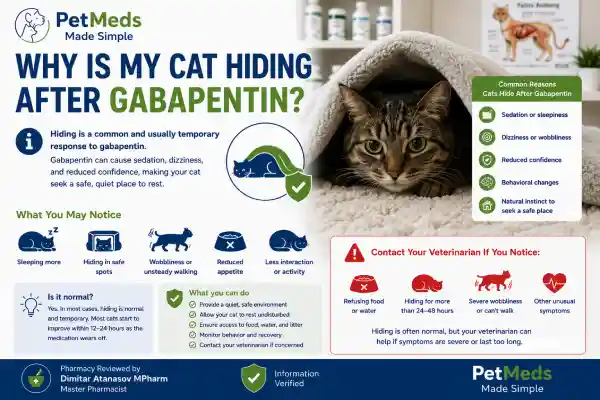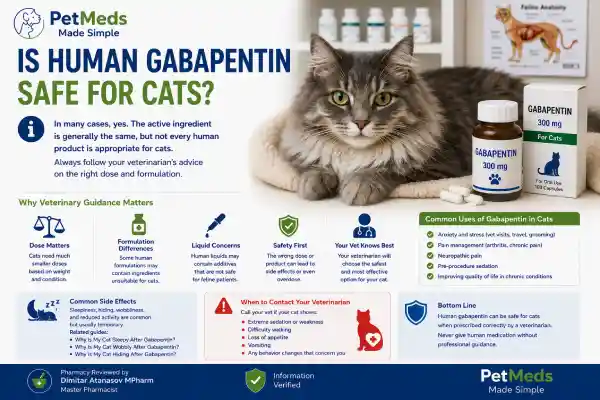
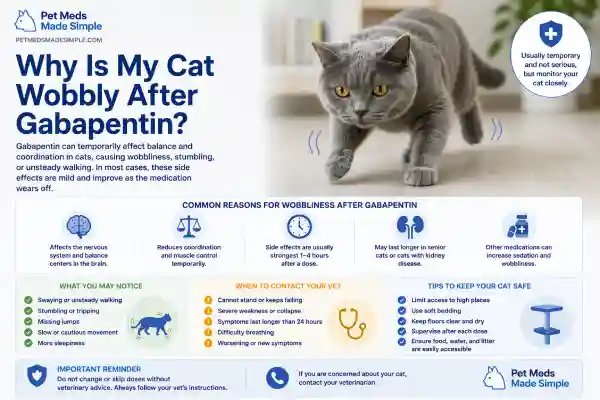
Quick Answer
Why is my cat wobbly after gabapentin? Wobbliness is one of the most common side effects of gabapentin in cats. The medication can temporarily affect balance, coordination, and muscle control, causing some cats to walk unsteadily, stumble, or appear weak. In most cases, this effect is temporary and improves as the medication wears off. However, severe weakness, inability to stand, collapse, or difficulty breathing require immediate veterinary attention.
Why is my cat wobbly after gabapentin?
Cats may become wobbly after gabapentin because the medication affects the nervous system and can temporarily reduce coordination and balance. Mild wobbliness is a common and expected side effect, especially after the first dose or when gabapentin is used before veterinary visits. Severe weakness or inability to stand should be evaluated by a veterinarian.
When Owners Commonly Ask This
Many cat owners become worried after seeing their cat walk differently following a gabapentin dose.
Common observations include:
- Walking like they’re drunk
- Swaying while standing
- Missing jumps
- Falling when turning
- Unsteady back legs
- Sleeping more than usual
Because cats are naturally agile animals, even minor coordination changes can appear dramatic.
Why Is My Cat Wobbly After Gabapentin?
What Is Gabapentin?
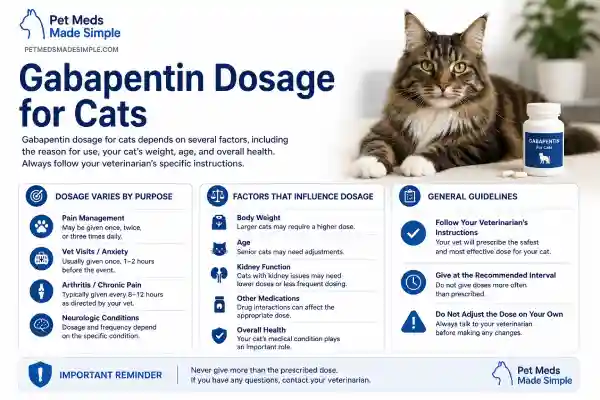
Gabapentin is one of the most commonly prescribed medications in feline medicine.
Veterinarians frequently use it for:
- Chronic pain
- Arthritis
- Nerve pain
- Veterinary visit anxiety
- Travel stress
- Certain neurological conditions
One of the reasons gabapentin is effective is that it calms nerve activity. Unfortunately, this same effect can sometimes temporarily affect balance and coordination.
Related reading:
Gabapentin for Cats: Uses, Dosage, Side Effects & Safety Guide
Is Wobbliness a Common Side Effect?
Yes.
Wobbliness is one of the most frequently reported side effects in cats receiving gabapentin.
Common Gabapentin Side Effects
| Side Effect | Frequency |
|---|---|
| Sleepiness | Very Common |
| Wobbliness | Common |
| Hiding | Common |
| Reduced Activity | Common |
| Weakness | Less Common |
| Vomiting | Less Common |
Most cases are mild and temporary.
Why Does Gabapentin Make Cats Wobbly?
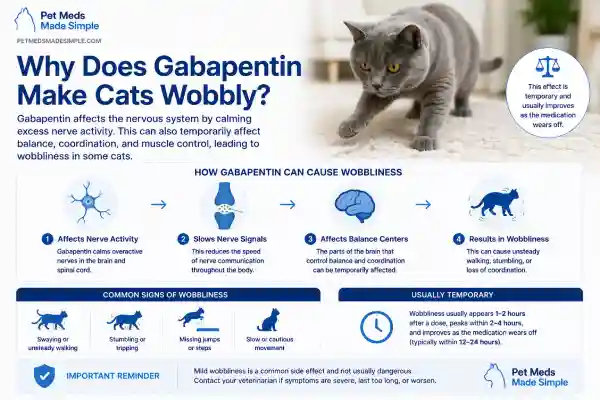
Gabapentin affects communication between nerve cells.
As nerve activity becomes calmer, some cats may temporarily experience:
- Reduced coordination
- Altered balance
- Slower reflexes
- Mild muscle weakness
What Owners May Notice
| Symptom | Description |
|---|---|
| Swaying | Side-to-side movement |
| Stumbling | Occasional loss of balance |
| Missing jumps | Poor coordination |
| Slow walking | Reduced confidence |
| Weak back legs | Temporary instability |
These effects usually improve as the medication wears off.
Does Wobbliness Mean the Medication Is Working?
Not necessarily.
Wobbliness is a side effect rather than the intended goal of treatment.
However, mild wobbliness often occurs because the medication is actively affecting the nervous system.
Intended Effects
- Pain relief
- Reduced anxiety
- Relaxation
- Stress reduction
Unintended Effects
- Sleepiness
- Wobbliness
- Reduced activity
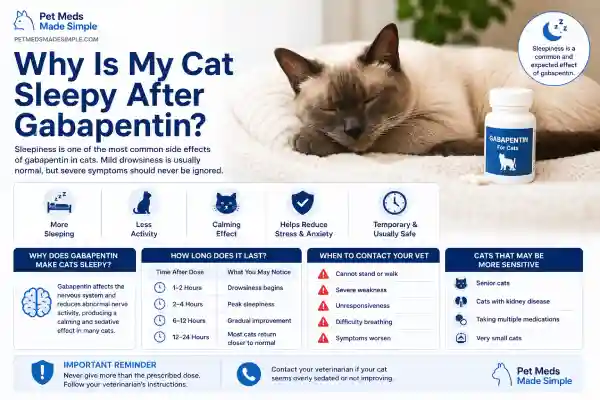
How Long Does Wobbliness Last?
The duration varies between cats.
Typical Timeline
| Time After Dose | Possible Effects |
|---|---|
| 1–2 Hours | Effects begin |
| 2–4 Hours | Peak wobbliness |
| 6–12 Hours | Gradual improvement |
| 12–24 Hours | Most cats improve significantly |
Some cats recover more quickly while others remain affected longer.
Is Wobbliness Worse After the First Dose?
Often, yes.
The first dose is commonly the most concerning for owners because they do not yet know how their cat will respond.
First Dose Reactions
| Observation | Common? |
|---|---|
| Sleepiness | Yes |
| Wobbliness | Yes |
| Hiding | Yes |
| Less activity | Yes |
| Mild confusion | Sometimes |
Many cats show less dramatic side effects with future doses.
Are Senior Cats More Likely to Become Wobbly?
Yes.
Senior cats are often more sensitive to gabapentin.
Why Older Cats May Be More Sensitive
- Slower metabolism
- Kidney disease
- Chronic illnesses
- Multiple medications
Risk Comparison
| Cat Type | Increased Risk? |
|---|---|
| Young adult | Lower |
| Healthy adult | Moderate |
| Senior cat | Higher |
| Kidney disease | Higher |
Older cats may require closer monitoring after each dose.
Could Kidney Disease Make Wobbliness Worse?
Yes.
Gabapentin is primarily eliminated through the kidneys.
If kidney function is reduced, the medication may remain in the body longer.
Potential Effects
- Stronger sedation
- Longer-lasting wobbliness
- Greater sensitivity
- Increased recovery time
Kidney Function Comparison
| Kidney Function | Possible Effect |
|---|---|
| Normal | Expected duration |
| Mildly reduced | Longer effects |
| Significantly reduced | Stronger effects |
Veterinarians often consider kidney health when prescribing gabapentin.
Could My Cat Fall After Taking Gabapentin?
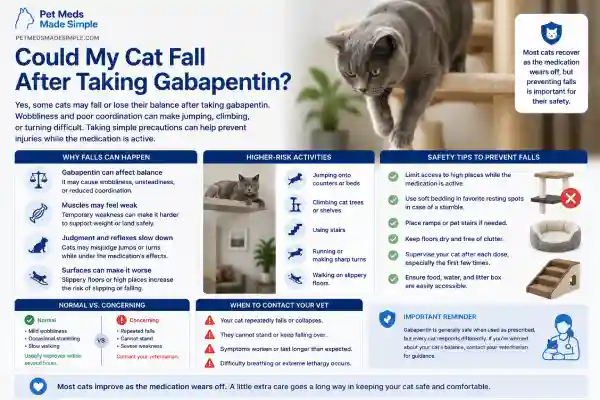
Sometimes.
This is one reason owners should monitor cats closely after a dose.
Higher-Risk Activities
- Jumping onto counters
- Climbing cat trees
- Using stairs
- Walking on slippery floors
Safety Tips
| Recommendation | Why It Helps |
|---|---|
| Limit jumping | Prevent falls |
| Use soft bedding | Improve comfort |
| Monitor closely | Detect problems |
| Restrict access to heights | Reduce injury risk |
Could Wobbliness Be Mistaken for Weakness?
Absolutely.
Many owners describe wobbliness as weakness.
Differences
| Wobbliness | Weakness |
|---|---|
| Balance problem | Strength problem |
| Swaying | Difficulty supporting weight |
| Stumbling | Collapsing |
| Usually temporary | May indicate illness |
Sometimes both occur together.
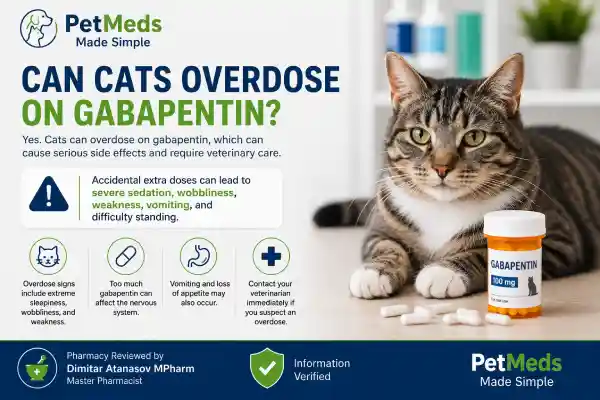
Could Wobbliness Be a Sign of an Overdose?
Sometimes.
While mild wobbliness is a common side effect, severe balance problems can occasionally indicate excessive medication exposure.
Possible Overdose Signs
| Symptom | Severity |
|---|---|
| Mild wobbliness | Usually expected |
| Sleepiness | Common |
| Severe weakness | Concerning |
| Cannot stand | Serious |
| Repeated falls | Serious |
| Extreme lethargy | Serious |
| Unresponsiveness | Emergency |
Most cats experiencing mild wobbliness are not overdosing, but owners should recognize the warning signs.
Related reading:
Can Cats Overdose on Gabapentin?
Could Other Medications Make Wobbliness Worse?
Yes.
Certain medications may increase the sedative effects of gabapentin.
Common Medication Types
- Pain medications
- Anxiety medications
- Seizure medications
- Sedatives used before procedures
Interaction Risk Table
| Medication Type | May Increase Wobbliness? |
|---|---|
| Pain medications | Yes |
| Anxiety medications | Yes |
| Seizure medications | Yes |
| Multiple sedating drugs | Higher risk |
Always inform your veterinarian about every medication and supplement your cat receives.
Could Sleepiness and Wobbliness Occur Together?
Very often.
In fact, many cats experience both side effects at the same time.
Common Combination
| Symptom | Common? |
|---|---|
| Sleepiness + wobbliness | Very Common |
| Sleepiness only | Common |
| Wobbliness only | Less Common |
| No side effects | Also Possible |
This combination is particularly common after the first dose.
Related reading:
Why Is My Cat Sleepy After Gabapentin?
Why Do Some Cats Become More Wobbly Than Others?
Every cat responds differently.
Several factors influence how strongly gabapentin affects balance.
Factors That Influence Sensitivity
| Factor | May Increase Wobbliness? |
|---|---|
| Higher dose | Yes |
| Senior age | Yes |
| Kidney disease | Yes |
| Multiple medications | Yes |
| Individual sensitivity | Yes |
This explains why two cats receiving similar treatment may have very different experiences.
How Veterinarians Evaluate Wobbliness
If wobbliness appears severe or lasts longer than expected, veterinarians perform a detailed assessment.
Common Questions
- When was the medication given?
- What dose was administered?
- Has the cat received gabapentin before?
- Are other medications involved?
- Does the cat have kidney disease?
Veterinary Evaluation
| Assessment | Purpose |
|---|---|
| Physical examination | Assess overall health |
| Neurological exam | Evaluate balance and coordination |
| Medication review | Identify interactions |
| Bloodwork | Assess organ function |
| Monitoring | Follow recovery progress |
Most cases can be evaluated successfully with history and examination.
Could My Cat Need a Lower Dose?
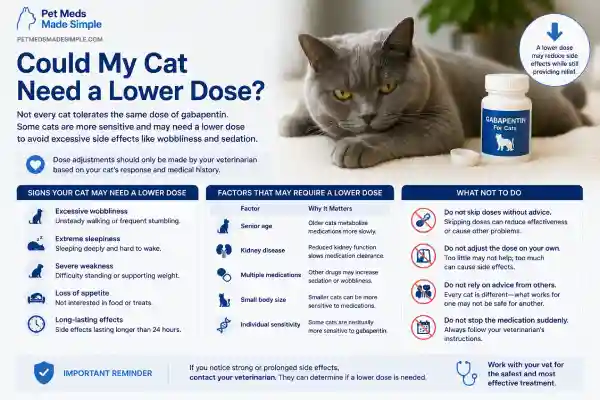
Sometimes.
Not every cat tolerates the same amount of medication equally.
Situations That May Require Reassessment
- Excessive wobbliness
- Severe sleepiness
- Prolonged recovery
- Repeated falls
- Significant behavioral changes
Owners should never adjust the dose themselves without veterinary guidance.
Could Wobbliness Be Dangerous?
Usually not.
However, the biggest risk is injury from falls.
Potential Risks
| Risk | Why It Matters |
|---|---|
| Falling from furniture | Injury risk |
| Missing jumps | Trauma risk |
| Slipping on floors | Reduced stability |
| Stair accidents | Increased fall risk |
Most cats recover completely once the medication effect decreases.
When Should Owners Contact Their Veterinarian?
Owners should contact their veterinarian if:
- Wobbliness seems severe
- Symptoms worsen
- Recovery takes longer than expected
- The cat repeatedly falls
- Appetite disappears completely
- New symptoms develop
Contact Your Veterinarian If
| Symptom | Call Vet? |
|---|---|
| Mild wobbliness | Usually no |
| Occasional stumbling | Monitor |
| Repeated falls | Yes |
| Severe weakness | Yes |
| Cannot stand | Yes |
| Symptoms worsening | Yes |
When Does Wobbliness Become an Emergency?
Most cats experiencing wobbliness do not require emergency care.
However, some symptoms should never be ignored.
Emergency Warning Signs
- Collapse
- Inability to stand
- Difficulty breathing
- Unresponsiveness
- Seizures
- Severe weakness
Emergency Table
| Symptom | Emergency? |
|---|---|
| Mild wobbliness | No |
| Sleeping more | No |
| Occasional stumbling | Monitor |
| Repeated falls | Contact Vet |
| Cannot stand | Yes |
| Difficulty breathing | Yes |
| Collapse | Yes |
| Unresponsiveness | Yes |
Related Symptoms Owners Often Search For
Cats experiencing wobbliness after gabapentin may also develop other temporary side effects.
Related guides:
- Gabapentin for Cats: Uses, Dosage, Side Effects & Safety Guide
- Why Is My Cat Sleepy After Gabapentin?
- Can Cats Take Gabapentin Long-Term?
- Can Cats Overdose on Gabapentin?
- Is Human Gabapentin Safe for Cats?
As additional articles in the Gabapentin for Cats series are published, they can be linked here.
Bottom Line
Why is my cat wobbly after gabapentin? Wobbliness is one of the most common side effects of gabapentin in cats. The medication can temporarily affect balance, coordination, and movement, causing some cats to walk unsteadily or stumble. In most cases, these effects are mild and improve as the medication wears off. Severe weakness, inability to stand, collapse, or breathing difficulties should be evaluated immediately by a veterinarian.
Veterinarian Takeaway
Gabapentin is widely used in feline medicine because it can help manage pain, anxiety, and stress. Temporary wobbliness is a common side effect and is usually not dangerous. The main concern is preventing falls and monitoring for unusually severe symptoms. Most cats recover normally as the medication leaves their system, but veterinary guidance should be sought whenever side effects appear excessive or unexpected.Why Is My Cat Wobbly After Gabapentin?
Frequently Asked Questions – Why Is My Cat Wobbly After Gabapentin?
Is it normal for my cat to wobble after gabapentin?
Yes. Mild wobbliness is a common side effect.
Why does gabapentin affect balance?
The medication influences nervous system activity and can temporarily reduce coordination.
How long does wobbliness last?
Many cats improve within several hours, although duration varies.
Can my cat fall after taking gabapentin?
Yes. Some cats may miss jumps or lose balance temporarily.
Are older cats more likely to wobble?
Yes. Senior cats are often more sensitive to gabapentin.
Can kidney disease make wobbliness worse?
Yes. Reduced kidney function may prolong medication effects.
Is wobbliness a sign of overdose?
Mild wobbliness is usually expected. Severe symptoms may require veterinary evaluation.
Should I skip the next dose?
Never change medication schedules without veterinary guidance.
Can other medications increase wobbliness?
Yes. Certain medications may increase sedation and balance problems.
When should I call my veterinarian?
If your cat cannot stand, repeatedly falls, develops severe weakness, or symptoms worsen.
Reviewed By
Pharmacy Reviewed By
Dimitar Atanasov, MPharm
Master Pharmacist | Medication Safety Educator
Editorial Policy
At Pet Meds Made Simple, we are committed to providing accurate, evidence-based information about pet medications, veterinary treatments, medication safety, and common health concerns affecting dogs and cats.
For more information, see our Editorial Policy:
Sources
- Plumb’s Veterinary Drug Handbook
- Merck Veterinary Manual
- American Association of Feline Practitioners (AAFP)
- Veterinary Information Network (VIN)
- Journal of Feline Medicine and Surgery
- Small Animal Clinical Pharmacology
- Veterinary Pharmacology and Therapeutics
- JAVMA
- Frontiers in Veterinary Science
- Veterinary Anaesthesia and Analgesia
Medical Review Statement
This article was pharmacy-reviewed by Dimitar Atanasov, MPharm, Master Pharmacist, using current veterinary pharmacology references, feline neurology references, feline pain-management guidelines, and published veterinary literature available at the time of review.
Image created with AI – Why Is My Cat Wobbly After Gabapentin?