
Quick Answer
Can Dogs Safely Take Joint Supplements With NSAIDs? Yes, most dogs can safely take joint supplements with NSAIDs when recommended by a veterinarian. In fact, combining these therapies is a common part of modern canine arthritis management. While NSAIDs help reduce pain and inflammation, evidence-based joint supplements may support cartilage, joint function, and long-term mobility. However, not every supplement is appropriate for every dog, and owners should always discuss new supplements with their veterinarian before adding them to an existing treatment plan.
Key Takeaways
| Question | Short Answer |
|---|---|
| Can dogs take joint supplements with NSAIDs? | Yes, in most cases they can safely be used together under veterinary guidance. |
| Do joint supplements replace NSAIDs? | No. They are designed to complement, not replace, prescription pain medication. |
| Which supplements have the strongest evidence? | Omega-3 fatty acids, glucosamine, chondroitin sulfate, green-lipped mussel, and UC-II collagen have the best supporting evidence. |
| How long do supplements take to work? | Improvement is usually gradual and may take 4–12 weeks. |
| Should NSAIDs be stopped once supplements begin working? | No. Medication changes should only be made after consulting your veterinarian. |
When Owners Commonly Ask This
Questions about combining joint supplements with NSAIDs usually arise after a dog has already been diagnosed with arthritis.
Many owners notice that prescription pain medication helps their dog move more comfortably, but they also begin looking for ways to support long-term joint health. They may hear about glucosamine, fish oil, collagen, or green-lipped mussel from friends, breeders, social media, or pet stores and wonder whether these products are safe to use alongside medications.
This is a reasonable question because arthritis is rarely managed with a single therapy. Modern veterinary medicine often relies on a multimodal approach, meaning several treatments work together to improve comfort, maintain mobility, and slow functional decline.
Can Dogs Safely Take Joint Supplements With NSAIDs?
Why Arthritis Treatment Usually Requires More Than One Therapy

Canine osteoarthritis is not simply a painful joint.
It is a chronic, progressive disease involving:
- gradual cartilage degeneration,
- inflammation inside the joint,
- remodeling of bone,
- reduced joint lubrication,
- muscle loss,
- decreased mobility over time.
Because several processes occur simultaneously, one medication rarely addresses every aspect of the disease.
Veterinary NSAIDs are excellent at controlling inflammation and reducing pain, but they do not rebuild damaged cartilage. Likewise, joint supplements cannot provide the rapid anti-inflammatory effects that NSAIDs offer.
Instead, each therapy has a different role.
How NSAIDs and Joint Supplements Work Together
| NSAIDs | Joint Supplements |
|---|---|
| Reduce inflammation | Support cartilage health |
| Provide pain relief | Help maintain joint structure |
| Improve daily comfort | Support long-term joint function |
| Usually work within hours to days | Often require several weeks |
| Prescription medications | Nutritional support products |
Rather than competing with each other, these treatments are designed to complement one another.
This is why many veterinarians recommend both as part of a comprehensive arthritis management plan.
Related reading: Can Dogs Stay on NSAIDs for Life?
What Are NSAIDs?
NSAIDs (nonsteroidal anti-inflammatory drugs) are among the most commonly prescribed medications for dogs with osteoarthritis and other painful inflammatory conditions.
They work by reducing the production of prostaglandins—chemical messengers involved in inflammation and pain.
Common veterinary NSAIDs include medications such as:
- carprofen,
- meloxicam,
- deracoxib,
- firocoxib,
- grapiprant (which has a different mechanism but is also used for osteoarthritis pain).
When prescribed appropriately and monitored regularly, these medications can significantly improve a dog’s quality of life by reducing discomfort and allowing more normal movement.
However, because NSAIDs primarily control inflammation rather than repairing joint tissues, veterinarians often combine them with other long-term strategies.
Related reading: Can Dogs Take Pain Medication Every Day?
What Are Joint Supplements?
Joint supplements are products designed to support the structures that keep joints functioning normally.
Unlike prescription NSAIDs, they are not classified as pain medications.
Instead, they may contain ingredients intended to support:
- cartilage,
- connective tissue,
- synovial fluid,
- collagen,
- normal inflammatory balance.
Some products contain only one active ingredient, while others combine several compounds into a single chew, tablet, capsule, or liquid.
It is important to remember that not all joint supplements have the same level of scientific evidence. Some ingredients have been evaluated in canine clinical studies, whereas others rely mainly on laboratory research or manufacturer-sponsored data.
Why Veterinarians Often Recommend Both Together
One of the biggest misconceptions among dog owners is that they must choose between prescription medication and supplements.
In reality, this is rarely how canine arthritis is managed.
Instead, veterinarians frequently recommend combining therapies that target different aspects of the disease.
For example:
- NSAIDs help reduce inflammation.
- Weight management decreases stress on the joints.
- Controlled exercise preserves muscle strength.
- Physical rehabilitation improves mobility.
- Joint supplements may support cartilage and connective tissues over time.
This combination often provides better long-term results than relying on any single treatment alone.
Related reading: Can Dogs Take Pain Medication Long-Term?
Is It Safe to Combine Joint Supplements With NSAIDs?

For most healthy dogs receiving veterinary care, the answer is yes.
Most commonly recommended joint supplements do not have clinically significant interactions with veterinary NSAIDs.
This is why combination therapy has become a standard part of managing chronic osteoarthritis in many patients.
However, “safe” does not mean owners should begin supplements without discussing them with their veterinarian.
Your veterinarian may wish to consider:
- your dog’s age,
- current medications,
- kidney function,
- liver health,
- gastrointestinal history,
- allergies,
- other medical conditions.
Individualizing treatment helps ensure that every product contributes positively to your dog’s overall care plan rather than increasing unnecessary risks.
Which Joint Supplement Ingredients Have the Strongest Scientific Evidence?
Not all joint supplements are supported by the same level of research.
Some ingredients have been evaluated in multiple canine studies and are commonly recommended by veterinarians, while others have only limited evidence or rely primarily on manufacturer-sponsored research.
Understanding the difference helps owners invest in products that are more likely to benefit their dogs.
Evidence Ranking of Common Joint Supplement Ingredients
| Ingredient | Scientific Evidence | Primary Goal | Commonly Combined With NSAIDs? |
|---|---|---|---|
| Omega-3 fatty acids (EPA/DHA) | ★★★★★ Excellent | Reduce inflammatory mediators | Yes |
| Glucosamine | ★★★★☆ Good | Cartilage support | Yes |
| Chondroitin sulfate | ★★★★☆ Good | Cartilage protection | Yes |
| UC-II (Undenatured Type II Collagen) | ★★★★☆ Good | Immune modulation within joints | Yes |
| Green-lipped mussel | ★★★★☆ Good | Joint support and anti-inflammatory effects | Yes |
| MSM (Methylsulfonylmethane) | ★★★☆☆ Moderate | Connective tissue support | Sometimes |
| Turmeric (Curcumin) | ★★☆☆☆ Limited | Anti-inflammatory support | Only with veterinary guidance |
No supplement is capable of reversing arthritis, but several have shown potential benefits when used consistently as part of a broader treatment plan.
Glucosamine
Glucosamine is one of the most widely recognized joint supplements in veterinary medicine.
It is a naturally occurring compound involved in cartilage formation and maintenance.
Although damaged cartilage cannot be fully regenerated, glucosamine may help support normal cartilage metabolism and reduce the progression of degenerative changes in some dogs.
Unlike NSAIDs, glucosamine does not provide immediate pain relief.
Owners should expect gradual rather than dramatic improvements.
Potential Benefits of Glucosamine
- Supports cartilage metabolism
- Helps maintain joint lubrication
- May improve long-term mobility
- Often included in combination products
- Generally well tolerated
Most veterinarians recommend using glucosamine consistently for several weeks before evaluating whether it is helping.
Stopping and restarting the supplement every few days is unlikely to provide meaningful benefits.
Chondroitin Sulfate
Chondroitin sulfate is frequently paired with glucosamine because the two ingredients appear to complement one another.
Chondroitin is an important structural component of cartilage and may help maintain the tissue’s ability to absorb shock.
Research suggests it may also inhibit some enzymes involved in cartilage breakdown.
Like glucosamine, its effects develop gradually.
Glucosamine vs. Chondroitin
| Glucosamine | Chondroitin |
|---|---|
| Supports cartilage metabolism | Helps preserve cartilage structure |
| Commonly used alone or in combination | Usually combined with glucosamine |
| Gradual onset | Gradual onset |
| Excellent safety profile | Excellent safety profile |
Many commercial veterinary joint supplements contain both ingredients because they target different aspects of joint health.
Omega-3 Fatty Acids (EPA and DHA)
Among all nutritional supplements, omega-3 fatty acids have some of the strongest scientific support for dogs with osteoarthritis.
These fatty acids particularly EPA and DHA derived from fish oil—help influence inflammatory pathways throughout the body.
Unlike NSAIDs, which directly inhibit inflammatory enzymes, omega-3 fatty acids gradually alter the production of inflammatory mediators over time.
Clinical studies have shown improvements in:
- mobility,
- willingness to exercise,
- comfort,
- weight-bearing,
- owner-assessed quality of life.
Because of this evidence, many veterinary specialists routinely recommend fish oil alongside NSAIDs.
Related reading: Natural Pain Relief for Dogs
Fish Oil Is Not the Same as Any Oil
Owners sometimes assume all oils provide identical benefits.
They do not.
The beneficial effects seen in veterinary studies are primarily associated with EPA (eicosapentaenoic acid) and DHA (docosahexaenoic acid) from marine sources.
Vegetable oils generally contain different fatty acids and cannot be assumed to produce the same effects.
When selecting a fish oil supplement, veterinarians often recommend products specifically formulated for dogs because quality control and EPA/DHA concentrations are more predictable.
Omega-3 Fatty Acids Compared With NSAIDs
| Omega-3 Fatty Acids | NSAIDs |
|---|---|
| Nutritional support | Prescription medication |
| Gradual effect | Faster pain relief |
| Influence inflammatory pathways | Directly reduce inflammation |
| Long-term support | Symptom control |
| Frequently used together | Frequently combined with fish oil |
These therapies complement each other rather than compete.
Green-Lipped Mussel
Green-lipped mussel (Perna canaliculus), sourced from New Zealand, has gained increasing attention in veterinary medicine.
It contains several naturally occurring compounds, including:
- omega-3 fatty acids,
- glycosaminoglycans,
- amino acids,
- minerals.
Some canine studies suggest improvements in mobility and comfort when green-lipped mussel is included as part of long-term arthritis management.
While the evidence is encouraging, results vary among products because manufacturing methods influence the concentration of active compounds.
Choosing veterinary-formulated products is generally preferable to generic supplements marketed for humans.
UC-II (Undenatured Type II Collagen)
UC-II is different from traditional collagen powders.
Rather than serving as a building block for cartilage, undenatured type II collagen is believed to influence immune responses associated with joint inflammation.
Several canine studies have reported improvements in mobility and activity levels comparable to some traditional joint supplements.
UC-II is commonly included in newer veterinary arthritis products and may be especially useful when combined with weight management, exercise, and NSAID therapy.
MSM (Methylsulfonylmethane)
MSM is frequently included in combination joint products.
It supplies sulfur, an element involved in connective tissue formation.
Although laboratory research suggests possible anti-inflammatory effects, canine clinical evidence remains more limited than that for glucosamine or omega-3 fatty acids.
For this reason, MSM is usually viewed as a supportive ingredient rather than the primary reason for selecting a supplement.
Do These Supplements Replace NSAIDs?
This is one of the most common misconceptions among dog owners.
The answer is no.
Even supplements with the strongest scientific evidence should not be viewed as replacements for prescription pain medications.
Instead, they work alongside NSAIDs by addressing different aspects of arthritis.
Table: Supplements vs. NSAIDs
| Joint Supplements | NSAIDs |
|---|---|
| Support long-term joint health | Control pain and inflammation |
| Gradual onset | Faster onset |
| Nutritional approach | Prescription therapy |
| May improve mobility over time | Improve comfort more rapidly |
| Best used together when appropriate | Often combined with supplements |
For many dogs, this combination provides a better balance of immediate pain relief and long-term joint support than either strategy alone.
Related reading: Can Dogs Take Gabapentin and NSAIDs Together?
Can Joint Supplements Reduce the Amount of NSAIDs a Dog Needs?
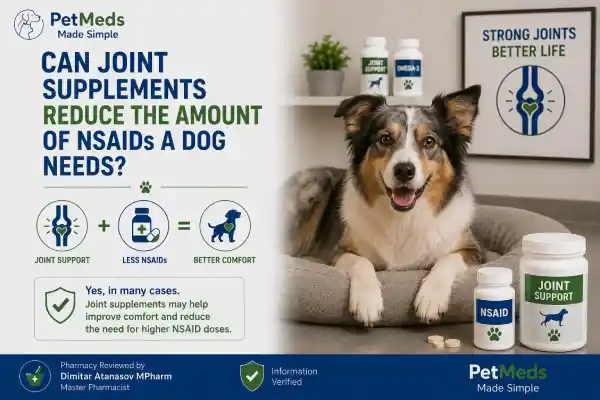
Many owners hope that starting a joint supplement will eventually allow them to lower or even stop their dog’s NSAID.
This is an understandable goal, especially for dogs expected to remain on pain medication for months or years.
The answer, however, is sometimes but not immediately, and not for every dog.
If a dog loses excess weight, begins an appropriate exercise program, responds well to rehabilitation, and benefits from an evidence-based joint supplement, the veterinarian may eventually determine that the current NSAID dose can be adjusted.
However, this decision should always be based on:
- the dog’s comfort,
- mobility,
- physical examination,
- ongoing monitoring,
- overall quality of life.
It should never be based solely on the owner believing the supplement has “started working.”
Why Veterinarians Usually Do Not Reduce NSAIDs Too Soon
One of the biggest mistakes owners make is stopping pain medication as soon as their dog appears to feel better.
The improvement they see is often because the NSAID is effectively controlling inflammation, not because the arthritis has disappeared.
Reducing medication too early may allow inflammation to return, causing:
- increased pain,
- reduced mobility,
- muscle loss,
- decreased willingness to exercise,
- progression of chronic discomfort.
This is why veterinarians usually recommend keeping the treatment plan stable until they can evaluate whether the dog is consistently doing well.
Related reading: Should Pain Medication Be Reduced Gradually in Dogs?
When Might an NSAID Dose Be Reassessed?
Veterinarians may consider reassessing long-term pain medication if several positive factors come together.
These include:
- improved body condition,
- consistent mobility,
- successful weight loss,
- participation in rehabilitation,
- positive response to multimodal therapy,
- stable blood work,
- absence of medication side effects.
Even then, the goal is not necessarily to stop medication completely.
Often, the objective is to identify the lowest effective dose that continues to provide good pain control.
Table: Factors That May Influence NSAID Reassessment
| Factor | Why It Matters |
|---|---|
| Healthy body weight | Reduces stress on painful joints |
| Consistent exercise | Maintains muscle support around joints |
| Physical rehabilitation | Improves function and mobility |
| Positive response to supplements | May improve overall joint comfort |
| Stable kidney and liver monitoring | Supports long-term medication safety |
| Good quality of life | Indicates treatment is working effectively |
Every dog responds differently, which is why individualized treatment plans remain essential.
Can Joint Supplements Replace NSAIDs?

For most dogs with clinically significant osteoarthritis, no.
Joint supplements are designed to support joint health not replace medications that control pain and inflammation.
A dog experiencing moderate or severe arthritis generally still requires appropriate pain management to remain comfortable.
Without adequate pain control, chronic inflammation may lead to:
- reduced activity,
- muscle wasting,
- stiffness,
- worsening mobility,
- decreased quality of life.
Supplements should therefore be viewed as partners rather than alternatives.
Table: Supplements vs. Medication
| Joint Supplements | NSAIDs |
|---|---|
| Nutritional support | Prescription treatment |
| Long-term joint support | Pain and inflammation control |
| Slow onset | Faster symptom relief |
| Cannot rapidly relieve severe pain | Effective for active inflammation |
| Best used alongside comprehensive care | Often combined with supplements |
What About Herbal Joint Supplements?
Many herbal products are marketed as “natural alternatives” to prescription pain medications.
Examples include:
- turmeric (curcumin),
- boswellia,
- devil’s claw,
- cannabidiol (CBD),
- various herbal blends.
Although some ingredients have shown promise in laboratory or preliminary studies, the quality of evidence varies considerably.
In addition, herbal supplements are not regulated in the same way as veterinary prescription medications.
Product quality, ingredient concentration, and purity may differ substantially between manufacturers.
For this reason, veterinarians generally recommend discussing any herbal supplement before adding it to an NSAID treatment plan.
Turmeric (Curcumin)
Curcumin is widely promoted because of its anti-inflammatory properties.
Laboratory studies suggest biological activity, but one important limitation is poor oral absorption.
Many commercial products attempt to improve absorption by combining curcumin with other ingredients.
Although some owners report improvements, current veterinary evidence is still less robust than for omega-3 fatty acids or traditional multimodal arthritis management.
Curcumin should therefore be considered a potential supportive therapy rather than a replacement for established treatments.
Boswellia
Boswellia serrata is another herbal ingredient marketed for joint health.
Some studies suggest anti-inflammatory effects, but canine clinical evidence remains limited.
Because formulations vary widely, the effectiveness of one product cannot automatically be applied to another.
Veterinary guidance is especially important when combining boswellia with NSAIDs because both influence inflammatory pathways.
What About CBD Products?
CBD has become increasingly popular among pet owners seeking additional arthritis support.
Research into CBD for dogs is still evolving.
Some studies suggest possible improvements in comfort or activity, while others show mixed results.
More importantly, CBD products vary tremendously in:
- cannabinoid concentration,
- purity,
- manufacturing quality,
- third-party testing.
Some products marketed online contain inaccurate ingredient labels or contaminants.
Owners should also remember that CBD may affect liver enzyme monitoring in some dogs, making veterinary supervision especially important.
Related reading: Can Dogs Take Gabapentin and NSAIDs Together?
Dogs With Kidney Disease
Kidney health deserves special attention whenever NSAIDs are prescribed.
Evidence-based joint supplements are generally not considered replacements for careful kidney monitoring.
If a dog has existing kidney disease, the veterinarian may recommend:
- baseline blood work,
- periodic kidney value monitoring,
- urine testing,
- blood pressure evaluation,
- individualized medication adjustments.
Adding a supplement does not eliminate the need for these precautions.
Related reading: Do Pain Medications Affect Kidney Values in Dogs?
Related reading: How Often Should Kidney Function Be Checked in Dogs on Pain Medication?
Dogs With Liver Disease
Although many joint supplements have favorable safety profiles, dogs with liver disease still require individualized treatment plans.
Certain herbal products may be metabolized by the liver, while some supplements can influence laboratory values or interact with other medications.
Veterinarians may recommend additional monitoring depending on:
- existing liver disease,
- concurrent medications,
- age,
- overall health status.
Owners should never assume that a supplement is automatically safe simply because it is sold without a prescription.
Related reading: Do Pain Medications Affect Liver Enzymes in Dogs?
Choosing a High-Quality Joint Supplement
The quality of joint supplements varies enormously.
Rather than selecting products based solely on marketing claims, veterinarians often look for several characteristics.
Table: What to Look For
| Feature | Why It Matters |
|---|---|
| Clearly listed active ingredients | Easier to evaluate dosing |
| Veterinary formulation | Often designed specifically for dogs |
| Manufacturer quality standards | Improves consistency |
| Published research | Greater confidence in effectiveness |
| Third-party quality testing | Better assurance of purity |
Price alone does not determine quality.
Some expensive products contain very little of the ingredients that have actually been studied in dogs, while some reasonably priced veterinary formulations are supported by considerably stronger evidence.
Common Mistakes Owners Make When Adding Joint Supplements

Most owners want to do everything possible to help their arthritic dog. Unfortunately, good intentions can sometimes lead to treatment decisions that reduce the overall effectiveness of the plan.
Understanding these common mistakes can help owners get the greatest benefit from both joint supplements and NSAIDs.
Mistake #1: Expecting Immediate Results
Unlike NSAIDs, which often begin relieving pain within hours or days, joint supplements work gradually.
Many ingredients support normal cartilage metabolism or influence inflammatory pathways over time rather than providing immediate pain relief.
Owners sometimes stop a supplement after only one or two weeks because they do not notice dramatic improvement.
In many cases, that is simply not enough time.
Most veterinarians recommend evaluating the response after 6 to 12 weeks, depending on the product and the dog’s overall condition.
Mistake #2: Buying the Cheapest Supplement Available
Joint supplements vary enormously in quality.
Two products may both advertise “glucosamine,” yet contain very different:
- ingredient concentrations,
- manufacturing standards,
- purity,
- bioavailability,
- supporting research.
Choosing a product solely because it is inexpensive—or because it has attractive marketing—does not necessarily provide the best value.
Veterinary-formulated products with transparent ingredient lists are generally preferred.
Mistake #3: Assuming “Natural” Means Completely Safe
This is one of the biggest misconceptions in veterinary medicine.
Natural products still contain biologically active compounds.
Some herbs may influence:
- liver metabolism,
- blood clotting,
- inflammatory pathways,
- interactions with prescription medications.
Always tell your veterinarian about every supplement your dog receives, including products purchased online or from health food stores.
Mistake #4: Stopping NSAIDs Without Veterinary Advice
Some owners become worried after reading about possible NSAID side effects and decide to discontinue the medication once they begin a joint supplement.
Unfortunately, this may allow chronic pain to return.
A dog that appears “better” often feels better because the NSAID is successfully controlling inflammation.
Removing the medication too early can result in:
- worsening stiffness,
- decreased activity,
- muscle loss,
- reduced quality of life.
Related reading: Should Pain Medication Be Reduced Gradually in Dogs?
Mistake #5: Ignoring Weight Management
Even the best joint supplement cannot compensate for excess body weight.
Every additional pound increases the mechanical load placed on painful joints.
Maintaining an ideal body condition remains one of the most effective long-term strategies for improving mobility in dogs with arthritis.
Mistake #6: Forgetting That Exercise Is Still Important
Years ago, prolonged rest was commonly recommended for dogs with arthritis.
Today, veterinarians know that controlled, consistent activity is usually far more beneficial.
Appropriate exercise helps maintain:
- muscle strength,
- joint flexibility,
- balance,
- coordination,
- overall mobility.
The key is avoiding excessive or high-impact activity while encouraging regular, moderate movement.
Related reading: Can Dogs Exercise While Taking Pain Medication?
Mistake #7: Skipping Follow-Up Examinations
Arthritis changes over time.
A treatment plan that works well today may need adjustments months or years later.
Regular veterinary rechecks allow your veterinarian to assess:
- comfort,
- mobility,
- body weight,
- medication effectiveness,
- potential side effects,
- whether additional therapies should be introduced.
These appointments are an important part of long-term arthritis management not simply prescription refill visits.
Owner Checklist Before Starting a Joint Supplement

Use this checklist before adding any supplement to your dog’s arthritis treatment plan.
✅ Confirm your veterinarian knows every medication your dog currently receives.
✅ Choose a veterinary-formulated product whenever possible.
✅ Understand that improvement may take several weeks.
✅ Continue giving NSAIDs exactly as prescribed unless your veterinarian advises otherwise.
✅ Monitor your dog’s comfort, mobility, appetite, and activity level.
✅ Keep follow-up appointments for routine examinations and laboratory monitoring when recommended.
Bottom Line
Yes, most dogs can safely take joint supplements with NSAIDs when those supplements are selected carefully and used under veterinary guidance.
Modern arthritis management is rarely based on a single medication.
Instead, veterinarians often combine multiple evidence-based strategies, including:
- NSAIDs,
- joint supplements,
- weight management,
- regular exercise,
- rehabilitation,
- environmental modifications,
- routine monitoring.
NSAIDs provide effective control of pain and inflammation.
Joint supplements support long-term joint health but are not replacements for prescription pain medication.
The best results usually come from combining therapies that address different aspects of arthritis rather than relying on one treatment alone.
Veterinarian Takeaway
For many dogs with osteoarthritis, combining an NSAID with a high-quality joint supplement is both reasonable and commonly recommended.
The goal is not simply to reduce pain today it is to preserve mobility, comfort, and quality of life for years to come.
Supplements such as omega-3 fatty acids, glucosamine, chondroitin sulfate, UC-II collagen, and green-lipped mussel may all play useful roles as part of a comprehensive treatment plan.
However, no supplement should replace an appropriate veterinary examination or a prescribed medication without professional guidance.
Every dog is different, and the safest plan depends on age, underlying diseases, concurrent medications, and the severity of arthritis.
Frequently Asked Questions – Can Dogs Safely Take Joint Supplements With NSAIDs?
Can dogs take glucosamine with carprofen?
Yes. Glucosamine is commonly used alongside carprofen and other veterinary NSAIDs. There are no well-established clinically significant interactions between glucosamine and carprofen when used appropriately.
Can fish oil replace NSAIDs?
No.
Fish oil may support long-term joint health and help influence inflammatory pathways, but it does not replace the rapid pain relief provided by NSAIDs.
How long should my dog take joint supplements?
Healthy puppies generally do not require routine joint supplementation unless a veterinarian recommends it because of a developmental orthopedic condition or another specific medical need.
Do all joint supplements work equally well?
No.
Products differ considerably in ingredient quality, concentrations, manufacturing standards, and scientific evidence.
Can joint supplements upset a dog’s stomach?
Some dogs may experience mild digestive upset when starting a new supplement. Giving the supplement with food often helps, but persistent vomiting or diarrhea should be discussed with a veterinarian.
Should I stop the supplement if I don’t see improvement after two weeks?
Usually not.
Most joint supplements require several weeks before meaningful improvements become noticeable.
Can supplements cure arthritis?
No.
Arthritis is a chronic, progressive condition. Supplements may support joint health, but they cannot reverse existing cartilage damage.
Are human joint supplements safe for dogs?
Not always.
Some human products contain ingredients or flavorings that may not be appropriate for dogs. Veterinary-specific products are generally preferred.
What is the most important thing owners can do besides giving medication?
Maintaining a healthy body weight and encouraging appropriate daily exercise are among the most effective ways to support dogs with arthritis alongside medication and supplements.
Sources
- Plumb DC. Plumb’s Veterinary Drug Handbook. Latest edition.
- Merck Veterinary Manual. Osteoarthritis in Dogs.
- American Animal Hospital Association (AAHA). Canine Osteoarthritis Guidelines.
- World Small Animal Veterinary Association (WSAVA). Global Pain Council Guidelines.
- American Veterinary Medical Association (AVMA). Resources on canine pain management.
- Lascelles BDX, et al. Guidelines for the recognition, assessment and treatment of pain.
- Innes JF, et al. Management of canine osteoarthritis.
- Frontiers in Veterinary Science. Reviews on multimodal management of canine osteoarthritis.
- JAVMA. Peer-reviewed studies evaluating glucosamine, chondroitin sulfate, omega-3 fatty acids, UC-II collagen, and multimodal osteoarthritis management.
- FDA Center for Veterinary Medicine (FDA-CVM). Approved veterinary NSAID information.
Medical Review Statement
This article was written by Dimitar Georgiev Atanasov, MPharm, and scientifically reviewed by Gergana Krasimirova Atanasova, MPharm. Veterinary review was performed by Dr. Valcho Georgiev Valchev, DVM. This content is intended for educational purposes only and should never replace individualized veterinary advice. Always consult your veterinarian before starting, stopping, or combining medications or supplements for your dog.
Image Disclosure
Image Disclosure: Some images used throughout this article may be AI-generated or AI-assisted illustrations created for educational purposes. They are intended to simplify complex veterinary concepts and should not be interpreted as actual patients or clinical photographs.