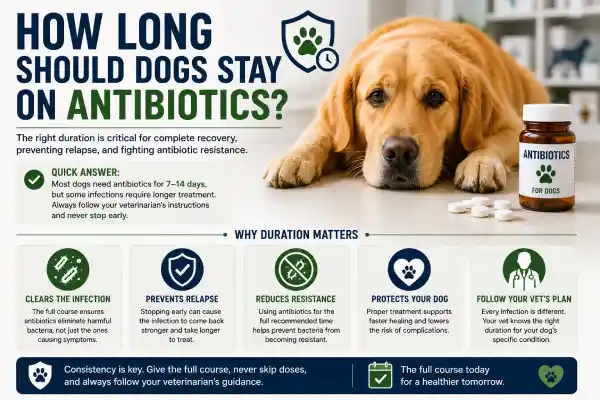
How long should dogs stay on antibiotics? Most dogs need to stay on antibiotics for 7 to 14 days, but the exact duration depends on the type of infection, severity, and how the dog responds to treatment. Stopping too early is one of the biggest reasons infections come back stronger.
Quick Answer
Dogs typically stay on antibiotics for 7–14 days, but some infections require longer treatment. Always follow your veterinarian’s instructions and never stop early—even if your dog seems better.
Why This Question Is More Important Than It Looks
At first glance, antibiotic duration seems simple:
👉 “Just give the medication for a few days until the dog feels better.”
This assumption is one of the biggest mistakes dog owners make.
In reality, antibiotics are not just about symptom relief—they are about completely eliminating the infection. When treatment is stopped too early, bacteria that survived the first phase of treatment can multiply again.
How Antibiotics Work Over Time
Antibiotics don’t kill all bacteria instantly. They work in phases.
At the beginning of treatment, the most vulnerable bacteria die first. This is why dogs often appear better after just a few days.
However, stronger and more resistant bacteria may still remain. These require continued exposure to the antibiotic to be fully eliminated.
If treatment is stopped early, these surviving bacteria become the source of relapse.
The Most Common Mistake: Stopping Too Early
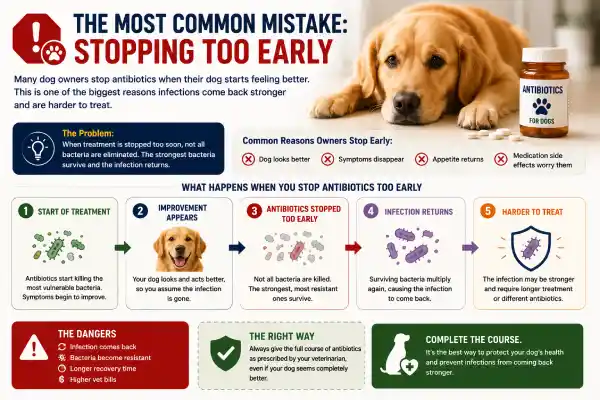
Many owners stop antibiotics when:
- the dog looks better
- symptoms disappear
- appetite returns
This creates a dangerous situation.
The infection is not gone—it is only suppressed.
👉 This is closely related to what we explained in
Miss a Dose of Antibiotics in Dogs? (Critical Vet Guide), where inconsistent dosing leads to similar problems.
How Long Should Dogs Stay on Antibiotics?
Typical Antibiotic Durations by Condition
The correct duration depends heavily on the type of infection.
Common Treatment Durations
| Infection Type | Typical Duration |
|---|---|
| Skin infections | 7–14 days |
| Urinary tract infections | 7–14 days |
| Respiratory infections | 10–21 days |
| Deep infections | 3–6 weeks |
| Bone infections | 4–8 weeks |
These ranges are not random—they are based on how deeply bacteria invade tissues.
Why Some Infections Need Longer Treatment
Superficial infections (like minor skin infections) are easier to treat because antibiotics can reach them quickly.
Deep infections—such as bone infections—require longer treatment because:
- blood supply is limited
- bacteria are harder to reach
- healing takes longer
👉 This is why antibiotics like Clindamycin are often used for deep tissue infections.
What Happens If You Stop Antibiotics Too Early
Stopping early can lead to several serious problems.
Key Risks
- infection returns
- symptoms worsen
- bacteria become resistant
- longer treatment needed later
In some cases, the second infection is harder to treat than the first.
Antibiotic Resistance Explained Simply
When antibiotics are stopped early, the strongest bacteria survive.
These bacteria:
- adapt
- become resistant
- no longer respond to the same drug
👉 This is a growing global issue in both human and veterinary medicine.
Signs Your Dog Still Needs Antibiotics
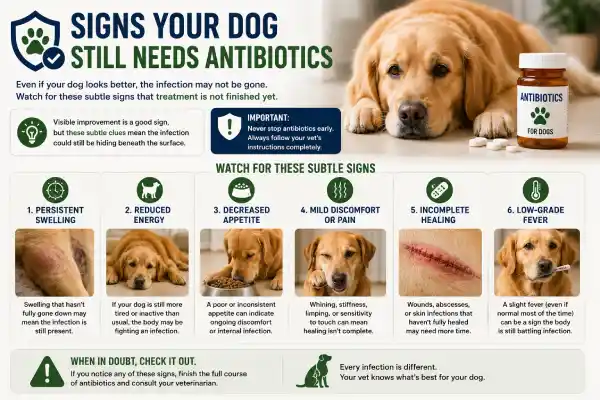
Even if your dog seems better, watch closely.
Subtle Signs
- slight swelling remains
- reduced energy
- mild discomfort
- incomplete healing
These indicate that treatment is not yet complete.
The Hidden Trap: “My Dog Looks Fine”
This is where most owners go wrong.
Dogs are very good at hiding symptoms.
Just because your dog:
- is eating
- is active
- looks normal
does NOT mean the infection is gone.
When Antibiotics May Need to Be Extended
Sometimes the initial course is not enough.
Veterinarians may extend treatment if:
- infection is severe
- improvement is slow
- symptoms persist
👉 This is common in conditions treated with Doxycycline, especially for systemic infections.
What About Puppies?
Puppies require special attention.
Because of their:
- developing immune system
- faster metabolism
- higher sensitivity
treatment duration must be carefully monitored.
👉 This is explained in
Is Cephalexin Safe for Puppies?
Can You Shorten the Treatment If Your Dog Improves?
No.
Even if improvement is rapid, stopping early is dangerous.
The visible improvement is only the first phase of recovery.
Can Antibiotics Be Given Too Long?
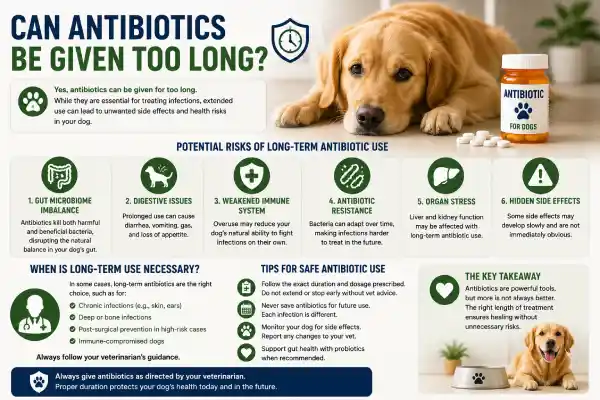
Yes, but this is less common.
Long-term use can lead to:
- gut imbalance
- diarrhea
- reduced appetite
👉 This is similar to side effects discussed in
Can Clindamycin Cause Vomiting in Dogs?
Short vs Long Antibiotic Courses
| Duration Type | Pros | Cons |
|---|---|---|
| Short course | fewer side effects | higher relapse risk |
| Long course | complete elimination | more monitoring needed |
Vet Perspective: Why Duration Matters More Than Dose
Many owners think:
👉 stronger dose = faster recovery
This is incorrect.
Veterinarians focus on:
👉 correct duration + consistency
How to Ensure You Follow the Full Course
Consistency is everything.
✔ Practical Tips
- set alarms
- track doses
- follow schedule strictly
- never skip doses
Conclusion
How long dogs should stay on antibiotics depends on the infection, but one rule always applies: never stop treatment early. Even if your dog appears fully recovered, the infection may still be present beneath the surface.
Following the full course is the difference between complete recovery and recurrence.
FAQ
How long should dogs stay on antibiotics?
Most dogs need antibiotics for 7–14 days, but some infections require longer treatment depending on severity.
Can I stop antibiotics if my dog feels better?
No. Stopping early can cause the infection to return and become harder to treat.
What happens if antibiotics are stopped too soon?
The infection may come back stronger, and bacteria may become resistant.
Can antibiotics be used long-term in dogs?
Yes, but only under veterinary supervision due to potential side effects.
What if I miss a dose?
Give it as soon as possible unless it’s close to the next dose. Never double dose.
Sources & Scientific References
- Plumb’s Veterinary Drug Handbook
- Veterinary Information Network (VIN)
- VCA Animal Hospitals
- American Veterinary Medical Association (AVMA)