

Quick Answer
Why is my dog pacing after pain medication? In many cases, pacing occurs because your dog is still uncomfortable or experiencing a temporary medication side effect. Certain pain medications can occasionally cause restlessness, confusion, dysphoria, or paradoxical excitement instead of relaxation. However, pacing may also indicate that the medication is not providing adequate pain relief, the underlying condition is worsening, or another medical problem has developed. If pacing is severe, lasts for several hours, or is accompanied by breathing difficulties, collapse, seizures, vomiting, or extreme confusion, contact your veterinarian immediately.
When Owners Commonly Ask This Question
Most owners become concerned when they notice that their dog:
- Starts walking around the house continuously after receiving pain medication.
- Cannot seem to lie down comfortably.
- Keeps changing sleeping positions.
- Pants while pacing.
- Appears restless after surgery.
- Walks from room to room without settling.
- Seems uncomfortable despite taking medication exactly as prescribed.
Although this behavior can be frightening, pacing does not always mean the medication is causing harm. Sometimes it is actually one of the first signs that the medication is not controlling the dog’s pain effectively.
Why Is My Dog Pacing After Pain Medication?
Why Is My Dog Pacing After Pain Medication?
When owners search “Why is my dog pacing after pain medication?”, they often expect a simple answer.
Unfortunately, there isn’t one.
Pacing is not a disease and it is not a diagnosis.
Instead, it is a behavioral sign that tells veterinarians your dog is uncomfortable for some reason.
That discomfort may come from:
- ongoing pain,
- a medication side effect,
- anxiety,
- confusion,
- nausea,
- urinary discomfort,
- neurological disease,
- or another underlying medical condition.
One of the biggest mistakes owners make is assuming that because their dog received pain medication, pain can no longer be the cause.
In reality, pain medication reduces discomfort—it does not always eliminate it completely.
In fact, if your dog still appears uncomfortable after treatment, our guide Why Is My Dog Not Improving on Pain Medication? explains why some painful conditions continue to progress despite medication.
Is Pacing After Pain Medication Normal?
Sometimes.
Many dogs become sleepy after receiving pain medication.
Others remain completely normal.
A small number, however, become restless instead.
Whether pacing is considered “normal” depends on:
- which medication your dog received,
- the reason it was prescribed,
- your dog’s age,
- other medications being taken,
- and the severity of the underlying condition.
Mild pacing that lasts for a short period after surgery may simply reflect recovery from anesthesia.
Persistent pacing that continues for several hours or worsens over time deserves veterinary attention.
Common Reasons Dogs Pace After Pain Medication
The following table summarizes the most common causes veterinarians consider.
| Possible Cause | Common? | Veterinary Attention Needed? |
|---|---|---|
| Pain not fully controlled | Very common | Yes |
| Medication side effect | Common | Sometimes |
| Dysphoria | Uncommon | Usually |
| Anxiety or confusion | Moderate | Sometimes |
| Medication wearing off | Common | Yes |
| Gastrointestinal discomfort | Moderate | Yes |
| Neurological problem | Less common | Yes |
| Medical emergency | Rare | Immediately |
As you can see, the medication itself is only one possible explanation.
Could Your Dog Still Be in Pain?
This is the first possibility every veterinarian considers.
Owners often assume:
“My dog received pain medication, so pain can’t be causing the pacing.”
Unfortunately, this isn’t always true.
Some painful conditions require multiple medications before adequate pain control is achieved.
Others simply become more severe over time.
Dogs experiencing ongoing pain often:
- pace continuously,
- refuse to lie down,
- repeatedly change position,
- pant while resting,
- appear unable to get comfortable,
- hesitate before sitting,
- or wake frequently during the night.
If your dog also cries, limps, or struggles to stand, pain becomes an even more likely explanation.
You may also find our article Why Is My Dog Still in Pain After Medication? helpful, as it discusses situations where medication alone does not provide complete relief.
Which Pain Medications Can Cause Restlessness?
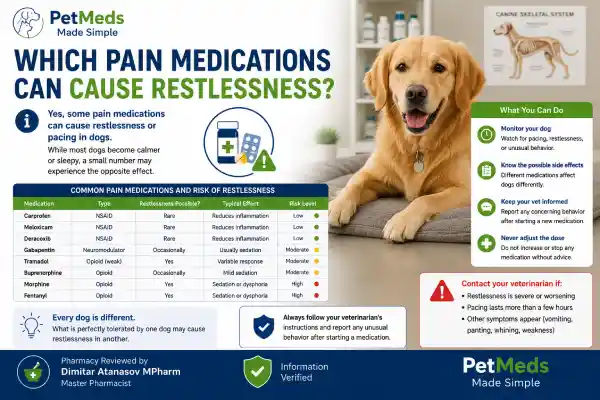
Not every pain medication affects the brain in the same way.
Some mainly reduce inflammation.
Others influence the central nervous system directly.
| Medication | Restlessness Possible? | Typical Effect |
|---|---|---|
| Carprofen | Rare | Reduces inflammation |
| Meloxicam | Rare | Reduces inflammation |
| Deracoxib | Rare | Reduces inflammation |
| Gabapentin | Occasionally | Usually sedation |
| Tramadol | Yes | Variable response |
| Morphine | Possible | Sedation or dysphoria |
| Fentanyl | Possible | Sedation or dysphoria |
| Buprenorphine | Occasionally | Mild behavioral changes |
Fortunately, most dogs tolerate these medications well.
However, individual responses vary considerably.
Could the Medication Be Causing Dysphoria?
Yes.
One of the lesser-known side effects of opioid medications is dysphoria.
Instead of feeling calm, the dog experiences a sense of discomfort or unease.
Unlike ordinary anxiety, dysphoria may cause dogs to:
- pace constantly,
- stare into space,
- appear confused,
- ignore owners,
- refuse to settle,
- vocalize,
- or seem unusually restless.
Many owners mistakenly think their dog is becoming more painful.
Instead, the medication may be temporarily affecting how the brain processes normal sensations.
Fortunately, dysphoria usually improves as the medication wears off.
Can Pain Medication Cause Anxiety?
Yes although this is relatively uncommon.
Some medications temporarily affect:
- balance,
- coordination,
- awareness,
- hearing,
- or vision.
Dogs may respond by becoming anxious simply because they feel different.
They may:
- follow family members,
- refuse to remain alone,
- pace from room to room,
- seek constant reassurance,
- or appear unusually clingy.
If anxiety appears together with pacing, you may also benefit from reading our guide Can Pain Medication Cause Anxiety in Dogs?, where we discuss how behavioral changes sometimes occur during treatment.
Could the Medication Be Wearing Off Too Soon?
Sometimes the pacing follows a very predictable pattern.
For example:
| Timeline | What It May Mean |
|---|---|
| Medication given | Dog relaxes |
| 4–8 hours later | Pain gradually returns |
| Dog begins pacing | Medication effect decreasing |
| Next dose given | Dog settles again |
This pattern often suggests that the medication is no longer providing sufficient pain control throughout the dosing interval.
It does not necessarily mean the medication has stopped working completely.
Our article Can Dogs Build Tolerance to Pain Medication? explains why worsening pain is often caused by disease progression rather than true medication tolerance.
Could the Underlying Condition Be Getting Worse?
Absolutely.
Many painful diseases continue progressing despite treatment.
These include:
- Osteoarthritis
- Hip dysplasia
- Elbow dysplasia
- Intervertebral disc disease (IVDD)
- Cancer
- Chronic neurological disease
As these conditions worsen, dogs may become increasingly restless because the medication is no longer sufficient for the amount of pain they are experiencing.
Owners frequently notice pacing together with:
- slower walks,
- difficulty climbing stairs,
- reluctance to jump,
- increased limping,
- decreased activity.
If your dog has become progressively less comfortable over several weeks, our article Warning Signs Your Dog Needs Stronger Pain Medication explains when treatment adjustments may be necessary instead of simply waiting for improvement.
Can Surgery Cause Temporary Pacing?
Yes.
Dogs recovering from surgery may pace for several reasons.
Possible causes include:
- residual anesthesia,
- temporary confusion,
- postoperative discomfort,
- unfamiliar surroundings,
- opioid medications,
- bladder fullness,
- stress from hospitalization.
In most dogs, this behavior gradually improves during the first 12–24 hours.
However, persistent pacing accompanied by severe pain, excessive panting, bleeding, collapse, or difficulty breathing should always be evaluated immediately.
Could Gastrointestinal Discomfort Cause Pacing?
Yes.
One of the most overlooked reasons why your dog is pacing after pain medication is gastrointestinal discomfort rather than the medication itself.
Some pain medications—particularly NSAIDs—may irritate the stomach, especially when taken for long periods or on an empty stomach.
Instead of showing obvious signs like vomiting, some dogs simply become restless because they cannot get comfortable.
Common signs include:
- Pacing around the house
- Constant position changes
- Lip licking
- Excessive swallowing
- Drooling
- Refusing food
- Stretching repeatedly
- Looking at the abdomen
If your dog develops vomiting, black stools, or abdominal pain, contact your veterinarian immediately. These may indicate a more serious complication rather than a mild medication side effect.
If you’re concerned about digestive complications, our guide Can Pain Medication Cause Stomach Bleeding in Dogs? explains which warning signs should never be ignored.
Could Urinary Problems Make a Dog Pace?

Absolutely.
Some owners focus entirely on the medication and overlook another common cause of pacing—an overfull bladder or urinary discomfort.
Dogs recovering from surgery may:
- Need to urinate but feel reluctant because movement is painful.
- Experience temporary urinary retention after anesthesia.
- Drink more water than usual.
- Develop urinary discomfort unrelated to the medication.
These dogs often:
- Walk to the door repeatedly.
- Circle the house.
- Squat frequently without producing urine.
- Pace after lying down for only a few minutes.
If your dog cannot urinate, strains continuously, or cries while trying to urinate, this should be treated as an emergency.
Can Pain Medication Cause Confusion?
Yes.
Although uncommon, certain pain medications can temporarily affect the central nervous system.
Older dogs are particularly sensitive because age-related brain changes make them less adaptable to medications.
A confused dog may:
- Pace without an obvious destination.
- Wander into unusual areas of the house.
- Become trapped behind furniture.
- Stare at walls.
- Forget familiar routines.
- Appear disoriented.
Unlike pain-related pacing, confusion often occurs alongside unusual behavior rather than obvious signs of discomfort.
Could the Pacing Be a Medication Interaction?
Sometimes.
Many dogs receiving pain medication are also prescribed additional medications after surgery or during chronic disease management.
Examples include:
- Antibiotics
- Sedatives
- Anti-anxiety medications
- Anti-nausea medications
- Corticosteroids
- Joint supplements
Although most combinations are safe, interactions may occasionally increase the risk of:
- Restlessness
- Excessive sedation
- Confusion
- Behavioral changes
- Weakness
Always tell your veterinarian about every medication and supplement your dog receives, including over-the-counter products.
Does Age Affect the Risk of Pacing?
Yes.
Senior dogs are generally more likely to develop behavioral changes after medication because:
- Liver metabolism slows with age.
- Kidney function may decline.
- Brain sensitivity increases.
- Multiple diseases often occur together.
For these reasons, older dogs sometimes require lower doses or closer monitoring than younger patients.
Is Pacing More Common After Surgery?

Yes.
Many owners first notice pacing after their dog returns home from surgery.
Several factors may contribute simultaneously:
| Possible Cause | Common After Surgery? |
|---|---|
| Residual anesthesia | ✔ |
| Pain | ✔ |
| Opioid medications | ✔ |
| Stress | ✔ |
| Dysphoria | ✔ |
| Bladder discomfort | ✔ |
| Hunger or thirst | ✔ |
Fortunately, mild pacing usually improves during the first day of recovery.
If it becomes progressively worse rather than better, your veterinarian should reassess your dog.
Home Checklist: What Should Owners Watch?
Before contacting your veterinarian, observe your dog carefully.
| Observation | Monitor |
|---|---|
| Continuous pacing | ✔ |
| Panting | ✔ |
| Crying | ✔ |
| Appetite | ✔ |
| Drinking water | ✔ |
| Urination | ✔ |
| Vomiting | ✔ |
| Ability to lie down | ✔ |
| Breathing | ✔ |
| Medication timing | ✔ |
Writing these observations down often helps your veterinarian identify patterns much more quickly.
What Should You Do If Your Dog Is Pacing?
If your dog begins pacing after pain medication:
Continue monitoring if:
- Your dog remains alert.
- Pacing gradually improves.
- Appetite remains normal.
- Breathing is normal.
- The behavior lasts only a short time.
Contact your veterinarian if:
- Pacing continues for several hours.
- Your dog appears painful.
- Your dog refuses food.
- Restlessness becomes worse.
- New neurological signs appear.
- The medication no longer seems effective.
Never give extra doses or human pain medication without veterinary approval.
If you’re wondering whether the medication itself is no longer providing enough relief, our article Can Dogs Build Tolerance to Pain Medication? explains how veterinarians distinguish true tolerance from worsening disease.
Likewise, if your dog continues to limp or struggle with mobility, Why Is My Dog Still Limping After Medication? discusses why persistent limping often requires further evaluation rather than simply increasing the dose.
Emergency Warning Signs
Seek emergency veterinary care immediately if your dog develops:
- Collapse
- Difficulty breathing
- Seizures
- Vomiting blood
- Black or tarry stools
- Severe weakness
- Sudden inability to walk
- Continuous crying despite medication
- Suspected medication overdose
- Swollen abdomen or repeated unsuccessful attempts to urinate
These symptoms suggest a medical emergency rather than a routine medication side effect.
Veterinarian Takeaway
Most cases of pacing after pain medication are not caused by true medication intolerance. More commonly, dogs pace because they remain uncomfortable, are experiencing temporary side effects, are recovering from surgery, or have another underlying medical problem. The timing of the pacing, accompanying symptoms, and the specific medication being used all help veterinarians determine the most likely cause. Never increase the dose or stop a prescribed pain medication without first consulting your veterinarian.
Bottom Line
Why is my dog pacing after pain medication? The answer depends on the individual dog and the medication involved.
Some dogs pace because they are still painful. Others experience temporary restlessness, dysphoria, anxiety, or confusion as a medication side effect. In many cases, the behavior improves as the medication wears off or the treatment plan is adjusted.
The safest approach is to monitor your dog’s behavior closely, keep a record of when the pacing occurs, and contact your veterinarian if the behavior persists, worsens, or is accompanied by other concerning signs. Early evaluation often leads to quicker pain relief and a more comfortable recovery.
Frequently Asked Questions
Why is my dog pacing after pain medication?
The most common causes are ongoing pain, temporary medication side effects, dysphoria, anxiety, postoperative recovery, or gastrointestinal discomfort.
Is pacing after surgery normal?
Mild pacing may occur during recovery from anesthesia or while pain medications are taking effect. Persistent or worsening pacing should be evaluated.
Can tramadol make dogs restless?
Yes. Some dogs experience agitation, pacing, or dysphoria instead of sedation.
Can gabapentin cause pacing?
Rarely. Although gabapentin usually causes sleepiness, some dogs experience paradoxical excitement or restlessness.
Should I give another dose if my dog is pacing?
No. Never increase or repeat a dose without veterinary advice.
Can pain alone cause pacing?
Yes. Dogs that remain painful often pace because they cannot become comfortable.
How long should pacing last?
Temporary pacing may resolve within a few hours. Persistent pacing warrants veterinary evaluation.
When is pacing an emergency?
Seek emergency care if pacing occurs alongside collapse, breathing difficulty, seizures, vomiting blood, black stools, or severe weakness.
Can older dogs pace more after medication?
Yes. Senior dogs are often more sensitive to medication effects and may require closer monitoring.
Should I stop the medication?
No. Unless your veterinarian instructs you to do so, continue the medication as prescribed and contact the clinic for advice if you’re concerned.
Sources
- Plumb’s Veterinary Drug Handbook
- Merck Veterinary Manual
- AAHA Pain Management Guidelines for Dogs and Cats
- WSAVA Global Pain Council Guidelines
- Veterinary Pharmacology and Therapeutics
- Small Animal Clinical Pharmacology
- JAVMA
- Frontiers in Veterinary Science
- Veterinary Anaesthesia and Analgesia
- VIN (Veterinary Information Network)
Medical Review Statement
This article was pharmacy-reviewed by Dimitar Georgiev Atanasov, MPharm, and veterinary-reviewed by Dr. Valcho Georgiev Valchev, DVM. It is intended for educational purposes only and should not replace individualized veterinary diagnosis, treatment, or medical advice.
Important Medical Disclaimer
The information provided on PetMedsMadeSimple.com is for educational purposes only and is not intended to diagnose, treat, cure, or prevent any disease. Always consult your veterinarian before starting, stopping, or changing any medication or supplement. Never adjust your dog’s medication dosage without professional guidance.
Image Disclosure
Some illustrations on PetMedsMadeSimple.com may be created or enhanced using artificial intelligence (AI) to support educational content. All medical information, medication safety guidance, and veterinary recommendations in this article are independently researched, pharmacy-reviewed by Dimitar Georgiev Atanasov, MPharm, and veterinary-reviewed by Dr. Valcho Georgiev Valchev, DVM. Images are intended for educational illustration only and should not be used as a substitute for professional veterinary examination or diagnosis.