Quick Answer
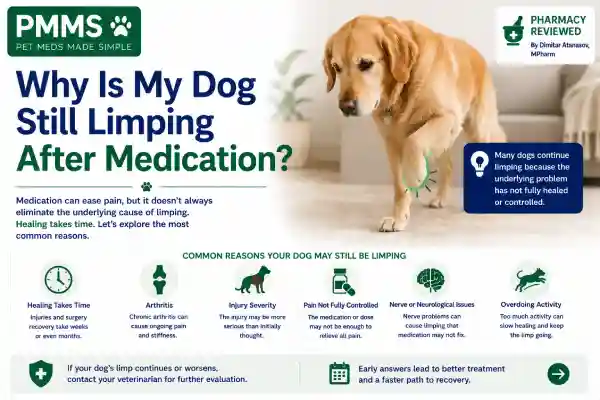
Why is my dog still limping after medication? In many cases, medication reduces pain and inflammation but does not immediately eliminate the underlying cause of limping. Dogs may continue limping because healing takes time, the condition is more severe than expected, the medication is not fully controlling pain, or another orthopedic or neurological problem is present.
Why is my dog still limping after medication?
Dogs may continue limping after medication because the underlying injury or disease has not fully healed. Pain medications help manage symptoms but do not always correct the root cause. Persistent limping may indicate ongoing pain, arthritis, ligament injuries, joint disease, nerve problems, or the need for treatment adjustments.
When Owners Commonly Ask This
This is one of the most frustrating situations for dog owners.
The typical scenario looks like this:
- The veterinarian prescribes medication.
- The dog starts treatment.
- Pain seems slightly improved.
- The limp remains.
Naturally, owners begin wondering:
“Why is my dog still limping after medication?”
The answer often depends on the reason the dog was limping in the first place.
Why Is My Dog Still Limping After Medication?
Does Medication Always Stop Limping?
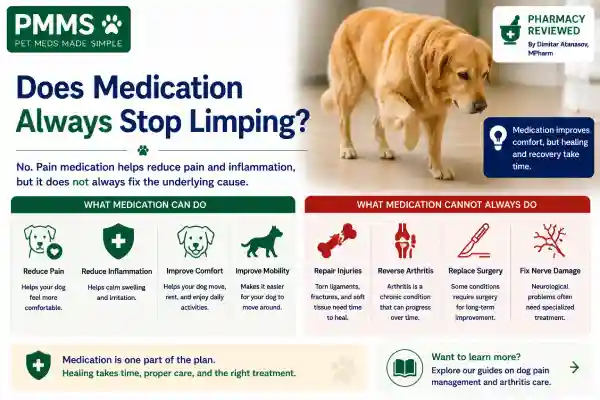
No.
This is one of the biggest misconceptions owners have.
Pain medication is designed to:
- Reduce pain
- Reduce inflammation
- Improve comfort
It does not automatically:
- Repair torn ligaments
- Reverse arthritis
- Heal fractures
- Correct neurological disease
What Medication Can and Cannot Do
| Medication Can Help | Medication Cannot Always Do |
|---|---|
| Reduce pain | Repair damaged joints |
| Reduce inflammation | Reverse arthritis |
| Improve comfort | Heal severe injuries instantly |
| Improve mobility | Correct structural problems |
Could Healing Simply Take More Time?
Very often.
Many injuries require days or weeks before noticeable improvement occurs.
Examples
- Muscle strains
- Soft tissue injuries
- Minor sprains
- Surgical recovery
Typical Recovery Timeline
| Condition | Possible Recovery Time |
|---|---|
| Mild strain | Days to weeks |
| Sprain | Several weeks |
| Surgery recovery | Weeks to months |
| Arthritis | Long-term management |
Many owners expect improvement within 24–48 hours when healing often requires much longer.
Could My Dog Still Be in Pain?
Absolutely.
One of the most common explanations is that pain remains present despite medication.
Signs Pain May Still Be Present
- Limping
- Reluctance to walk
- Difficulty standing
- Slower movement
- Crying
- Panting
Related reading:
Why Is My Dog Crying Even After Pain Medication?
Why Is My Dog Panting After Pain Medication?
Why Does Pain Medication Stop Working?
Could the Medication Be Helping More Than You Realize?
Sometimes.
Owners often focus on the remaining limp and overlook improvements.
Examples
Before medication:
- Refused to walk
- Constant limping
- Crying
After medication:
- Walking farther
- More active
- Better appetite
Even though the limp remains, meaningful improvement may have occurred.
Could Arthritis Be the Cause?
Very commonly.
Arthritis is one of the leading causes of persistent limping in dogs.
Why Arthritis Causes Ongoing Limping
Arthritis is a chronic condition.
Pain medications help manage symptoms but do not cure the disease.
Common Signs
- Stiffness
- Slow rising
- Limping after rest
- Reduced activity
Related reading:
Best Pain Medication for Dogs with Arthritis
Safest Pain Medication for Dogs
Can Dogs Take Pain Medication Long-Term?
Could the Injury Be More Serious Than Expected?
Yes.
Sometimes initial symptoms underestimate the severity of the problem.
Examples
- Torn cruciate ligament
- Hip dysplasia
- Severe arthritis
- Joint instability
- Fractures
These conditions may continue causing limping despite medication.
Could My Dog Be Overdoing Activity?
Very often.
Many dogs begin feeling slightly better and immediately become more active.
Unfortunately, this can slow recovery.
Common Examples
- Running too soon
- Jumping on furniture
- Playing roughly
- Climbing stairs excessively
Medication can sometimes mask pain enough for dogs to worsen an injury.
Could a Nerve Problem Cause Persistent Limping?
Yes.
Not every limp originates from joints or muscles.
Neurological Causes
- Intervertebral disc disease (IVDD)
- Nerve injuries
- Spinal disease
- Degenerative neurological conditions
These cases often require additional evaluation.
How Veterinarians Evaluate Persistent Limping
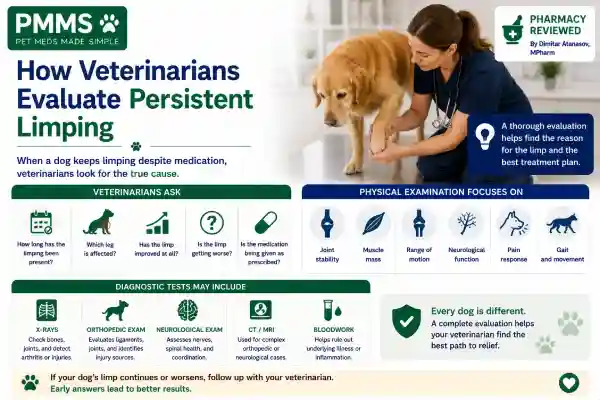
When a dog continues limping despite medication, veterinarians look beyond the medication itself.
The goal is identifying the true cause of the ongoing problem.
Common Questions
- How long has the limping been present?
- Which leg is affected?
- Has the limp improved at all?
- Is the limp getting worse?
- Is the dog receiving medication as prescribed?
These answers help guide the next steps.
Physical Examination
Veterinarians often evaluate:
- Joint stability
- Muscle mass
- Range of motion
- Neurological function
- Pain response
- Gait abnormalities
Diagnostic Testing
| Test | Purpose |
|---|---|
| X-rays | Evaluate bones and joints |
| Orthopedic exam | Assess ligament and joint injuries |
| Neurological exam | Evaluate nerve function |
| CT/MRI | Advanced cases |
| Bloodwork | Rule out underlying disease |
Persistent limping often requires further investigation rather than simply increasing medication.
Could the Medication Dose Be Too Low?
Sometimes.
Not every dog responds the same way to treatment.
Factors Affecting Response
- Body weight
- Severity of pain
- Type of injury
- Individual sensitivity
- Underlying disease
Possible Signs Pain Control Is Inadequate
- Continued limping
- Reduced activity
- Panting
- Reluctance to walk
- Crying or vocalization
Related reading:
Why Does Pain Medication Stop Working?
Why Is My Dog Crying Even After Pain Medication?
Could Weakness Be Mistaken for Limping?
Absolutely.
Owners sometimes describe weakness as limping.
Medication-Related Weakness May Look Like
- Wobbliness
- Slow walking
- Difficulty rising
- Dragging feet
- Unsteady gait
Medications Commonly Associated With Weakness
- Gabapentin
- Tramadol
- Combination therapy
Related reading:
Why Is My Dog Weak After Pain Medication?
Can Dogs Take Pain Medication Long-Term?
Could My Dog Need a Different Medication?
Sometimes.
Not every medication works equally well for every condition.
Examples
Arthritis may respond differently than:
- Ligament injuries
- Post-surgical pain
- Neurological disease
- Chronic joint disease
Veterinarians occasionally modify treatment plans if progress is insufficient.
Could Weight Affect Recovery?
Yes.
Excess body weight places additional stress on:
- Hips
- Knees
- Elbows
- Spine
Why Weight Matters
Even a small amount of excess weight may worsen:
- Arthritis pain
- Joint inflammation
- Limping severity
Weight management is often an important part of long-term treatment success.
Could Arthritis Continue Progressing Despite Medication?
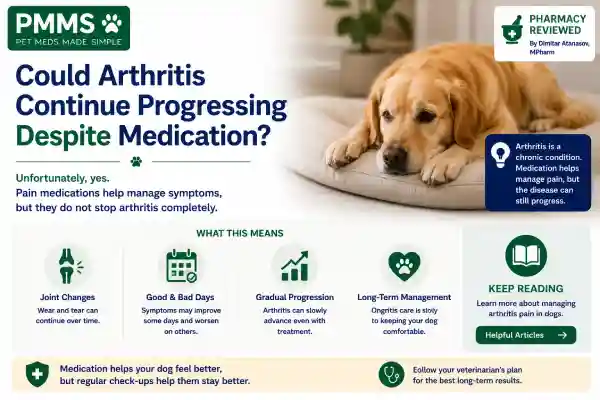
Unfortunately, yes.
Pain medications help manage symptoms.
They do not stop arthritis completely.
Common Arthritis Pattern
- Good days
- Bad days
- Temporary improvement
- Gradual progression over time
This is one reason regular veterinary monitoring is important.
When Should Owners Contact Their Veterinarian?
Owners should contact their veterinarian if:
- Limping persists beyond expectations
- Symptoms worsen
- New symptoms develop
- The dog refuses to bear weight
- Pain appears uncontrolled
Early reassessment often prevents longer-term problems.
When Does Limping Become an Emergency?
Many limps are not emergencies.
However, certain situations require immediate veterinary care.
Emergency Warning Signs
- Sudden inability to stand
- Complete non-weight-bearing lameness
- Severe pain
- Visible deformity
- Collapse
- Paralysis
- Dragging limbs
Emergency Symptoms Table
| Symptom | Emergency? |
|---|---|
| Mild limp | Monitor |
| Limp lasting several days | Contact Vet |
| Worsening limp | Contact Vet |
| Refusing to bear weight | Yes |
| Severe pain | Yes |
| Paralysis | Yes |
| Collapse | Yes |
| Visible fracture | Yes |
Related Symptoms Owners Often Search For
Owners searching Why Is My Dog Still Limping After Medication? frequently search for other pain-management concerns.
Persistent Pain
Related reading:
Why Is My Dog Crying Even After Pain Medication?
Why Does Pain Medication Stop Working?
Can Dogs Take Pain Medication Long-Term?
Weakness and Mobility Problems
Related articles:
Why Is My Dog Weak After Pain Medication?
Can Pain Medication Cause Aggression in Dogs?
Breathing and Recovery Concerns
Owners also search:
Why Is My Dog Panting After Pain Medication?
Medication Emergencies
Related reading:
What Happens If Dogs Overdose on Pain Medication?
Can Dogs Take Ibuprofen Accidentally?
Arthritis Management
Many owners continue with:
Best Pain Medication for Dogs with Arthritis
Safest Pain Medication for Dogs
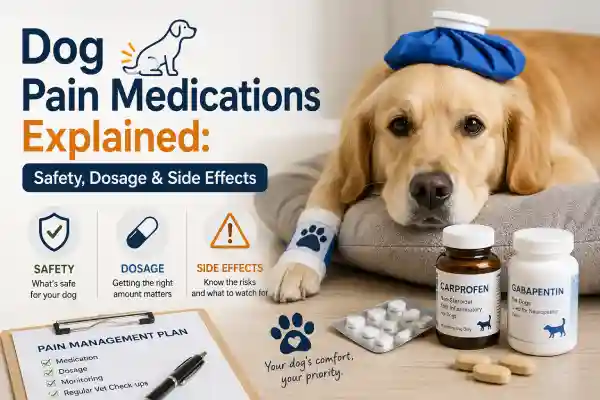
Dog Pain Medications Explained: Safety, Dosage & Side Effects
Bottom Line
Why is my dog still limping after medication? Pain medications help reduce discomfort, but they do not always eliminate the underlying cause of limping. Healing may take time, pain may still be present, arthritis may be progressing, or the condition may require additional treatment. Persistent limping should never be ignored, especially if symptoms worsen or fail to improve.
Veterinarian Takeaway
One of the most common misunderstandings among dog owners is expecting medication to completely eliminate limping within a few days. While pain medications often improve comfort, ongoing limping may indicate continued pain, arthritis, orthopedic injury, neurological disease, or incomplete healing. Veterinary reassessment is appropriate whenever progress is slower than expected.
Frequently Asked Questions – Why Is My Dog Still Limping After Medication?
Why is my dog still limping after taking pain medication?
The medication may be reducing pain while the underlying injury or disease continues to heal.
Should pain medication completely stop limping?
Not always. Pain relief and complete recovery are not necessarily the same thing.
Can arthritis cause limping even with medication?
Yes. Arthritis is a chronic condition that often requires ongoing management.
How long should limping last after starting medication?
It depends on the underlying condition. Some injuries require weeks or months to heal.
Could the medication dose be too low?
Possibly. Your veterinarian may reassess treatment if improvement is limited.
Can weakness look like limping?
Yes. Medication-related weakness can sometimes be mistaken for lameness.
Should I increase the medication myself?
No. Never adjust medication without veterinary guidance.
When should I contact my veterinarian?
If limping persists, worsens, or fails to improve as expected.
When is limping an emergency?
If your dog refuses to bear weight, experiences paralysis, collapses, or shows severe pain.
Could surgery recovery cause persistent limping?
Yes. Recovery after surgery may take weeks or even months depending on the procedure.
Reviewed By
Pharmacy Reviewed By
Dimitar Atanasov, MPharm
Master Pharmacist | Medication Safety Educator
Editorial Policy
At Pet Meds Made Simple, we are committed to providing accurate, evidence-based information about pet medications, veterinary treatments, medication safety, and common health concerns affecting dogs and cats.
For more information, see our Editorial Policy:
Sources
- Plumb’s Veterinary Drug Handbook
- Merck Veterinary Manual
- American Animal Hospital Association (AAHA)
- American Veterinary Medical Association (AVMA)
- Veterinary Pharmacology and Therapeutics
- Small Animal Clinical Pharmacology
- Veterinary Information Network (VIN)
- Journal of the American Veterinary Medical Association (JAVMA)
- Frontiers in Veterinary Science
- Veterinary Anaesthesia and Analgesia
Medical Review Statement
This article was pharmacy-reviewed by Dimitar Atanasov, MPharm, Master Pharmacist, using current veterinary pharmacology references, canine pain-management guidelines, orthopedic medicine references, and published veterinary literature available at the time of review.
Image created with AI – Why Is My Dog Still Limping After Medication?