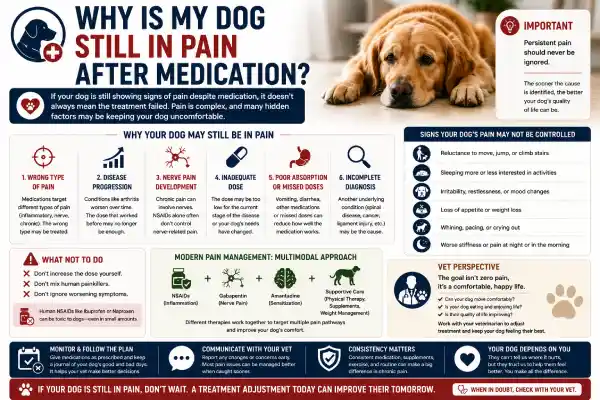
Why is my dog still in pain after medication? If your dog continues showing signs of discomfort despite treatment, it does not always mean the medication failed. In many cases, persistent pain happens because the underlying disease has progressed, the type of pain has changed, or the treatment plan no longer matches the condition.
Many owners become frustrated when they do everything correctly—give the medication on time, follow veterinary instructions, and still notice limping, stiffness, whining, reduced activity, or behavioral changes. This situation is actually very common in veterinary medicine, especially in dogs with chronic conditions like arthritis, spinal disease, or long-term orthopedic injuries.
The important thing to understand is this:
👉 Pain changes over time.
👉 Treatment sometimes must change too.
Quick Answer
Dogs may still be in pain after medication because the dose is inadequate, the wrong type of medication is being used, the disease has progressed, or the pain has evolved into chronic or nerve-related pain. Persistent pain should always be reassessed by a veterinarian.
The Biggest Misunderstanding About Pain Medication
One of the biggest misconceptions among dog owners is the belief that pain medication should completely eliminate all discomfort.
In reality, veterinary pain management often focuses on:
- improving mobility
- reducing suffering
- slowing progression
- improving quality of life
rather than creating a completely pain-free state.
This is especially true in chronic diseases such as osteoarthritis.
A dog may still have some discomfort while:
- walking better
- eating normally
- sleeping comfortably
- engaging with family again
That is still considered successful pain management.
Why Is My Dog Still in Pain After Medication?
Why Dogs Hide Pain Better Than Humans
Dogs naturally hide weakness and discomfort.
This behavior comes from survival instincts. In the wild, animals showing pain become vulnerable.
Because of this, many dogs with chronic pain:
- adapt their movement
- reduce activity quietly
- stop jumping gradually
- sleep more often
Owners often miss the early warning signs because they appear slowly over time.
This is why articles like:
- Signs Your Dog Needs Stronger Pain Medication
- Natural Pain Relief for Dogs: What Actually Works?
- Safest Pain Medication for Dogs (Vet Comparison Guide)
become extremely important for long-term monitoring.
Understanding the Different Types of Pain in Dogs
Not all pain behaves the same way.
This is one of the biggest reasons dogs may continue hurting despite medication.
Some medications work well for inflammation but poorly for nerve pain. Others help acute pain but not chronic sensitization.
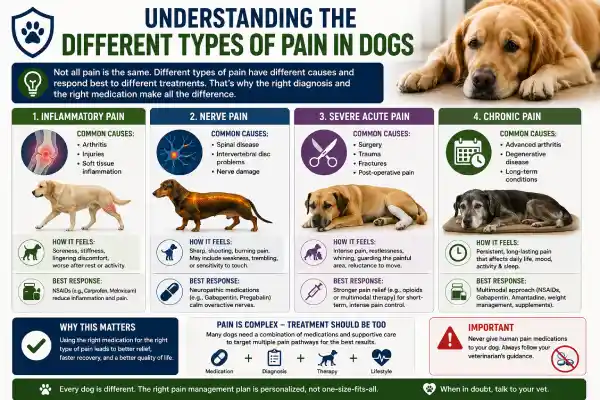
Main Types of Pain in Dogs
| Pain Type | Common Causes | Often Responds Best To |
|---|---|---|
| Inflammatory pain | arthritis, injury | NSAIDs |
| Nerve pain | spinal disease, disc issues | gabapentin |
| Severe acute pain | surgery, trauma | opioids |
| Chronic pain | advanced arthritis | multimodal therapy |
Why This Matters So Much
Imagine a dog with spinal nerve compression.
If the dog receives only an anti-inflammatory medication like Carprofen, inflammation may improve slightly—but the nerve pain can continue.
That is why medications like Gabapentin are often added.
This connects naturally with:
- Gabapentin for Dogs: Uses, Dosage & Side Effects
- How Fast Does Gabapentin Work in Dogs?
- Can Gabapentin Cause Weakness in Dogs?
because nerve pain behaves very differently from inflammatory pain.Why Is My Dog Still in Pain After Medication?
Reason #1: The Medication Is Treating the Wrong Pain Pathway
This is probably the most common hidden issue in chronic pain management.
Many owners think:
👉 “Pain is pain.”
But veterinary medicine recognizes multiple pain pathways.
For example:
- NSAIDs mainly target inflammation
- gabapentin targets nerve pain
- amantadine helps chronic sensitization
If the wrong pathway is targeted, the dog may only improve partially.
Why Chronic Pain Changes Over Time
Pain evolves biologically.
At the beginning of a condition like arthritis:
- inflammation is dominant
- swelling causes discomfort
- NSAIDs often work extremely well
But later:
- nerves become sensitized
- muscles weaken
- posture changes
- joints deteriorate further
At that stage, pain becomes more complex.
This is why some dogs initially respond well to medication and later seem to “stop improving.”
Central Sensitization: The Hidden Problem Many Owners Never Hear About
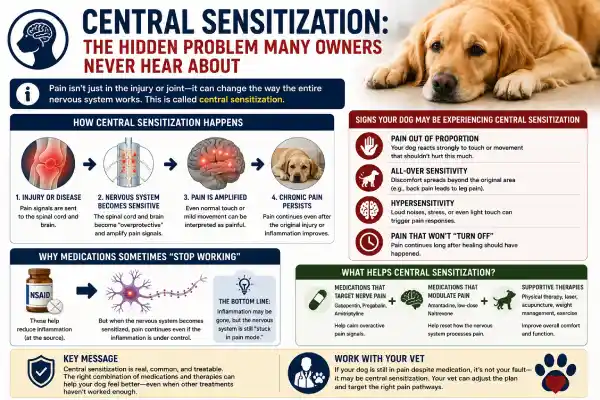
One of the most important concepts in chronic pain medicine is:
Central Sensitization
This happens when the nervous system becomes hypersensitive after long-term pain exposure.
The result:
- pain signals become amplified
- mild movement becomes painful
- the body “overreacts” to discomfort
At this stage:
👉 traditional anti-inflammatory medications alone may no longer be enough.
This is exactly why articles like:
- Amantadine for Dogs: A Hidden Pain Management Tool
- What Is the Safest NSAID for Dogs Long-Term?
- Best Pain Medication for Dogs with Arthritis
are critical for owners managing advanced disease.
Reason #2: The Disease Is Progressing
Pain medication does not stop aging or degeneration.
This is extremely important to understand.
For example, with osteoarthritis:
- cartilage continues wearing down
- inflammation continues developing
- joint mechanics worsen over time
Medication can reduce symptoms, but it cannot completely reverse structural disease.
Early Arthritis vs Advanced Arthritis
| Early Stage | Advanced Stage |
|---|---|
| occasional stiffness | daily pain |
| mild limping | difficulty standing |
| good muscle mass | muscle wasting |
| responds well to NSAIDs | often requires combination therapy |
The Hidden Trap: “Maybe My Dog Is Just Getting Older”
This is one of the most dangerous assumptions owners make.
Many symptoms blamed on “aging” are actually signs of uncontrolled pain.
Examples include:
- avoiding stairs
- slower walking
- hesitation before jumping
- sleeping more
- avoiding slippery floors
These are often pain behaviors—not simply age.
Reason #3: NSAIDs Sometimes Stop Working Over Time
Many owners notice this pattern:
- medication works well initially
- improvement plateaus
- symptoms slowly return
This does NOT necessarily mean the medication is “bad.”
Instead, it often means:
👉 the pain evolved.
NSAIDs such as:
- Carprofen
- Meloxicam
primarily control inflammation.
But chronic pain eventually develops neurological components that inflammation control alone cannot fully address.Why Is My Dog Still in Pain After Medication?
Modern Veterinary Medicine Uses Multimodal Pain Management
This is one of the biggest advances in veterinary medicine.
Instead of relying on one drug, veterinarians now combine therapies.
Common Multimodal Pain Strategies
| Combination | Why It Helps |
|---|---|
| NSAID + Gabapentin | inflammation + nerve pain |
| NSAID + Amantadine | reduces sensitization |
| Triple therapy | advanced chronic pain |
This is why internal linking between articles matters so much on your site.
A reader searching:
👉 “why is my dog still limping after medication”
naturally progresses toward:
- Gabapentin for Dogs
- Amantadine for Dogs
- Signs Your Dog Needs Stronger Pain Medication
- Safest Pain Medication for Dogs
This creates topical authority for Google AND keeps users engaged longer.
Reason #4: The Medication Dose Is No Longer Adequate
As disease progresses, previous doses may become insufficient.
A dose that controlled pain six months ago may no longer work today.
This commonly occurs with:
- arthritis
- hip dysplasia
- spinal disease
However:
❌ owners should NEVER increase doses themselves.
Especially not with NSAIDs.
Why Increasing the Dose Yourself Is Dangerous
Higher doses increase risk of:
- stomach ulcers
- vomiting
- kidney stress
- liver complications
This becomes even more important after reading:
because human painkillers are especially dangerous in dogs.
Reason #5: Nerve Pain Is Being Missed
Nerve pain behaves differently from inflammatory pain.
Dogs with nerve pain may show:
- trembling
- sudden yelping
- weakness
- sensitivity to touch
- paw dragging
This type of pain often responds poorly to NSAIDs alone.
Signs Your Dog May Have Nerve Pain
| Possible Sign | Why It Matters |
|---|---|
| sudden crying out | nerve irritation |
| weakness | neurological involvement |
| shaking | neuropathic discomfort |
| pain despite NSAIDs | inflammation may not be main issue |
The Emotional Side of Chronic Pain
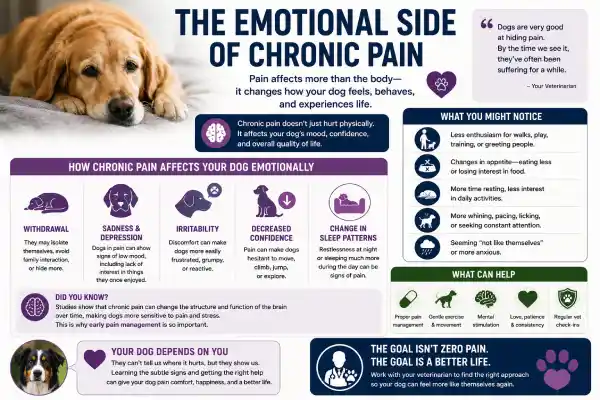
Pain affects more than mobility.
Dogs in chronic discomfort often become:
- quieter
- withdrawn
- less social
- less playful
Owners often describe this as:
👉 “my dog just isn’t himself anymore.”
That observation is medically important.
Behavioral changes are often one of the earliest indicators of chronic suffering.
Appetite Changes Are a Major Warning Sign
Many dogs with worsening pain begin eating less.
This happens because:
- pain increases stress hormones
- discomfort reduces appetite
- movement to food bowls may hurt
This connects directly with:
which naturally fits inside this pain cluster.
What If the Diagnosis Was Incomplete?
Sometimes persistent pain means the original diagnosis was not fully correct.
Examples include:
- spinal disease mistaken for arthritis
- cancer-related pain
- neurological disease
- ligament injury
This is why worsening pain should never simply be ignored.
Why Quality of Life Matters More Than Perfect Mobility
Veterinarians evaluate more than limping.
They assess:
- sleep quality
- appetite
- happiness
- engagement
- ability to move comfortably
The goal is not always:
👉 “perfect movement.”
The goal is:
👉 a meaningful, comfortable life.
Signs Your Dog’s Pain Is NOT Controlled
Watch carefully for:
- worsening limping
- difficulty rising
- avoiding movement
- sleeping excessively
- irritability
- nighttime pacing
- appetite decline
Signs Your Dog May Need Stronger Pain Medication
| Sign | Possible Meaning |
|---|---|
| worsening stiffness | disease progression |
| medication wears off early | inadequate control |
| reduced activity | chronic pain worsening |
| nighttime discomfort | advanced pain |
What NOT to Do
Never:
- increase medication yourself
- combine random medications
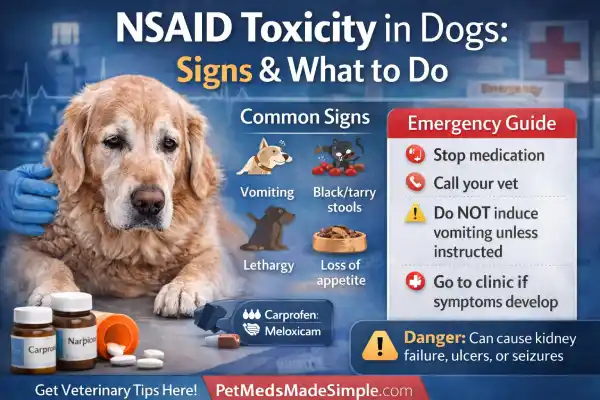
- use human NSAIDs
Especially avoid:
- Ibuprofen
- Naproxen
These can be toxic to dogs.
Vet Perspective (Critical Insight) Why Is My Dog Still in Pain After Medication?
Veterinarians do not define success as:
👉 “absolutely no pain.”
Instead, they ask:
- Can the dog move comfortably?
- Is the dog eating normally?
- Is quality of life improving?
This is a much more realistic and medically safer goal.Why Is My Dog Still in Pain After Medication?
Real-Life Example
Dog A
- mild arthritis
- responds well to carprofen
Dog B
- advanced arthritis + nerve pain
Result:
❌ same medication no longer enough
Needs:
✔ gabapentin
✔ amantadine
✔ multimodal therapy
This scenario is extremely common in older dogs.
The Future of Veterinary Pain Management
Veterinary medicine is shifting toward:
- individualized therapy
- multimodal treatment
- neurological pain control
- long-term quality of life management
This is changing how chronic pain is treated worldwide.
Conclusion
If your dog is still in pain after medication, it does not automatically mean treatment failed. Pain often evolves over time, becomes more neurologically complex, or requires a broader treatment strategy.Why Is My Dog Still in Pain After Medication?
The most important thing is recognizing persistent discomfort early and reassessing the treatment plan before quality of life declines further.
Modern veterinary medicine offers far more options than many owners realize—but chronic pain rarely responds permanently to a single medication alone.Why Is My Dog Still in Pain After Medication?
FAQ – Why Is My Dog Still in Pain After Medication?
Why is my dog still limping after pain medication?
The medication may not fully control the underlying condition, especially in advanced arthritis or nerve pain.
Can dogs build tolerance to pain medication?
Sometimes the disease progresses, making the previous dose less effective over time.
What if gabapentin is not helping my dog?
The pain may involve inflammation, structural damage, or another condition requiring combination therapy.
When should I worry about persistent pain?
If mobility worsens, appetite declines, or behavior changes significantly.
Can arthritis pain become resistant to medication?
Not resistant in the traditional sense, but chronic pain often evolves and becomes harder to control.
Sources & Scientific References
- American Animal Hospital Association (AAHA) Pain Management Guidelines
- Merck Veterinary Manual
- Plumb’s Veterinary Drug Handbook
- Veterinary Information Network (VIN)
Medical Disclaimer
This article is for educational purposes only and does not replace professional veterinary advice.
Images created with AI – Why Is My Dog Still in Pain After Medication?