Quick Answer
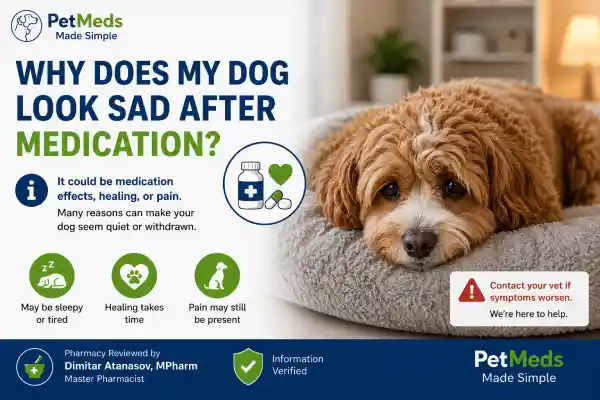
Why does my dog look sad after medication? In many cases, a dog that appears sad after taking medication is actually experiencing temporary drowsiness, mild sedation, or reduced activity rather than true depression. Pain medications, gabapentin, anxiety medications, and some antibiotics can all temporarily change a dog’s behavior. However, persistent sadness, withdrawal, loss of appetite, difficulty walking, severe lethargy, or personality changes may indicate uncontrolled pain, medication side effects, or another underlying medical problem that should be evaluated by a veterinarian.
When Owners Commonly Ask This Question
Owners usually search “Why does my dog look sad after medication?” after noticing changes such as:
- Their normally happy dog suddenly seems quiet.
- Their dog no longer greets family members.
- Their pet spends more time sleeping than usual.
- Their dog avoids playing.
- Their dog appears emotionally different after starting medication.
- Their dog seems withdrawn after surgery.
- Their dog looks depressed after pain medication.
These behavioral changes can be frightening because dogs cannot explain how they feel. Fortunately, in many cases the explanation is less alarming than owners first imagine.
Why Does My Dog Look Sad After Medication?
Is My Dog Actually Sad?
One of the first questions veterinarians ask is whether the dog is truly experiencing sadness or simply behaving differently because of medication.
Dogs cannot describe emotions the way humans do, so owners naturally interpret changes through human behavior.
A dog that:
- sleeps more,
- moves more slowly,
- avoids excitement,
- rests quietly,
- or seems less enthusiastic,
may simply be experiencing the expected effects of treatment.
This is especially common during the first few days after starting medications such as gabapentin or certain pain relievers.
Our guide Why Does Gabapentin Cause Sedation? explains why reduced activity is often a normal effect rather than a dangerous complication.
Can Medication Change a Dog’s Mood?
Yes.
Many medications affect the central nervous system either directly or indirectly.
Some drugs intentionally reduce nervous system activity to:
- relieve pain,
- decrease anxiety,
- promote relaxation,
- improve recovery,
- reduce nerve sensitivity.
As these medications begin working, owners may notice their dog becoming quieter than usual.
This change often looks like sadness, even though the dog may simply be calmer and more comfortable.
Different medications influence behavior differently.
| Medication Type | Possible Behavioral Changes |
|---|---|
| Gabapentin | Sleepiness, reduced activity, quieter behavior |
| Opioid pain medications | Sedation, reduced interaction, slower responses |
| Anxiety medications | Calmness, temporary decreased excitement |
| NSAIDs | Usually minimal mood changes, unless pain improves or side effects occur |
| Certain antibiotics | Occasionally lethargy if gastrointestinal upset develops |
Understanding which medication your dog is taking helps determine whether these changes are expected or require veterinary attention.
Why Does My Dog Look Sad After Medication?
There is rarely a single explanation.
Instead, veterinarians usually consider several possibilities.
The most common include:
- Temporary medication sedation
- Ongoing pain despite treatment
- Recovery after surgery
- Fatigue from illness
- Medication side effects
- Reduced appetite
- Anxiety caused by hospitalization
- Underlying disease progression
Rather than assuming the medication is harmful, veterinarians evaluate the entire clinical picture.
Temporary Sedation Is Often Misinterpreted
One of the biggest misconceptions among dog owners is believing sedation equals depression.
These are not the same thing.
Sedation is an expected effect of many medications.
Dogs may appear:
- quieter,
- less playful,
- less interested in toys,
- slower to respond,
- more willing to sleep.
While owners often describe this as their dog “looking sad,” veterinarians usually recognize it as temporary central nervous system depression caused by medication.
If your dog recently started gabapentin, our article How Long Does Gabapentin Sedation Last in Dogs? explains what owners should expect during the first several days of treatment.
Could Pain Still Be Present?
Absolutely.
Ironically, some dogs appear sad because the medication is not controlling their pain well enough.
Owners sometimes assume:
“My dog is taking pain medication, so pain can’t be the problem.”
Unfortunately, this isn’t always true.
Pain medications reduce discomfort—they do not always eliminate it completely.
Dogs experiencing persistent pain may:
- avoid eye contact,
- rest more,
- stop wagging their tail,
- lose interest in favorite activities,
- isolate themselves,
- appear emotionally withdrawn.
If your dog is recovering from an injury or surgery, persistent discomfort should always remain on the list of possible explanations.
Our article Why Is My Dog Not Improving on Pain Medication? discusses how veterinarians determine whether treatment is providing adequate pain relief.
Could Recovery After Surgery Make Dogs Look Sad?

Yes.
Many owners notice emotional changes during the first several days after surgery.
Several factors contribute:
- lingering anesthesia,
- reduced mobility,
- unfamiliar hospital experience,
- postoperative discomfort,
- restricted activity,
- medication effects.
These factors often combine, making even normally energetic dogs appear unusually quiet.
Fortunately, many dogs gradually return to their normal personalities as healing progresses.
| Recovery Stage | Typical Behavior |
|---|---|
| First 24 hours | Sleepy, quiet, reduced appetite |
| Days 2–3 | Resting frequently, limited activity |
| Days 4–7 | Increasing alertness and interaction |
| Following weeks | Gradual return to normal personality |
Every dog recovers at a different pace.
Does Age Matter?
Very much.
Senior dogs often respond differently to medications than younger adults.
Older dogs:
- metabolize certain medications more slowly,
- have decreased muscle mass,
- may have arthritis,
- frequently have chronic medical conditions,
- recover more slowly from illness.
Because of these factors, senior dogs may appear quieter for longer periods after beginning treatment.
Veterinarians often recommend closer monitoring in older patients, particularly during the first week of therapy.
Could My Dog Simply Be Sleeping More?
Yes.
In fact, this is one of the most common explanations.
Pain relief allows many dogs to finally rest comfortably.
Imagine a dog that has experienced chronic arthritis pain for several weeks.
After receiving effective medication, the dog may suddenly begin sleeping much more than usual.
This does not necessarily indicate worsening health.
Instead, the body may finally have an opportunity to recover.
Owners frequently mistake this increased rest for emotional withdrawal when it may actually represent successful pain control.
Medications Most Commonly Associated With “Sad” Behavior
Although almost any medication can indirectly affect behavior if it causes discomfort or fatigue, some medications are more commonly associated with temporary changes.
| Medication | Likelihood of Temporary Quiet Behavior |
|---|---|
| Gabapentin | High |
| Tramadol | Moderate to High |
| Codeine-containing medications | Moderate |
| Trazodone | High |
| Fluoxetine (early treatment) | Mild to Moderate |
| NSAIDs | Usually Low |
| Antibiotics | Usually Low unless illness is progressing |
Behavioral changes should always be interpreted together with your dog’s overall condition rather than focusing on the medication alone.
Could My Dog Be Acting Confused Instead of Sad?
Sometimes.
Owners often describe several different behaviors using the word “sad.”
However, veterinarians distinguish between:
- sedation,
- confusion,
- disorientation,
- anxiety,
- depression,
- pain,
- weakness.
These conditions may appear similar but require very different approaches.
If your dog seems unusually disoriented rather than simply quiet, our article Why Is My Dog Acting Confused After Medication? explains the differences and discusses when confusion becomes an emergency.
Could the Medication Dose Be Too High?
Yes.
While many medications intentionally produce a calming effect, excessive sedation is never the goal.
A dose that is too high may cause your dog to appear:
- unusually withdrawn,
- difficult to wake,
- uninterested in food,
- reluctant to walk,
- less responsive to family members.
Owners often describe these dogs as looking “heartbroken” or “depressed.”
In reality, the medication may simply be affecting the central nervous system more strongly than intended.
Several factors increase the likelihood of excessive sedation:
- Small body size
- Advanced age
- Liver disease
- Kidney disease
- Multiple medications given together
- Individual sensitivity
Your veterinarian may recommend adjusting the dosage or changing medications if these signs persist beyond the expected adjustment period.
Could Multiple Medications Be Working Together?
Absolutely.
Many dogs recovering from surgery or managing chronic diseases receive more than one medication at the same time.
For example, a dog may receive:
- Gabapentin
- An NSAID
- Trazodone
- An antibiotic
- A joint supplement
Although each medication may be appropriate individually, their combined effects can sometimes produce more noticeable behavioral changes.
Veterinarians carefully evaluate the complete medication list whenever owners report that their dog seems unusually quiet.
| Medication Combination | Possible Effect |
|---|---|
| Gabapentin + Trazodone | Increased drowsiness |
| Gabapentin + Opioids | Greater sedation |
| Pain medication + Anxiety medication | Reduced activity and slower responses |
| Multiple sedating medications | Dogs may appear unusually quiet for several days |
Owners should never discontinue one medication simply because another was recently added.
Instead, discuss any concerns with your veterinarian before making changes.
Could Loss of Appetite Make My Dog Look Sad?
Very often.
Dogs that are not eating well frequently appear:
- less energetic,
- quieter,
- reluctant to play,
- less interested in family interaction.
The emotional appearance owners notice may actually be the result of reduced calorie intake rather than a direct medication effect.
Several medications can temporarily reduce appetite, especially during the first few days of treatment.
Likewise, pain itself often decreases appetite.
Our article Can Pain Medication Affect Appetite? explains how pain medications may influence eating habits and when appetite loss should become a concern.
Could My Dog Be Feeling Nauseous?
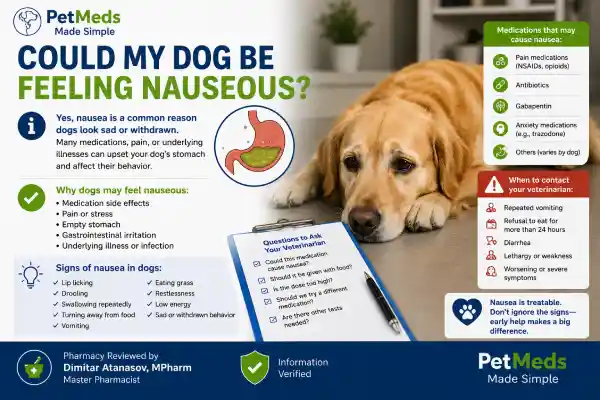
Yes.
Some medications may irritate the stomach or cause mild nausea.
A nauseous dog often appears:
- quiet,
- withdrawn,
- uninterested in treats,
- reluctant to move,
- less interactive.
Owners frequently interpret these behaviors as sadness.
Additional signs that nausea may be involved include:
- Lip licking
- Drooling
- Swallowing repeatedly
- Eating grass
- Vomiting
- Refusing food
If these signs develop after starting a new medication, your veterinarian should be informed.
Could Anxiety Make Dogs Seem Depressed?
Yes.
Not every dog that appears sad is actually sleepy.
Some dogs become anxious after:
- Surgery
- Hospitalization
- Wearing an Elizabethan collar
- Being confined
- Experiencing pain
- Changes in routine
Anxious dogs often become quieter than usual.
Instead of pacing constantly, some dogs simply withdraw from social interaction.
If anxiety rather than sedation is responsible, other signs may include:
- Panting
- Restlessness
- Trembling
- Following owners constantly
- Difficulty settling
Our article Can Pain Medication Cause Anxiety in Dogs? explains why some medications may indirectly contribute to anxious behaviors.
Could Pain Medication Be Causing Personality Changes?
Owners often ask this question because their dog “doesn’t seem like himself.”
The good news is that most medication-related personality changes are temporary.
Many dogs become quieter while:
- recovering from surgery,
- adapting to new medications,
- healing from injury,
- sleeping more because discomfort has improved.
Permanent personality changes caused solely by commonly prescribed veterinary medications are uncommon.
Our article Can Personality Changes Be Temporary? explains why most dogs gradually return to their normal behavior once treatment is adjusted or recovery progresses.
Is My Dog Weak or Simply Quiet?
This distinction is extremely important.
A quiet dog:
- walks normally,
- responds when called,
- eats,
- drinks,
- simply rests more.
A weak dog may:
- struggle to stand,
- stumble,
- collapse,
- drag the rear legs,
- tire very quickly.
Weakness is not simply another form of sadness.
If your dog appears physically weak, veterinary evaluation is recommended.
Our guide Why Is My Dog Weak After Pain Medication? discusses how owners can distinguish medication-related weakness from more serious medical problems.
Could Dehydration Affect My Dog’s Behavior?
Yes.
Dogs that become mildly dehydrated often appear:
- tired,
- quiet,
- less playful,
- less interested in food.
Dehydration may occur because:
- Pain reduces drinking.
- Nausea decreases water intake.
- Vomiting develops.
- Diarrhea occurs.
- Recovery after surgery limits activity.
Simple dehydration can significantly affect energy levels.
Veterinarians therefore assess hydration status whenever a dog appears unusually lethargic after beginning treatment.
Does the Underlying Disease Matter?
Very much.
Sometimes the medication is blamed when the underlying illness is actually progressing.
Examples include:
- Osteoarthritis worsening
- Cancer progression
- Spinal disease
- Intervertebral disc disease
- Neurological disorders
- Chronic infections
In these situations, the medication may still be working appropriately—the disease has simply become more severe.
This is one reason veterinarians recommend follow-up examinations rather than assuming medication failure.
Can Dogs Hide Pain?

Yes and remarkably well.
Dogs have evolved to mask discomfort.
As a result, obvious crying is relatively uncommon.
Instead, dogs in pain may simply become:
- quieter,
- less social,
- slower to move,
- reluctant to exercise,
- less interested in family activities.
Owners often describe these subtle changes as sadness.
In reality, these dogs may still be experiencing significant pain despite receiving medication.
Our article Why Is My Dog Crying Even After Pain Medication? explains why pain can sometimes remain uncontrolled even when treatment has already started.
Could Recovery Be Taking Longer Than Expected?
Absolutely.
Every dog heals at a different rate.
Recovery depends on factors including:
- Age
- Breed
- Type of surgery
- Overall health
- Body condition
- Severity of injury
- Existing medical conditions
Some dogs begin acting normally within two days.
Others may require several weeks before their usual playful personality fully returns.
Patience, careful monitoring, and regular communication with your veterinarian are all important during this period.
Could My Dog Be Experiencing Medication Side Effects?
Yes.
Every medication has the potential to cause side effects, although most dogs tolerate commonly prescribed veterinary medications very well.
The challenge is that many side effects resemble behaviors owners describe as “looking sad.”
For example, a dog experiencing mild medication-related lethargy may:
- Sleep longer than usual.
- Show less interest in playing.
- Walk more slowly.
- Spend more time lying down.
- Seek quiet areas of the house.
These signs do not automatically mean the medication is unsafe.
Instead, veterinarians evaluate:
- How severe the signs are.
- When they began.
- Whether they are improving.
- Whether additional symptoms are present.
Mild side effects often improve as the body adjusts during the first several days of treatment.
How Long Should Temporary Behavioral Changes Last?
This depends entirely on the medication being used.
Some drugs cause noticeable drowsiness for only a few hours.
Others may affect activity for several days while the body adapts.
Generally speaking:
| Time After Starting Medication | What Owners May Notice |
|---|---|
| First few hours | Increased sleepiness, quieter behavior |
| First 1–3 days | Reduced activity while adjusting |
| Days 3–7 | Many dogs begin returning to normal |
| After one week | Persistent behavioral changes deserve veterinary evaluation |
If your dog’s behavior continues worsening instead of improving, contact your veterinarian.
Which Dogs Are More Sensitive to Medication?
Not every dog responds the same way.
Some dogs appear almost completely unaffected.
Others become noticeably sleepy after even standard doses.
Dogs that may be more sensitive include:
- Senior dogs
- Very small breeds
- Dogs with kidney disease
- Dogs with liver disease
- Dogs receiving multiple medications
- Dogs recovering from major surgery
These patients often require closer monitoring during the first few days of treatment.
Could My Dog Simply Be Exhausted From Healing?
Absolutely.
Healing requires a tremendous amount of energy.
Following surgery or serious illness, the body directs nutrients and energy toward:
- Tissue repair
- Inflammation control
- Immune function
- Bone healing
- Muscle recovery
As a result, many dogs naturally become:
- sleepier,
- quieter,
- less interested in exercise,
- slower to engage in play.
Owners sometimes worry because their energetic dog suddenly spends most of the day resting.
In many cases, this is exactly what the body needs.
Could My Dog Be Feeling Isolated?
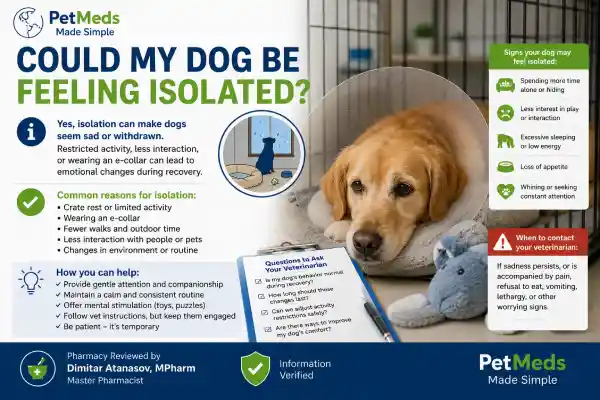
Sometimes the medication is only part of the picture.
Dogs recovering from surgery often experience several lifestyle changes simultaneously.
These may include:
- Crate rest.
- Limited walks.
- Wearing an Elizabethan collar.
- Reduced interaction with other pets.
- Fewer outdoor activities.
- Less physical exercise.
These temporary restrictions can make even healthy dogs appear less enthusiastic than usual.
Fortunately, most dogs regain their normal personalities as activity restrictions are gradually lifted.
What Behaviors Are Usually Normal?
Owners often become worried about behaviors that are actually expected during recovery.
The following signs are commonly considered normal if they are mild and gradually improving:
| Usually Expected | Why It Happens |
|---|---|
| Sleeping more | Recovery and medication effects |
| Playing less | Conserving energy |
| Reduced excitement | Mild sedation |
| Quiet behavior | Healing process |
| Wanting extra rest | Pain relief allows recovery |
| Less interest in walks | Temporary discomfort |
These behaviors should slowly improve over several days.
Which Behaviors Are NOT Normal?
Some changes deserve prompt veterinary attention.
Contact your veterinarian if your dog:
- Cannot be awakened normally.
- Refuses all food for more than 24 hours.
- Has repeated vomiting.
- Has severe diarrhea.
- Cannot stand.
- Develops difficulty breathing.
- Experiences seizures.
- Cries continuously despite medication.
- Suddenly collapses.
- Shows rapidly worsening weakness.
These signs are not typical adjustment effects and should never be ignored.
| Warning Sign | Recommended Action |
|---|---|
| Collapse | Emergency veterinary care |
| Difficulty breathing | Immediate emergency evaluation |
| Repeated vomiting | Contact veterinarian promptly |
| Seizures | Emergency care |
| Severe weakness | Veterinary examination the same day |
| Persistent refusal to eat | Veterinary advice within 24 hours |
Can Owners Help Their Dog Feel Better?
Yes.
While medications do their job internally, owners can support recovery in several simple ways.
Helpful strategies include:
- Providing a quiet place to rest.
- Keeping daily routines consistent.
- Offering fresh water at all times.
- Encouraging eating if approved by the veterinarian.
- Limiting excessive excitement.
- Monitoring behavior each day.
- Administering medications exactly as prescribed.
Many dogs recover emotionally just as quickly as they recover physically when given a calm, predictable environment.
Should I Stop the Medication If My Dog Looks Sad?
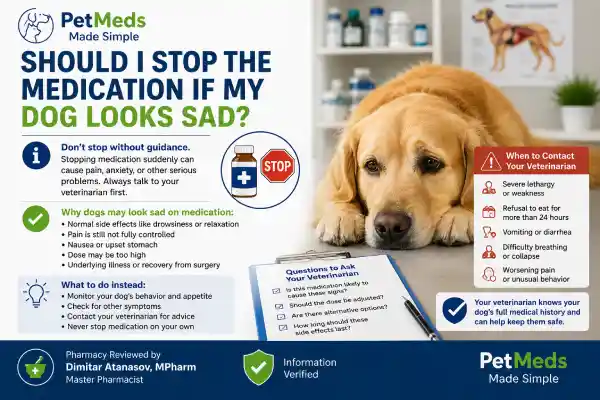
Usually no.
This is one of the most common mistakes owners make.
Stopping medication without veterinary advice can sometimes:
- Allow pain to return.
- Delay healing.
- Increase anxiety.
- Cause rebound symptoms.
- Reduce seizure control in neurological patients.
Instead, contact your veterinarian and describe exactly what you are observing.
Your veterinarian may recommend:
- Continuing the medication.
- Adjusting the dose.
- Changing the dosing schedule.
- Switching medications.
- Scheduling a recheck examination.
Never discontinue prescription medications simply because your dog appears quieter than usual.
How Can Owners Monitor Behavioral Changes?
Keeping a simple daily journal is one of the easiest ways to determine whether improvement is occurring.
Record observations such as:
| Daily Observation | Monitor |
|---|---|
| Appetite | ✔ |
| Water intake | ✔ |
| Tail wagging | ✔ |
| Interest in family | ✔ |
| Walking normally | ✔ |
| Playing | ✔ |
| Sleeping | ✔ |
| Medication times | ✔ |
| Bathroom habits | ✔ |
Small improvements from one day to the next often reassure both owners and veterinarians that recovery is progressing normally.
When Should You Call Your Veterinarian?
Although temporary quiet behavior is often expected, veterinary advice should be sought if:
- Your dog becomes progressively more withdrawn.
- The sadness lasts longer than expected.
- Appetite continues to decline.
- Your dog develops vomiting or diarrhea.
- Walking becomes difficult.
- Your dog seems painful despite medication.
- You notice confusion, collapse, or seizures.
- Something simply doesn’t seem right.
Owners know their dogs better than anyone else.
If your dog’s behavior feels dramatically different from normal, trust your instincts and contact your veterinarian.
Veterinarian Takeaway
Most dogs that appear sad after medication are not experiencing true depression. Instead, they are commonly adjusting to sedation, recovering from surgery, resting because pain is finally controlled, or adapting to a new medication. The key is monitoring whether your dog’s behavior gradually improves. Persistent withdrawal, worsening lethargy, inability to walk, refusal to eat, or signs of uncontrolled pain should always be evaluated by a veterinarian rather than being attributed to medication alone.
Bottom Line
Why does my dog look sad after medication? In most cases, this behavior is temporary and related to sedation, healing, or the body’s adjustment to treatment rather than true depression. Pain medications, gabapentin, trazodone, and other commonly prescribed veterinary medications can all make dogs appear quieter, less playful, or more interested in sleeping.
However, owners should never assume that every behavioral change is simply a medication effect. Persistent sadness may also indicate:
- Ongoing pain
- Medication side effects
- Poor appetite
- Nausea
- Disease progression
- A medication dose that needs adjustment
- Another underlying medical condition
If your dog’s behavior continues to worsen, lasts longer than expected, or is accompanied by weakness, vomiting, breathing problems, collapse, seizures, or refusal to eat, contact your veterinarian promptly.
Most importantly, never stop prescription medication without veterinary guidance. In many situations, what appears to be sadness is actually a sign that your dog is recovering, resting comfortably, or adapting to treatment.
Frequently Asked Questions – Why Does My Dog Look Sad After Medication
Why does my dog look sad after medication?
Many dogs appear sad because medications can temporarily cause drowsiness, reduced activity, or calmer behavior. In other cases, persistent pain, nausea, or the underlying illness may be responsible.
Is it normal for my dog to sleep more after medication?
Yes. Many pain medications, gabapentin, and anxiety medications commonly increase sleepiness during the first few days of treatment.
Can pain medication make my dog depressed?
Pain medications do not usually cause true depression. They are more likely to cause temporary sedation or reduced activity, which owners often mistake for sadness.
How long should my dog seem sad after medication?
Many dogs begin acting more like themselves within several days as they adjust to treatment or recover from surgery. If the behavior persists or worsens, veterinary evaluation is recommended.
Could my dog’s sadness mean the medication isn’t working?
Yes. Sometimes dogs appear withdrawn because pain is still not adequately controlled rather than because of the medication itself.
Should I stop the medication if my dog seems sad?
No. Never discontinue prescription medication without first consulting your veterinarian, as stopping treatment may worsen pain or delay recovery.
Which medications most commonly make dogs look sad?
Gabapentin, trazodone, opioid pain medications, and some anti-anxiety medications are among the drugs most commonly associated with temporary quiet or sleepy behavior.
Can surgery make my dog seem emotionally different?
Yes. Surgery, anesthesia, pain, restricted activity, and medications can all contribute to temporary behavioral changes during recovery.
When should I call my veterinarian?
Contact your veterinarian if your dog develops severe lethargy, collapse, seizures, repeated vomiting, difficulty breathing, refuses food for more than 24 hours, or appears to be in uncontrolled pain.
Will my dog’s personality return to normal?
In most cases, yes. As recovery progresses or the medication is adjusted, dogs typically return to their usual personality and activity level.
Sources
- Plumb’s Veterinary Drug Handbook
- Merck Veterinary Manual
- BSAVA Small Animal Formulary
- AAHA Pain Management Guidelines for Dogs and Cats
- WSAVA Global Pain Council Guidelines
- Veterinary Pharmacology and Therapeutics
- Small Animal Clinical Pharmacology
- Journal of the American Veterinary Medical Association (JAVMA)
- Veterinary Anaesthesia and Analgesia
- Veterinary Information Network (VIN)
Medical Review Statement
This article was pharmacy-reviewed by Dimitar Georgiev Atanasov, MPharm, and veterinary-reviewed by Dr. Valcho Georgiev Valchev, DVM. It is intended for educational purposes only and should not replace individualized veterinary diagnosis, treatment, or medical advice. Always consult your veterinarian before starting, stopping, or changing any medication prescribed for your dog.
Important Medical Disclaimer
The information on PetMedsMadeSimple.com is provided for educational purposes only. It is not intended to diagnose, treat, cure, or prevent any disease. Every dog is unique, and medication decisions should always be made together with your veterinarian. Never change your dog’s medication dosage or discontinue treatment without professional advice.
Image Disclosure
Some illustrations on PetMedsMadeSimple.com may be created or enhanced using artificial intelligence (AI) to help explain veterinary concepts more clearly. Every article is independently researched, pharmacy-reviewed by Dimitar Georgiev Atanasov, MPharm, and veterinary-reviewed by Dr. Valcho Georgiev Valchev, DVM. AI-assisted images are used for educational purposes only and do not represent actual veterinary patients or replace professional veterinary examination, diagnosis, or treatment.