Quick Answer
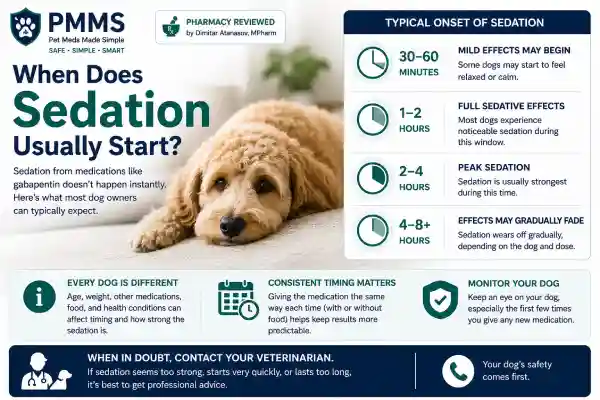
How long does gabapentin sedation last in dogs? For most dogs, sedation from gabapentin begins within 1–3 hours after administration and gradually improves over the next 6–12 hours. However, the duration can vary depending on dosage, age, kidney function, other medications, and individual sensitivity. Some dogs may appear sleepy longer, especially after higher doses or when taking multiple medications.
How long does gabapentin sedation last in dogs?
Most dogs experience gabapentin-related sedation for approximately 6–12 hours. The strongest sedative effects usually occur during the first few hours after administration. Senior dogs, dogs with kidney disease, and dogs receiving higher doses may experience sedation for a longer period.
When Owners Commonly Ask This
Owners often search how long does gabapentin sedation last in dogs after noticing:
- Their dog sleeping most of the day
- Difficulty waking the dog
- Excessive drowsiness
- Reduced activity after a dose
- Continued sleepiness several hours later
- Slower responses than usual
A common concern is:
“My dog took gabapentin this morning and is still sleepy. Is this normal?”
What Is Gabapentin Sedation?
Sedation refers to the calming and drowsy effects that may occur after taking gabapentin.
Some dogs become:
- Sleepier than normal
- Less active
- More relaxed
- Less responsive to stimulation
This is one of the most commonly reported side effects of gabapentin.
How Long Does Gabapentin Sedation Last in Dogs?
Why Does Gabapentin Cause Sedation?
Gabapentin affects nerve signaling within the nervous system.
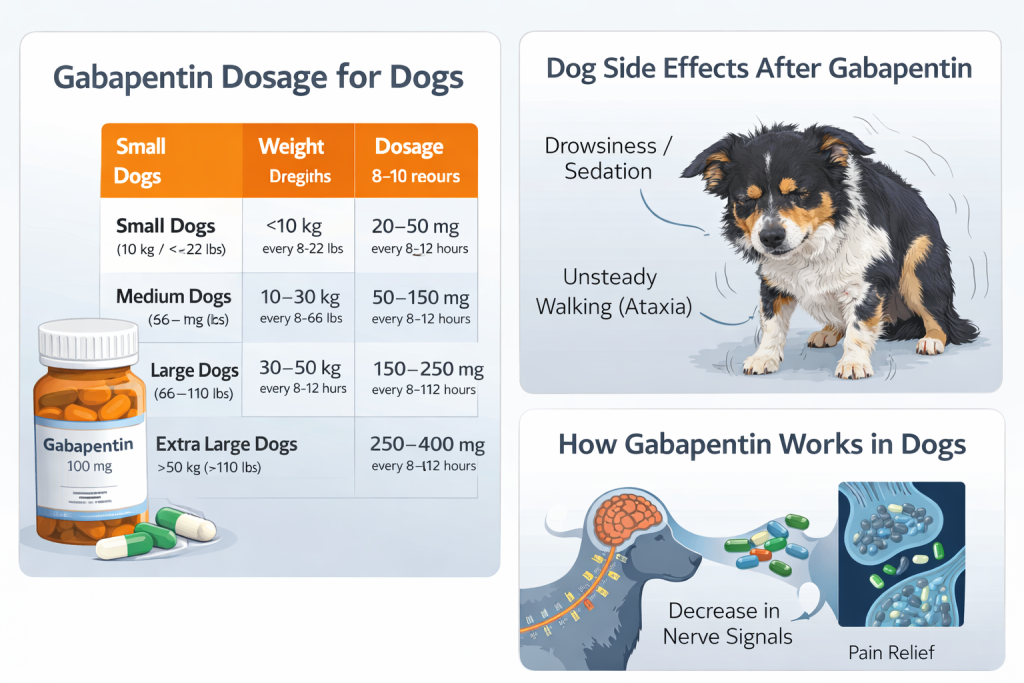
Although it was originally developed as a seizure medication, veterinarians commonly use it for:
- Chronic pain
- Nerve pain
- Anxiety
- Veterinary visits
- Post-surgical recovery
Because it affects nervous system activity, some dogs experience:
- Drowsiness
- Relaxation
- Reduced alertness
When Does Sedation Usually Start?
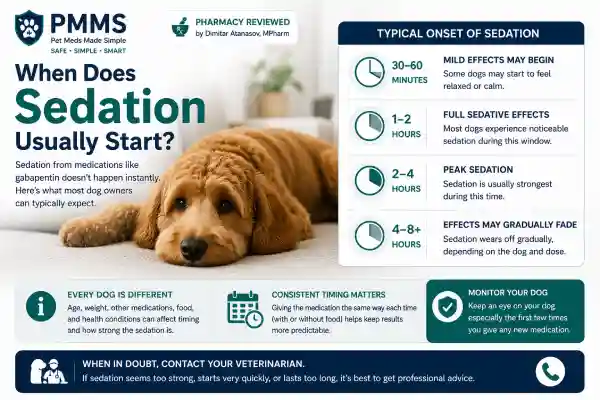
For most dogs:
Within 1–3 Hours
The sedative effect often begins during this period.
Many owners notice:
- More sleeping
- Less activity
- Calmer behavior
during the first few hours after dosing.
How Long Does Sedation Usually Last?
In most cases:
Mild Sedation
6–8 hours
Moderate Sedation
8–12 hours
Strong Sedation
Up to 12 hours or longer in some dogs
The exact duration varies considerably between individuals.
Could Sedation Last Longer in Senior Dogs?
Absolutely.
Senior dogs may process medications more slowly.
Factors include:
- Reduced kidney function
- Reduced liver function
- Increased medication sensitivity
- Multiple health conditions
As a result, sedation may persist longer than expected.
Related article:
Can Senior Dogs Take Gabapentin Safely?
Could a Higher Dose Cause Longer Sedation?
Yes.
Generally speaking:
Higher Dose
↓
Stronger Sedation
↓
Longer Recovery Time
Owners frequently notice increased sleepiness after:
- Dose increases
- Medication adjustments
- New treatment plans
Could Sedation Become Less Noticeable Over Time?
Often, yes.
Some dogs gradually adapt to gabapentin.
During the first few days, owners may observe:
- More sleeping
- Reduced activity
- Mild lethargy
These effects sometimes improve as the body adjusts.
Could Other Medications Make Sedation Last Longer?
Definitely.
Many dogs receive gabapentin alongside:
- Trazodone
- Anxiety medications
- Pain medications
- Seizure medications
Combination therapy may significantly increase sedation.
Related internal links:
Could Kidney Disease Prolong Sedation?
Yes.
Dogs with kidney disease may clear medications more slowly.
This can potentially increase:
- Sedation duration
- Medication sensitivity
- Side effect severity
Kidney function is especially important in older dogs.
Could Sedation Cause Other Symptoms?
Sometimes.
Owners may notice:
- Weakness
- Clingy behavior
- Confusion
- Reduced appetite
- Slower walking
These symptoms can occur alongside sedation.
Related articles:
- Why Is My Dog Weak After Gabapentin?
- Why Is My Dog Clingy After Gabapentin?
- Why Is My Dog Confused After Gabapentin?
- Why Is My Dog Refusing Food on Gabapentin?
Could Sedation Affect Daily Activities?
Absolutely.
A sedated dog may:
- Sleep through normal activities
- Show less interest in play
- Walk more slowly
- Interact less with family members
These effects are usually temporary.
What Should Owners Monitor?
Pay attention to:
- Sleep duration
- Ability to wake normally
- Walking ability
- Appetite
- Water intake
- Breathing
- Changes after each dose
Monitoring these details helps determine whether the response is normal.
How Veterinarians Evaluate Excessive Sedation
When owners ask how long does gabapentin sedation last in dogs, veterinarians first determine whether the sedation falls within the expected range or if something more serious may be occurring.
A veterinary evaluation may include:
- Review of the gabapentin dosage
- Medication history
- Neurological examination
- Assessment of kidney function
- Review of other medications
- Evaluation of mobility and alertness
One of the most important questions is:
“Is your dog sleepy but easy to wake, or difficult to wake and unresponsive?”
The answer helps distinguish normal sedation from a potentially serious problem.
Could Overdose Look Like Prolonged Sedation?
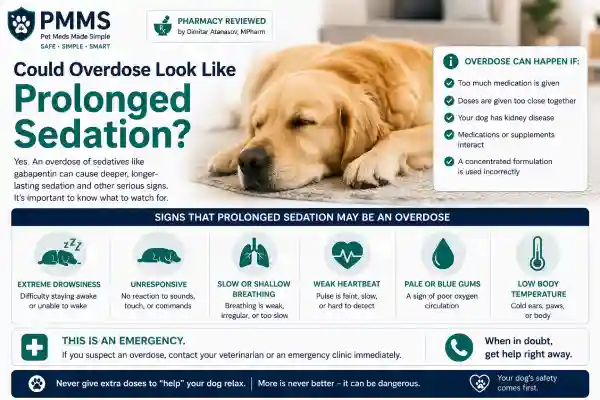
Absolutely.
One of the most common signs of gabapentin overdose is:
Severe, prolonged sedation
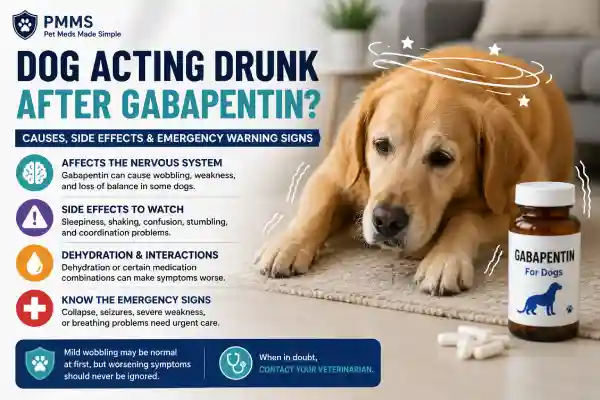
Affected dogs may appear:
- Extremely sleepy
- Difficult to wake
- Weak
- Disoriented
- Unsteady on their feet
While mild sleepiness can be expected, excessive sedation that continues far beyond the usual timeframe deserves veterinary attention.
Related article:
Can Dogs Overdose on Gabapentin?
Could Weakness Be Mistaken for Sedation?
Yes.
Owners sometimes assume a dog is simply sleepy when the dog is actually experiencing:
- Weakness
- Poor coordination
- Mobility problems
The two can appear very similar.
Related article:
Why Is My Dog Weak After Gabapentin?
Could Confusion Make Sedation Seem Worse?
Sometimes.
A confused dog may:
- Respond slowly
- Appear detached
- Seem unusually quiet
- Have trouble recognizing routines
Owners may interpret these changes as excessive sedation.
Related article:
Why Is My Dog Confused After Gabapentin?
Could Senior Dogs Recover More Slowly?
Yes.
Senior dogs often experience:
- Slower medication clearance
- Increased sensitivity
- Multiple health conditions
As a result, recovery from sedation may take longer than in younger dogs.
Related article:
Can Senior Dogs Take Gabapentin Safely?
Could Sedation Affect Appetite?
Absolutely.
A sleepy dog may:
- Skip meals
- Show less interest in treats
- Eat later than usual
- Drink less water
In many cases, appetite returns as the sedative effects wear off.
Related article:
Why Is My Dog Refusing Food on Gabapentin?
Could Sedation Cause Behavioral Changes?
Yes.
Some dogs become:
- Clingy
- Quiet
- Less playful
- Less interactive
Others may seem unusually calm compared with their normal personality.
Related articles:
- Why Is My Dog Clingy After Gabapentin?
- Can Gabapentin Affect Dog Personality?
- Why Is My Dog Acting Strange on Gabapentin?
Could Sedation Last Longer After Dose Increases?
Definitely.
Owners often notice stronger sedation after:
- Increasing the dose
- Starting treatment
- Adding another medication
The body may need time to adjust to these changes.
Could Sedation Improve As Treatment Continues?
Often, yes.
Many dogs experience the strongest sedation during:
- The first few doses
- The first week of treatment
- Shortly after dosage increases
Over time, some dogs become less sensitive to these effects.
When Does Sedation Become an Emergency?
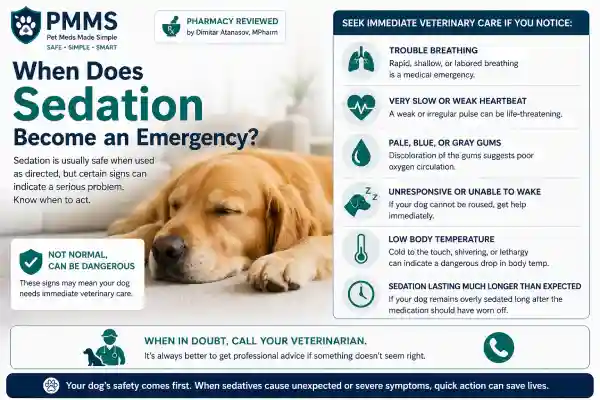
Mild sleepiness is usually expected.
However, immediate veterinary care is recommended if sedation occurs alongside:
Inability to Wake Normally
Difficulty waking the dog is concerning.
Collapse
Any collapse should be treated as an emergency.
Severe Weakness
Particularly if worsening.
Breathing Problems
Abnormal breathing should never be ignored.
Severe Confusion
Profound disorientation warrants prompt evaluation.
Refusal of Food and Water
Especially when combined with extreme sedation.
Could the Underlying Condition Be Contributing?
Very often.
Dogs receiving gabapentin commonly have:
- Chronic pain
- Arthritis
- Neurological disease
- Anxiety disorders
- Recovery from surgery
These conditions can influence energy levels and behavior independently of the medication.
Related Symptoms Owners Often Search For
Owners searching how long does gabapentin sedation last in dogs frequently search for:
Sleeping More
Related article: Why Does My Dog Sleep So Much on Gabapentin?
Weakness
Related article: Why Is My Dog Weak After Gabapentin?
Confusion
Related article: Why Is My Dog Confused After Gabapentin?
Clinginess
Related article: Why Is My Dog Clingy After Gabapentin?
Personality Changes
Related article: Can Gabapentin Affect Dog Personality?
Refusing Food
Related article: Why Is My Dog Refusing Food on Gabapentin?
Shaking
Related article: Why Does My Dog Shake Before Gabapentin Wears Off?
Acting Strange
Related article: Why Is My Dog Acting Strange on Gabapentin?
Breathing Problems
Related article: Can Gabapentin Cause Breathing Problems?
Overdose
Related article: Can Dogs Overdose on Gabapentin?
What Questions Should Owners Ask Their Veterinarian?
Helpful questions include:
- Is this amount of sedation normal?
- Could the dose be too high?
- Could another medication be contributing?
- Should kidney function be evaluated?
- How long should sedation last in my dog?
- What symptoms would require emergency care?
Keeping a medication journal can be very helpful when discussing side effects.
Veterinarian Takeaway
How long does gabapentin sedation last in dogs? For most dogs, sedation lasts approximately 6–12 hours and is strongest during the first few hours after dosing. Senior dogs, dogs with kidney disease, and dogs receiving higher doses may experience longer-lasting effects. Mild sleepiness is common, but severe or prolonged sedation should be evaluated by a veterinarian. How Long Does Gabapentin Sedation Last in Dogs?
Bottom Line
If you’re wondering how long does gabapentin sedation last in dogs, most dogs experience sedation for:
- Approximately 6–12 hours
- Longer after higher doses
- Longer in some senior dogs
- Longer when multiple medications are used
Most cases improve as the medication wears off, but severe sedation, breathing difficulties, collapse, or inability to wake normally require immediate veterinary attention.How Long Does Gabapentin Sedation Last in Dogs?
Frequently Asked Questions – How Long Does Gabapentin Sedation Last in Dogs?
How long does gabapentin sedation usually last in dogs?
Most dogs experience sedation for approximately 6–12 hours.
When does sedation typically begin?
Sedation often begins within 1–3 hours after administration.
Can senior dogs stay sleepy longer?
Yes. Older dogs may process medications more slowly.
Can a higher dose increase sedation?
Absolutely. Higher doses often cause stronger and longer-lasting sedation.
Is mild sleepiness normal?
Yes. Mild drowsiness is one of the most common gabapentin side effects.
Could kidney disease prolong sedation?
Yes. Reduced kidney function may increase medication sensitivity.
Can gabapentin affect appetite because of sedation?
Yes. Sleepy dogs may temporarily eat less.
Can overdose cause prolonged sedation?
Yes. Severe, persistent sedation is a common overdose sign.
Should I stop gabapentin if my dog seems too sleepy?
No. Never stop medication without veterinary guidance.
When should I seek emergency care?
Seek immediate veterinary attention if your dog cannot be awakened normally, collapses, develops breathing difficulties, becomes severely confused, or refuses food and water.
Reviewed By
Pharmacy Reviewed By
Dimitar Atanasov, MPharm
Master Pharmacist | Medication Safety Educator
Editorial Policy
At Pet Meds Made Simple, we are committed to providing accurate, evidence-based information about pet medications, veterinary treatments, medication safety, and common health concerns that affect dogs and cats.
Our content is researched using veterinary reference texts, peer-reviewed veterinary literature, clinical guidelines, and trusted veterinary organizations. Every article is written with the goal of helping pet owners better understand their pet’s medications while supporting—not replacing—the advice of their veterinarian.How Long Does Gabapentin Sedation Last in Dogs?
Read our full Editorial Policy:
Pet Meds Made Simple Editorial Policy
Sources
- Plumb’s Veterinary Drug Handbook
- American Animal Hospital Association (AAHA)
- American Veterinary Medical Association (AVMA)
- Merck Veterinary Manual
- Veterinary Pharmacology and Therapeutics
- Small Animal Clinical Pharmacology
- Journal of the American Veterinary Medical Association (JAVMA)
- Frontiers in Veterinary Science
- Veterinary Anaesthesia and Analgesia
- Veterinary Information Network (VIN)
Medical Review Statement
This article was pharmacy-reviewed by Dimitar Atanasov, MPharm, Master Pharmacist, using current veterinary pharmacology references, canine medication-safety guidelines, and published veterinary literature available at the time of review.
Images created with AI – How Long Does Gabapentin Sedation Last in Dogs?