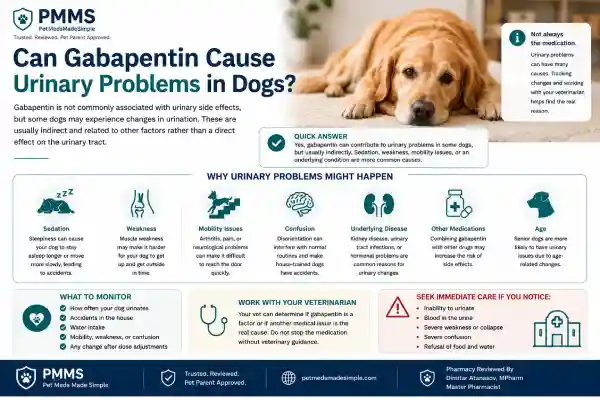
Quick Answer
Can gabapentin cause urinary problems in dogs? Sometimes. Urinary problems are not among the most common side effects of gabapentin, but some dogs may develop changes in urination while taking the medication. These changes may be related to sedation, weakness, mobility issues, underlying disease, age-related conditions, or medication interactions rather than gabapentin itself.
Can gabapentin cause urinary problems in dogs?
Yes, some dogs may experience urinary changes while taking gabapentin. Potential issues include urinary accidents, difficulty getting outside in time, increased urination, reduced awareness of bladder fullness, or worsening of pre-existing urinary conditions. Persistent urinary changes should be evaluated by a veterinarian.
When Owners Commonly Ask This
Owners often search can gabapentin cause urinary problems in dogs after noticing:
- Urinary accidents in the house
- Increased urination
- Difficulty holding urine
- Leaking urine while sleeping
- Changes after starting gabapentin
- Senior dogs suddenly having accidents
Many owners wonder whether the medication is responsible or whether another health problem is developing.
Can Gabapentin Directly Affect Urination?
Possibly, but usually not directly.
Gabapentin primarily affects the nervous system rather than the urinary tract.
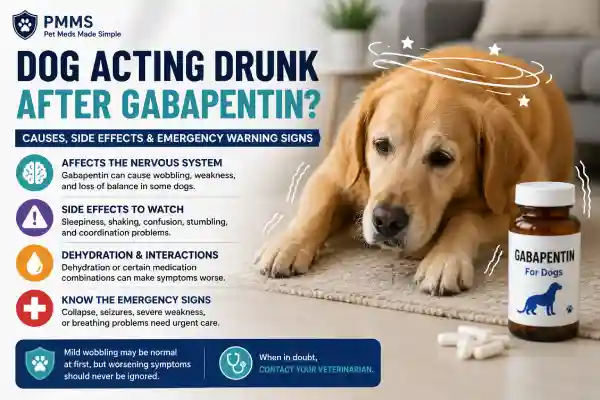
However, some secondary effects may influence urination, including:
- Sedation
- Weakness
- Reduced mobility
- Mild confusion
These factors can make urinary problems more noticeable.
Can Gabapentin Cause Urinary Problems in Dogs?
What Types of Urinary Problems Might Owners Notice?
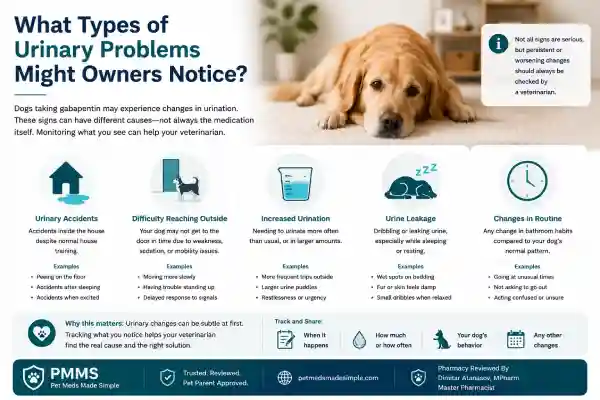
Some owners report:
Urinary Accidents
Accidents occurring inside the house despite previous good house training.
Difficulty Reaching Outside
The dog may not reach the door in time.
Increased Urination
Some dogs appear to urinate more frequently.
Urine Leakage
Particularly while sleeping or resting.
Changes in Bathroom Habits
Differences in routine compared with normal behavior.
Could Sedation Lead to Urinary Accidents?
Yes.
One of the most common explanations is sedation.
Dogs that feel sleepy may:
- Stay asleep longer
- Wake up later
- Move more slowly
- Delay going outside
This can occasionally result in accidents.
Related article:
Why Does My Dog Sleep So Much on Gabapentin?
Could Weakness Make It Harder to Reach Outside?
Absolutely.
Dogs experiencing weakness may:
- Walk more slowly
- Have difficulty standing
- Struggle with stairs
- Delay going outdoors
The bladder itself may be functioning normally, but mobility problems can create accidents.
Related article:
Why Is My Dog Weak After Gabapentin?
Could Confusion Affect Bathroom Habits?
Sometimes.
A confused dog may:
- Forget normal routines
- Seem disoriented
- Fail to signal the need to go outside
- Wander aimlessly
Owners occasionally mistake these signs for urinary disease.
Related article:
Why Is My Dog Confused After Gabapentin?
Could Senior Dogs Be More Susceptible?
Yes.
Older dogs often have:
- Reduced mobility
- Cognitive decline
- Arthritis
- Existing urinary issues
Gabapentin may make these conditions more noticeable.
Related article:
Can Senior Dogs Take Gabapentin Safely?
Could Kidney Disease Be Involved?
Very often.
Kidney disease can cause:
- Increased urination
- Increased thirst
- Accidents
- Changes in urine production
Owners sometimes assume gabapentin is responsible when an underlying kidney problem is actually the cause.
Could Arthritis Contribute to Urinary Problems?
Absolutely.
Many dogs taking gabapentin have:
- Arthritis
- Back pain
- Hip problems
These conditions may make it difficult to:
- Rise quickly
- Walk outside
- Maintain normal bathroom routines
In these situations, the urinary issue may be related to pain and mobility rather than medication.
Could Other Medications Be Responsible?
Yes.
Many dogs receiving gabapentin are also prescribed:
- NSAIDs
- Anxiety medications
- Seizure medications
- Antibiotics
Sometimes another medication is contributing to urinary changes.
Related internal links:
Could Dose Increases Make Urinary Problems More Noticeable?
Sometimes.
After a dose increase, some dogs may experience:
- More sedation
- More weakness
- More confusion
These effects may indirectly affect bathroom habits.
What Should Owners Monitor?
Pay attention to:
- Urination frequency
- Water intake
- Urinary accidents
- Walking ability
- Weakness
- Confusion
- Changes after dosing
These details can help veterinarians identify the underlying cause.
Could Urinary Problems Be Temporary?
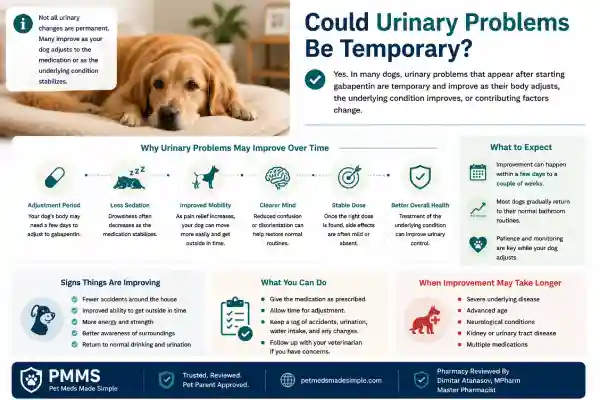
Yes.
Some urinary changes may improve as:
- The dog adjusts to treatment
- Sedation decreases
- Mobility improves
- Dosages are stabilized
Temporary changes are generally less concerning than progressive symptoms.
How Veterinarians Evaluate Urinary Problems
When owners ask can gabapentin cause urinary problems in dogs, veterinarians try to determine whether the issue is caused by:
- Medication effects
- Sedation
- Weakness
- Arthritis
- Neurological disease
- Urinary tract disease
- Kidney disease
- Age-related conditions
A veterinary evaluation may include:
- Physical examination
- Neurological assessment
- Urinalysis
- Blood work
- Review of medications
- Evaluation of mobility and pain
One of the most important questions is:
“Did the urinary problem begin before or after gabapentin was started?”
The timing often provides valuable clues.
Could Overdose Affect Urination?
Potentially.
Dogs experiencing gabapentin overdose may develop:
- Severe sedation
- Weakness
- Confusion
- Difficulty standing
- Reduced awareness of normal bathroom routines
Some dogs may have urinary accidents simply because they are too sedated or weak to respond normally.
Related article:
Can Dogs Overdose on Gabapentin?
Could Increased Thirst Lead to More Urination?
Sometimes.
Although gabapentin is not commonly associated with excessive thirst, increased water intake can occur for various reasons, including:
- Underlying illness
- Kidney disease
- Other medications
- Recovery from illness
More water consumption naturally results in more urination.
Could Urinary Leakage Occur During Sleep?
Occasionally.
A heavily sedated dog may:
- Sleep more deeply
- Wake less frequently
- Be slower to respond to bladder signals
Owners sometimes notice leakage or accidents during periods of heavy sedation.
Related article:
Why Does My Dog Sleep So Much on Gabapentin?
Could Neurological Disease Be the Real Cause?
Very often.
Many dogs prescribed gabapentin suffer from:
- Nerve pain
- Spinal disease
- Neurological disorders
These conditions themselves can affect bladder control.
In such cases, the underlying disease may be far more important than the medication.
Could Urinary Problems Improve Over Time?
Often, yes.
If urinary changes are related to:
- Temporary sedation
- Medication adjustment
- Dose changes
they may improve as the dog’s body adapts.
However, persistent urinary problems deserve veterinary attention.
Could Urinary Problems Affect Quality of Life?
Absolutely.
Frequent accidents may lead to:
- Discomfort
- Skin irritation
- Sleep disruption
- Increased owner stress
- Reduced mobility
Addressing the cause is important for both the dog and the family.
When Do Urinary Problems Become an Emergency?
Some urinary changes are mild.
However, immediate veterinary care is recommended if urinary problems occur alongside:
Inability to Urinate
This is a medical emergency.
Blood in the Urine
Always warrants prompt evaluation.
Severe Weakness
Particularly if worsening.
Collapse
Emergency assessment is needed.
Severe Confusion
Neurological symptoms should not be ignored.
Refusal of Food and Water
Particularly if combined with urinary changes.
Could the Underlying Condition Be More Important Than the Medication?
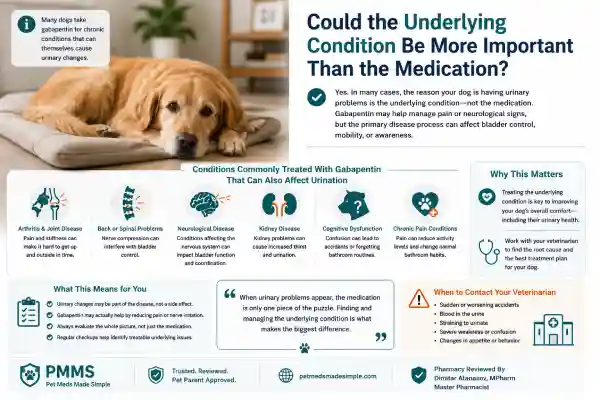
Very often.
Dogs receiving gabapentin commonly have:
- Arthritis
- Back disease
- Nerve injuries
- Chronic pain
- Neurological conditions
These diseases may contribute more to urinary changes than gabapentin itself.
This is one reason veterinarians evaluate the whole patient rather than focusing solely on the medication.
Related Symptoms Owners Often Search For
Owners searching can gabapentin cause urinary problems in dogs frequently search for:
Weakness
Related article: Why Is My Dog Weak After Gabapentin?
Confusion
Related article: Why Is My Dog Confused After Gabapentin?
Acting Strange
Related article: Why Is My Dog Acting Strange on Gabapentin?
Sleeping More
Related article: Why Does My Dog Sleep So Much on Gabapentin?
Clingy Behavior
Related article: Why Is My Dog Clingy After Gabapentin?
Refusing Food
Related article: Why Is My Dog Refusing Food on Gabapentin?
Vomiting
Related article: Why Is My Dog Vomiting After Gabapentin?
Breathing Problems
Related article: Can Gabapentin Cause Breathing Problems in Dogs?
Constipation
Related article: Can Gabapentin Cause Constipation in Dogs?
Overdose
Related article: Can Dogs Overdose on Gabapentin?
What Questions Should Owners Ask Their Veterinarian?
Helpful questions include:
- Could gabapentin be contributing to these urinary changes?
- Could weakness or sedation be involved?
- Should kidney function be evaluated?
- Is arthritis affecting bathroom habits?
- Could another medication be contributing?
- When should urinary changes be considered an emergency?
Keeping a record of urination patterns can be very helpful.
Veterinarian Takeaway
Can gabapentin cause urinary problems in dogs? Sometimes, but urinary problems are usually related to sedation, weakness, mobility limitations, underlying disease, age-related conditions, or medication combinations rather than a direct effect of gabapentin on the urinary tract. Persistent urinary changes should always be discussed with a veterinarian.
Bottom Line
If you’re wondering can gabapentin cause urinary problems in dogs, the answer is that it can sometimes contribute indirectly.
Possible explanations include:
- Sedation
- Weakness
- Reduced mobility
- Confusion
- Arthritis
- Kidney disease
- Neurological conditions
- Medication interactions
Many cases are mild and temporary, but significant urinary changes should always be evaluated to identify the true cause.
Frequently Asked Questions – Can Gabapentin Cause Urinary Problems in Dogs?
Can gabapentin cause urinary accidents in dogs?
Yes. Sedation, weakness, or reduced mobility may contribute to accidents in some dogs.
Is urinary incontinence a common side effect?
No. It is not considered one of the most common gabapentin side effects.
Can weakness affect bladder habits?
Absolutely. Weak dogs may struggle to get outside in time.
Could confusion lead to accidents?
Yes. Confused dogs may forget normal bathroom routines.
Are senior dogs at greater risk?
Yes. Older dogs often have additional mobility and urinary health issues.
Can kidney disease cause similar symptoms?
Very often. Kidney disease commonly affects urination patterns.
Could arthritis contribute to urinary accidents?
Yes. Pain and difficulty moving can interfere with normal bathroom habits.
Can overdose affect urination?
Potentially. Severe sedation and weakness may increase accident risk.
Should I stop gabapentin if my dog starts having accidents?
No. Never discontinue medication without veterinary guidance.
When should I seek emergency care?
Seek immediate veterinary attention if your dog cannot urinate, has blood in the urine, collapses, develops severe weakness, or becomes severely confused.
Veterinarian Takeaway
Can gabapentin cause urinary problems in dogs? While urinary changes are not among the most common side effects, gabapentin may indirectly contribute through sedation, weakness, reduced mobility, or confusion. Underlying disease is often a more important factor than the medication itself.
Reviewed By
Pharmacy Reviewed By
Dimitar Atanasov, MPharm
Master Pharmacist | Medication Safety Educator
Editorial Policy
At Pet Meds Made Simple, we are committed to providing accurate, evidence-based information about pet medications, veterinary treatments, medication safety, and common health concerns that affect dogs and cats.
Our content is researched using veterinary reference texts, peer-reviewed veterinary literature, clinical guidelines, and trusted veterinary organizations. Every article is written with the goal of helping pet owners better understand their pet’s medications while supporting—not replacing—the advice of their veterinarian.
Read our full Editorial Policy:
Pet Meds Made Simple Editorial Policy
Sources
- Plumb’s Veterinary Drug Handbook
- American Animal Hospital Association (AAHA)
- American Veterinary Medical Association (AVMA)
- Merck Veterinary Manual
- Veterinary Pharmacology and Therapeutics
- Small Animal Clinical Pharmacology
- Journal of the American Veterinary Medical Association (JAVMA)
- Frontiers in Veterinary Science
- Veterinary Anaesthesia and Analgesia
- Veterinary Information Network (VIN)
Medical Review Statement
This article was pharmacy-reviewed by Dimitar Atanasov, MPharm, Master Pharmacist, using current veterinary pharmacology references, canine urinary-health resources, medication-safety guidelines, and published veterinary literature available at the time of review.
Images created with AI – Can Gabapentin Cause Urinary Problems in Dogs?