Quick Answer
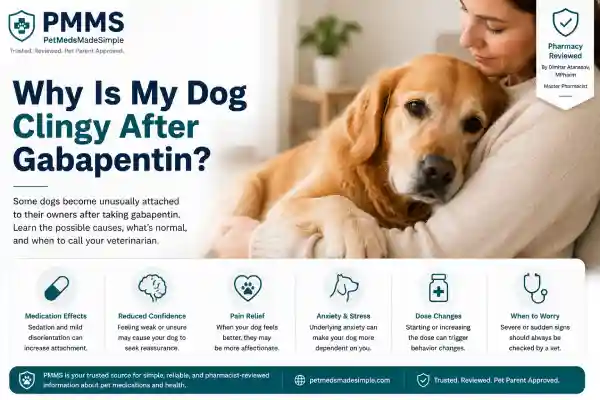
Why is my dog clingy after gabapentin? Some dogs become unusually clingy after taking gabapentin because the medication can affect alertness, confidence, anxiety levels, and behavior. Dogs may seek extra comfort, reassurance, or physical contact while adjusting to the medication. In many cases, this behavior is temporary and improves as the medication wears off or the dog adapts to treatment.
Why is my dog clingy after gabapentin?
A dog may become clingy after gabapentin because the medication can cause sedation, mild disorientation, reduced confidence, behavioral changes, or anxiety-related responses. Some dogs seek more attention and reassurance while experiencing these effects. Most cases are temporary, but severe behavioral changes should be discussed with a veterinarian.
When Owners Commonly Ask This
Owners often search why is my dog clingy after gabapentin after noticing:
- Following them around the house
- Refusing to be alone
- Constantly seeking attention
- Wanting to sit closer than usual
- Increased physical contact
- Crying when separated
Many describe it as:
“My dog suddenly won’t leave my side.”
Is Clingy Behavior a Known Side Effect?
Not officially.
However, behavioral changes can occur in some dogs taking gabapentin.
While clinginess is not among the most commonly listed side effects, owners occasionally report:
- Increased attachment
- Seeking reassurance
- Following family members more closely
- Acting unusually dependent
Why Is My Dog Clingy After Gabapentin
Could Sedation Make My Dog More Clingy?
Yes.
Dogs experiencing sedation may feel:
- Less confident
- More vulnerable
- More dependent on familiar people
As a result, they may stay closer to their owners than usual.
Related article:
Why Does My Dog Sleep So Much on Gabapentin?
Could Mild Disorientation Be Responsible?
Sometimes.
A dog that feels slightly confused may seek comfort from familiar people.
Signs can include:
- Following owners constantly
- Looking for reassurance
- Hesitation in unfamiliar situations
- Reduced independence
Related article:
Why Is My Dog Confused After Gabapentin?
Could Anxiety Play a Role?
Absolutely.
Some dogs receiving gabapentin already struggle with:
- Anxiety
- Fear
- Noise sensitivity
- Separation concerns
In these situations, clinginess may be related to the underlying condition rather than the medication itself.
Related internal links:
Could Pain Relief Change My Dog’s Behavior?
Surprisingly, yes.
Before treatment, a dog in pain may:
- Avoid interaction
- Stay isolated
- Sleep alone
After pain relief, the same dog may become:
- More affectionate
- More social
- More interactive
Owners sometimes interpret this as unusual clinginess when the dog is actually feeling better.
Related internal links:
Could Personality Changes Be Involved?
Possibly.
Some dogs experience temporary behavior changes after starting gabapentin.
These changes may include:
- Increased attachment
- Reduced independence
- More social behavior
- Different interaction patterns
Related article:
Can Gabapentin Affect Dog Personality?
Could Senior Dogs Be More Sensitive?
Yes.
Senior dogs are often more susceptible to:
- Sedation
- Confusion
- Behavioral changes
- Medication sensitivity
As a result, clinginess may be more noticeable.
Related article:
Can Senior Dogs Take Gabapentin Safely?
Could a Dose Increase Trigger Clingy Behavior?
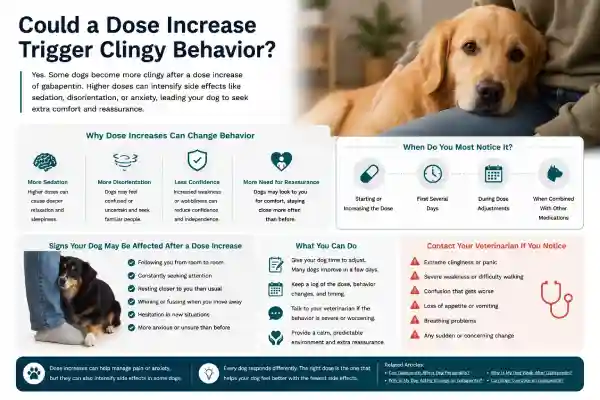
Sometimes.
Owners often report behavioral changes after:
- Starting treatment
- Increasing dosage
- Adding another medication
Higher doses may increase:
- Sedation
- Confusion
- Dependence on familiar surroundings
Could Other Medications Be Contributing?
Very often.
Many dogs receive gabapentin together with:
- Trazodone
- Anxiety medications
- Pain medications
- Seizure medications
Behavior changes may be caused by the combination rather than gabapentin alone.
Related internal links:
Could Clinginess Be a Sign of Weakness?
Yes.
A dog that feels physically weak may stay closer to owners because:
- Moving is harder
- Confidence is reduced
- Familiar people feel safer
Related article:
Why Is My Dog Weak After Gabapentin?
Could Clinginess Be Temporary?
In many cases, yes.
Mild behavioral changes often improve:
- As the medication wears off
- As the dog adapts to treatment
- After dose adjustments
- Once underlying pain improves
Temporary clinginess is generally less concerning than severe behavioral changes.
What Should Owners Monitor?
Pay attention to:
- Appetite
- Activity level
- Sleep patterns
- Anxiety
- Walking ability
- Responsiveness
- Changes after dosing
These observations can help determine whether the behavior is medication-related.
How Veterinarians Evaluate Clingy Behavior
When owners ask why is my dog clingy after gabapentin, veterinarians try to determine whether the behavior is caused by:
- Medication effects
- Anxiety
- Pain relief
- Confusion
- Weakness
- Underlying illness
- Medication interactions
A veterinary evaluation may include:
- Review of current medications
- Behavioral assessment
- Neurological examination
- Pain evaluation
- Discussion of recent changes in routine
One of the most important questions is:
“Is your dog acting clingy only after medication, or all the time?”
The answer often helps identify the cause.
Could Clinginess Improve Over Time?
Often, yes.
Many dogs experience temporary behavioral changes when:
- Starting gabapentin
- Increasing the dose
- Beginning combination therapy
As the body adapts, clingy behavior may gradually decrease.
This is especially common when the behavior is related to mild sedation.
Could Clinginess Be a Sign My Dog Feels Safer?
Absolutely.
Dogs frequently seek familiar people when they:
- Feel uncertain
- Feel sleepy
- Feel vulnerable
- Experience mild disorientation
For some dogs, staying close to their owner is simply a coping mechanism.
Could Clinginess Be Related to Reduced Confidence?
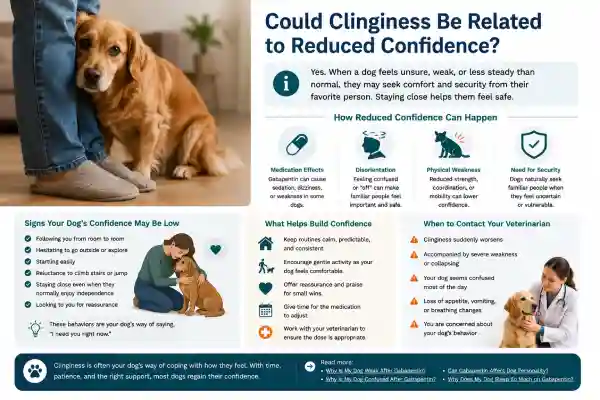
Yes.
A dog that feels:
- Wobbly
- Weak
- Less coordinated
may become more dependent on familiar people.
Owners sometimes notice:
- Following them room to room
- Reluctance to go outside alone
- Increased attention-seeking behavior
Related articles:
Could Overdose Cause Clingy Behavior?
Sometimes.
In overdose situations, dogs may appear:
- Confused
- Disoriented
- Dependent
- Uncertain
Some dogs seek constant reassurance before progressing to more obvious symptoms.
However, overdose more commonly causes:
- Severe sedation
- Weakness
- Reduced responsiveness
Related article:
Can Dogs Overdose on Gabapentin?
Could Clinginess Be Related to Confusion?
Very often.
A confused dog may:
- Stay close to family members
- Seek familiar surroundings
- Become reluctant to explore
Owners frequently describe this as clingy behavior.
Related article:
Why Is My Dog Confused After Gabapentin?
Could Appetite Changes Occur Alongside Clinginess?
Yes.
Some dogs experiencing medication side effects may show:
- Reduced appetite
- Increased attachment
- More sleeping
- Less activity
These symptoms often occur together.
Related article:
Why Is My Dog Refusing Food on Gabapentin?
When Does Clinginess Become Concerning?
Mild clinginess is usually not dangerous.
However, veterinary evaluation is recommended if clinginess occurs alongside:
Severe Confusion
Profound disorientation should be evaluated.
Inability to Walk Normally
Weakness and mobility problems require attention.
Breathing Difficulties
Any breathing abnormality is concerning.
Collapse
Emergency veterinary care is needed immediately.
Extreme Anxiety
Behavior that becomes disruptive or severe deserves evaluation.
Rapidly Worsening Symptoms
Progressive deterioration should never be ignored.
Could the Underlying Condition Be More Important Than the Medication?
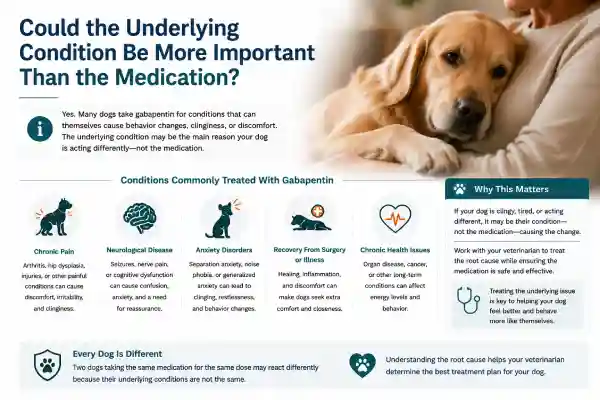
Very often.
Dogs receiving gabapentin commonly have:
- Chronic pain
- Arthritis
- Neurological disease
- Anxiety disorders
- Recovery from surgery
Sometimes the clinginess is related to the underlying condition rather than the medication itself.
Related Symptoms Owners Often Search For
Owners searching why is my dog clingy after gabapentin frequently search for:
Acting Strange
Related article: Why Is My Dog Acting Strange on Gabapentin?
Confusion
Related article: Why Is My Dog Confused After Gabapentin?
Weakness
Related article: Why Is My Dog Weak After Gabapentin?
Personality Changes
Related article: Can Gabapentin Affect Dog Personality?
Sleeping More
Related article: Why Does My Dog Sleep So Much on Gabapentin?
Refusing Food
Related article: Why Is My Dog Refusing Food on Gabapentin?
Vomiting
Related article: Why Is My Dog Vomiting After Gabapentin?
Breathing Problems
Related article: Can Gabapentin Cause Breathing Problems in Dogs?
Shaking
Related article: Why Does My Dog Shake Before Gabapentin Wears Off?
Overdose
Related article: Can Dogs Overdose on Gabapentin?
What Questions Should Owners Ask Their Veterinarian?
Helpful questions include:
- Is this behavior expected?
- Could the dose be too high?
- Is my dog experiencing confusion?
- Could another medication be contributing?
- Is the clinginess related to pain relief?
- What symptoms would indicate a more serious problem?
Keeping a simple behavior journal can help identify patterns.
Veterinarian Takeaway
Why is my dog clingy after gabapentin? Some dogs become more attached to their owners because of sedation, mild disorientation, reduced confidence, pain relief, anxiety-related factors, or temporary behavioral changes. Most cases are mild and temporary, but severe behavioral changes should be evaluated by a veterinarian.
Bottom Line
If you’re wondering why is my dog clingy after gabapentin, the behavior is often related to:
- Sedation
- Mild confusion
- Reduced confidence
- Pain relief
- Anxiety
- Medication adjustments
Many dogs improve as they adjust to treatment. However, clinginess accompanied by severe weakness, confusion, breathing difficulties, or collapse should be evaluated promptly.
Frequently Asked Questions – Why Is My Dog Clingy After Gabapentin
Can gabapentin make dogs clingy?
Yes. Some dogs may seek extra comfort and reassurance while taking gabapentin.
Is clinginess a common side effect?
It is not among the most commonly reported side effects, but some owners notice increased attachment.
Could confusion cause clinginess?
Absolutely. Confused dogs often seek familiar people and surroundings.
Can pain relief make dogs more affectionate?
Yes. Dogs that feel better may become more social and interactive.
Are senior dogs more likely to become clingy?
Often yes. Older dogs may be more sensitive to medication effects.
Could weakness make my dog stay close to me?
Yes. Reduced confidence and mobility can increase dependence on owners.
Can dose increases trigger clinginess?
Sometimes. Behavioral changes may become more noticeable after dosage adjustments.
Could another medication be responsible?
Yes. Medication combinations may contribute to behavioral changes.
Should I stop gabapentin because my dog is clingy?
No. Never stop prescribed medication without veterinary guidance.
When should I call my veterinarian?
Contact your veterinarian if clinginess is severe, worsening, or occurs with other concerning symptoms.
Reviewed By
Pharmacy Reviewed By
Dimitar Atanasov, MPharm
Master Pharmacist | Medication Safety Educator
Editorial Policy
At Pet Meds Made Simple, we are committed to providing accurate, evidence-based information about pet medications, veterinary treatments, medication safety, and common health concerns that affect dogs and cats.
Our content is researched using veterinary reference texts, peer-reviewed veterinary literature, clinical guidelines, and trusted veterinary organizations. Every article is written with the goal of helping pet owners better understand their pet’s medications while supporting—not replacing—the advice of their veterinarian.
Read our full Editorial Policy:
Pet Meds Made Simple Editorial Policy
Sources
- Plumb’s Veterinary Drug Handbook
- American Animal Hospital Association (AAHA)
- American Veterinary Medical Association (AVMA)
- Merck Veterinary Manual
- Veterinary Pharmacology and Therapeutics
- Small Animal Clinical Pharmacology
- Journal of the American Veterinary Medical Association (JAVMA)
- Frontiers in Veterinary Science
- Veterinary Anaesthesia and Analgesia
- Veterinary Information Network (VIN)
Medical Review Statement
This article was pharmacy-reviewed by Dimitar Atanasov, MPharm, Master Pharmacist, using current veterinary pharmacology references, canine behavioral medicine resources, medication-safety guidelines, and published veterinary literature available at the time of review.
Images created with AI – Why Is My Dog Clingy After Gabapentin