
Quick Answer
Can gabapentin cause breathing problems in dogs? Breathing problems are considered uncommon with gabapentin when used alone at prescribed doses. However, excessive sedation, overdose situations, underlying medical conditions, or combining gabapentin with other sedating medications may increase the risk of breathing-related concerns. Any dog experiencing difficulty breathing should be evaluated by a veterinarian immediately.
Can gabapentin cause breathing problems in dogs?
Gabapentin does not commonly cause breathing problems in dogs when used as prescribed. However, excessive sedation, overdose, underlying disease, or use with other sedating medications may increase the risk of breathing-related complications. Dogs showing labored breathing, blue gums, collapse, or severe lethargy require immediate veterinary attention.
When Owners Commonly Ask This
Owners often search can gabapentin cause breathing problems in dogs when:
- Their dog seems to breathe differently after a dose.
- Panting develops unexpectedly.
- Their dog appears overly sedated.
- Gabapentin is combined with trazodone or other medications.
- An accidental overdose is suspected.
- An older dog begins breathing heavily after treatment.
Breathing changes naturally make owners nervous because they can sometimes indicate a medical emergency.
Does Gabapentin Normally Affect Breathing?
For most dogs, no.
Gabapentin primarily affects the nervous system and is commonly used for:
- Chronic pain
- Nerve pain
- Arthritis-related discomfort
- Anxiety management
- Sedation before veterinary visits
When used appropriately, gabapentin does not typically cause serious respiratory depression in dogs.
This is one reason veterinarians frequently prescribe it for long-term management.
Can Gabapentin Cause Breathing Problems in Dogs?
What Kind of Breathing Changes Might Owners Notice?
Owners may report:
Panting
A dog may appear to pant more than usual.
Faster Breathing
Respiratory rate may seem elevated.
Noisy Breathing
Particularly in dogs with existing airway issues.
Deep Sleeping With Slower Movements
Which can sometimes be mistaken for breathing problems.
Importantly, these observations do not always mean the medication is responsible.
Related articles:
- Why Is My Dog Panting After Gabapentin?
- Why Does My Dog Sleep So Much on Gabapentin?
- Can Anxiety Medication Cause Weakness in Dogs?
Could Excessive Sedation Be Mistaken for Breathing Problems?
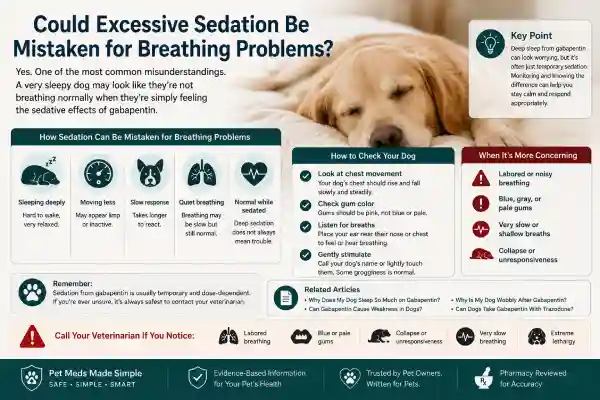
Absolutely.
This is one of the most common misunderstandings.
A heavily sedated dog may:
- Sleep deeply
- Move less
- Respond more slowly
- Appear unusually quiet
Owners sometimes worry the dog is not breathing normally when the dog is simply experiencing the sedative effects of medication.
Veterinarians often evaluate both breathing quality and overall responsiveness to determine whether a true respiratory problem exists.
Can Gabapentin Cause Respiratory Depression?
In healthy dogs receiving prescribed doses, significant respiratory depression is considered uncommon.
However, risk may increase when:
- Excessive doses are given
- Multiple sedating drugs are combined
- Serious underlying illness is present
- The dog is extremely elderly or medically fragile
This is why veterinarians carefully consider all medications a patient is receiving.
Could Another Medication Be Responsible?
Very often, yes.
Many dogs taking gabapentin are also prescribed:
- Trazodone
- Opioid pain medications
- Sedatives
- Anxiety medications
- Seizure medications
The combination of medications may contribute to excessive sedation.
Related articles:
Are Senior Dogs at Greater Risk?
Potentially.
Older dogs may process medications differently and may be more sensitive to sedative effects.
Veterinarians often monitor senior dogs more closely for:
- Excessive sleepiness
- Weakness
- Wobbliness
- Changes in breathing effort
Related article:
Can Senior Dogs Take Gabapentin Safely?
Could Underlying Disease Be the Real Cause?
Frequently.
Dogs receiving gabapentin often already have medical conditions that may affect breathing.
Examples include:
Heart Disease
Can cause increased breathing effort.
Lung Disease
May cause coughing or respiratory distress.
Pain
Pain itself can increase respiratory rate.
Anxiety
Anxiety commonly causes panting and rapid breathing.
This is why veterinarians rarely assume gabapentin is automatically responsible.
What Is Normal Breathing vs Concerning Breathing?
Understanding the difference can help owners respond appropriately.
Usually Less Concerning
- Mild panting
- Slight increase in respiratory rate
- Temporary changes after activity
- Mild sedation
More Concerning
- Labored breathing
- Open-mouth breathing at rest
- Blue or gray gums
- Collapse
- Severe lethargy
- Inability to settle comfortably
These signs warrant immediate veterinary attention.
Can Overdose Cause Breathing Problems?
Yes.
Although gabapentin generally has a relatively wide margin of safety, overdose situations can increase the likelihood of serious side effects.
Potential overdose signs include:
- Extreme sedation
- Weakness
- Disorientation
- Loss of coordination
- Breathing abnormalities
Related article:
Signs of Medication Overdose in Dogs
Could Anxiety Cause Rapid Breathing Instead?
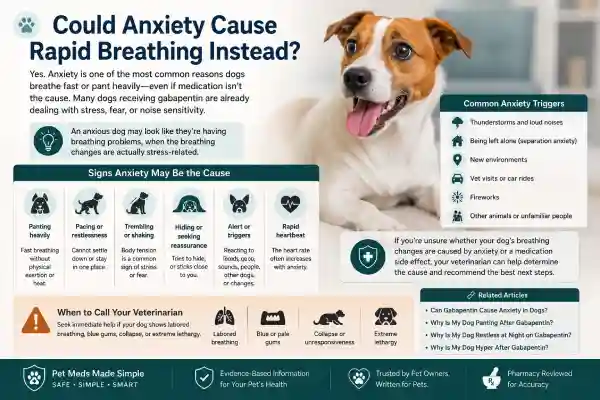
Yes.
This is surprisingly common.
Many owners searching can gabapentin cause breathing problems in dogs are actually observing anxiety-related breathing changes.
An anxious dog may:
- Pant heavily
- Pace
- Tremble
- Seek constant reassurance
These signs can sometimes resemble medication-related side effects.
Related articles:
- Can Gabapentin Cause Anxiety in Dogs?
- Why Is My Dog Hyper After Gabapentin?
- Why Is My Dog Restless at Night on Gabapentin?
What Owners Should Monitor at Home
If breathing changes occur, monitor:
- Breathing rate
- Gum color
- Activity level
- Appetite
- Water intake
- Responsiveness
- Timing relative to medication administration
Recording videos can be extremely helpful for your veterinarian.
How Veterinarians Evaluate Breathing Problems After Gabapentin
When owners ask can gabapentin cause breathing problems in dogs, veterinarians focus on determining whether the medication is truly responsible or whether another condition may be causing the symptoms.
A veterinary evaluation may include:
- Medication history review
- Physical examination
- Respiratory rate assessment
- Heart and lung evaluation
- Review of other medications
- Neurological assessment
- Oxygenation status
- Bloodwork if needed
One of the first questions veterinarians often ask is:
“What exactly do you mean by breathing problems?”
Many owners use the phrase to describe panting, while others are observing true respiratory distress.
Could Pain Cause Fast Breathing?
Absolutely.
Pain is one of the most common causes of increased respiratory rate in dogs.
Dogs experiencing pain may:
- Pant excessively
- Breathe faster
- Pace
- Struggle to settle comfortably
- Appear restless
Sometimes owners assume gabapentin is causing the breathing change when the medication is actually not controlling the pain effectively.
Related articles:
- Why Is My Dog Still in Pain on Gabapentin?
- Why Is My Dog Crying Despite Gabapentin?
- Can Gabapentin Cause Weak Back Legs?
Can Panting Be Normal After Gabapentin?
Sometimes.
Panting does not automatically mean a dangerous side effect is occurring.
Panting may be associated with:
- Anxiety
- Pain
- Warm environments
- Stress
- Excitement
- Certain medications
The key question is whether the panting is mild and temporary or severe and persistent.
Related article:
Why Is My Dog Panting After Gabapentin?
When Do Breathing Changes Become an Emergency?
Seek immediate veterinary attention if your dog develops:
Labored Breathing
Visible effort with every breath.
Blue, Gray, or Pale Gums
May indicate inadequate oxygenation.
Open-Mouth Breathing at Rest
Particularly concerning in dogs that are not overheated.
Collapse
Requires emergency evaluation.
Severe Weakness
Especially when accompanied by breathing abnormalities.
Loss of Consciousness
A true emergency situation.
These signs should never be monitored at home without veterinary guidance.
Could Kidney Disease Increase Risk?
Potentially.
Because gabapentin is primarily eliminated by the kidneys, dogs with kidney disease may process the medication more slowly.
This can increase the likelihood of:
- Excessive sedation
- Weakness
- Coordination problems
- Other medication-related side effects
Related article:
Gabapentin and Kidney Disease in Dogs: Is It Safe?
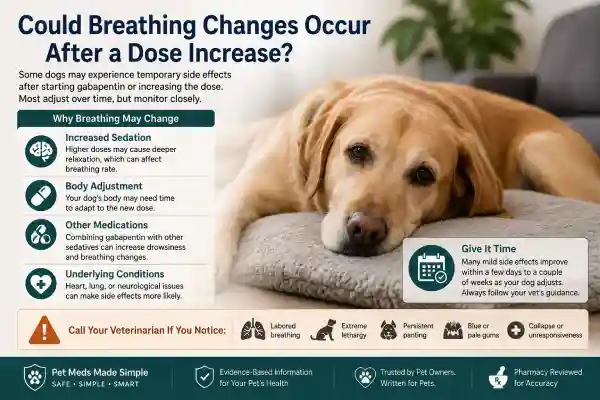
Could Breathing Changes Occur After a Dose Increase?
Sometimes.
Veterinarians occasionally see increased side effects shortly after:
- Starting treatment
- Increasing the dosage
- Adding another medication
Many dogs adjust over time, but persistent symptoms should always be discussed with a veterinarian.
Related Symptoms Owners Often Search For
Owners searching can gabapentin cause breathing problems in dogs frequently search for:
Panting
Related article: Why Is My Dog Panting After Gabapentin?
Weakness
Related article: Can Gabapentin Cause Weakness in Dogs?
Wobbliness
Related article: Why Is My Dog Wobbly After Gabapentin?
Confusion
Related article: Can Anxiety Medication Cause Confusion in Dogs?
Hyperactivity
Related article: Why Is My Dog Hyper After Gabapentin?
Restlessness
Related article: Why Is My Dog Restless at Night on Gabapentin?
Aggression
Related article: Can Gabapentin Cause Aggression in Dogs?
Sleeping More
Related article: Why Does My Dog Sleep So Much on Gabapentin?
Vomiting
Related article: Why Is My Dog Vomiting After Gabapentin?
Shaking
Related article: Can Gabapentin Cause Shaking in Dogs?
What Questions Should Owners Ask Their Veterinarian?
Helpful questions include:
- Is this normal panting or a breathing problem?
- Could another medication be contributing?
- Is my dog’s dosage appropriate?
- Could pain be causing the breathing changes?
- Does my dog need further testing?
- What signs should prompt an emergency visit?
These conversations can help clarify whether the symptoms are medication-related.
Veterinarian Takeaway
Can gabapentin cause breathing problems in dogs? Significant breathing problems are uncommon when gabapentin is used appropriately. However, overdose, excessive sedation, underlying disease, advanced age, or combination therapy with other sedating medications may increase risk. Any dog showing true respiratory distress should be evaluated immediately by a veterinarian.
Bottom Line
If you’re wondering can gabapentin cause breathing problems in dogs, the answer is that serious respiratory complications are uncommon but possible under certain circumstances.
Most cases of increased breathing or panting are more likely to be associated with:
- Anxiety
- Pain
- Underlying illness
- Medication combinations
- Sedation-related changes
Because breathing problems can occasionally indicate a medical emergency, owners should never ignore significant changes in respiratory effort.
Frequently Asked Questions – Can Gabapentin Cause Breathing Problems in Dogs?
Can gabapentin cause breathing problems in dogs?
Serious breathing problems are uncommon but may occur in certain situations such as overdose or excessive sedation.
Is panting the same as respiratory distress?
No. Panting is common and often harmless, while respiratory distress involves increased breathing effort.
Can gabapentin slow a dog’s breathing?
Significant respiratory depression is uncommon at prescribed doses.
Are senior dogs more sensitive to breathing-related side effects?
Potentially. Older dogs may be more sensitive to sedation and medication effects.
Can gabapentin and trazodone together affect breathing?
Combination therapy may increase sedation, which is why veterinary monitoring is important.
Could pain cause fast breathing?
Yes. Pain is a common cause of increased respiratory rate.
What breathing signs are emergencies?
Labored breathing, blue gums, collapse, and open-mouth breathing at rest require immediate veterinary attention.
Can an overdose cause breathing abnormalities?
Yes. Overdose may increase the risk of serious side effects.
Should I stop gabapentin if my dog is panting?
Do not stop medication without veterinary guidance.
When should I call my veterinarian?
Any persistent breathing change, severe panting, weakness, collapse, or respiratory distress warrants veterinary evaluation.
Reviewed By
Pharmacy Reviewed By
Dimitar Atanasov, MPharm
Master Pharmacist | Medication Safety Educator
Editorial Policy
At Pet Meds Made Simple, we are committed to providing accurate, evidence-based information about pet medications, veterinary treatments, medication safety, and common health concerns that affect dogs and cats.
Our content is researched using veterinary reference texts, peer-reviewed veterinary literature, clinical guidelines, and trusted veterinary organizations. Every article is written with the goal of helping pet owners better understand their pet’s medications while supporting—not replacing—the advice of their veterinarian.
Read our full Editorial Policy:
Sources
- Plumb’s Veterinary Drug Handbook
- American Animal Hospital Association (AAHA)
- American Veterinary Medical Association (AVMA)
- Merck Veterinary Manual
- Veterinary Pharmacology and Therapeutics
- Small Animal Clinical Pharmacology
- Journal of the American Veterinary Medical Association (JAVMA)
- Frontiers in Veterinary Science
- Veterinary Anaesthesia and Analgesia
- Veterinary Information Network (VIN)
Medical Review Statement
This article was pharmacy-reviewed by Dimitar Atanasov, MPharm, Master Pharmacist, using current veterinary pharmacology references, canine pain-management guidelines, and published veterinary literature available at the time of review.
iamge created with AI – Can Gabapentin Cause Breathing Problems in Dogs?