Quick Answer
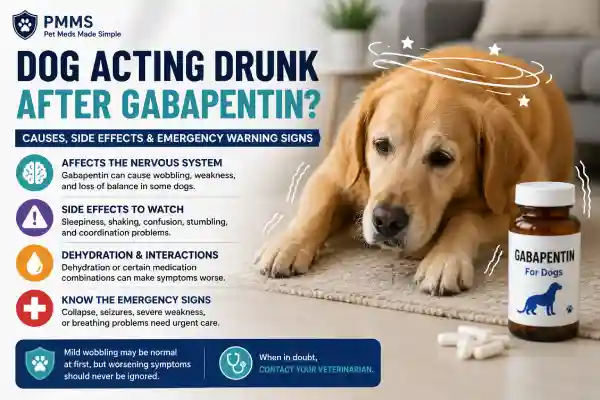
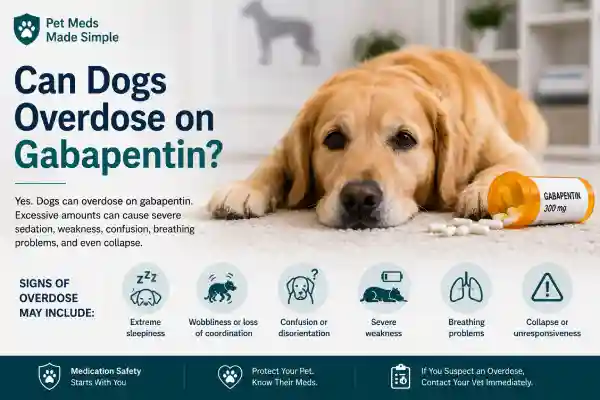
Can dogs overdose on gabapentin? Yes. Although gabapentin is generally considered relatively safe when prescribed appropriately, dogs can overdose if they receive excessive amounts. Signs may include extreme sleepiness, severe weakness, wobbliness, confusion, loss of coordination, and, in severe cases, breathing difficulties or collapse. Any suspected overdose should be treated as a veterinary emergency.
Can dogs overdose on gabapentin?
Yes. Dogs can overdose on gabapentin if they receive too much medication or accidentally ingest multiple tablets or capsules. Common overdose signs include severe sedation, weakness, wobbliness, disorientation, and difficulty walking. Veterinary attention should be sought immediately if an overdose is suspected.
When Owners Commonly Ask This
Owners often search can dogs overdose on gabapentin after situations such as:
- Giving a double dose by mistake
- Accidentally repeating a dose
- A family member giving an extra dose
- A dog chewing into a medication bottle
- Uncertainty about whether a dose was already given
- A dog consuming human gabapentin capsules
Many owners realize the mistake only after noticing unusual behavior.
Can Gabapentin Overdose Actually Happen?
Yes.
While gabapentin often has a wider safety margin than some medications, excessive amounts can still cause serious problems.
The risk depends on:
- Amount consumed
- Dog’s size
- Age
- Overall health
- Kidney function
- Other medications being taken
This is why any suspected overdose should be discussed with a veterinarian immediately.
Can Dogs Overdose on Gabapentin?
What Happens During a Gabapentin Overdose?
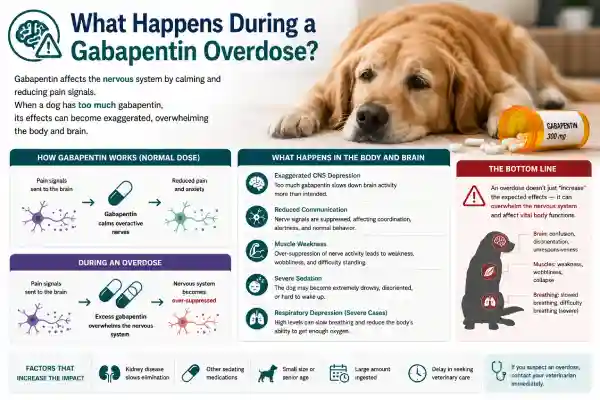
Gabapentin affects the nervous system.
When excessive amounts are present, the medication’s effects may become exaggerated.
Instead of mild sedation, a dog may develop:
- Extreme sleepiness
- Severe weakness
- Poor coordination
- Mental dullness
- Difficulty standing
- Excessive drooling
The severity varies considerably from one dog to another.
What Are the Early Signs of Gabapentin Overdose?
Owners may notice:
Excessive Sleepiness
Much more pronounced than expected.
Weakness
Difficulty standing or walking normally.
Wobbliness
Loss of coordination and balance.
Confusion
Appearing disoriented or unaware of surroundings.
Unusual Behavior
Acting different than normal.
Reduced Responsiveness
Slower reactions to familiar people or commands.
Related articles:
- Why Is My Dog Weak After Gabapentin?
- Can Anxiety Medication Cause Confusion in Dogs?
- Can Gabapentin Affect Dog Personality?
What Are More Serious Signs?
As overdose severity increases, dogs may develop:
Inability to Stand
Marked weakness or collapse.
Severe Disorientation
Profound confusion.
Breathing Difficulties
Potentially life-threatening.
Unresponsiveness
Failure to react normally.
Collapse
Requires immediate veterinary attention.
Related article:
Can Gabapentin Cause Breathing Problems in Dogs?
Can a Double Dose Cause an Overdose?
Not always.
Many owners accidentally give:
- One extra dose
- A repeated dose
- A slightly larger dose
The outcome depends on:
- The amount involved
- The dog’s weight
- The dog’s overall health
Even when symptoms remain mild, owners should still contact their veterinarian for guidance.
What If My Dog Ate an Entire Bottle?
This should always be treated as an emergency.
Factors veterinarians will want to know include:
- Strength of each tablet or capsule
- Estimated number consumed
- Time of ingestion
- Dog’s weight
- Current symptoms
Do not wait for symptoms to develop before seeking help.
Can Human Gabapentin Be More Dangerous?
Potentially.
The concern is not always the gabapentin itself.
Some human formulations contain additional ingredients that may create additional risks for dogs.
Always tell your veterinarian:
- Product name
- Strength
- Manufacturer
- Any combination ingredients
Related article:
Can I Give My Dog Human Gabapentin?
Are Senior Dogs at Higher Risk?
Often, yes.
Senior dogs may:
- Process medications differently
- Have underlying kidney disease
- Be more sensitive to sedation
This may increase the likelihood of noticeable overdose effects.
Related article:
Can Senior Dogs Take Gabapentin Safely?
Could Kidney Disease Make an Overdose Worse?
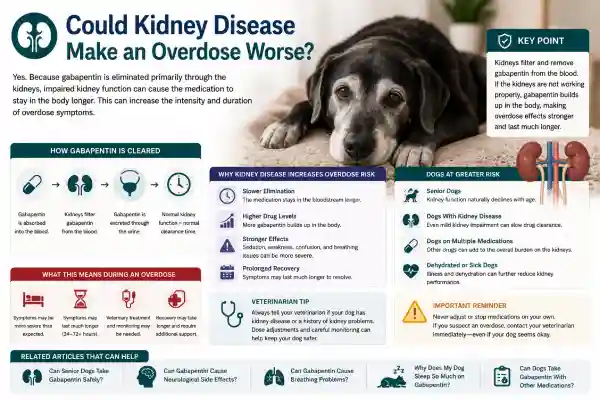
Yes.
Because gabapentin is primarily eliminated through the kidneys, impaired kidney function may allow the medication to remain in the body longer.
This can increase:
- Duration of side effects
- Severity of symptoms
- Recovery time
Dogs with kidney disease require especially careful monitoring.
Could Other Medications Increase Risk?
Absolutely.
Many dogs taking gabapentin also receive:
- Trazodone
- Pain medications
- Seizure medications
- Sedatives
Medication combinations may increase:
- Sedation
- Weakness
- Coordination problems
This is one reason veterinarians always review the entire medication list.
Related articles:
What Should Owners Do Immediately?
If overdose is suspected:
- Stay calm.
- Remove access to remaining medication.
- Determine approximately how much was consumed.
- Contact your veterinarian immediately.
- Follow professional instructions.
Do not attempt home treatments unless specifically instructed by a veterinary professional.
Can Dogs Recover From Gabapentin Overdose?
Many dogs recover successfully, especially when treatment is provided promptly.
Outcome depends on:
- Amount consumed
- Speed of intervention
- Underlying health conditions
- Presence of other medications
Early veterinary care generally improves the prognosis significantly.
How Veterinarians Treat Gabapentin Overdose
Treatment depends on:
- How much gabapentin was consumed
- When ingestion occurred
- Whether symptoms are present
- The dog’s age and health status
- Other medications involved
Veterinarians may recommend:
Monitoring
For mild exposures.
Hospitalization
For moderate to severe cases.
Intravenous Fluids
To support hydration and medication clearance.
Neurological Monitoring
To assess coordination, alertness, and response.
Supportive Care
The goal is often to support the dog while the medication is metabolized and eliminated.
Treatment plans vary significantly from case to case.
Can Gabapentin Overdose Be Fatal?
Severe outcomes are uncommon but possible.
Risk may increase when:
- Extremely large amounts are consumed
- Multiple medications are involved
- Significant underlying disease is present
- Veterinary treatment is delayed
Fortunately, many dogs recover well with appropriate veterinary care.
The most important factor is seeking help quickly.
How Long Can Overdose Symptoms Last?
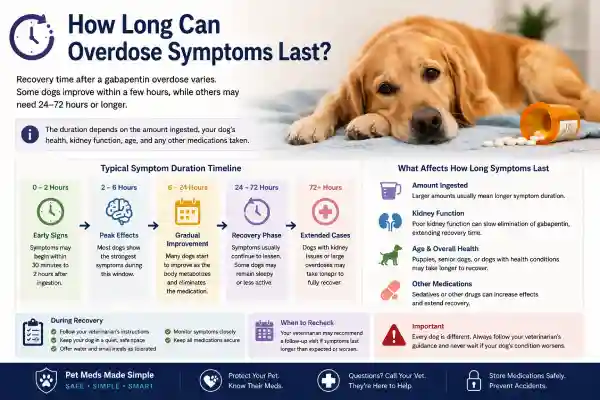
Recovery time varies.
Factors include:
- Amount consumed
- Kidney function
- Age
- Concurrent medications
- Overall health
Some dogs improve relatively quickly, while others may require longer monitoring periods.
Could Symptoms Continue Into the Next Day?
Yes.
Particularly if:
- Large amounts were consumed
- Kidney disease is present
- Multiple sedating medications were involved
Owners should continue following veterinary instructions even if symptoms appear to improve initially.
What If My Dog Seems Fine Right Now?
This is one of the biggest mistakes owners make.
A dog may appear normal shortly after ingestion.
However, symptoms can develop later as the medication is absorbed.
Do not assume everything is safe simply because your dog currently appears normal.
Always contact your veterinarian if overdose is suspected.
When Does Gabapentin Overdose Become an Emergency?
Seek immediate veterinary care if your dog develops:
Collapse
Any collapse should be treated as an emergency.
Severe Weakness
Particularly inability to stand.
Extreme Sedation
Difficulty waking or responding normally.
Breathing Difficulties
Labored or abnormal breathing.
Unresponsiveness
Failure to react to surroundings.
Severe Disorientation
Profound confusion or inability to function normally.
Could Overdose Cause Neurological Symptoms?
Yes.
Excessive amounts may affect the nervous system and cause:
- Confusion
- Severe wobbliness
- Tremors
- Weakness
- Abnormal behavior
- Reduced responsiveness
Could Overdose Look Like a Personality Change?
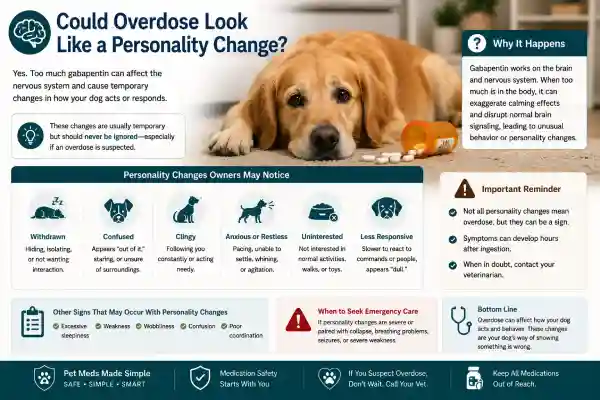
Sometimes.
Owners may notice:
- Unusual behavior
- Withdrawal
- Excessive clinginess
- Confusion
- Loss of interest in normal activities
These changes are often temporary but still require veterinary evaluation if overdose is suspected.
Related article:
Can Gabapentin Affect Dog Personality?
Related Symptoms Owners Often Search For
Owners searching can dogs overdose on gabapentin frequently search for:
Weakness
Related article: Why Is My Dog Weak After Gabapentin?
Breathing Problems
Related article: Can Gabapentin Cause Breathing Problems in Dogs?
Excessive Sleepiness
Related article: Why Does My Dog Sleep So Much on Gabapentin?
Vomiting
Related article: Why Is My Dog Vomiting After Gabapentin?
Shaking
Related article: Can Gabapentin Cause Shaking in Dogs?
Personality Changes
Related article: Can Gabapentin Affect Dog Personality?
Missing a Dose
Related article: What Happens If My Dog Misses Gabapentin?
Withdrawal
Related article: Why Does Gabapentin Stop Working in Dogs?
What Questions Should Owners Ask Their Veterinarian?
Helpful questions include:
- How much gabapentin is considered dangerous for my dog?
- Does my dog need emergency treatment?
- What symptoms should I monitor?
- Could other medications increase risk?
- How long should I watch for symptoms?
- When should I return for reevaluation?
These questions can help owners understand the situation and make informed decisions.
Veterinarian Takeaway
Can dogs overdose on gabapentin? Yes. Although gabapentin is generally considered relatively safe when prescribed appropriately, overdose can occur when excessive amounts are consumed. Symptoms may range from mild sleepiness and weakness to severe neurological signs, breathing difficulties, and collapse. Any suspected overdose should prompt immediate veterinary consultation.
Bottom Line
If you’re wondering can dogs overdose on gabapentin, the answer is yes.
Potential overdose signs include:
- Severe sleepiness
- Weakness
- Wobbliness
- Confusion
- Reduced responsiveness
- Breathing difficulties
- Collapse
Prompt veterinary care is the safest response whenever an overdose is suspected.
Frequently Asked Questions – Can Dogs Overdose on Gabapentin?
Can a dog overdose on gabapentin?
Yes. Excessive amounts can cause significant side effects and require veterinary evaluation.
What are the first signs of gabapentin overdose?
Common early signs include sleepiness, weakness, wobbliness, and confusion.
Is a double dose always dangerous?
Treat this as an emergency and seek veterinary care immediately.
What if my dog ate an entire bottle of gabapentin?
Treat this as an emergency and seek veterinary care immediately.
Can gabapentin overdose cause breathing problems?
Yes. Severe overdose may contribute to respiratory complications.
Are senior dogs at greater risk?
Often yes, particularly if kidney disease or other health problems are present.
Can overdose cause neurological symptoms?
Yes. Confusion, tremors, severe weakness, and abnormal behavior may occur.
How long do overdose symptoms last?
Recovery time varies depending on the amount consumed and the dog’s health status.
How long do overdose symptoms last?
Recovery time varies depending on the amount consumed and the dog’s health status.
Can dogs recover from gabapentin overdose?
Many dogs recover successfully with prompt veterinary treatment.
Should I wait for symptoms before calling my veterinarian?
No. Contact a veterinarian immediately if an overdose is suspected.
Reviewed By
Pharmacy Reviewed By
Dimitar Atanasov, MPharm
Master Pharmacist | Medication Safety Educator
Editorial Policy
At Pet Meds Made Simple, we are committed to providing accurate, evidence-based information about pet medications, veterinary treatments, medication safety, and common health concerns that affect dogs and cats.
Our content is researched using veterinary reference texts, peer-reviewed veterinary literature, clinical guidelines, and trusted veterinary organizations. Every article is written with the goal of helping pet owners better understand their pet’s medications while supporting—not replacing—the advice of their veterinarian.
Read our full Editorial Policy:
Sources
- Plumb’s Veterinary Drug Handbook
- American Animal Hospital Association (AAHA)
- American Veterinary Medical Association (AVMA)
- Merck Veterinary Manual
- Veterinary Pharmacology and Therapeutics
- Small Animal Clinical Pharmacology
- Journal of the American Veterinary Medical Association (JAVMA)
- Frontiers in Veterinary Science
- Veterinary Anaesthesia and Analgesia
- Veterinary Information Network (VIN)
- ASPCA Animal Poison Control Center