Quick Answer
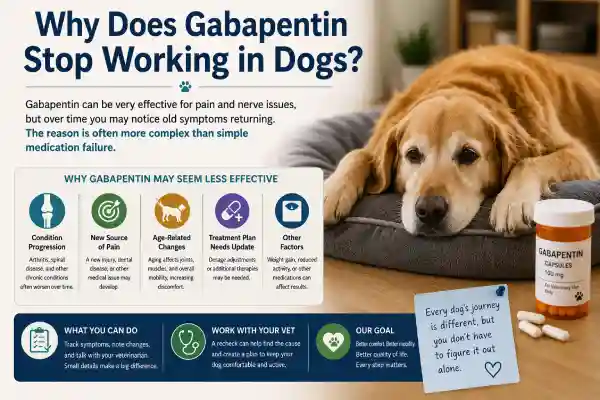
Why does gabapentin stop working in dogs? In many cases, gabapentin has not actually stopped working. Instead, the condition being treated may have progressed, your dog’s pain may have increased, or another medical problem may have developed. Dogs with arthritis, nerve pain, chronic spinal disease, and other long-term conditions often require treatment adjustments over time. If your dog suddenly seems less comfortable despite gabapentin, a veterinary re-evaluation is usually the best next step.
Many owners become worried after seeing gabapentin work well for weeks or months and then noticing old symptoms returning.
At first, their dog seems more comfortable.
Walking improves.
Sleep improves.
Daily activities become easier.
Then something changes.
The limp returns.
The whining comes back.
The dog seems slower and less interested in activity.
Naturally, owners begin asking:
“Why does gabapentin stop working in dogs?”
The good news is that the answer is often more complex—and more manageable—than complete medication failure.
When Owners Commonly Ask This
Most owners start searching for answers when they notice changes such as:
- Their dog is becoming stiff again.
- Pain seems to be returning.
- Mobility is declining.
- The dog is crying despite medication.
- Daily walks are becoming shorter.
- Their dog appears uncomfortable at night.
- Symptoms that previously improved are becoming noticeable again.
This concern is especially common among owners of senior dogs and dogs receiving long-term treatment.
Related articles:
- Can Dogs Take Gabapentin Long-Term Safely?
- Can Senior Dogs Safely Take Anxiety Medication?
- How Long Does Gabapentin Last in Dogs?
Does Gabapentin Actually Stop Working?
Sometimes, but not usually in the way owners imagine.
Most dogs do not suddenly become immune to gabapentin.
Instead, veterinarians often discover that the situation surrounding the dog has changed.
The medication may still be helping.
However, the condition being treated may have become more severe than before.
For example, a dog with moderate arthritis may eventually develop severe arthritis.
The same dose that once provided excellent relief may no longer provide the same level of comfort.
In this situation, gabapentin has not truly stopped working.
The dog’s needs have simply changed.
Why Does Gabapentin Stop Working in Dogs?
The Condition Being Treated May Be Progressing
This is one of the most common explanations.
Many conditions treated with gabapentin are progressive by nature.
Examples include:
- Arthritis
- Degenerative joint disease
- Chronic spinal disease
- Intervertebral disc disease
- Neurological disorders
- Chronic nerve pain
These conditions often worsen over time.
As a result, a treatment plan that worked well six months ago may no longer be sufficient today.
Pain Is Not Always Coming From the Same Source
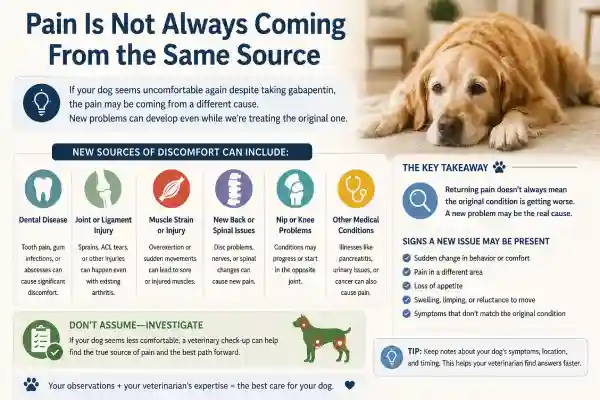
Owners often assume that returning symptoms mean the original condition is getting worse.
Sometimes that is true.
Other times, veterinarians discover an entirely new problem.
A dog receiving gabapentin for arthritis may later develop:
- Dental disease
- Hip injury
- Knee problems
- Muscle strain
- New spinal issues
In these situations, gabapentin may still be helping the original condition while another source of discomfort develops.
Age Changes How Dogs Experience Chronic Pain
As dogs age, their bodies change.
Muscle mass declines.
Joint disease progresses.
Recovery becomes slower.
Mobility becomes more difficult.
Senior dogs often require periodic adjustments to their treatment plans because their overall health changes with time.
Related articles:
- Can Dogs Take Gabapentin Long-Term Safely?
- Can Gabapentin Cause Weakness in Dogs?
- Why Is My Dog Wobbly After Gabapentin?
Sometimes the Treatment Plan Needs Updating
Veterinary medicine rarely relies on a single medication forever.
As conditions evolve, treatment plans often evolve as well.
Your veterinarian may decide to:
- Adjust the dosage
- Change the dosing schedule
- Add another medication
- Introduce rehabilitation therapy
- Recommend weight management
- Investigate new medical conditions
The goal is always to improve comfort while maintaining safety.
What Signs Suggest Gabapentin May No Longer Be Providing Enough Support?
Many owners notice subtle changes before major ones.
More Difficulty Standing Up
Dogs may take longer to rise from resting positions.
Increased Stiffness
Morning stiffness often becomes more noticeable.
Less Interest in Exercise
A previously active dog may become reluctant to walk.
More Restlessness
Discomfort frequently causes dogs to struggle to settle comfortably.
Increased Vocalization
Some dogs begin whining, crying, or pacing more often.
Related articles:
- Why Is My Dog Crying Despite Gabapentin?
- Why Does My Dog Follow Me Everywhere After Medication?
- Can Dogs Become Emotionally Numb on Anxiety Medication?
Could Another Medication Be Affecting Things?
Possibly.
Dogs taking multiple medications may experience changes that owners mistakenly attribute to gabapentin.
For example, medication combinations can influence:
- Energy levels
- Mobility
- Appetite
- Sleep
- Behavior
Related articles:
- Can Dogs Take Prozac and Trazodone Together?
- Can Dogs Take CBD With Anxiety Medication?
- Can Dogs Take Melatonin With Anxiety Medication?
This is one reason veterinarians review the entire medication list during follow-up visits.
Why Symptom Tracking Can Be Extremely Helpful
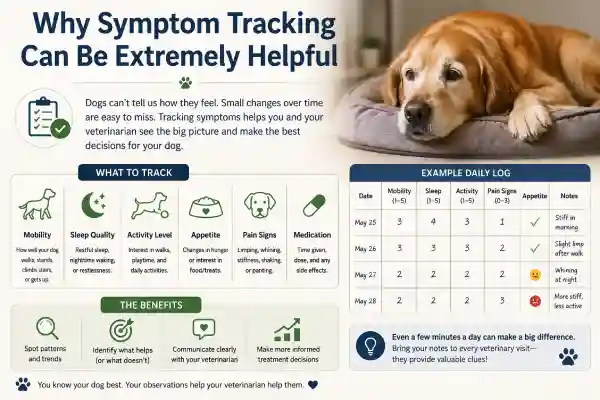
Owners often remember that their dog seems worse but struggle to identify exactly when the changes began.
Simple symptom tracking can help.
Consider monitoring:
- Walking ability
- Stair use
- Sleep quality
- Activity level
- Appetite
- Medication timing
Patterns often emerge that help veterinarians identify the underlying cause.
How Veterinarians Evaluate Reduced Effectiveness
When a dog seems less comfortable despite gabapentin, veterinarians usually investigate several possibilities.
They may ask:
- Has the condition progressed?
- Has a new injury occurred?
- Has weight increased?
- Have mobility habits changed?
- Has another illness developed?
- Have medications changed recently?
The objective is not simply increasing medication.
The objective is understanding why symptoms are changing.
Related Symptoms Owners Often Notice
Owners who believe gabapentin is becoming less effective frequently report additional symptoms.
Increased Crying
Related article:
Why Is My Dog Crying Despite Gabapentin?
Weakness
Related article:
Can Gabapentin Cause Weakness in Dogs?
Wobbliness
Related article:
Why Is My Dog Wobbly After Gabapentin?
Anxiety-Like Behavior
Related article:
Can Gabapentin Cause Anxiety in Dogs?
Noise Sensitivity
Related article:
Why Is My Dog Sensitive to Noise Suddenly?
Clinginess
Related article:
Why Does My Dog Follow Me Everywhere After Medication?
Rebound Anxiety Symptoms
Related article:
What Causes Rebound Anxiety in Dogs?
Notice how these symptoms do not automatically mean gabapentin has failed.
Instead, they may indicate that your dog’s overall condition needs reassessment.
When Reduced Effectiveness Becomes Concerning
Contact your veterinarian if:
- Pain is clearly returning.
- Mobility is worsening.
- Daily activities are becoming difficult.
- Your dog cries frequently.
- Falls are occurring.
- Quality of life is declining.
- New symptoms appear unexpectedly.
The earlier changes are investigated, the easier they are often to address.
What Owners Can Do If Gabapentin Seems Less Effective
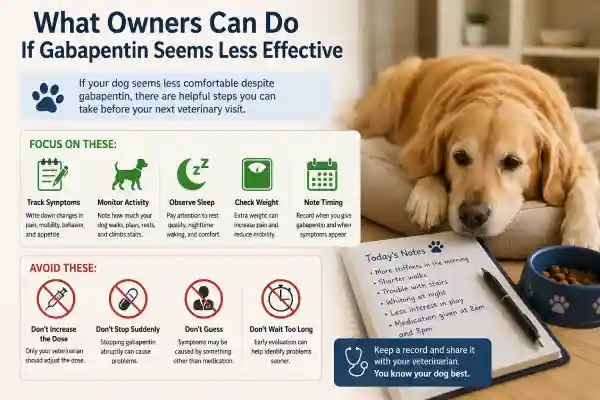
The best approach is observation rather than immediate medication changes.
Focus on:
- Recording symptoms
- Monitoring activity
- Tracking comfort levels
- Watching for new problems
Avoid:
- Increasing doses yourself
- Stopping medication suddenly
- Assuming the medication has completely failed
Your veterinarian can determine whether treatment adjustments are needed.
Veterinarian Takeaway
Why does gabapentin stop working in dogs? In many cases, the medication itself has not stopped working. Instead, chronic conditions such as arthritis, nerve pain, or spinal disease may progress over time. New medical issues may also develop. If your dog appears less comfortable than before, a veterinary evaluation can help identify the cause and determine whether the treatment plan should be adjusted.
Bottom Line
Many owners assume that returning symptoms mean gabapentin has stopped working.
Often, that is not the case.
Dogs change.
Medical conditions change.
Pain levels change.
Treatment plans sometimes need to change as well.
If your dog appears less comfortable despite gabapentin, focus on identifying what has changed rather than assuming the medication has failed. Working closely with your veterinarian often leads to the best outcome.
Frequently Asked Questions – Why Does Gabapentin Stop Working in Dogs?
Can dogs become resistant to gabapentin?
True resistance is uncommon. More often, the underlying condition progresses over time.
Why is my dog painful again despite gabapentin?
The original condition may have worsened, or a new source of pain may have developed.
Can arthritis make gabapentin seem less effective?
Yes. Progressive arthritis is one of the most common reasons owners notice reduced comfort.
Should I increase my dog’s gabapentin dose?
No. Dosage changes should only be made under veterinary supervision.
Can senior dogs need more medication over time?
Sometimes. Senior dogs often experience changing mobility and pain-management needs.
Does long-term gabapentin use become less effective?
Not necessarily. Many dogs benefit from long-term treatment for years.
Can another illness affect how well gabapentin works?
Yes. New medical conditions can change your dog’s comfort and behavior.
Can weight gain affect pain control?
Yes. Extra weight can place additional stress on joints and mobility.
What symptoms suggest my dog’s condition is worsening?
Increased limping, stiffness, crying, weakness, or reduced activity may indicate progression.
When should I contact my veterinarian?
Any significant decline in comfort, mobility, or quality of life deserves veterinary attention.
Reviewed By
Pharmacy Reviewed By
Dimitar Atanasov, MPharm
Master Pharmacist | Medication Safety Educator
Editorial Policy
At Pet Meds Made Simple, our content is researched using current veterinary references, peer-reviewed literature, and established veterinary guidelines. Every article is reviewed for medication safety, accuracy, and owner education.
Read our full Editorial Policy:
Sources
- Merck Veterinary Manual
- American Veterinary Medical Association (AVMA)
- American Animal Hospital Association (AAHA)
- FDA Center for Veterinary Medicine
- Veterinary Information Network (VIN)
- American College of Veterinary Internal Medicine (ACVIM)
- Plumb’s Veterinary Drug Handbook
- Veterinary Pharmacology and Therapeutics
- Current veterinary pain management guidelines
- Peer-reviewed research on gabapentin use in dogs
images created with AI – Why Does Gabapentin Stop Working in Dogs?