

What is the best time to give buspirone to dogs?
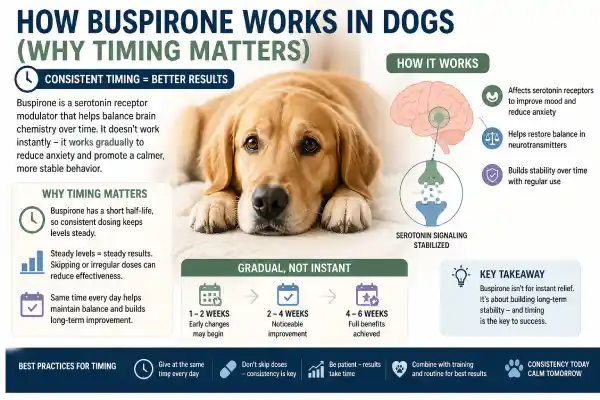
The best time to give buspirone to dogs is consistently at the same time every day, usually morning and evening, depending on the prescribed dosing schedule. Unlike fast-acting medications, buspirone works gradually, so timing consistency is more important than giving it right before an anxiety trigger.
Buspirone is commonly used for mild to moderate chronic anxiety, and its effectiveness depends heavily on how regularly it is given.
As a pharmacist, I’ll say this clearly:
👉 Buspirone is not about “when anxiety happens” — it’s about building stability over time
➡️ Learn full guide:
Buspirone for Dogs: Anxiety Treatment Explained (Vet-Backed Guide)
How Buspirone Works in Dogs (Why Timing Matters)
Buspirone is a serotonin receptor modulator, which means it gradually affects the brain’s chemistry rather than producing an immediate calming effect. Unlike medications such as alprazolam or trazodone, buspirone does not sedate quickly or stop anxiety instantly. Instead, it works by stabilizing neurotransmitter activity over time, leading to more balanced behavior.
Because of this mechanism, timing is not about reacting to anxiety—it’s about maintaining steady levels of the medication in the bloodstream. When buspirone is given consistently, it helps create a stable emotional baseline, reducing overall anxiety intensity and making dogs less reactive to stress triggers.
If doses are given at irregular times or skipped, the drug levels fluctuate. This can lead to:
- Reduced effectiveness
- Delayed response
- Inconsistent behavior improvement
Another important factor is that buspirone has a relatively short half-life, meaning it does not stay in the body for extended periods. This is why it is often prescribed two to three times daily, depending on the case.
👉 The key takeaway:
Buspirone works best when it is part of a routine, not a reaction
➡️ Internal links:
- What Can I Give My Dog for Anxiety? (Full Comparison Guide)
- Best Anxiety Medication for Dogs (Comparison Guide – Vet-Backed)
Best Time to Give Buspirone to Dogs
Best Time of Day to Give Buspirone
The best time to give buspirone depends on the dosing schedule prescribed by your veterinarian, but most commonly it is given:
✔ Twice daily (every 12 hours)
✔ Three times daily (every 8 hours)
Typical Schedule Examples
- Morning → 8:00 AM
- Evening → 8:00 PM
OR
- Morning → 8:00 AM
- Afternoon → 2:00 PM
- Night → 8:00 PM
The most important factor is consistency, not the exact hour.
Giving buspirone at the same times each day helps:
- Maintain stable blood levels
- Improve effectiveness
- Reduce fluctuations in behavior
Should It Be Given Before Anxiety Triggers?
👉 Not necessarily.
Buspirone is not a situational medication, so giving it right before a stressful event will not provide immediate relief.
However, in some cases, maintaining consistent dosing can:
- Reduce baseline anxiety
- Improve response to triggers
Table: Buspirone Timing vs Fast-Acting Medications
| Medication | Timing Strategy | Purpose |
|---|---|---|
| Buspirone | Fixed schedule | Long-term control |
| Alprazolam | Before event | Fast relief |
| Trazodone | Before/after event | Moderate control |
| Fluoxetine | Daily | Chronic anxiety |
How Long Before You See Results?

One of the biggest misunderstandings about buspirone is expecting immediate results. Unlike fast-acting medications, buspirone requires time to build up its effects.
Typical Timeline
- First changes → 1–2 weeks
- Noticeable improvement → 2–4 weeks
- Full effect → 4–6 weeks
During this period, consistent timing becomes even more important. Missing doses or changing the schedule can delay progress and make it seem like the medication isn’t working.
Why It Takes Time
Buspirone gradually:
- Adjusts serotonin signaling
- Reduces baseline anxiety
- Improves behavioral stability
This slow mechanism is actually beneficial because it avoids:
✔ Heavy sedation
✔ Sudden behavioral changes
✔ Dependency risks
👉 But it requires patience and consistency.
Common Timing Mistakes
❌ Giving buspirone only when needed
❌ Skipping doses
❌ Changing timing daily
❌ Expecting immediate results
One of the most common mistakes is treating buspirone like a fast-acting drug. Owners often give it only before stressful events and then assume it doesn’t work. This completely defeats its purpose.
Another issue is inconsistent timing. Even small variations (several hours difference) can lead to fluctuations in drug levels, reducing effectiveness.
Skipping doses is particularly problematic because it disrupts the steady-state concentration needed for therapeutic benefit.
👉 The biggest mistake is misunderstanding its role:
Buspirone is a foundation medication, not a rescue drug
Best Strategy: Consistency + Combination Therapy

For many dogs, the best results come from combining buspirone with other approaches rather than relying on it alone.
Typical Strategy
- Buspirone → daily baseline control
- Trazodone → situational support
- Alprazolam → emergency use
This layered approach allows:
✔ Stable long-term anxiety control
✔ Flexibility for stressful events
✔ Lower doses of each medication
Behavioral Support Is Critical
Medication works best when combined with:
- Training
- Routine
- Environmental control
For example:
- Feeding at the same time daily
- Consistent walking schedule
- Calm travel environment
👉 These factors enhance the effect of buspirone significantly.
Table: Ideal Buspirone Routine
| Time | Action |
|---|---|
| Morning | Give dose + feed |
| Afternoon | Optional dose (if prescribed) |
| Evening | Give dose + calm routine |
Pro Tips for Best Results
✔ Give at the same time every day
✔ Do not skip doses
✔ Be patient (results take weeks)
✔ Combine with behavioral strategies
To maximize effectiveness, build buspirone into your dog’s daily routine. For example, give it with meals to make it easier to remember and to reduce the risk of missed doses.
Consistency is everything. Even if the medication seems like it’s not working initially, continuing the same schedule is critical for achieving full benefits.
Another important tip is to track progress. Small improvements—like reduced reactivity or calmer behavior—can be easy to miss but indicate the medication is working.
Finally, don’t hesitate to adjust the plan with your veterinarian. Some dogs respond better to slightly different schedules or combination therapy.
👉 The goal is steady, predictable improvement—not immediate sedation.
FAQ
What is the best time to give buspirone to dogs?
At the same time every day, usually morning and evening.
Can I give buspirone only before anxiety events?
No, it must be given regularly to be effective.
How long does buspirone take to work in dogs?
2–6 weeks for full effect.
Can it be combined with other medications?
Yes, under veterinary supervision.
Is buspirone sedating?
Usually mild or non-sedating.
Conclusion
Buspirone works best when used consistently—not occasionally.
✔ Fixed daily schedule
✔ Long-term anxiety control
✔ Works gradually over time
👉 The key is routine, patience, and consistency
Medical Disclaimer
This content is for informational purposes only and does not replace professional veterinary advice.
Sources
American Veterinary Medical Association
Merck Veterinary Manual
VCA Animal Hospitals
Veterinary Information Network (VIN)