

Quick Answer
Can Meloxicam Cause Kidney Damage in Dogs? – Yes, meloxicam can cause kidney damage in dogs, especially if the dog is dehydrated, has pre-existing kidney disease, receives too high a dose, or takes meloxicam with another NSAID or steroid. Meloxicam is a veterinary NSAID used for pain and inflammation, but NSAIDs can reduce protective blood flow to the kidneys in high-risk situations, which may lead to acute kidney injury.
For healthy dogs using the correct dose under veterinary supervision, meloxicam is commonly used and often well tolerated. The danger rises when owners give extra doses, combine it with human painkillers, or continue it when the dog stops eating, vomits, has diarrhea, or becomes dehydrated.
What Is Meloxicam?
Meloxicam is a non-steroidal anti-inflammatory drug, also called an NSAID. In dogs, it is commonly prescribed for:
- arthritis pain
- joint inflammation
- post-surgical pain
- limping related to inflammation
- chronic musculoskeletal pain
It works by reducing inflammatory chemicals called prostaglandins. That helps with pain and swelling, but prostaglandins also have protective roles in the stomach, intestines, kidneys, and blood flow. This is why NSAIDs can sometimes cause digestive, liver, or kidney side effects.
Internal link: Is meloxicam safe for dogs?
Can Meloxicam Cause Kidney Damage in Dogs?
Yes. Meloxicam can contribute to kidney damage in some dogs, especially when the kidneys are already under stress.
The kidney risk is not unique to meloxicam. It is a known risk of the NSAID drug class. The FDA explains that NSAIDs may reduce kidney blood flow and, in some cases, lead to kidney damage or sudden kidney failure.
That does not mean every dog taking meloxicam will develop kidney failure. Many dogs take meloxicam safely when:
- the dose is correct
- the dog is hydrated
- kidney values are monitored
- no other NSAID or steroid is given at the same time
- the dog is eating normally
- the veterinarian checks risk factors first
The problem usually appears when meloxicam is used in the wrong dog, at the wrong dose, for too long without monitoring, or during illness.
Can Meloxicam Cause Kidney Damage in Dogs?
How Meloxicam Can Affect the Kidneys
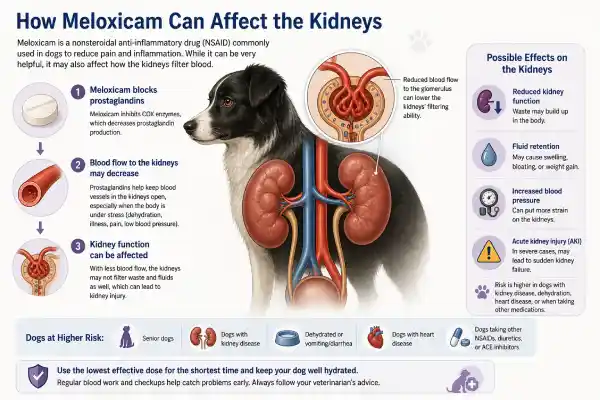
The kidneys need steady blood flow to filter waste from the body. Prostaglandins help support kidney blood flow during stressful situations such as dehydration, low blood pressure, or illness.
Meloxicam reduces prostaglandin activity. In a healthy, stable dog, this may not cause a problem. But in a dog with dehydration, vomiting, diarrhea, heart disease, low blood pressure, or existing kidney disease, the kidneys may depend more heavily on prostaglandins to maintain blood flow.
When that protective system is blocked, kidney filtration can drop. In severe cases, this may contribute to acute kidney injury.
Internal link: NSAID Toxicity in Dogs: Signs & What to Do
Dogs at Higher Risk of Kidney Damage from Meloxicam
| Higher-Risk Situation | Why It Matters |
|---|---|
| Pre-existing kidney disease | Kidneys have less reserve capacity |
| Dehydration | Kidney blood flow may already be reduced |
| Vomiting or diarrhea | Fluid loss increases kidney stress |
| Senior dogs | More likely to have hidden kidney/liver issues |
| Heart disease | Circulation may be less stable |
| High dose or accidental overdose | Increases toxicity risk |
| Long-term use without blood tests | Problems may be missed early |
| Combining with another NSAID | Greatly increases adverse effect risk |
| Combining with steroids | Higher risk of GI and kidney complications |
| Poor appetite | Often a warning sign and dehydration risk |
Warning Signs of Kidney Problems in Dogs Taking Meloxicam
Contact your veterinarian urgently if your dog develops:
- increased thirst
- increased urination
- reduced urination
- vomiting
- diarrhea
- loss of appetite
- lethargy
- weakness
- bad breath or mouth ulcers
- pale gums
- collapse
- black or bloody stool
Kidney-related NSAID problems may not always appear immediately. Some toxicity signs can appear after 24–72 hours, especially after overdose or repeated dosing mistakes.
Normal Side Effects vs Kidney Warning Signs
| Sign | Mild / Common NSAID Reaction | More Concerning Kidney Warning |
|---|---|---|
| Mild soft stool | Possible | Monitor closely |
| One episode of vomiting | Possible | Call vet if repeated |
| Not eating | Concerning | Stop and call vet |
| Drinking more water | Not typical | Kidney warning sign |
| Urinating more | Not typical | Kidney warning sign |
| Extreme tiredness | Concerning | Possible systemic problem |
| Collapse | Emergency | Immediate vet care |
| Black stool | Emergency | Possible GI bleeding |
Important: If a dog on meloxicam stops eating, vomits repeatedly, develops diarrhea, or becomes lethargic, do not simply give the next dose. Call your vet first.
Can One Dose of Meloxicam Damage a Dog’s Kidneys?
One correct veterinary dose is unlikely to damage the kidneys in a healthy, well-hydrated dog. However, one dose can be dangerous if:
- the dog already has kidney disease
- the dose is too high
- the dog is dehydrated
- the dog recently received another NSAID
- the dog is also taking steroids
- the dog is very old, weak, or systemically ill
This is why meloxicam should be used only under veterinary direction.
Meloxicam Overdose and Kidney Damage
Overdose is one of the biggest kidney danger scenarios.
Meloxicam overdose may happen when:
- an owner gives an extra dose too soon
- the dog receives human meloxicam tablets
- the wrong oral syringe measurement is used
- a small dog receives a large-dog dose
- two family members accidentally dose the dog
- meloxicam is combined with aspirin, ibuprofen, carprofen, deracoxib, or another NSAID
Internal link: How Much Ibuprofen Is Toxic to Dogs?
Never Combine Meloxicam With These Without Vet Approval
| Do Not Combine With Meloxicam | Why It Is Risky |
|---|---|
| Carprofen / Rimadyl | Another NSAID; higher kidney/GI risk |
| Deracoxib / Deramaxx | Another NSAID |
| Aspirin | NSAID; bleeding and kidney risk |
| Ibuprofen | Highly dangerous for dogs |
| Naproxen | Very toxic to dogs |
| Prednisone / steroids | Higher GI ulcer and complication risk |
| Some diuretics | May increase kidney stress |
| ACE inhibitors | Vet must assess kidney/blood pressure risk |
Internal link:
Carprofen for Dogs: Uses, Dosage & Side Effects
Rimadyl for Dogs: Uses, Dosage & Side Effects
Deracoxib vs Carprofen: Which Is Better for Dogs?
Can I Give My Dog Ibuprofen or Aspirin?
What Should You Do If Your Dog Has Kidney Disease?
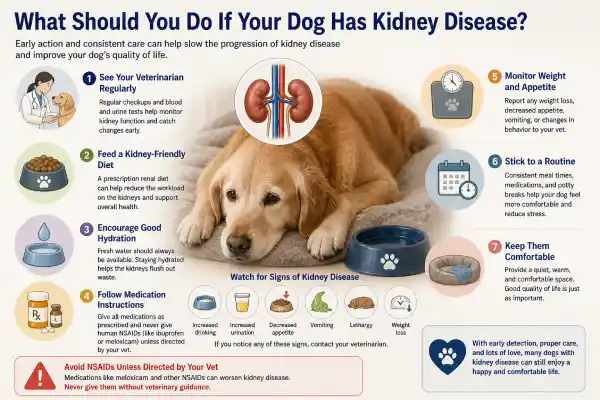
Dogs with known kidney disease should not receive meloxicam unless a veterinarian decides the benefit outweighs the risk.
Your vet may recommend:
- avoiding meloxicam completely
- using a lower-risk pain plan
- checking bloodwork before treatment
- repeating kidney values after starting
- using non-NSAID pain options
- adding joint supplements or physical therapy
- using short courses only when necessary
For chronic arthritis in kidney-sensitive dogs, veterinarians may prefer a multimodal plan instead of relying heavily on NSAIDs.
Internal link: Best Pain Medication for Dogs with Arthritis
Safer Pain Relief Alternatives for Kidney-Risk Dogs
| Option | Best For | Kidney Consideration |
|---|---|---|
| Gabapentin | Nerve pain, chronic pain support | Dose may need adjustment in kidney disease |
| Amantadine | Chronic pain, arthritis add-on | Often used as part of multimodal pain control |
| Buprenorphine | Stronger short-term pain relief | Vet-controlled opioid option |
| Physical therapy | Arthritis, mobility | Kidney-safe |
| Weight loss | Arthritis pain reduction | Kidney-safe |
| Omega-3s | Inflammation support | Usually gentle but ask vet |
| Joint supplements | Long-term support | Not a fast painkiller |
| Acupuncture/rehab | Chronic pain support | Kidney-safe |
Internal link:
Gabapentin and Kidney Disease in Dogs: Is It Safe?
Amantadine for Dogs: A Hidden Pain Management Tool
Buprenorphine for Dogs: Pain Relief Explained
Natural Pain Relief for Dogs: What Works & What Doesn’t
How Vets Reduce Kidney Risk When Using Meloxicam
Veterinarians usually reduce meloxicam risk by:
- checking medical history
- avoiding use in dehydrated or vomiting dogs
- avoiding combination with other NSAIDs or steroids
- using the lowest effective dose
- using blood tests for long-term use
- monitoring appetite, thirst, urination, and energy
- stopping the drug quickly if warning signs appear
For long-term NSAID use, monitoring kidney and liver values is especially important.Can Meloxicam Cause Kidney Damage in Dogs?
When to Stop Meloxicam and Call the Vet
Stop and call your vet if your dog has:
- vomiting
- diarrhea
- refuses food
- drinks much more water
- urinates much more or much less
- becomes weak or very tired
- develops black stool
- collapses
- seems painful despite medication
Do not restart meloxicam unless your veterinarian says it is safe.
Common Mistakes Owners Make
Giving human meloxicam tablets
Human tablets may not match safe veterinary dosing, especially for small dogs.
Combining meloxicam with aspirin
This can increase the risk of stomach bleeding and kidney injury.
Giving it when the dog is dehydrated
Vomiting, diarrhea, heat stress, or poor water intake can make NSAIDs riskier.
Continuing after appetite loss
Loss of appetite can be an early warning sign of NSAID intolerance.
Skipping bloodwork for long-term use
Kidney and liver changes may not be obvious at first.
Pro Tips for Safer Meloxicam Use

- Give only the exact dose prescribed.
- Use the correct veterinary syringe.
- Do not mix with other pain medications unless your vet approves.
- Make sure your dog is eating and drinking normally.
- Watch for increased thirst or urination.
- Ask for bloodwork if treatment is long-term.
- Store the bottle away from pets and children.
- Call your vet before giving another dose if your dog seems unwell.
FAQ – Can Meloxicam Cause Kidney Damage in Dogs?
Can meloxicam cause kidney failure in dogs?
Yes, meloxicam and other NSAIDs can contribute to kidney injury or kidney failure, especially in dehydrated dogs, dogs with kidney disease, overdose cases, or dogs taking other risky medications.
Is meloxicam safe for dogs with kidney disease?
It may not be safe. Dogs with kidney disease need veterinary evaluation before using meloxicam. In many cases, vets choose alternative pain control strategies.
What are the first signs of kidney problems from meloxicam?
Possible signs include increased thirst, increased urination, vomiting, poor appetite, lethargy, weakness, or reduced urination.
Can I give meloxicam with gabapentin?
Sometimes vets combine NSAIDs with gabapentin for multimodal pain control, but this should only be done under veterinary guidance.
Can I give meloxicam with carprofen?
No, not unless a veterinarian specifically instructs you during a controlled switch. Meloxicam and carprofen are both NSAIDs, and combining NSAIDs increases the risk of serious side effects.
Should senior dogs avoid meloxicam?
Not always, but senior dogs should usually have bloodwork before and during long-term NSAID therapy because hidden kidney or liver problems are more common with age.
What should I do if I gave too much meloxicam?
Call your veterinarian or an emergency pet poison service immediately. Do not wait for symptoms to appear.
Conclusion
Meloxicam can be an effective pain and inflammation medication for dogs, but it can also cause kidney damage in the wrong situation. The highest-risk dogs are those with dehydration, vomiting, diarrhea, kidney disease, overdose exposure, or combination use with another NSAID or steroid.
Used correctly, meloxicam may help many dogs with arthritis or post-surgical pain. Used carelessly, it can become dangerous. The safest approach is simple: use only the prescribed dose, avoid drug combinations, monitor appetite and hydration, and ask your vet about bloodwork if your dog needs long-term treatment.Can Meloxicam Cause Kidney Damage in Dogs?
Medical Disclaimer
This article is for educational purposes only and is not a substitute for veterinary diagnosis, treatment, or emergency care. Never give meloxicam, human pain medication, or any NSAID to your dog without veterinary guidance. If your dog may have received an overdose or shows vomiting, weakness, collapse, increased thirst, reduced urination, black stool, or severe lethargy, contact a veterinarian immediately.Can Meloxicam Cause Kidney Damage in Dogs?
Sources
- U.S. FDA – Get the Facts about Pain Relievers for Pets.
- U.S. FDA – Veterinary NSAIDs and serious side effects.
- VCA Hospitals – NSAIDs and kidney risks in pets.
- VCA Hospitals – Meloxicam overview.
- Pet Poison Helpline / Vetmeds – Meloxicam toxicity signs.
Image are created with AI – Can Meloxicam Cause Kidney Damage in Dogs?