
Quick Answer
How long should dogs rest after starting pain medication? There is no single rest period that applies to every dog. The medication itself does not determine how long your dog needs to rest the injury, surgery, arthritis, or other painful condition being treated does. A dog with a mild soft-tissue injury may need several days of restricted activity, while orthopedic surgery, fractures, spinal problems, or ligament injuries can require weeks of carefully controlled recovery. Dogs with arthritis often need gentle movement rather than complete rest. Pain medication can make a dog feel better before the underlying tissues have healed, so increased energy should never be interpreted as permission to return immediately to normal exercise.
How Long Should Dogs Rest After Starting Pain Medication?
If your dog suddenly seems better after the first few doses of pain medication, seeing that improvement can be encouraging.
Your dog may:
- get up more easily
- walk with less hesitation
- appear interested in playing
- follow you around the house again
- ask to go outside
- attempt to jump onto furniture
But this creates an important problem.
Pain relief can happen much faster than tissue healing.
A dog may feel considerably better within hours or days while the muscle, ligament, joint, bone, or surgical site responsible for the original pain still needs much longer to recover.
So, how long should dogs rest after starting pain medication?
The safest answer is:
Rest should be based primarily on the underlying condition and your veterinarian’s activity instructions—not on how energetic your dog appears after medication.
This distinction is especially important because pain medication can temporarily remove one of the body’s natural mechanisms for limiting activity: discomfort.
Owners interested in this relationship should also read our guide Can Dogs Exercise While Taking Pain Medication?, which explains why being able to exercise and being medically ready to exercise are not necessarily the same thing.
How Long Should Dogs Rest After Starting Pain Medication?
Pain Relief Does Not Mean the Injury Has Healed

This is probably the single most important concept for owners to understand.
Pain medications can reduce:
- discomfort
- inflammation
- stiffness
- sensitivity
- reluctance to move
But they do not instantly repair damaged tissue.
For example, an NSAID may make a dog with an orthopedic injury noticeably more comfortable while the injured tissues remain vulnerable.
Similarly, a dog recovering from surgery may become more active because medication is successfully controlling postoperative pain. The incision and deeper tissues, however, still require time to heal.
This creates what can almost be thought of as a false recovery window.
The dog feels capable of doing more than the body is actually ready to tolerate.
That is why the answer to how long should dogs rest after starting pain medication cannot simply be “until they stop limping.”
The Underlying Condition Determines the Rest Period
Different painful conditions require dramatically different activity plans.
Mild Soft-Tissue Injuries
Minor strains and sprains may improve relatively quickly.
A veterinarian may recommend a short period of restricted activity followed by a gradual return to controlled movement.
That often means:
- short leash walks
- no running
- no rough play
- no jumping
- limiting stairs when appropriate
However, even seemingly minor injuries can take longer than expected.
If limping persists or worsens despite treatment, veterinary reassessment may be needed.
Arthritis
Arthritis is completely different.
Dogs with osteoarthritis generally should not spend prolonged periods in complete inactivity simply because they have started pain medication.
Controlled movement is often an important part of long-term arthritis management.
Too little activity can contribute to:
- muscle loss
- stiffness
- reduced joint mobility
- weight gain
- declining physical conditioning
The goal is usually to find the correct balance between activity and recovery.
This becomes particularly important for dogs receiving chronic NSAID therapy. Our article Can Dogs Stay on NSAIDs for Life? discusses how veterinarians balance long-term comfort with medication safety.
Orthopedic Injuries
Ligament, tendon, joint, and bone injuries often require considerably more restriction.
Even when medication makes a dog comfortable, unrestricted activity can place excessive force on healing structures.
Running, jumping, sudden turning, or rough play may delay recovery or worsen the original injury.
For these dogs, the question “How long should dogs rest after starting pain medication?” must be answered according to the specific orthopedic diagnosis rather than the medication being used.
After Surgery
Postoperative recovery is another situation where pain relief can be misleading.
Modern pain management can make dogs remarkably comfortable shortly after surgery.
That is beneficial—but it can also make keeping an energetic dog quiet surprisingly difficult.
Your veterinarian may recommend:
- confinement
- leash-only bathroom breaks
- restricted stairs
- preventing jumping
- gradual rehabilitation
- specific exercise progression
The exact duration depends on the procedure.
Never increase activity simply because your dog appears comfortable while receiving pain medication.
Why Dogs Sometimes Become More Active After Starting Pain Medication

A sudden increase in energy is often evidence that pain relief is working.
Imagine a dog that has spent several days avoiding movement because every step hurts.
Once medication reduces that discomfort, the dog may suddenly want to:
- run
- play
- jump
- climb stairs
- chase another dog
- explore outside
Owners naturally interpret this as recovery.
But clinically, these are two separate processes:
Pain control = how comfortable the dog feels.
Healing = how physically prepared the injured tissue is for normal activity.
The first can happen much faster than the second.
That distinction should guide every decision about activity during recovery.
Can Dogs Walk While Taking Pain Medication?
Often, yes—but the type and duration of walking matter.
A veterinarian may allow short, controlled leash walks while restricting:
- running
- off-leash exercise
- jumping
- vigorous play
- sudden changes of direction
For some conditions, controlled walking helps maintain mobility and muscle strength.
For others, even walking may need to be significantly restricted temporarily.
This is why generic recommendations such as “rest for three days” are inadequate.
How long should dogs rest after starting pain medication depends on what is actually causing the pain.
Why Complete Bed Rest Is Not Always Better
More rest is not automatically better.
This is particularly important in older dogs and dogs with chronic arthritis.
Prolonged inactivity may contribute to:
- muscle wasting
- weakness
- increased stiffness
- poorer balance
- reduced cardiovascular fitness
- weight gain
An older arthritic dog that spends weeks barely moving may actually become less mobile despite receiving effective medication.
The goal is therefore not necessarily zero activity.
The goal is appropriate activity.
This may mean alternating controlled movement with adequate recovery periods rather than allowing either unrestricted exercise or prolonged inactivity.
Can Dogs Swim During the Recovery Period?
Swimming is often perceived as automatically safe because it is low-impact.
That is not always true.
Swimming still requires substantial muscular effort and repetitive joint movement. Entering and exiting the water can also place considerable stress on painful or healing tissues.
For some dogs, professionally supervised hydrotherapy can be valuable.
For others, swimming too early may interfere with recovery.
We cover this distinction in detail in Can Dogs Swim While Taking Pain Medication?
Do not use swimming as a substitute for normal exercise during a prescribed rest period unless your veterinarian specifically approves it.
How Long Should Dogs Rest After Starting NSAID Pain Medication?

NSAIDs such as carprofen, meloxicam, deracoxib, and firocoxib can produce noticeable improvement in comfort relatively quickly.
However, the onset of pain relief still does not determine the duration of rest.
A dog taking an NSAID for arthritis may benefit from regular controlled activity.
A dog receiving an NSAID after an orthopedic injury may require significant restriction.
The same medication can therefore be associated with completely different exercise recommendations.
This is another reason how long should dogs rest after starting pain medication must be determined from the diagnosis rather than the drug name alone.
Dogs receiving NSAIDs for extended periods also require appropriate safety monitoring. Our guides Do Pain Medications Affect Kidney Values in Dogs? and Do Pain Medications Affect Liver Enzymes in Dogs? explain why veterinarians sometimes recommend baseline and follow-up blood testing.
Should Senior Dogs Rest Longer After Starting Pain Medication?
Not automatically.
Age alone does not determine the correct rest period.
However, senior dogs commonly have additional factors that influence recovery, including:
- osteoarthritis
- reduced muscle mass
- poorer balance
- slower recovery after injury
- chronic kidney or liver disease
- multiple medications
A senior dog may therefore need a more gradual return to activity.
At the same time, excessive restriction can accelerate muscle loss and make mobility worse.
The objective is usually controlled, comfortable movement, tailored to the dog’s condition and physical ability.
Long-term treatment also requires monitoring for medication-related changes. For example, our recent guides Can Pain Medication Cause Increased Thirst in Dogs? and Can Pain Medication Cause Frequent Urination in Dogs? explain why new drinking or urinary changes deserve attention during treatment.
Feeling Better Does Not Mean Full Recovery
This deserves repeating because it is one of the easiest mistakes to make.
If your dog begins:
- walking normally
- asking to play
- bringing toys
- attempting to run
- jumping onto furniture
after starting pain medication, this is encouraging.
It means your dog’s comfort may be improving.
But it does not necessarily mean normal activity is safe yet.
Returning to unrestricted activity too early may:
- aggravate inflammation
- reinjure healing tissue
- worsen limping
- prolong recovery
- increase pain once medication wears off
This is especially important during the first days after an injury or procedure.
How Owners Can Make Rest Easier
Keeping a dog quiet can be surprisingly difficult once pain relief starts working.
Practical strategies may include:
- using a leash for bathroom trips
- blocking access to stairs
- preventing jumping onto furniture
- separating energetic dogs during playtime
- using non-physical enrichment
- following prescribed rehabilitation exercises
- keeping walks short and controlled
The goal is not to make your dog completely inactive unless your veterinarian specifically recommends strict confinement.
Instead, activity should match the stage of recovery.
If your dog is receiving medication for an extended period, consistent administration is equally important. Should Dogs Take Pain Medication Before Meals? explains how meal timing may affect gastrointestinal tolerance with some commonly prescribed pain medications.
What If My Dog Is Still Limping Despite Rest and Pain Medication?

Persistent limping deserves attention.
A mild limp may take time to resolve because medication controls discomfort without instantly healing the original problem.
However, contact your veterinarian if the limp:
- becomes worse
- does not improve as expected
- returns after activity
- is accompanied by swelling
- prevents weight bearing
- causes obvious distress
Persistent limping may indicate that the injury requires additional investigation, a longer recovery period, or a different treatment approach.
The important question is not simply whether your dog is taking pain medication.
It is whether the underlying condition is actually improving.
How Long Should Dogs Rest After Starting Pain Medication for a Soft-Tissue Injury?
Soft-tissue injuries are one of the most common reasons dogs receive short-term pain medication.
These injuries may involve:
- muscles
- tendons
- ligaments
- connective tissues surrounding joints
A dog with a mild strain may begin feeling substantially better after only a few doses of medication. However, the damaged tissue usually needs longer to recover than the pain takes to improve.
During the early recovery period, veterinarians may recommend controlled activity rather than normal exercise. Depending on the diagnosis, this can include short leash walks for bathroom breaks while avoiding running, jumping, rough play, and sudden turns.
The important point is that how long should dogs rest after starting pain medication cannot be determined simply by watching when the medication begins working.
The underlying tissue must have enough time to recover.
How Long Should Dogs Rest After Starting Pain Medication for Arthritis?
Arthritis requires a very different approach.
For most dogs with chronic osteoarthritis, prolonged complete rest is generally undesirable. Appropriate controlled activity helps preserve:
- muscle strength
- joint mobility
- balance
- cardiovascular fitness
- healthy body weight
The goal is usually to find an activity level that keeps the dog mobile without triggering a significant increase in pain afterward.
A dog that becomes more comfortable after starting medication may naturally want to walk farther. That improvement is encouraging, but activity should still be increased gradually.
This is particularly relevant for dogs receiving long-term NSAID therapy. Our guide Can Dogs Stay on NSAIDs for Life? discusses why chronic treatment requires an ongoing balance between mobility, pain control, and medication safety.
How Long Should Dogs Rest After Starting Pain Medication Following Surgery?
Surgery requires its own recovery plan.
A dog may appear remarkably comfortable because modern multimodal pain management can provide effective postoperative relief.
However, skin, muscle, connective tissue, bone, or other structures may still be healing underneath.
Depending on the procedure, your veterinarian may recommend:
- strict activity restriction
- leash-only bathroom breaks
- preventing jumping
- limiting stairs
- crate or small-room confinement
- controlled rehabilitation exercises
- gradual return to longer walks
Some minor procedures require relatively short restrictions, while orthopedic procedures can require weeks of carefully managed recovery.
Therefore, how long should dogs rest after starting pain medication after surgery should always be determined by the surgical procedure and veterinary recovery plan not by how energetic the dog appears.
What About Fractures and Major Orthopedic Injuries?
Fractures, severe ligament injuries, joint instability, and other major orthopedic problems deserve particularly careful activity management.
Pain relief can make these dogs feel capable of using the affected limb before the structure is ready for normal loading.
That creates a risk of reinjury.
For example, a dog may suddenly attempt to:
- jump off a couch
- run across the yard
- chase another animal
- climb stairs
- make a sharp turn
because the medication has reduced discomfort.
The fact that the dog can perform the movement does not mean the movement is safe.
For major orthopedic injuries, follow the specific activity restrictions provided by your veterinarian or veterinary surgeon.
Should a Dog Rest If the Limp Is Already Improving?

Usually, some degree of controlled recovery should continue for the period recommended by your veterinarian.
One common mistake is ending activity restrictions as soon as the limp disappears.
Pain and inflammation can improve before damaged tissues regain normal strength.
A dog may therefore walk normally around the house but still be vulnerable to reinjury during:
- running
- jumping
- prolonged walks
- vigorous play
- sudden acceleration
This is another reason the answer to how long should dogs rest after starting pain medication cannot simply be “until the limp disappears.”
If the original problem was significant enough to require restricted activity, follow the recovery plan even when your dog seems much better.
What If the Limp Returns After Exercise?
A limp that improves with rest but returns after exercise may indicate that the activity level is currently too high or that the underlying problem has not fully resolved.
This pattern deserves attention.
Owners should note:
- what activity occurred beforehand
- how long the exercise lasted
- which leg appears affected
- how long the renewed limp lasts
- whether swelling or sensitivity develops
Do not repeatedly “test” the injured limb by increasing exercise to see whether your dog can tolerate it.
If limping repeatedly returns after activity, contact your veterinarian for guidance.
This may mean the recovery period needs to be extended or the original diagnosis reassessed.
Can Too Much Rest Slow Recovery?
In some situations, yes.
This is why “rest” should not automatically be interpreted as keeping every dog completely immobile.
Prolonged inactivity can contribute to:
- muscle atrophy
- reduced joint flexibility
- weakness
- poorer balance
- reduced endurance
- weight gain
These effects can be particularly significant in senior dogs and dogs with arthritis.
Rehabilitation is therefore increasingly important in veterinary pain management.
Depending on the condition, veterinarians may recommend gradually introducing controlled exercises designed to restore strength and mobility without overloading healing tissues.
The appropriate balance between rest and movement depends on the diagnosis.
Is Rehabilitation Different From Normal Exercise?
Yes.
This distinction matters.
Normal exercise might include:
- long walks
- running
- fetch
- rough play
- swimming
- hiking
Rehabilitation is controlled and therapeutic.
It may involve:
- carefully timed leash walking
- range-of-motion exercises
- balance exercises
- controlled strengthening
- professionally supervised hydrotherapy
The purpose is not simply to tire the dog.
It is to restore function safely.
This is particularly useful when deciding how long should dogs rest after starting pain medication, because the transition from rest to normal exercise may involve a rehabilitation phase rather than an immediate return to unrestricted activity.
Should Dogs Be Allowed to Run Once Pain Medication Starts Working?
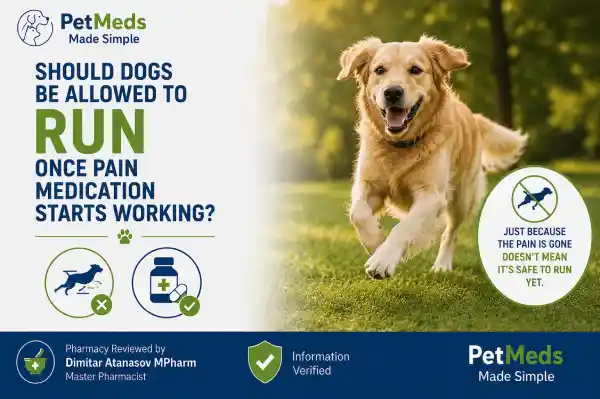
Not simply because the medication has started working.
Running places considerably more force on joints, muscles, ligaments, and healing tissues than controlled walking.
A dog may appear completely comfortable during the activity because the medication is suppressing pain.
The consequences may become obvious only afterward when the dog:
- begins limping again
- becomes stiff
- struggles to stand
- appears sore the following morning
If your veterinarian has prescribed restricted activity, running should remain restricted until specifically permitted.
What If My Dog Refuses to Rest?
This is surprisingly common.
Dogs do not understand why their activity is being restricted.
Once pain relief improves their comfort, some become even harder to keep quiet.
Useful strategies can include:
- leash-controlled bathroom breaks
- baby gates
- blocking access to stairs
- preventing furniture jumping
- separating pets during energetic play
- food puzzles
- scent-based enrichment
- calm training exercises
For dogs requiring strict postoperative or orthopedic restriction, your veterinarian may suggest additional management strategies.
Never give extra pain medication or sedating medication simply to make your dog quieter unless your veterinarian specifically prescribes it.
Does the Type of Pain Medication Change the Required Rest Period?
Usually, the diagnosis matters much more than the medication.
Two dogs could receive the same NSAID while requiring completely different activity plans.
For example:
Dog A: chronic osteoarthritis
→ may benefit from regular controlled exercise.
Dog B: acute ligament injury
→ may require substantial activity restriction.
Both dogs could receive carprofen, but their recovery recommendations would be very different.
Similarly, gabapentin or another adjunctive medication may reduce discomfort without changing how quickly the underlying injury heals.
This is why how long should dogs rest after starting pain medication should never be determined solely by the medication name.
What If My Dog Develops Side Effects During the Rest Period?

Recovery should not distract owners from monitoring medication safety.
Contact your veterinarian if your dog develops new signs such as:
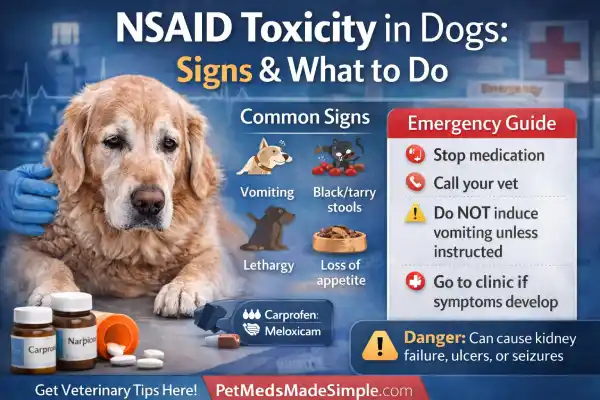
- vomiting
- diarrhea
- reduced appetite
- marked lethargy
- black or tarry stool
- unusual changes in drinking
- changes in urination
Our related guides Can Pain Medication Cause Increased Thirst in Dogs? and Can Pain Medication Cause Frequent Urination in Dogs? explain why changes in drinking and urination can deserve additional investigation.
For dogs receiving NSAIDs over longer periods, Do Pain Medications Affect Kidney Values in Dogs? and Do Pain Medications Affect Liver Enzymes in Dogs? cover the laboratory monitoring veterinarians may use to identify potential problems early.
How Do You Know When a Dog Is Ready for More Activity?
Do not judge recovery from energy level alone.
A better assessment considers several factors together.
Signs of progress may include:
- steadily decreasing limping
- comfortable weight bearing
- no increase in pain after controlled walks
- improving mobility
- absence of new swelling
- normal appetite and behavior
- veterinary confirmation that healing is progressing
Activity should generally be increased gradually rather than moving immediately from restricted exercise to normal running and play.
If increasing activity causes the limp or pain to return, that is valuable information to discuss with your veterinarian.
Ultimately, the safest answer to how long should dogs rest after starting pain medication comes from the diagnosis, the dog’s response to treatment, and the veterinarian monitoring the recovery not from the point at which the dog first appears pain-free.
When Should Dogs Stop Resting and Return to Normal Activity?
The transition from rest to normal activity should usually be gradual rather than sudden.
One of the biggest mistakes owners can make is moving directly from restricted activity to:
- long walks
- running
- fetch
- dog park visits
- jumping
- hiking
- vigorous swimming
because their dog suddenly appears comfortable.
Pain medication may make movement easier before healing is complete. A better approach is to increase activity progressively while watching how the dog responds during the activity and over the following 24 hours.
If increasing activity causes renewed limping, stiffness, reluctance to move, or obvious discomfort, the dog may not yet be ready for that level of exercise.
Therefore, how long should dogs rest after starting pain medication should ultimately be determined by recovery progress rather than pain relief alone.
Why the First Pain-Free Day Is Not the End of Recovery
A pain-free day is encouraging, but it should not automatically mark the end of activity restriction.
Consider a dog recovering from a muscle or ligament injury.
Medication may reduce inflammation enough for the dog to walk comfortably. However, microscopic tissue repair continues long after obvious discomfort disappears.
Returning to unrestricted activity too quickly may overload healing tissue and trigger another episode of pain.
This is particularly important for energetic dogs that immediately attempt to resume their previous routine.
Owners should view improved comfort as one sign of recovery, not proof that recovery is complete.
How Long Should Dogs Rest After Starting Pain Medication If They Feel Completely Normal?
Even if your dog appears completely normal, follow the activity restrictions recommended for the underlying condition.
There is no universal number of days.
A minor strain and major orthopedic surgery clearly should not have identical recovery schedules.
The veterinarian may consider:
- the original diagnosis
- severity of tissue damage
- duration of symptoms
- age
- body weight
- muscle condition
- response to treatment
- whether surgery was performed
- whether limping returns after activity
This individualized approach explains why answering how long should dogs rest after starting pain medication with a fixed number such as “three days” or “one week” can be misleading.
When Should Owners Contact Their Veterinarian During Recovery?
Contact your veterinarian if your dog’s recovery stops progressing or suddenly moves in the wrong direction.
Important warning signs include:
- worsening limping
- complete refusal to bear weight
- new swelling
- obvious pain when touched
- crying or vocalizing
- inability to settle comfortably
- sudden weakness
- loss of appetite
- vomiting or diarrhea
- black or tarry stool
- major changes in thirst or urination
The last group is especially important in dogs receiving NSAIDs. Changes in drinking and urinary habits are discussed further in Can Pain Medication Cause Increased Thirst in Dogs? and Can Pain Medication Cause Frequent Urination in Dogs?
Do not simply extend rest indefinitely if your dog is not improving. Persistent symptoms may mean the diagnosis or treatment plan needs reassessment.
Never Increase Pain Medication to Allow More Exercise
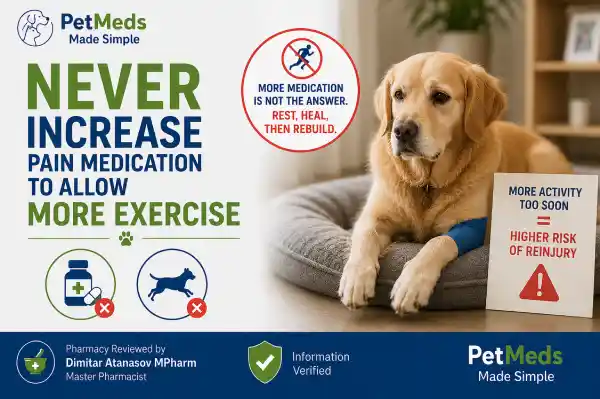
Pain medication should never be used as a way to push a dog through activity.
If your dog becomes uncomfortable after walking, the solution is not to independently increase the dose so the dog can continue exercising.
Increasing medication without veterinary guidance can increase the risk of adverse effects while masking an injury that requires additional rest or treatment.
Similarly, never combine veterinary NSAIDs with human pain medications unless specifically instructed by a veterinarian.
The objective of treatment is comfortable recovery—not simply suppressing enough pain to allow normal activity prematurely.
Long-Term Pain Relief Is About Quality of Life
Not every dog taking pain medication is recovering from an acute injury.
Many senior dogs receive medication because of chronic osteoarthritis or another long-term painful condition.
For these dogs, asking how long should dogs rest after starting pain medication requires a different perspective.
The objective is not weeks of inactivity.
It is sustainable mobility.
A successful long-term pain plan may allow a dog to:
- walk comfortably
- maintain muscle strength
- move around the home independently
- enjoy controlled outdoor activity
- sleep comfortably
- participate in family life
Our guide Can Dogs Stay on NSAIDs for Life? discusses why some dogs remain on treatment long-term and how veterinarians weigh pain control against potential medication risks.
Why Veterinary Monitoring Matters During Long-Term Pain Treatment
When pain medication continues for weeks, months, or years, monitoring becomes increasingly important.
Veterinarians may periodically assess:
- mobility
- body weight
- muscle mass
- pain control
- appetite
- hydration
- kidney values
- liver enzymes
The goal is not simply to find abnormalities.
Monitoring helps determine whether the medication continues providing enough benefit to justify treatment and whether the overall pain-management strategy needs adjustment.
This becomes especially relevant when dogs become more active after treatment begins. Improved activity is desirable, but it should remain appropriate for the underlying disease.
Bottom Line
How long should dogs rest after starting pain medication? There is no universal rest period because pain medication does not determine how quickly the underlying condition heals. Minor soft-tissue injuries may require a relatively short period of controlled activity, while fractures, ligament injuries, spinal conditions, or orthopedic surgery can require much longer restrictions. Dogs with chronic arthritis may actually benefit from regular controlled movement rather than prolonged complete rest.
The most important rule is simple: feeling better is not the same as being fully healed.
Follow the activity restrictions provided by your veterinarian, increase exercise gradually, and watch for renewed limping or discomfort after activity. Never use additional pain medication simply to allow a dog to exercise more.
Veterinarian Takeaway
When owners ask how long should dogs rest after starting pain medication, veterinarians base the answer primarily on the condition being treated—not the medication prescribed.
Effective pain medication can make dogs feel substantially better before bones, ligaments, muscles, surgical tissues, or joints are ready for unrestricted activity. At the same time, excessive rest can contribute to muscle loss and stiffness, particularly in dogs with chronic arthritis.
The safest recovery plan therefore balances pain control, appropriate rest, controlled movement, and gradual rehabilitation according to the individual dog’s diagnosis and progress.
Frequently Asked Questions – How Long Should Dogs Rest After Starting Pain Medication?
How long should dogs rest after starting pain medication?
How long should dogs rest after starting pain medication depends primarily on the underlying condition. Some minor injuries may require only a short period of restriction, while orthopedic surgery, fractures, ligament injuries, or spinal problems can require weeks of carefully controlled recovery.
Should my dog rest if the pain medication is already working?
Yes, if rest has been prescribed. Pain relief may occur before the underlying tissues have healed enough for normal activity.
Can my dog walk after starting pain medication?
Often yes, but the type and duration of walking depend on the diagnosis. Some dogs may be allowed short leash walks while running, jumping, and vigorous exercise remain restricted.
How long should dogs rest after starting pain medication for arthritis?
Dogs with arthritis generally need a different approach. Prolonged complete inactivity can worsen stiffness and muscle loss, so controlled regular movement is often part of long-term management.
Can my dog run once the limp disappears?
Not automatically. Disappearance of limping does not prove that damaged tissues have fully healed. Follow your veterinarian’s activity progression recommendations.
Can dogs swim while recovering on pain medication?
Sometimes, but swimming is still physical exercise. Our guide Can Dogs Swim While Taking Pain Medication? explains why swimming should not automatically be considered safe during a prescribed rest period.
What if my dog starts limping again after exercise?
Reduce activity and contact your veterinarian if the limp persists or repeatedly returns. Recurring limping may indicate that activity was increased too quickly or that the underlying problem requires reassessment.
Can too much rest make a dog weaker?
Yes. Prolonged inactivity can contribute to muscle loss, stiffness, reduced balance, and poorer conditioning. This is especially relevant for senior and arthritic dogs.
Does the type of pain medication determine how long my dog should rest?
Usually not. How long should dogs rest after starting pain medication is determined much more by the injury or disease being treated than whether the dog receives carprofen, meloxicam, gabapentin, or another medication.
When should I call my veterinarian during recovery?
Contact your veterinarian if limping worsens, your dog stops bearing weight, new swelling develops, pain suddenly increases, or medication-related warning signs such as vomiting, diarrhea, appetite loss, black stool, excessive thirst, or unusual urination occur.
Sources
- American Animal Hospital Association (AAHA). 2022 AAHA Pain Management Guidelines for Dogs and Cats.
- World Small Animal Veterinary Association (WSAVA). Global Pain Council Guidelines for Recognition, Assessment and Treatment of Pain.
- Merck Veterinary Manual. Pain Assessment and Management in Dogs and Cats.
- Plumb DC. Plumb’s Veterinary Drug Handbook. Latest edition.
- Grimm KA, Lamont LA, Tranquilli WJ, Greene SA, Robertson SA. Veterinary Anesthesia and Analgesia.
- Papich MG. Saunders Handbook of Veterinary Drugs.
- Millis DL, Levine D. Canine Rehabilitation and Physical Therapy.
- Fossum TW. Small Animal Surgery.
- Small Animal Clinical Pharmacology.
- BSAVA Manual of Canine and Feline Musculoskeletal Disorders.
Medical Review Statement
This article was written by Dimitar Georgiev Atanasov, MPharm, pharmacy and scientifically reviewed by Gergana Krasimirova Atanasova, MPharm, and veterinary reviewed by Dr. Valcho Georgiev Valchev, DVM.
Pet Meds Made Simple provides educational information and does not replace individualized veterinary diagnosis or treatment. Your veterinarian’s instructions regarding rest, rehabilitation, medication, and return to exercise should take priority because recovery requirements differ substantially between conditions.
Image Disclosure
Image Disclosure: Some images used in this article may be AI-generated or digitally enhanced for educational and illustrative purposes. They are designed to support understanding of veterinary concepts and should not be used as a substitute for professional veterinary diagnosis or clinical examination.