Quick Answer
Can gabapentin cause weakness in dogs?
Yes, gabapentin can cause weakness in dogs. This is a common side effect, especially at higher doses or when starting the medication. Weakness may appear as unsteady walking, reduced energy, or difficulty standing, and is usually temporary as the dog’s body adjusts.
Gabapentin is widely used for pain management, nerve-related conditions, and anxiety, but like all central nervous system medications, it can affect coordination and muscle control.
As a pharmacist, I’ll say this clearly:
👉 Weakness is usually dose-related and manageable—but never something to ignore
What Is Gabapentin and How Does It Work in Dogs?
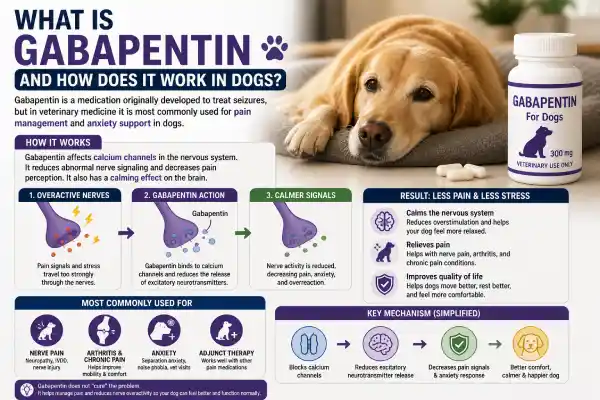
Gabapentin is a medication originally developed to treat seizures, but in veterinary medicine it is most commonly used for:
- Chronic pain (especially nerve pain)
- Arthritis support
- Anxiety (as adjunct therapy)
It works by affecting calcium channels in the nervous system, which reduces abnormal nerve signaling and decreases pain perception. At the same time, it has a calming effect on the central nervous system, which is why it is often used alongside other medications.
This calming effect is also the reason why weakness can occur.
When gabapentin reduces nerve signaling, it doesn’t only affect pain—it can also slightly reduce muscle responsiveness and coordination, leading to:
- Wobbly walking
- Slower movement
- Mild muscle weakness
This is particularly noticeable when:
- Starting the medication
- Increasing the dose
- Combining with other sedatives
👉 The key concept:
Gabapentin slows nerve communication, and sometimes that includes motor control.
➡️ Internal links :
- Gabapentin for Dogs: Uses, Dosage & Side Effects (Vet-Backed Guide)
- Gabapentin Dosage for Dogs: Complete Weight Chart & Safety Guide
- Gabapentin Side Effects in Dogs: What to Watch For (Vet-Backed)
- Carprofen vs Gabapentin for Dogs: Which Works Better? (Vet-Backed)
Can Gabapentin Cause Weakness in Dogs?
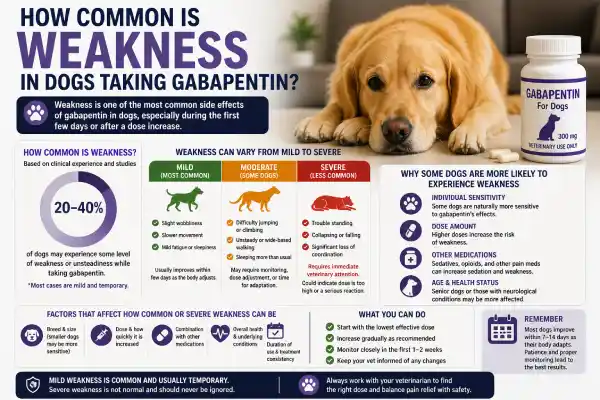
How Common Is Weakness in Dogs Taking Gabapentin?
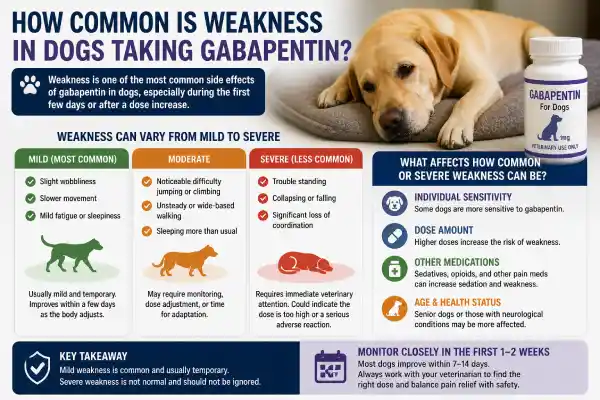
Weakness is considered one of the most common side effects of gabapentin in dogs, particularly during the early stages of treatment. Many dogs experience some level of:
- Mild lethargy
- Reduced coordination
- Slight instability when walking
However, the severity can vary widely.
Mild Cases (Most Common)
- Slight wobbliness
- Slower movement
- Mild fatigue
These symptoms are usually temporary and improve within a few days.
Moderate Cases
- Noticeable difficulty jumping
- Unsteady walking
- Sleeping more than usual
These may require monitoring or dose adjustment.
Severe Cases (Less Common)
- Trouble standing
- Collapsing
- Significant coordination issues
👉 These require veterinary attention.
➡️ Internal links:
- What Can I Give My Dog for Pain? (Vet Comparison Guide)
- Best Pain Medication for Dogs with Arthritis (Comparison Guide)
- Safest Pain Medication for Dogs (Vet Comparison Guide)
Table: Normal vs Concerning Weakness
| Level | Symptoms | Action |
|---|---|---|
| Mild | Slight wobble | Normal |
| Moderate | Trouble moving | Monitor |
| Severe | Cannot stand | Vet needed |
Why Gabapentin Causes Weakness
The main reason gabapentin causes weakness is its effect on the central nervous system (CNS).
It reduces nerve signaling by:
- Blocking calcium channels
- Slowing neurotransmitter release
- Reducing excitability in neurons
While this is beneficial for pain and anxiety, it also leads to:
👉 Reduced muscle coordination
👉 Slower reflexes
👉 General sedation
Key Risk Factors
Weakness is more likely in:
- Senior dogs
- Dogs on high doses
- Dogs taking multiple medications
Drug Interactions Increase Risk
Combining gabapentin with:
- Trazodone
- Alprazolam
- Diazepam
👉 Can significantly increase sedation and weakness.
➡️ Internal links:
- Trazodone for Dogs: Uses, Dosage & Safety (Vet-Backed Guide)
- Alprazolam for Dogs: Is It Safe? (Vet-Backed Guide)
- Can Dogs Take Diazepam for Thunderstorms? (Complete Guide)
How Long Does the Weakness Last?
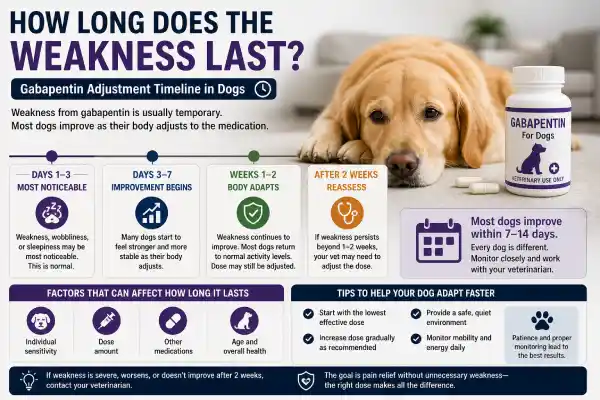
In most cases, gabapentin-related weakness is temporary.
Typical Timeline
- First 1–3 days → most noticeable
- 3–7 days → improvement begins
- 1–2 weeks → body adapts
This is because the dog’s nervous system gradually adjusts to the medication.
When It Doesn’t Improve
If weakness persists beyond 1–2 weeks:
- Dose may be too high
- Combination therapy may be too strong
- Dog may be sensitive to the medication
👉 In these cases, adjustment is needed.
➡️ Internal links:
- Amantadine vs Gabapentin for Dogs: Which Works Better?
- NSAIDs vs Opioids for Dogs: Complete Comparison Guide
When Should You Be Concerned?
While mild weakness is normal, certain signs require attention.
Warning Signs
❌ Severe instability
❌ Falling or collapsing
❌ Refusal to move
❌ Loss of appetite
Emergency Signs
⚠️ Cannot stand
⚠️ Extreme sedation
⚠️ Breathing issues
👉 Seek veterinary care immediately.
➡️ Internal links:
Common Mistakes
❌ Starting with high dose
❌ Ignoring early weakness
❌ Combining medications without guidance
❌ Stopping suddenly
Many owners assume weakness means the medication is “bad,” but often it just needs adjustment.
The real mistake is:
👉 Not balancing dose vs effect
Pro Tips for Best Results
✔ Start low, increase slowly
✔ Monitor walking and behavior
✔ Use combination therapy carefully
✔ Adjust gradually
Tracking your dog’s mobility daily is one of the best ways to ensure safe use.
➡️ Internal links:
- Natural Pain Relief for Dogs: What Actually Works?
- Best Pain Medication for Dogs (Full Comparison Guide)
FAQ
Does gabapentin make dogs weak?
Yes, especially at higher doses.
Is this normal?
Mild weakness is common.
Will it go away?
Usually within 1–2 weeks.
Should I stop the medication?
Not without veterinary advice.
Is gabapentin safe long-term?
Yes, with proper dosing and monitoring.
Conclusion
Gabapentin can cause weakness—but this is usually manageable.
✔ Common side effect
✔ Often temporary
✔ Dose-dependent
👉 The goal is pain relief without excessive weakness
Medical Disclaimer
This content is for informational purposes only and does not replace professional veterinary advice.
Sources
American Veterinary Medical Association
Merck Veterinary Manual
VCA Animal Hospitals
Veterinary Information Network (VIN)