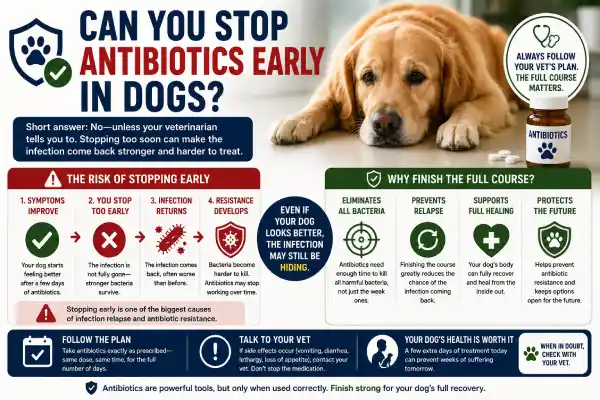
Can you stop antibiotics early in dogs? In most cases, no—you should not stop antibiotics early, even if your dog appears fully recovered. Stopping too soon is one of the leading causes of infection relapse and antibiotic resistance.
Quick Answer
You should not stop antibiotics early in dogs unless your veterinarian specifically instructs you to do so. Even if symptoms improve, the infection may still be present at a deeper level.
Why This Question Is So Important
This is one of the most common mistakes dog owners make.
The typical scenario looks like this:
- Day 1–3 → symptoms improve
- Day 4 → dog looks “normal”
- Owner stops medication
👉 Result:
- infection comes back
- often stronger
- harder to treat
What Actually Happens When You Start Antibiotics
To understand why stopping early is dangerous, you need to understand how antibiotics work over time.
Antibiotics do NOT eliminate all bacteria immediately.
Instead:
- They kill the weakest bacteria first
- Reduce symptoms quickly
- Leave stronger bacteria behind
👉 Those remaining bacteria are the problem.
Can You Stop Antibiotics Early in Dogs?
The Critical Mistake: Stopping When Symptoms Disappear
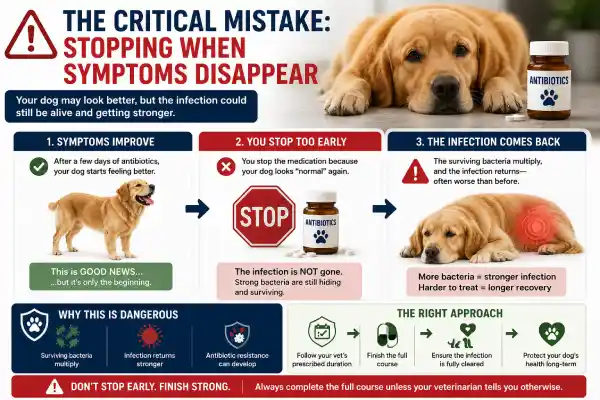
This is where most owners go wrong.
Symptoms improve because:
👉 bacterial load is reduced
But:
👉 infection is NOT fully eliminated
If treatment stops here:
- surviving bacteria multiply
- infection returns
- resistance develops
👉 This connects directly to
How Long Should Dogs Stay on Antibiotics?, where duration is critical for full recovery.
Antibiotic Resistance: The Real Danger
Stopping antibiotics early does more than delay recovery—it creates stronger bacteria.
How It Happens
- weaker bacteria die
- stronger bacteria survive
- survivors adapt
Over time:
👉 antibiotics stop working completely
This is why veterinarians are strict about:
👉 completing the full course
Why Dogs Often “Look Better” Too Soon
Dogs are biologically programmed to:
- hide pain
- mask symptoms
- adapt quickly
So when your dog looks fine:
👉 it does NOT mean the infection is gone
What Happens If You Stop Antibiotics Early
| Stage | What Happens |
|---|---|
| Early stop | bacteria survive |
| Short-term | symptoms disappear |
| Mid-term | infection returns |
| Long-term | resistance develops |
👉 This is not theory—this is seen daily in veterinary practice.
The Hidden Layer: Deep vs Surface Infections
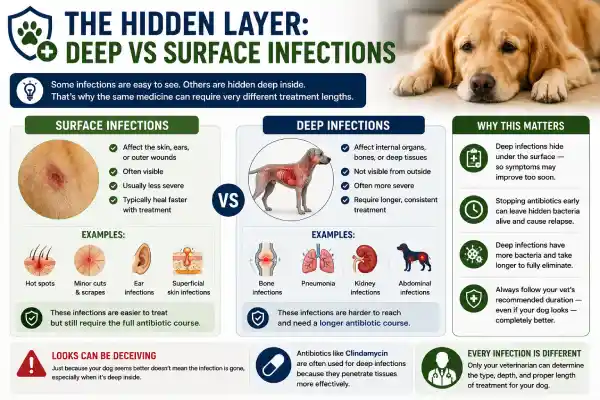
Some infections are more deceptive than others.
Surface Infections
- skin
- minor wounds
👉 appear to heal quickly
Deep Infections
- bone
- internal organs
- systemic infections
👉 require much longer treatment
👉 Antibiotics like Clindamycin are often used for deeper infections where stopping early is especially dangerous.
Are There ANY Cases Where You Can Stop Early?
Yes—but only under veterinary supervision.
Possible Exceptions
- severe side effects
- allergic reaction
- wrong diagnosis
👉 In these cases:
✔ vet changes medication
❌ you do NOT decide yourself
What Happens When Infection Comes Back
Relapse infections are often:
- more aggressive
- harder to treat
- longer to resolve
In some cases:
👉 a stronger antibiotic is needed
Examples may include:
- Doxycycline
- Cephalexin
Real Scenario (Very Common)
Dog with skin infection:
- starts antibiotics
- improves in 3 days
- owner stops at day 5
👉 After 1 week:
- infection returns
- worse than before
👉 This is EXACTLY why full courses matter.
The Link Between Early Stopping and Side Effects
Some owners stop early because they see side effects like:
- vomiting
- lethargy
- reduced appetite
👉 These are discussed in:
👉 But stopping early is not the solution.
What You Should Do Instead
If side effects appear:
- contact your vet
- adjust treatment if needed
- do NOT stop abruptly
Full Course vs Early Stop
| Approach | Outcome |
|---|---|
| Full course | complete recovery |
| Early stop | relapse risk |
| Repeated early stop | resistance |
Vet Perspective (CRITICAL INSIGHT)
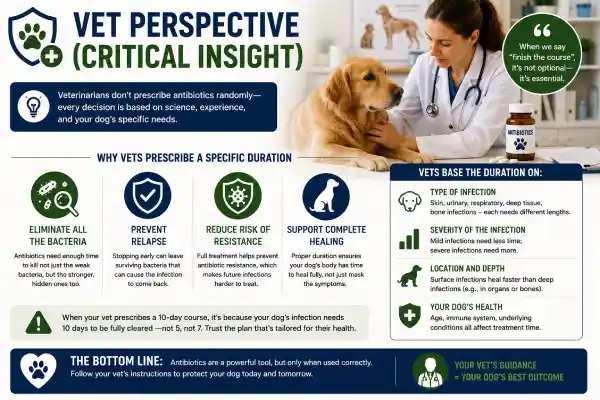
Veterinarians don’t prescribe antibiotics randomly.
They base duration on:
- infection type
- severity
- tissue involvement
👉 When they say:
👉 “finish the course”
It is not optional.
Signs You Are Safe to STOP (Only With Vet Approval)
- infection fully resolved
- no symptoms
- vet confirms recovery
👉 Without these:
👉 continue treatment
Special Case: Puppies
Puppies are more vulnerable.
Because of:
- weaker immune system
- faster progression of infections
👉 Stopping early is even more dangerous.
Long-Term Consequences of Stopping Early
Repeated early stopping can lead to:
- chronic infections
- resistant bacteria
- higher vet costs
- limited treatment options
👉 This is one of the fastest ways to complicate a simple condition.
Conclusion
You should not stop antibiotics early in dogs, even if your dog appears fully recovered. What looks like healing is often only the first phase of treatment. Stopping early allows stronger bacteria to survive, leading to relapse and resistance.
The safest approach is simple:
👉 always complete the full course
👉 follow your veterinarian’s guidance
FAQ
Can I stop antibiotics if my dog feels better?
No. Feeling better does not mean the infection is gone.
What happens if I stop antibiotics early in dogs?
The infection may return stronger and become harder to treat.
Are there situations where stopping early is okay?
Only if your veterinarian instructs you to do so.
Why do vets insist on finishing antibiotics?
To fully eliminate bacteria and prevent resistance.
Can stopping early cause antibiotic resistance?
Yes. It is one of the main causes of resistant infections.
Sources & Scientific References
Medical Disclaimer
This article is for educational purposes only and does not replace professional veterinary advice.