Quick Answer
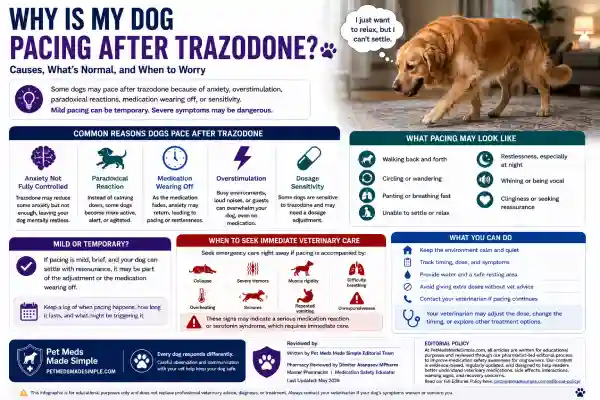
Why Is My Dog Pacing After Trazodone? Some dogs may pace after trazodone because of paradoxical excitement, rebound anxiety, overstimulation, mild disorientation, dosage sensitivity, or underlying anxiety that the medication did not fully control. Mild temporary pacing may occur in some dogs, but severe agitation, collapse, tremors, overheating, or neurological symptoms require immediate veterinary care.
Many dog owners expect trazodone to make their dog:
- sleepy
- calm
- relaxed
- quieter
So it can feel alarming when a dog instead:
- walks around nonstop
- pants and paces
- circles the room
- refuses to lie down
- acts restless late at night
- seems “wired” instead of calm
Some owners even describe it as:
“My dog looks tired but cannot settle.”
And honestly?
That description is surprisingly common.
While trazodone helps many dogs relax safely, others may respond differently depending on:
- dose
- anxiety severity
- timing
- age
- medication interactions
- neurological sensitivity
This guide explains:
- why pacing may happen after trazodone
- what mild pacing usually looks like
- when pacing may signal a more serious problem
- how veterinarians evaluate trazodone reactions
- what owners should monitor closely at home
What Is Trazodone and Why Do Veterinarians Use It?
Trazodone is commonly prescribed for dogs experiencing:
- anxiety
- noise phobias
- travel stress
- confinement stress
- vet visit anxiety
- post-surgical restlessness
Veterinarians often use trazodone because it can help dogs:
- settle more easily
- sleep better
- tolerate stressful situations
- reduce panic behaviors
Many owners searching about pacing are already using trazodone alongside articles like:
- Can Dogs Take Anxiety Medication Every Day?
- How Long Does Xanax Last in Dogs?
- What Happens If My Dog Misses Anxiety Medication?
But medications affecting the brain and behavior rarely work exactly the same way in every dog.
Some dogs become deeply relaxed.
Others may appear:
- restless
- confused
- emotionally unsettled
- unusually reactive
Why Is My Dog Pacing After Trazodone?
Why Do Some Dogs Pace After Trazodone?
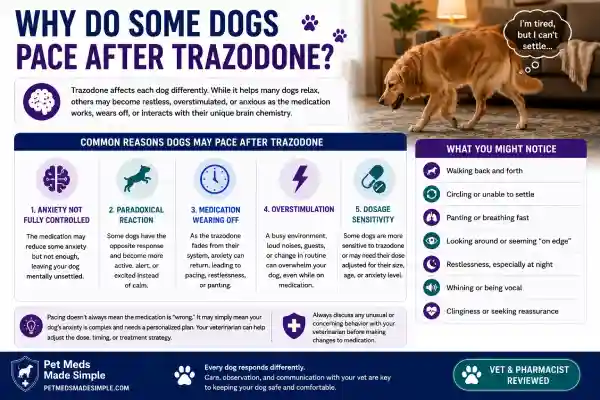
There are several possible explanations.
In some dogs, trazodone reduces physical inhibition without fully calming the emotional anxiety underneath. The dog may look sleepy but still feel mentally stressed.
Other dogs may experience:
- paradoxical excitement
- overstimulation
- rebound anxiety
- medication interactions
- mild neurological side effects
Common Reasons Dogs Pace After Trazodone
| Possible Cause | What Owners May Notice |
|---|---|
| Anxiety not fully controlled | Restlessness, whining, pacing |
| Paradoxical reaction | Hyperactivity instead of calming |
| Mild disorientation | Wandering or inability to settle |
| Medication wearing off | Evening pacing or rebound anxiety |
| Overstimulation | Panting, circling, agitation |
Some owners notice pacing:
- late at night
- after fireworks
- during storms
- several hours after dosing
- when trazodone starts wearing off
That pattern matters because timing often helps veterinarians understand whether the problem is:
- the medication itself
- anxiety rebound
- overstimulation
- or another underlying issue
This also overlaps with:
- Why Does My Dog Cry at Night Even With Medication?
- Why Is My Dog More Hyper After Anxiety Medication?
- Can Anxiety Medication Cause Personality Changes?
What Does Trazodone Pacing Usually Look Like?
Dogs experiencing trazodone-related pacing may:
- repeatedly walk around the house
- circle furniture
- move room to room
- pant continuously
- lie down briefly then stand up again
- appear unable to get comfortable
Some dogs seem:
physically tired but mentally restless.
Others may become:
- clingy
- emotionally reactive
- overstimulated
- unusually alert
Owners sometimes confuse this pacing with:
- excitement
- panic
- neurological problems
- or even seizures
That’s why behavior context is important.
Mild vs More Serious Symptoms
| Symptom | Usually Mild | More Concerning |
|---|---|---|
| Temporary pacing | Yes | Sometimes |
| Mild panting | Common | Monitor |
| Restlessness for 1–2 hours | Sometimes | Monitor |
| Unable to settle all night | Less typical | More concerning |
| Tremors or rigidity | No | Emergency concern |
| Collapse | No | Emergency |
Mild pacing by itself is not always dangerous.
But pacing combined with severe neurological or physical symptoms should never be ignored.
This may overlap with:
- Can Anxiety Medication Cause Seizures in Dogs?
- Why Is My Dog Shaking Even After Anxiety Medication?
- Can Dog Medications Cause Behavior Changes?
Can Trazodone Make Dogs Hyper Instead of Calm?
Yes – and veterinarians do occasionally see this.
This is often called:
a paradoxical reaction.
Instead of calming down, some dogs become:
- hyperactive
- restless
- agitated
- emotionally reactive
This reaction appears more commonly in:
- highly anxious dogs
- sensitive dogs
- senior dogs
- dogs taking multiple behavioral medications
Some owners describe it as:
“The medication seemed to make my dog more wired.”
This type of response may overlap with:
- Can Anxiety Medication Make Dogs Aggressive?
- Can Anxiety Medication Cause Personality Changes?
- Why Is My Dog More Hyper After Anxiety Medication?
Can Pacing Happen When Trazodone Wears Off?
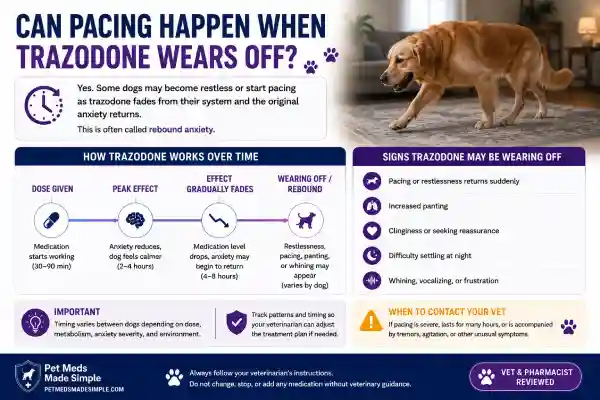
Absolutely.
Some dogs become restless as trazodone fades from the body and the original anxiety returns.
Owners may notice:
- pacing late at night
- whining
- clinginess
- panting
- inability to settle
- sudden restlessness several hours after dosing
This may reflect:
rebound anxiety.
For example:
a dog frightened by fireworks may briefly relax after trazodone, then begin pacing again once the medication effect weakens.
Signs Trazodone May Be Wearing Off
| Possible Sign | What It May Mean |
|---|---|
| Pacing returns suddenly | Anxiety resurfacing |
| Increased panting | Stress response |
| Clinginess | Emotional discomfort |
| Nighttime wandering | Rebound anxiety |
| Vocalization | Anxiety increasing again |
This overlaps closely with:
- How Long Does Xanax Last in Dogs?
- What Happens If My Dog Misses Anxiety Medication?
- Can Dogs Take Anxiety Medication Every Day?
Are Senior Dogs More Sensitive to Trazodone?
Sometimes – yes.
Older dogs may metabolize behavioral medications more slowly and may become more sensitive to:
- sedation
- confusion
- disorientation
- neurological side effects
A senior dog pacing after trazodone may occasionally be experiencing:
- cognitive dysfunction
- nighttime confusion
- sensory decline
- medication-related disorientation
This is especially important if pacing appears alongside:
- staring
- wandering
- confusion
- tremors
- weakness
Senior-dog medication reactions often require closer monitoring.
This also connects naturally with:
- Can Anxiety Medication Cause Seizures in Dogs?
- Why Is My Dog Hiding After Taking Anxiety Medication?
- Can Anxiety Medication Cause Personality Changes?
Can Medication Interactions Make Pacing Worse?
Yes.
Combining trazodone with:
- fluoxetine
- Xanax
- gabapentin
- pain medications
- multiple sedatives
may increase the risk of:
- agitation
- confusion
- serotonin-related overstimulation
- neurological side effects
Medication Combinations That Need Closer Monitoring
| Combination | Possible Concern |
|---|---|
| Trazodone + fluoxetine | Serotonin-related overstimulation |
| Trazodone + Xanax | Behavioral instability |
| Trazodone + gabapentin | Weakness or confusion |
| Multiple anxiety medications | Neurological side effects |
This is one reason veterinarians often review:
- medication timing
- supplements
- dosing schedules
- previous medication reactions
before changing treatment plans.
This overlaps with:
- Can Dog Medications Be Given Together?
- Can Dogs Take Antibiotics With Gabapentin?
- Can Antibiotics Interact With Anxiety or Pain Medications?
When Is Pacing an Emergency?
Most pacing episodes are not life-threatening.
But pacing combined with severe neurological symptoms may signal:
a dangerous medication reaction.
Seek immediate veterinary care if your dog develops:
- collapse
- severe tremors
- muscle rigidity
- overheating
- inability to wake
- breathing difficulty
- repeated vomiting
- unresponsiveness
- seizure-like activity
Emergency Warning Signs
| Symptom | Emergency Level |
|---|---|
| Mild pacing only | Usually monitor |
| Panting with agitation | Contact vet if worsening |
| Collapse | Emergency |
| Muscle rigidity | Emergency |
| Severe tremors | Emergency |
| Blue gums | Emergency |
| Unresponsiveness | Emergency |
One of the biggest mistakes owners make is assuming:
all restlessness is harmless.
Most mild pacing improves.
But severe neurological symptoms should never be ignored.
This strongly overlaps with:
- What Happens If Dogs Take Too Much Trazodone?
- Can Anxiety Medication Cause Seizures in Dogs?
- Why Is My Dog Shaking Even After Anxiety Medication?
What Should Owners Do If Their Dog Keeps Pacing?
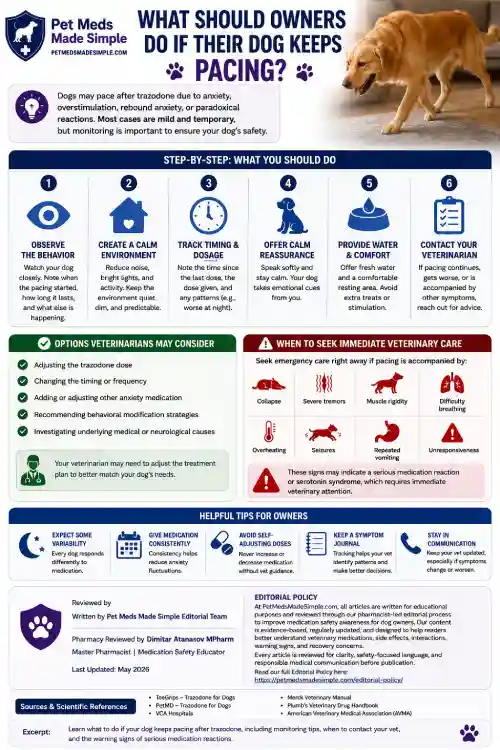
Start by observing:
- how long the pacing lasts
- whether the dog can settle
- breathing patterns
- responsiveness
- timing after medication
Helpful things owners can do include:
- lowering noise and stimulation
- dimming lights
- keeping the environment calm
- avoiding additional medications unless directed
- contacting the veterinarian if symptoms continue
Helpful Steps for Owners
| Step | Why It Helps |
|---|---|
| Keep the environment calm | Reduce overstimulation |
| Track timing after medication | Helps identify patterns |
| Monitor breathing and behavior | Detect worsening symptoms |
| Avoid giving extra doses | Reduce overdose risk |
| Contact your veterinarian if pacing persists | Improve medication safety |
How Veterinarians Evaluate Trazodone Pacing
Veterinarians may evaluate:
- trazodone dose
- timing of symptoms
- anxiety severity
- medication interactions
- neurological signs
- underlying medical conditions
Sometimes the solution involves:
- adjusting the dose
- changing timing
- lowering stimulation
- changing medications
- combining behavioral therapy
Because behavioral medications affect dogs differently, treatment plans often need individualized adjustment.Why Is My Dog Pacing After Trazodone?
FAQ — Why Is My Dog Pacing After Trazodone?
Is pacing after trazodone normal?
Mild temporary pacing may happen in some dogs, especially during adjustment or as the medication wears off.
Can trazodone make dogs hyper?
Yes. Some dogs experience paradoxical excitement instead of sedation.
Why is my dog pacing at night after trazodone?
The medication may be wearing off, anxiety may be returning, or the dog may feel restless or disoriented.
Should I give more trazodone if my dog keeps pacing?
No. Never increase doses without veterinary guidance.
Can pacing mean serotonin syndrome?
Usually pacing alone is not serotonin syndrome, but pacing with tremors, rigidity, overheating, or collapse is more concerning.
What symptoms are emergencies?
Collapse, severe tremors, muscle rigidity, breathing difficulty, seizures, or unresponsiveness require immediate veterinary care.
Medical Disclaimer
This article is for educational purposes only and does not replace professional veterinary advice, diagnosis, or treatment. The content is written and pharmacist-reviewed to improve medication safety awareness and help dog owners better understand trazodone-related pacing, paradoxical reactions, rebound anxiety, serotonin syndrome risks, medication interactions, and neurological warning signs in dogs. Always contact your veterinarian immediately if your dog develops collapse, severe tremors, breathing difficulty, muscle rigidity, or seizure-like activity.Why Is My Dog Pacing After Trazodone?
Reviewed by
Written by Pet Meds Made Simple Editorial Team
Pharmacy Reviewed by Dimitar Atanasov MPharm
Master Pharmacist | Medication Safety Educator
Last Updated: May 2026
Editorial Policy
At PetMedsMadeSimple.com, all articles are written for educational purposes and reviewed through our pharmacist-led editorial process to improve medication safety awareness for dog owners. Our content is evidence-based, regularly updated, and designed to help readers better understand veterinary medications, side effects, interactions, warning signs, and recovery concerns.Why Is My Dog Shaking Even After Anxiety Medication?
Every article is reviewed for clarity, safety-focused language, and responsible medical communication before publication.
Read our full Editorial Policy here: Pet Meds Made Simple Editorial Policy
Sources & Scientific References
- ToeGrips – Trazodone for Dogs
- PetMD – Trazodone for Dogs
- VCA Hospitals
- Merck Veterinary Manual
- Plumb’s Veterinary Drug Handbook
- American Veterinary Medical Association (AVMA)
Images created with AI – Why Is My Dog Pacing After Trazodone?