Quick Answer
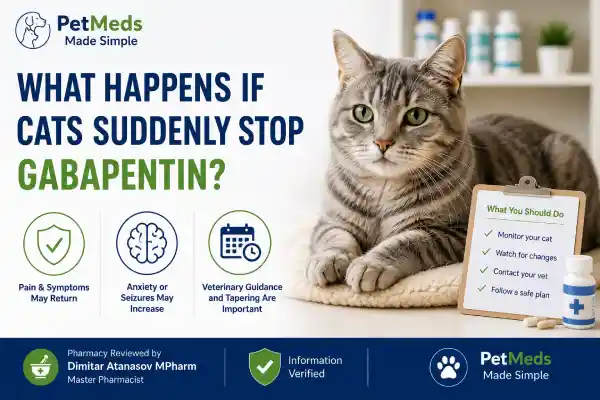
What happens if cats suddenly stop gabapentin? In many healthy cats receiving gabapentin for short-term stress relief, missing a single dose may not cause serious problems. However, cats taking gabapentin long-term—especially for chronic pain or seizure management—should never stop the medication abruptly without veterinary guidance. Sudden discontinuation may allow pain to return, increase anxiety, trigger withdrawal-like signs in some cats, and, in seizure patients, increase the risk of seizure recurrence. Most veterinarians recommend gradually tapering gabapentin whenever possible.
When Owners Commonly Ask This Question
Cat owners usually search “What happens if cats suddenly stop gabapentin?” after one of these situations:
- They accidentally missed a dose.
- Their cat refuses to take the medication.
- The prescription has run out.
- Their cat seems better and they wonder if the medication is still necessary.
- They are worried about long-term medication use.
- Their cat experienced side effects and they want to stop treatment immediately.
Fortunately, missing one dose does not automatically cause an emergency. The safest approach depends on why your cat is taking gabapentin, how long it has been prescribed, the dose being used, and your cat’s overall health.
What Happens If Cats Suddenly Stop Gabapentin
Why Do Veterinarians Prescribe Gabapentin for Cats?
Before understanding why stopping gabapentin suddenly may be a problem, it helps to understand why veterinarians prescribe it in the first place.
Gabapentin has become one of the most commonly used medications in feline medicine because it serves several different purposes.
Veterinarians may prescribe gabapentin for:
- Chronic arthritis pain
- Neuropathic (nerve) pain
- Recovery after orthopedic surgery
- Dental pain
- Cancer-related discomfort
- Feline hyperesthesia syndrome
- Seizure disorders
- Anxiety before veterinary visits
- Stress associated with travel
Because the drug is used for so many different conditions, the risks of stopping it depend largely on the condition being treated.
For example, a cat receiving one dose before a veterinary appointment has a very different risk profile than a cat receiving gabapentin twice daily for several months.
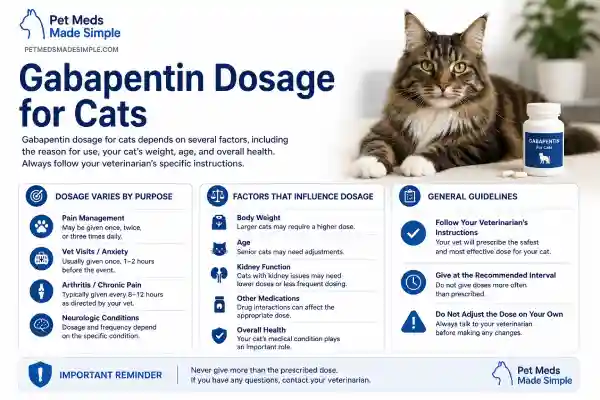
If you’re unfamiliar with how this medication works, our pillar guide Gabapentin for Cats: Uses, Dosage, Side Effects & Safety Guide explains its common veterinary uses and what owners should expect during treatment.What Happens If Cats Suddenly Stop Gabapentin?
Does Every Cat Need to Taper Off Gabapentin?
No.
This is one of the biggest misconceptions online.
Many owners read that gabapentin should never be stopped suddenly.
The reality is more nuanced.
Whether tapering is necessary depends on several important factors.
| Situation | Is Tapering Usually Recommended? |
|---|---|
| Single dose before a veterinary visit | Usually not |
| Short-term use for a few days | Sometimes |
| Several weeks of treatment | Often |
| Long-term daily therapy | Yes |
| Seizure management | Strongly recommended |
| Chronic pain management | Usually recommended |
Veterinarians make this decision individually for every patient.
There is no universal tapering schedule that works for every cat.
How Does Gabapentin Work?
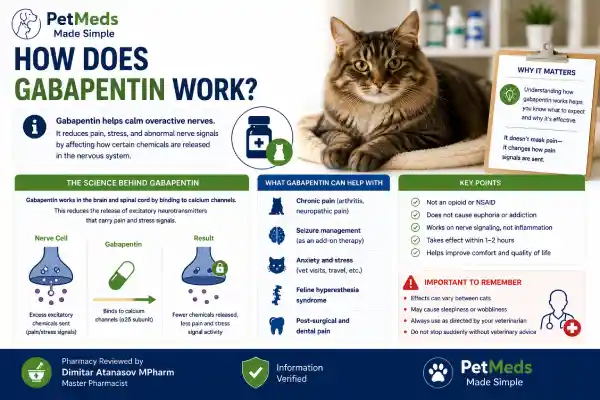
Gabapentin does not work like traditional pain medications.
Although its name suggests it acts directly on the neurotransmitter GABA, its primary mechanism is different.
Instead, gabapentin binds to calcium channels in the nervous system, reducing the release of excitatory neurotransmitters that amplify pain signals and abnormal nerve activity.
As a result, gabapentin may help:
- Reduce neuropathic pain
- Improve comfort in arthritic cats
- Decrease stress responses
- Provide mild sedation
- Reduce seizure activity in some patients
Because the nervous system gradually adapts to these effects during long-term treatment, stopping the medication abruptly may sometimes allow symptoms to return rapidly.
What Happens If Cats Suddenly Stop Gabapentin?
The answer depends on why the medication was prescribed.
In many cats, nothing dramatic happens after missing one dose.
However, in others, stopping gabapentin suddenly may result in the return of the condition that the medication was successfully controlling.
Examples include:
| Condition Being Treated | Possible Result After Sudden Discontinuation |
|---|---|
| Arthritis | Increased pain and reduced mobility |
| Neuropathic pain | Return of nerve pain |
| Anxiety | Increased stress or fearfulness |
| Seizure disorder | Increased seizure risk |
| Hyperesthesia syndrome | Return of abnormal skin sensitivity |
| Post-surgical pain | Increased discomfort during recovery |
For this reason, veterinarians generally recommend contacting the prescribing clinic before making any changes to the treatment plan.
Is Missing One Dose Dangerous?
Usually not.
If your cat accidentally misses one scheduled dose, there is often no reason to panic.
In many cases, your veterinarian may simply recommend giving the next scheduled dose as directed.
However, the safest approach depends on:
- The prescribed dose
- The dosing frequency
- The medical condition being treated
- How much time has passed since the missed dose
- Whether your cat has epilepsy or another neurological disorder
Owners should never double the next dose unless specifically instructed by their veterinarian.
If your cat frequently refuses medication, our article What Happens If My Cat Misses Gabapentin? (planned companion guide) will discuss practical strategies for missed doses and medication administration.
Why Can Sudden Discontinuation Be a Problem?
The biggest concern is not always a classic “withdrawal.”
Instead, veterinarians often worry about rebound symptoms.
Rebound symptoms occur when the original disease returns quickly after treatment stops.
For example:
- Arthritis pain becomes noticeable again.
- Mobility decreases.
- A previously calm cat becomes anxious.
- Neuropathic pain reappears.
- Hyperesthesia episodes return.
Owners sometimes interpret this as the medication causing a new problem.
In reality, the medication had been successfully controlling an existing condition all along.
This distinction is extremely important when evaluating whether gabapentin is still needed.
Are Withdrawal Symptoms Possible?
Although withdrawal is far less common in cats than many internet sources suggest, it may occur in some patients, particularly after long-term, high-dose therapy.
Possible withdrawal-like signs reported in veterinary medicine include:
- Increased anxiety
- Restlessness
- Vocalization
- Agitation
- Reduced sleep
- Increased sensitivity to touch
- Trembling
- Return of pain-related behaviors
Fortunately, most cats do not experience severe withdrawal, especially when treatment is reduced gradually under veterinary supervision.
Which Cats Are Most at Risk?
Certain cats deserve closer monitoring if gabapentin needs to be discontinued.
Veterinarians are particularly cautious with:
- Cats receiving gabapentin for epilepsy
- Senior cats with chronic pain
- Cats taking gabapentin for several months
- Cats receiving high daily doses
- Cats with multiple neurological conditions
- Cats taking several medications simultaneously
These patients often benefit from a structured tapering plan rather than abrupt discontinuation.
Can Cats Experience Rebound Pain After Stopping Gabapentin?
Yes.
One of the most common reasons owners believe their cat is experiencing “gabapentin withdrawal” is actually rebound pain.
Rebound pain occurs when the medication is removed and the underlying painful condition is no longer adequately controlled.
This is especially common in cats with:
- Osteoarthritis
- Degenerative joint disease
- Neuropathic pain
- Cancer-related pain
- Chronic spinal disorders
For example, an older cat with arthritis may appear comfortable while taking gabapentin every 12 hours. If the medication is stopped abruptly, the cat may begin hiding again, hesitate before jumping onto furniture, or refuse to climb stairs within a day or two.
These signs do not necessarily mean the medication caused harm. Instead, they often indicate that gabapentin had been effectively masking chronic pain.
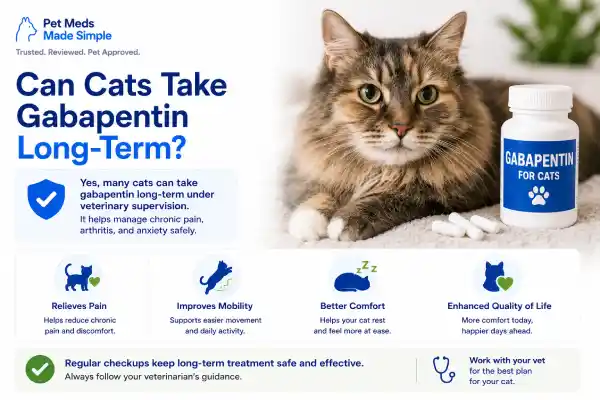
If your senior cat has been receiving long-term therapy, our article Can Cats Take Gabapentin Long-Term? explains why regular reassessment is important before making any medication changes.
Could Anxiety Return After Stopping Gabapentin?
Absolutely.
Many veterinarians prescribe gabapentin before stressful events such as:
- Veterinary visits
- Grooming appointments
- Long car journeys
- Air travel
- Diagnostic imaging
Cats receiving only an occasional dose before these situations usually do not develop withdrawal.
However, cats receiving gabapentin every day for anxiety or chronic stress may become more anxious if treatment is discontinued abruptly.
Owners may notice:
- Hiding more frequently
- Increased vocalization
- Dilated pupils
- Startling easily
- Refusing interaction
- Reduced appetite
- Less interest in play
These behaviors are usually related to the return of the original anxiety, not because gabapentin has become addictive.
Can Seizures Return If Gabapentin Is Stopped?
This is one of the most important situations discussed in veterinary medicine.
Gabapentin is not usually the first-choice anticonvulsant in cats, but it may be used alongside other seizure medications in certain neurological patients.
If gabapentin is helping control seizure activity, stopping it suddenly could increase the likelihood of breakthrough seizures.
For this reason, veterinarians generally recommend tapering rather than abruptly discontinuing treatment whenever possible.
Owners of epileptic cats should never stop anticonvulsant medications without veterinary supervision, even if the cat appears completely normal.
Does Every Cat React the Same Way?
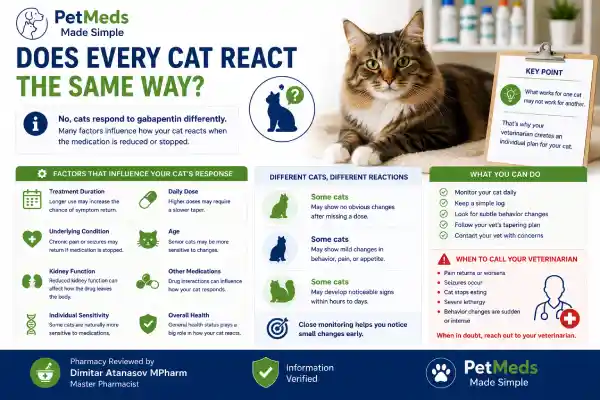
No.
Cats respond to gabapentin very differently.
Some cats can miss a dose with little noticeable change.
Others become uncomfortable within hours.
Several factors influence the response.
| Factor | Possible Effect After Stopping |
|---|---|
| Treatment duration | Longer use increases the likelihood of rebound symptoms |
| Daily dose | Higher doses may require slower tapering |
| Underlying disease | Chronic illness increases risk of symptom recurrence |
| Age | Senior cats often require closer monitoring |
| Kidney function | Reduced clearance may influence tapering decisions |
| Other medications | Drug combinations may affect clinical response |
This is why veterinarians avoid using a “one-size-fits-all” recommendation.
How Quickly Can Symptoms Return?
The timeline varies considerably.
Some owners notice changes within the first day.
Others may not see any difference for several days.
In general:
| Time After Stopping | What May Happen |
|---|---|
| First 12 hours | Often no obvious change |
| 12–24 hours | Mild return of pain or anxiety may begin |
| 24–48 hours | Mobility changes may become noticeable |
| 2–5 days | Chronic symptoms may become increasingly apparent |
| Beyond 5 days | Underlying disease usually determines ongoing clinical signs |
Remember that these are general observations rather than strict rules.
Every cat responds differently.
What If My Cat Seems Worse After Stopping Gabapentin?
Owners naturally become concerned if their cat appears worse shortly after discontinuing medication.
Ask yourself several questions:
- Is my cat moving less?
- Has hiding increased?
- Is my cat eating normally?
- Does my cat seem painful when touched?
- Has grooming decreased?
- Is my cat avoiding jumping?
- Has my cat become unusually quiet?
If the answer to several of these questions is yes, contact your veterinarian rather than restarting medication on your own.
Your veterinarian may determine that:
- the original disease has progressed,
- pain control needs adjustment,
- another illness has developed,
- or gabapentin should be restarted using a structured treatment plan.
Can Older Cats Be More Sensitive?
Yes.
Senior cats often require extra caution when changing medications.
Many older cats receiving gabapentin have chronic diseases such as:
- Osteoarthritis
- Chronic kidney disease
- Cancer
- Degenerative spinal disease
These conditions may become noticeably worse if pain management is interrupted.
In addition, senior cats tend to lose muscle mass more rapidly when chronic pain returns because they become less active.
For this reason, veterinarians usually recommend scheduling a recheck examination before discontinuing long-term pain medication in elderly patients.
Should Owners Restart Gabapentin Without Calling the Veterinarian?
Generally, no.
Although gabapentin has a wide safety margin, restarting medication without professional guidance is not always appropriate.
The veterinarian may first want to determine:
- Why the medication was stopped.
- Whether the diagnosis has changed.
- Whether another medication would be more appropriate.
- Whether the dose should be adjusted.
- Whether blood work is indicated before restarting therapy.
A quick phone call can often prevent unnecessary complications.
Could Another Medical Problem Be Responsible?
Yes.
Not every change occurring after gabapentin discontinuation is actually related to the medication.
Veterinarians also consider other possibilities such as:
- Progression of arthritis
- Kidney disease
- Hyperthyroidism
- Dental pain
- Cancer
- Gastrointestinal illness
- New neurological disease
This is particularly important if new symptoms develop several days after stopping treatment.
How Do Veterinarians Safely Stop Gabapentin?
There is no single tapering schedule that works for every cat.
Instead, veterinarians create an individualized plan based on:
- The condition being treated
- The current dose
- How long the medication has been used
- The cat’s age
- Kidney function
- Other medications being given
For example, a cat that received gabapentin before one veterinary appointment usually does not require tapering.
However, a cat receiving the medication twice daily for several months often benefits from gradually reducing the dose over time.
The goal is simple:
- Allow the nervous system to adapt gradually.
- Minimize the return of pain.
- Reduce anxiety during the transition.
- Lower the risk of seizure recurrence in neurological patients.
What Happens During a Gradual Taper?
A gradual reduction allows veterinarians to evaluate whether the medication is still needed.
Many owners assume stopping gabapentin is an “all-or-nothing” decision.
Instead, tapering gives the veterinarian an opportunity to monitor:
- Comfort level
- Mobility
- Appetite
- Activity
- Sleep quality
- Grooming habits
- Overall quality of life
If symptoms remain well controlled, the medication may eventually be discontinued.
If problems return, the veterinarian can adjust the treatment plan before the cat becomes significantly uncomfortable.
Signs That Your Cat May Still Need Gabapentin
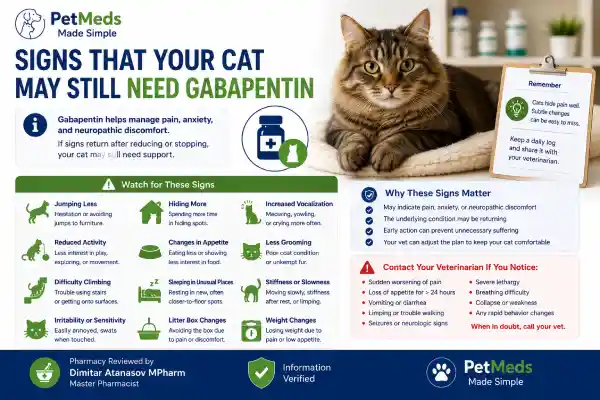
Sometimes owners decide to stop medication because their cat “looks better.”
Ironically, looking better may actually mean the medication is working.
After reducing or stopping gabapentin, watch carefully for:
| Possible Sign | What It May Suggest |
|---|---|
| Jumping less | Arthritis pain returning |
| Hiding more often | Pain or anxiety |
| Sleeping in unusual places | Discomfort |
| Reduced grooming | Chronic pain |
| Reluctance to climb stairs | Joint pain |
| Less interaction with family | Pain or illness |
| Increased vocalization | Discomfort or anxiety |
| Decreased appetite | Pain or another medical problem |
These changes are often subtle.
Cats instinctively hide pain, making careful observation extremely important.
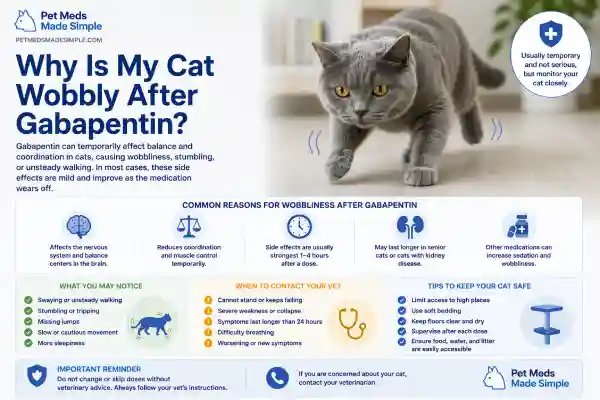
If your cat has recently become less active, our article Why Is My Cat Wobbly After Gabapentin? discusses how to distinguish medication side effects from the progression of an underlying medical condition.
What If My Cat Missed Several Doses?
Missing several consecutive doses is different from missing only one.
Owners sometimes discover that:
- They forgot to refill the prescription.
- Their cat has been hiding and refusing medication.
- Another family member assumed the medication had already been given.
The longer the interruption continues, the greater the chance that the original condition may begin returning.
Depending on your cat’s medical history, your veterinarian may recommend:
- Restarting the previous dose.
- Beginning a new tapering schedule.
- Performing a physical examination.
- Running blood tests.
- Adjusting the treatment plan.
Never assume that restarting the medication exactly as before is always the safest option.
Can Kidney Disease Affect Stopping Gabapentin?
Yes.
This is an important consideration in feline medicine.
Gabapentin is eliminated primarily through the kidneys.
Cats with chronic kidney disease (CKD) process the medication more slowly than healthy cats.
Because of this, veterinarians often prescribe:
- Lower doses
- Longer dosing intervals
- More gradual medication adjustments
Stopping the medication may also require individualized planning depending on the severity of kidney disease.
Older cats are especially likely to have reduced kidney function, even if they appear healthy.
What About Cats Taking Other Medications?
Gabapentin is frequently used alongside other medications.
Examples include:
- NSAIDs
- Opioids
- Amantadine
- Anti-inflammatory medications
- Anticonvulsants
- Anti-anxiety medications
When several medications are involved, discontinuing one drug may change how effectively the entire pain-management plan works.
For this reason, veterinarians usually review the complete medication list before recommending any changes.
Common Owner Mistakes
Most problems associated with stopping gabapentin occur because owners understandably make decisions based on incomplete information.
Some of the most common mistakes include:
| Mistake | Why It Can Be Risky |
|---|---|
| Stopping suddenly because the cat seems better | The medication may be controlling the disease successfully |
| Running out of medication | Creates an unnecessary interruption |
| Doubling the next dose after a missed dose | May increase side effects |
| Restarting without veterinary advice | The dose may no longer be appropriate |
| Assuming withdrawal is always occurring | The original illness may simply be returning |
Fortunately, these situations are usually preventable with good communication between owners and the veterinary team.
How Can Owners Monitor Their Cat During a Taper?
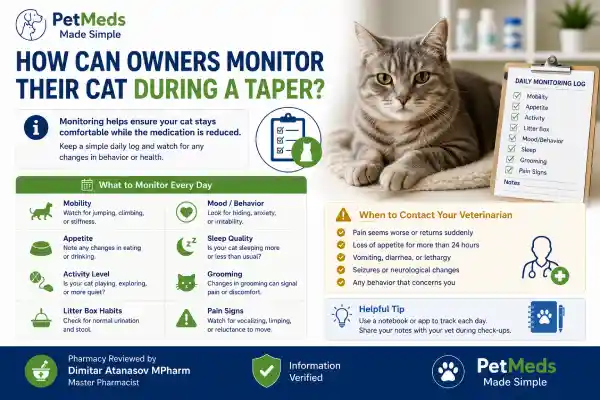
Keeping a simple daily journal is one of the best ways to identify subtle changes.
Veterinarians often recommend recording:
| Daily Observation | Monitor |
|---|---|
| Appetite | ✔ |
| Water intake | ✔ |
| Activity level | ✔ |
| Ability to jump | ✔ |
| Grooming habits | ✔ |
| Hiding behavior | ✔ |
| Vocalization | ✔ |
| Litter box habits | ✔ |
| Medication given | ✔ |
Because cats often hide discomfort, small changes recorded over several days are frequently more informative than a single observation.
When Should You Contact Your Veterinarian Immediately?
Although most cats tolerate medication adjustments well, certain symptoms should never be ignored.
Seek veterinary advice promptly if your cat:
- Experiences a seizure.
- Becomes unable to walk normally.
- Cries out in pain.
- Stops eating for more than 24 hours.
- Vomits repeatedly.
- Develops severe lethargy.
- Has difficulty breathing.
- Collapses.
- Appears significantly weaker than usual.
- Shows rapidly worsening neurological signs.
Early treatment is almost always easier than waiting until symptoms become severe.
Can Cats Become Dependent on Gabapentin?
This is one of the most common concerns owners have after their cat has been taking gabapentin for several weeks or months.
Fortunately, the answer is reassuring.
Gabapentin is not considered addictive in cats.
Unlike certain medications that can lead to drug-seeking behavior, gabapentin does not create psychological dependence in the way opioids or some human anxiety medications can.
However, this does not mean it should be stopped abruptly.
Many owners confuse three completely different situations:
| Situation | What It Means |
|---|---|
| Addiction | The body craves the drug and seeks it compulsively (not expected in cats) |
| Physical adaptation | The nervous system becomes accustomed to the medication after long-term use |
| Return of the original disease | Pain, anxiety, or seizures come back because the medication is no longer controlling them |
Most cats experiencing problems after stopping gabapentin are dealing with the third situation, not addiction.
Can Stopping Gabapentin Too Soon Slow Recovery?
Yes.
This is especially true for cats recovering from:
- Orthopedic surgery
- Fracture repair
- Dental surgery
- Soft tissue surgery
- Chronic arthritis flare-ups
Pain slows recovery.
When pain returns, cats often:
- Move less.
- Sleep more.
- Eat less.
- Groom less.
- Avoid jumping.
- Become withdrawn.
Reduced movement may lead to:
- Muscle loss
- Joint stiffness
- Delayed rehabilitation
- Slower return to normal activity
For this reason, veterinarians usually recommend continuing pain management until they are confident healing has progressed sufficiently.
Could Appetite Change After Stopping Gabapentin?
Yes.
Appetite changes can occur for several different reasons.
Some cats actually begin eating more after gabapentin is discontinued because temporary sedation resolves.
Others eat less because pain has returned.
This is why appetite alone cannot determine whether stopping the medication was successful.
Veterinarians evaluate appetite alongside:
- Mobility
- Body weight
- Grooming
- Activity
- Social interaction
- Sleeping habits
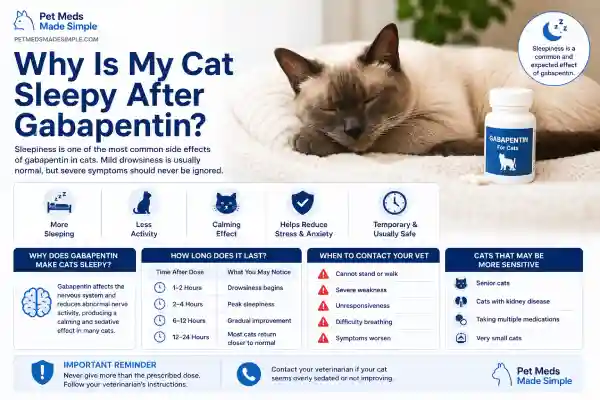
If your cat recently lost interest in food while taking gabapentin, our article Why Is My Cat Sleepy After Gabapentin? also explains how sedation may indirectly influence eating behavior.
What Should Owners Do If They Forget to Refill the Prescription?
Running out of medication is one of the most common reasons cats stop gabapentin unexpectedly.
If you realize the prescription has run out:
- Contact your veterinary clinic as soon as possible.
- Explain how many doses have been missed.
- Do not guess whether the dose should be increased or restarted.
- Continue monitoring your cat closely.
- Ask whether a tapering schedule is still appropriate.
Most veterinary clinics would much rather answer a quick phone call than have a patient experience unnecessary pain because treatment was interrupted.
Can Cats Stop Gabapentin After Stress-Related Use?
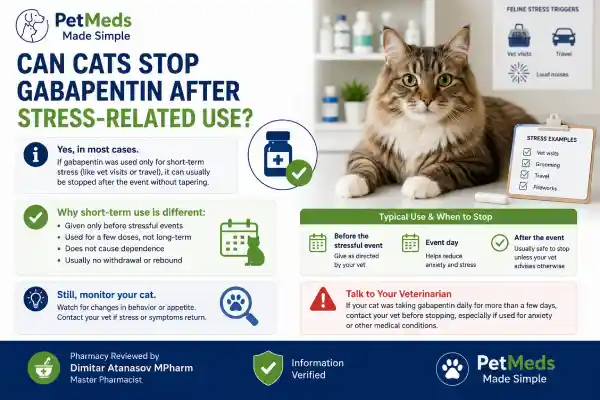
Usually, yes.
Many cats receive gabapentin only:
- Before veterinary appointments
- Before travel
- Before grooming
- Before stressful procedures
In these situations, gabapentin is commonly administered as a single dose or over a very short period.
Once the stressful event has passed, the medication is generally discontinued without tapering.
This differs completely from cats receiving daily gabapentin for chronic diseases.
What Questions Will Your Veterinarian Ask?
If you call because you are concerned about stopping gabapentin, your veterinarian will likely ask:
- Why was gabapentin prescribed?
- When was the last dose given?
- How long has your cat been taking it?
- What dose is being used?
- Have any doses been missed before?
- Is your cat eating normally?
- Is your cat walking normally?
- Have you noticed signs of pain?
- Has your cat experienced seizures?
- Is your cat taking any other medications?
These questions help determine whether simple monitoring is appropriate or whether your cat should be examined.
Can Owners Reduce the Risk of Missing Doses?
Absolutely.
A few simple habits can prevent most interruptions.
Consider:
| Helpful Strategy | Benefit |
|---|---|
| Set phone reminders | Reduces forgotten doses |
| Use a medication calendar | Tracks every dose |
| Refill prescriptions several days early | Prevents running out |
| Keep medications in one location | Improves consistency |
| Have one primary caregiver responsible | Avoids duplicate or missed doses |
Consistency is particularly important for cats receiving long-term therapy.
Veterinarian Takeaway
Most cats will not experience severe withdrawal if gabapentin is discontinued. However, the medication should never be stopped abruptly without veterinary advice in cats receiving long-term treatment for chronic pain, neurological disease, or seizure management.
In many cases, what owners interpret as withdrawal is actually the return of the condition that gabapentin was successfully controlling. Gradual tapering allows veterinarians to monitor pain, mobility, behavior, and overall quality of life while minimizing unnecessary discomfort.
Bottom Line
What happens if cats suddenly stop gabapentin? The answer depends on why the medication was prescribed.
Cats receiving a single dose before a veterinary visit usually experience no significant problems after the medication wears off. In contrast, cats taking gabapentin daily for arthritis, chronic pain, neurological disease, or seizures should generally not stop treatment abruptly without veterinary guidance.
Stopping gabapentin suddenly may lead to the return of pain, anxiety, hyperesthesia, or seizures—not because the medication is addictive, but because it was effectively managing the underlying condition.
If your cat has missed a dose or you are considering stopping gabapentin, contact your veterinarian before making changes. An individualized tapering plan is often the safest and most comfortable approach.
Frequently Asked Questions – What Happens If Cats Suddenly Stop Gabapentin?
Can cats suddenly stop gabapentin?
Cats taking gabapentin long-term should generally not stop the medication suddenly unless instructed by their veterinarian.
What happens if my cat misses one dose?
Most healthy cats will not experience serious problems after missing a single dose, but you should contact your veterinarian for individualized advice.
Can stopping gabapentin cause seizures?
It may increase seizure risk in cats using gabapentin as part of seizure management.
Is gabapentin addictive for cats?
No. Gabapentin is not considered addictive, although the nervous system may adapt to long-term treatment.
How long does gabapentin stay in a cat’s body?
The medication is usually eliminated within about one day in healthy cats, although this varies with kidney function.
Can arthritis pain return after stopping gabapentin?
Yes. Many cats experience the return of chronic pain if the medication is withdrawn before the underlying disease is adequately controlled.
Can older cats stop gabapentin safely?
Yes, but senior cats often require closer veterinary monitoring and individualized tapering plans.
Should I double the next dose if one is missed?
No. Never double a dose unless your veterinarian specifically instructs you to do so.
What if my cat refuses gabapentin?
Contact your veterinarian rather than discontinuing treatment. They may recommend alternative formulations or administration techniques.
When should I call my veterinarian?
Immediately if your cat experiences seizures, severe pain, repeated vomiting, collapse, difficulty breathing, or refuses food for more than 24 hours.
Sources
- Plumb’s Veterinary Drug Handbook
- Merck Veterinary Manual
- BSAVA Small Animal Formulary
- WSAVA Global Pain Council Guidelines
- Feline Veterinary Medical Association (FelineVMA)
- International Society of Feline Medicine (ISFM)
- Veterinary Pharmacology and Therapeutics
- Small Animal Clinical Pharmacology
- Journal of Feline Medicine and Surgery (JFMS)
- VIN (Veterinary Information Network)
Medical Review Statement
This article was pharmacy-reviewed by Dimitar Georgiev Atanasov, MPharm, and veterinary-reviewed by Dr. Valcho Georgiev Valchev, DVM. It is intended for educational purposes only and should not replace individualized veterinary diagnosis, treatment, or medical advice.
Important Medical Disclaimer
The information provided on PetMedsMadeSimple.com is for educational purposes only and is not intended to diagnose, treat, cure, or prevent any disease. Always consult your veterinarian before starting, stopping, or changing any medication or supplement. Never adjust your cat’s medication dosage without professional guidance.
Image Disclosure
Some illustrations used on PetMedsMadeSimple.com may be AI-assisted or AI-generated to help explain veterinary concepts more clearly. Every article is independently researched, pharmacy-reviewed by Dimitar Georgiev Atanasov, MPharm, and veterinary-reviewed by Dr. Valcho Georgiev Valchev, DVM. AI-generated images are intended solely for educational illustration and do not depict actual patients or replace professional veterinary diagnosis, examination, or treatment.