
Quick Answer
Why is my dog crying after a seizure? In many cases, crying or whining after a seizure is part of the post-ictal phase the recovery period immediately following a seizure. During this time, dogs may be confused, frightened, temporarily blind, sore, or disoriented, causing them to vocalize. While this behavior is often temporary, persistent crying, severe pain, repeated seizures, or difficulty recovering should always be evaluated by a veterinarian.
Why Is My Dog Crying After a Seizure?
Why Is My Dog Crying After a Seizure?
Few experiences are as frightening for a dog owner as watching their pet have a seizure. Unfortunately, the seizure itself is often only part of the event. Many owners become even more worried when, after the convulsions stop, their dog begins whining, crying, barking, or making unusual vocal sounds.
If you’ve found yourself asking “Why is my dog crying after a seizure?”, you’re certainly not alone.
This is one of the most common questions owners have after witnessing a seizure for the first time.
The reassuring news is that crying after a seizure is often part of the normal recovery process. However, it should never be ignored because, in some situations, it can also indicate pain, injury, prolonged brain recovery, or another medical problem that requires immediate veterinary attention.
Dogs recovering from seizures often experience a combination of physical and neurological changes that temporarily alter their behavior. Some pace around the house, others become restless, some appear blind or confused, while others seek comfort from their owners. Crying is simply another possible response during this recovery period.
If your dog has recently started anticonvulsant therapy, you may also find these PMMS guides helpful:
- Seizure Medications for Dogs: Complete Guide (Uses, Safety, Dosage & Treatment Options)
- Best Seizure Medication for Dogs: Complete Comparison Guide
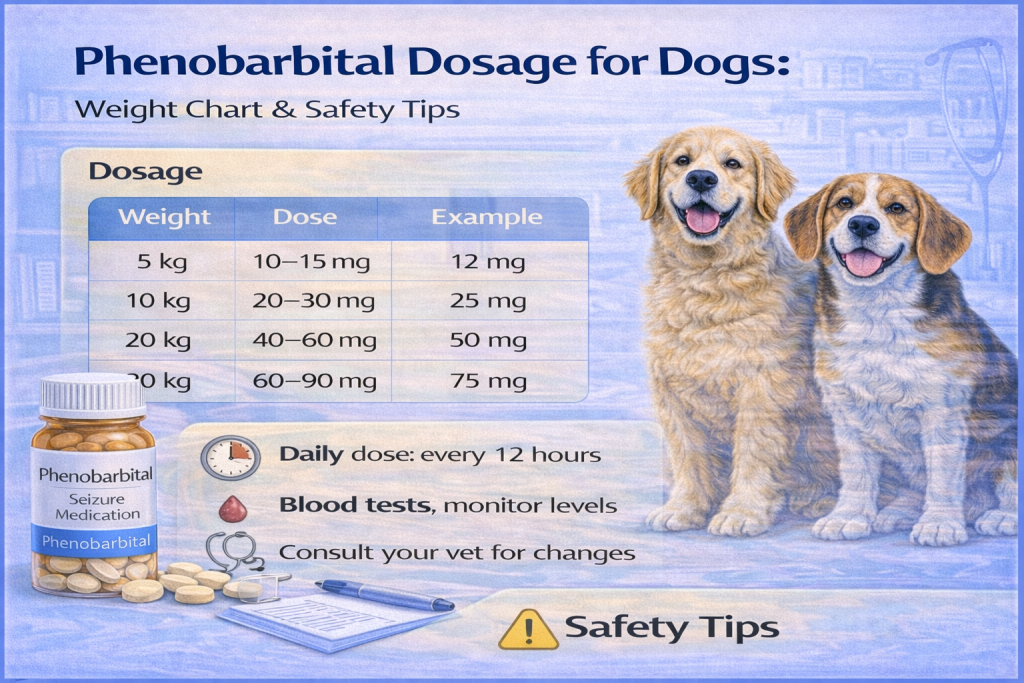
- Phenobarbital for Dogs: Uses, Dosage, Side Effects & Safety
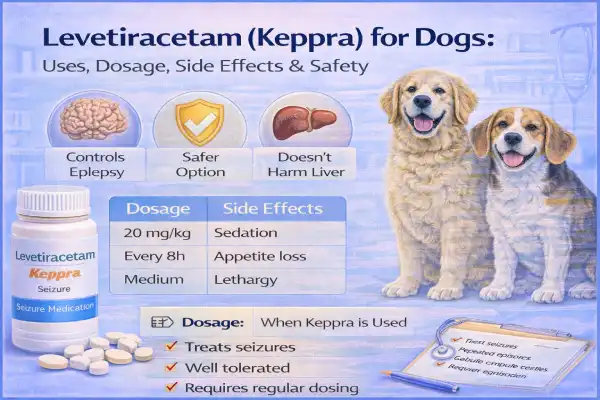
- Levetiracetam (Keppra) for Dogs: Uses, Dosage, Side Effects & Safety
Understanding what happens inside your dog’s brain after a seizure is the key to understanding why your dog is crying after a seizure.
What Happens During a Seizure?
A seizure occurs when abnormal electrical activity suddenly spreads through the brain.
Instead of neurons communicating in an organized manner, thousands or even millions of nerve cells begin firing simultaneously.
This electrical “storm” disrupts normal brain function and causes the classic seizure signs many owners recognize, including:
- Collapse
- Loss of consciousness
- Muscle stiffening
- Paddling movements
- Jaw chomping
- Excessive salivation
- Urination
- Defecation
- Vocalization
Although these episodes often last only one to three minutes, the brain may need considerably longer to recover afterward.
That recovery period explains why many owners wonder:
“Why is my dog crying after a seizure if the seizure has already ended?”
The answer usually lies in the recovery stage known as the post-ictal phase.
Understanding the Post-Ictal Phase

The post-ictal phase begins immediately after seizure activity stops.
This is the period during which the brain gradually returns to normal function.
Think of it as the brain “rebooting” after being overwhelmed by abnormal electrical activity.
During this recovery period, dogs may temporarily lose the ability to process information normally.
As a result, they may:
- Cry
- Whine
- Bark unexpectedly
- Wander aimlessly
- Pace continuously
- Walk into furniture
- Fail to recognize familiar people
- Hide
- Seek excessive attention
- Sleep for several hours
For many dogs, crying after a seizure is simply one symptom of this temporary neurological confusion.
The duration of the post-ictal phase varies considerably.
Some dogs recover within minutes.
Others may require several hours before behaving normally again.
Rarely, recovery can continue for an entire day.
Why Do Dogs Cry After a Seizure?
There isn’t just one explanation.
Several different mechanisms can cause a dog to vocalize during seizure recovery.
Understanding these possibilities helps owners recognize when crying is expected and when veterinary attention may be needed.
Temporary Brain Confusion
The most common reason a dog cries after a seizure is neurological confusion.
Immediately after seizure activity ends, the brain has not fully returned to normal function.
Dogs may feel:
- Disoriented
- Frightened
- Unable to recognize their surroundings
- Uncertain where they are
- Unable to understand what just happened
Imagine waking suddenly in a completely unfamiliar environment without knowing how you got there.
That level of confusion can be extremely frightening.
Instead of speaking, dogs communicate their distress through whining, barking, crying, or other vocalizations.
Fortunately, this type of crying usually improves as brain function gradually returns to normal.
Temporary Blindness
One of the least recognized consequences of seizures is temporary blindness.
Some dogs lose their vision for several minutes or even hours after a seizure.
Owners may notice their dog:
- Walking into walls
- Missing doorways
- Hesitating to move
- Looking frightened
- Staring into space
- Crying while wandering
Naturally, suddenly losing vision—even temporarily—is frightening.
Many dogs respond by crying because they feel vulnerable and uncertain about their surroundings.
This blindness usually resolves as the brain recovers.
Anxiety and Fear
Many owners assume their dog remembers the seizure itself.
In reality, most dogs probably do not remember the seizure.
What they do experience is the frightening recovery afterward.
The post-ictal phase can produce intense anxiety.
Dogs may become:
- Extremely clingy
- Restless
- Hypervigilant
- Easily startled
- Unable to settle
- Fearful of unfamiliar sounds
- Nervous around people
This emotional distress often explains why dogs cry after a seizure, even when no physical injury has occurred.
Owners who notice increased anxiety after seizures may also find these articles helpful:
Muscle Pain and Physical Soreness
Not every dog cries because of confusion alone.
Generalized seizures involve intense, repeated muscle contractions throughout the body.
These contractions can be physically exhausting.
Following a seizure, dogs may experience muscle soreness similar to how people feel after intense exercise.
Commonly affected muscles include:
- Neck muscles
- Shoulder muscles
- Back muscles
- Hind limbs
- Jaw muscles
A sore dog may:
- Cry when standing
- Whine while walking
- Hesitate to climb stairs
- Move stiffly
- Rest more than usual
Fortunately, mild muscle soreness typically improves over the next 24–48 hours.
However, severe pain should always be evaluated because it may indicate an injury sustained during the seizure.
Could My Dog Have Been Injured During the Seizure?
Sometimes, the crying has little to do with the seizure itself.
Instead, it results from an injury that occurred while the dog was convulsing.
Dogs may accidentally:
- Strike furniture
- Fall down stairs
- Hit walls
- Bite their tongue
- Damage a nail
- Strain muscles
- Sprain joints
After every seizure, owners should perform a gentle visual examination.
Look for:
- Bleeding
- Swelling
- Limping
- Broken nails
- Facial injuries
- Difficulty walking
If your dog appears painful after a seizure, your veterinarian should perform a complete examination to rule out traumatic injuries.
Does Every Dog Cry After a Seizure?
No.
Every dog experiences seizures differently.
Some dogs recover quietly by sleeping for several hours.
Others become unusually hungry.
Some immediately want affection.
Others pace constantly around the house.
Still others bark, howl, whine, or cry.
The severity of post-ictal behaviors often depends on:
| Factor | Possible Effect on Recovery |
|---|---|
| Length of seizure | Longer seizures often prolong recovery |
| Number of seizures | Cluster seizures may increase confusion |
| Underlying brain disease | May prolong neurological recovery |
| Age | Senior dogs sometimes recover more slowly |
| Medication | Some anticonvulsants may contribute to temporary sedation |
| Individual temperament | Some dogs vocalize more than others |
Because every dog is different, crying after a seizure is not automatically a sign that something is seriously wrong.
The most important question is whether your dog’s recovery follows its usual pattern or represents a significant change from previous seizures.
Can Crying After a Seizure Be a Sign of Pain?
One of the biggest concerns owners have is whether crying means their dog is actually in pain.
The honest answer is sometimes—but not always.
Most dogs that cry after a seizure are not crying because the seizure itself was painful. Unlike many injuries, generalized seizures do not usually cause pain while they are occurring because the dog is unconscious or has an altered level of awareness.
However, the recovery period is different.
Dogs may experience discomfort afterward for several reasons, including:
- Muscle soreness
- Minor injuries sustained during the seizure
- Tongue or cheek bites
- Joint strain
- Temporary headaches (suspected but difficult to confirm in veterinary medicine)
This is why veterinarians evaluate the entire dog rather than assuming every crying episode has the same cause.
If your dog also appears reluctant to move, cries when touched, or develops a limp after a seizure, schedule a veterinary examination as soon as possible.
Can Seizure Medications Cause Crying?

Sometimes owners assume that seizure medication is responsible for the crying.
While anticonvulsants themselves are not common causes of vocalization, they can occasionally contribute indirectly.
For example, some medications may cause:
- Temporary drowsiness
- Disorientation
- Restlessness
- Anxiety
- Behavioral changes during dose adjustments
Dogs beginning Phenobarbital for Dogs: Uses, Dosage, Side Effects & Safety often need several days or weeks to adapt to treatment. Likewise, some dogs starting Levetiracetam (Keppra) for Dogs: Uses, Dosage, Side Effects & Safety may seem temporarily quieter or sleepier than usual.
These medication effects can overlap with the post-ictal phase, making it difficult for owners to determine exactly why their dog is crying after a seizure.
If the crying begins only after starting a new medication or increasing the dose, speak with your veterinarian before making any changes.
Never stop seizure medication abruptly, as this may trigger breakthrough seizures or even life-threatening status epilepticus.
How Long Does Crying Usually Last?
The duration varies considerably.
Some dogs cry for only a few minutes.
Others remain restless or vocal for several hours.
The recovery period depends on several factors, including:
- The severity of the seizure
- Whether multiple seizures occurred
- Your dog’s age
- The underlying cause of the seizures
- Overall health
- Current medications
A general guide is shown below.
| Recovery Time | What Owners May Notice |
|---|---|
| 5–15 minutes | Mild confusion, brief whining, seeking reassurance |
| 15–60 minutes | Restlessness, pacing, crying, increased thirst |
| 1–6 hours | Sleepiness, temporary blindness, anxiety, occasional vocalization |
| 6–24 hours | Gradual return to normal behavior after severe seizures |
Many dogs sleep deeply after the post-ictal phase ends.
This prolonged sleep is often a normal part of brain recovery.
What Should You Do If Your Dog Is Crying After a Seizure?

Watching your dog recover from a seizure can be emotionally exhausting.
Fortunately, there are several things owners can do to make recovery safer and less stressful.
Stay Calm
Dogs are remarkably sensitive to human emotions.
Speaking softly and remaining calm can help reduce additional stress during recovery.
Avoid shouting, sudden movements, or forcing your dog to respond immediately.
Keep the Environment Quiet
During the post-ictal phase, many dogs are extremely sensitive to stimulation.
Reduce unnecessary stress by:
- Turning off loud televisions
- Lowering music volume
- Keeping children calm
- Limiting other pets’ access
- Dimming bright lights if possible
A quiet environment often allows the brain to recover more comfortably.
Prevent Injury
Dogs recovering from seizures may still be:
- Unsteady
- Temporarily blind
- Confused
- Poorly coordinated
Protect your dog by:
- Blocking stairways
- Moving sharp furniture if practical
- Preventing access to swimming pools
- Avoiding slippery floors
- Staying nearby until normal awareness returns
Safety should always be your first priority.
Do Not Force Food or Water Immediately
Some dogs are extremely thirsty after a seizure.
Others want food immediately.
Although small amounts of water are usually appropriate once your dog is fully awake and able to swallow normally, avoid allowing excessive drinking all at once because this may lead to vomiting.
If your dog seems ravenously hungry, wait until they are fully coordinated before offering a small meal.
Record What Happened
Keeping a seizure diary is one of the most valuable things owners can do.
Write down:
- Date
- Time
- Duration
- Description of the seizure
- How long the crying lasted
- Any unusual behaviors
- Recovery time
- Possible triggers
These details help your veterinarian determine whether treatment adjustments are needed.
Many owners also record seizures using a smartphone video, which can be extremely helpful during veterinary consultations.
Is Crying More Common After Certain Types of Seizures?
Yes.
Although any seizure can be followed by crying, some situations make prolonged post-ictal vocalization more likely.
Generalized Seizures
Generalized tonic-clonic seizures involve the entire brain.
Because they produce widespread neurological disruption, recovery is often longer.
Dogs may:
- Cry
- Pace
- Appear frightened
- Sleep excessively
- Become temporarily blind
These seizures are the most common reason owners ask, “Why is my dog crying after a seizure?”
Cluster Seizures
Cluster seizures occur when two or more seizures happen within a 24-hour period.
Recovery tends to be much more difficult because the brain has little opportunity to recover between episodes.
Dogs may remain confused, anxious, or vocal for much longer than after a single seizure.
If your dog experiences cluster seizures, you should also read What to Do During a Dog Seizure (Emergency Guide for Pet Owners) and Why Is My Dog Still Having Seizures on Medication?, as these situations often require urgent veterinary evaluation.
Status Epilepticus
Status epilepticus is a life-threatening emergency in which seizure activity continues for several minutes or repeated seizures occur without full recovery between them.
Dogs surviving status epilepticus often experience a prolonged recovery period.
In addition to crying, they may show:
- Severe disorientation
- Temporary blindness
- Difficulty walking
- Profound exhaustion
- Reduced responsiveness
These dogs require immediate emergency veterinary care and should never be managed at home.
Could Crying Mean the Seizures Are Getting Worse?
Not necessarily.
A dog that cries after a seizure is not automatically developing more severe epilepsy.
However, changes in post-seizure behavior deserve attention.
Contact your veterinarian if:
- Your dog cries much longer than usual.
- The crying becomes more intense after each seizure.
- Recovery takes significantly longer than before.
- New neurological signs develop.
- Seizures become more frequent despite medication.
Sometimes these changes simply reflect disease progression, but they may also indicate that your dog’s current treatment plan needs to be adjusted.
Many dogs benefit from medication changes, additional anticonvulsants, or further diagnostic testing when recovery patterns begin to change.
When Should You Contact Your Veterinarian?
Most dogs recover from a seizure without developing serious complications. In many cases, the crying gradually decreases as the post-ictal phase resolves and the brain returns to normal function.
However, there are situations where crying after a seizure should never be ignored.
You should schedule a veterinary appointment if your dog:
- Cries continuously for several hours after every seizure.
- Appears to be in significant pain.
- Refuses to eat or drink after recovering.
- Has difficulty standing or walking after the post-ictal phase.
- Experiences worsening seizures despite medication.
- Recovers much more slowly than usual.
- Develops new behavioral or neurological changes.
- Begins crying after seizures when this has never happened before.
Changes in your dog’s normal recovery pattern are often more important than the crying itself.
For example, if your dog has always recovered quietly after seizures but suddenly begins crying intensely after every episode, your veterinarian should investigate the cause.
Seek Emergency Veterinary Care Immediately If:
Although crying alone is rarely an emergency, certain accompanying signs require immediate medical attention.
Seek emergency care if your dog:
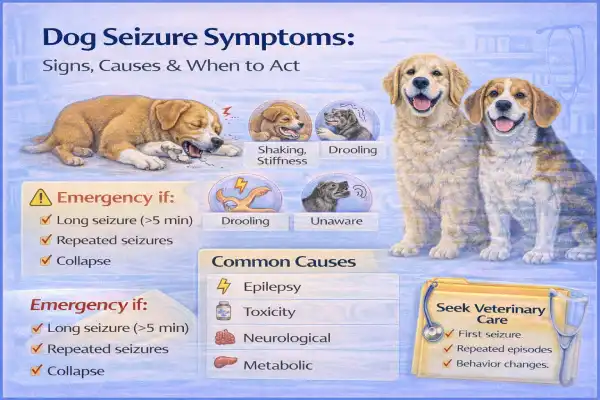
- Has a seizure lasting longer than five minutes.
- Experiences two or more seizures without fully recovering.
- Remains unconscious after the seizure.
- Cannot stand several hours later.
- Develops severe breathing difficulty.
- Has uncontrolled bleeding after the seizure.
- Appears severely injured.
- Develops blue or pale gums.
- Continues crying while becoming progressively less responsive.
These situations may indicate status epilepticus, traumatic injury, severe neurological disease, or another life-threatening emergency.
Can Crying After a Seizure Be Prevented?
Unfortunately, there is no guaranteed way to prevent post-seizure crying because it is usually part of the brain’s recovery process.
However, effective seizure management can often reduce both seizure frequency and recovery severity.
Veterinarians commonly recommend:
- Giving seizure medication exactly as prescribed.
- Never skipping doses.
- Keeping regular recheck appointments.
- Monitoring blood work when recommended.
- Recording every seizure in a seizure diary.
- Identifying possible seizure triggers.
- Maintaining a consistent daily routine.
Owners whose dogs receive Phenobarbital for Dogs: Uses, Dosage, Side Effects & Safety or Levetiracetam (Keppra) for Dogs: Uses, Dosage, Side Effects & Safety should never adjust medication doses without veterinary advice, even if recovery behaviors seem unusual.
Could Crying Mean My Dog Doesn’t Recognize Me?

Yes and this can be one of the most distressing parts of the post-ictal phase.
Some dogs temporarily fail to recognize familiar people after a seizure.
Owners may notice that their dog:
- Walks past them without responding.
- Appears frightened by familiar family members.
- Avoids eye contact.
- Seems confused by familiar rooms.
- Wanders aimlessly through the house.
- Cries while looking around.
Fortunately, this confusion is usually temporary.
As normal brain activity returns, most dogs gradually begin recognizing their surroundings and family members again.
This temporary disorientation is one reason many owners ask “Why is my dog crying after a seizure?” even though no physical injury is present.
Can Puppies and Senior Dogs Recover Differently?
Age can influence post-seizure recovery.
Puppies
Young dogs often recover surprisingly quickly because they generally have healthy organs and good neurological resilience.
However, seizures in puppies are more likely to have underlying causes that require investigation, including:
- Congenital liver disease
- Metabolic disorders
- Infectious diseases
- Developmental brain abnormalities
Any puppy experiencing seizures should undergo prompt veterinary evaluation.
Senior Dogs
Older dogs sometimes experience a longer post-ictal period.
Recovery may be slower because senior dogs are more likely to have:
- Brain tumors
- Stroke-like events
- Chronic kidney disease
- Liver disease
- Cognitive dysfunction
- Multiple medications
These factors can prolong confusion and increase the likelihood of crying after a seizure.
Related Symptoms Owners Often Notice
Owners searching “Why Is My Dog Crying After a Seizure?” frequently report several other symptoms occurring during the recovery period.
Common related signs include:
- Pacing
- Panting
- Excessive thirst
- Increased appetite
- Temporary blindness
- Confusion
- Restlessness
- Shaking
- Weakness
- Wobbliness
- Drooling
- Disorientation
- Hiding
- Clinginess
- Sleeping for several hours
Many of these signs are normal components of the post-ictal phase.
However, if they become progressively worse or persist much longer than your dog’s usual recovery time, they warrant veterinary evaluation.
When Owners Commonly Ask This
Veterinarians frequently hear questions such as:
- “Why is my dog crying after a seizure if the seizure has already stopped?”
- “Does crying mean my dog is in pain?”
- “Is my dog scared after a seizure?”
- “Why won’t my dog settle down?”
- “How long does the post-ictal phase last?”
- “Should I comfort my dog or leave them alone?”
- “Can seizure medication cause crying?”
- “Does my dog remember having the seizure?”
- “Should I let my dog sleep after a seizure?”
- “When should I go to the emergency veterinarian?”
These are all common concerns, and the answers often depend on your dog’s age, seizure history, recovery pattern, and underlying medical condition.
Veterinarian Takeaway
If you’ve been asking “Why is my dog crying after a seizure?”, remember that crying is often a temporary part of the post-ictal recovery phase rather than a sign that the seizure itself caused severe pain.
Most dogs recover completely within minutes to several hours, although some may remain confused, anxious, temporarily blind, or physically sore for longer periods.
The most important thing owners can do is observe their dog’s recovery carefully, provide a calm and safe environment, and report any significant changes in seizure frequency or recovery behavior to their veterinarian.
Bottom Line
Why is my dog crying after a seizure? In most cases, crying is caused by temporary brain recovery during the post-ictal phase rather than by ongoing seizure activity. Confusion, anxiety, temporary blindness, muscle soreness, and disorientation can all cause dogs to whine or cry as they recover.
Although this behavior is often normal, persistent crying, signs of severe pain, repeated seizures, prolonged recovery, or difficulty standing should always be evaluated by a veterinarian. Early assessment helps identify injuries, medication problems, or underlying neurological conditions while ensuring your dog receives the safest and most effective treatment.
Frequently Asked Questions – Why Is My Dog Crying After a Seizure
Why is my dog crying after a seizure even though the seizure is over?
Most dogs cry because they are experiencing the post-ictal phase, during which the brain is recovering from abnormal electrical activity. Temporary confusion, fear, or disorientation are common.
Is crying after a seizure normal?
Yes. Many dogs whine, cry, pace, or appear restless after seizures. This behavior usually improves as the brain recovers.
Does crying mean my dog is in pain?
Not always. While some dogs may have muscle soreness or minor injuries, many cry because they are confused or frightened rather than because they are experiencing severe pain.
How long does crying usually last after a seizure?
It varies. Some dogs stop crying within minutes, while others remain vocal for several hours depending on the severity of the seizure and the length of the post-ictal phase.
Should I comfort my dog after a seizure?
Yes. Speak calmly, keep the environment quiet, and stay nearby. Avoid forcing interaction if your dog seems confused or frightened.
Can seizure medication cause crying?
Seizure medications are not a common direct cause of crying, but temporary drowsiness, anxiety, or behavioral changes during treatment adjustments may contribute.
Should I let my dog sleep after a seizure?
Yes. Many dogs are extremely tired after recovering from a seizure, and rest is usually beneficial once they are fully awake and safe.
When should I worry about crying after a seizure?
Seek veterinary advice if the crying is unusually severe, lasts much longer than normal, is accompanied by signs of injury, or occurs with repeated seizures.
Can seizures permanently change my dog’s behavior?
Most dogs return to their normal behavior after recovery. Persistent personality changes should be discussed with your veterinarian.
Can dogs fully recover after a seizure?
Yes. Most dogs recover completely, especially when seizures are appropriately managed and underlying conditions are treated.
Sources
- Plumb’s Veterinary Drug Handbook
- Merck Veterinary Manual
- BSAVA Small Animal Formulary
- Veterinary Pharmacology and Therapeutics (Riviere & Papich)
- Small Animal Clinical Pharmacology (Maddison, Page & Church)
- ACVIM Consensus Statement on Seizure Management in Dogs
- WSAVA Global Guidelines
- Veterinary Information Network (VIN)
- Journal of the American Veterinary Medical Association (JAVMA)
- Frontiers in Veterinary Science
- PubMed (peer-reviewed literature on canine epilepsy, post-ictal behavior, and seizure recovery)
Medical Review Statement
This article was written by Dimitar Georgiev Atanasov, MPharm, pharmacy and scientifically reviewed by Gergana Krasimirova Atanasova, MPharm, and independently veterinary reviewed by Dr. Valcho Georgiev Valchev, DVM. It is based on current veterinary pharmacology references, peer-reviewed scientific literature, canine neurology references, epilepsy treatment guidelines, and evidence-based veterinary recommendations to ensure accurate, practical, and trustworthy information for dog owners.
Important Medical Disclaimer
The information provided on PetMedsMadeSimple.com is intended for educational purposes only and should not replace professional veterinary diagnosis or treatment.
Never start, stop, or adjust your dog’s seizure medication without consulting your veterinarian. If your dog develops prolonged seizures, repeated seizures, collapse, severe breathing difficulties, persistent vomiting, becomes impossible to wake, or shows signs of severe injury after a seizure, seek emergency veterinary care immediately.
Image Disclosure
Some images used in this article may be AI-generated or AI-assisted for educational purposes. Every PMMS article is independently researched, pharmacy-written, scientifically reviewed, and veterinary-reviewed. AI-generated illustrations are used solely to improve understanding of veterinary medications and should not be interpreted as photographs of actual clinical patients.