
Quick Answer
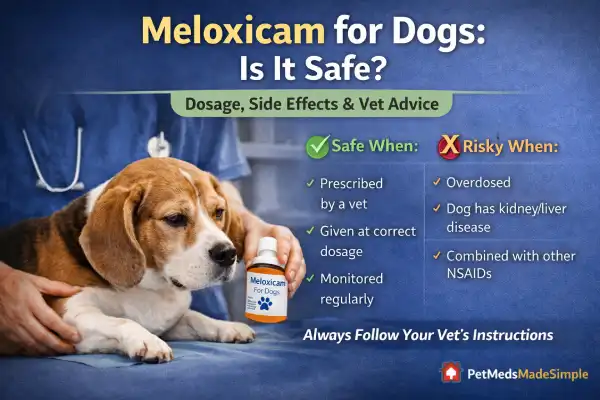
Safest NSAID for Dogs long-term are typically carprofen, meloxicam, and firocoxib when used under veterinary supervision. However, no NSAID is completely risk-free. Long-term safety depends on dose, monitoring, hydration, and combining therapies correctly.
Why This Question Is So Important
Most owners ask this when:
- their dog has been on NSAIDs for weeks or months
- they start worrying about side effects
- they notice subtle changes (less appetite, mild lethargy)
- they read something online about kidney damage
👉 And they’re right to question it.
Because NSAIDs are:
✔ the most effective arthritis drugs
❌ but also the most commonly misused
The Truth Most Articles Don’t Tell You
There is no such thing as:
❌ “100% safe NSAID”
There is only:
👉 risk-managed NSAID use
This is a key concept also connected to broader pain management strategies explained in What Can I Give My Dog for Pain? (Vet Comparison Guide).
Safest NSAID for Dogs
What Are NSAIDs and Why Dogs Need Them
NSAIDs (Non-Steroidal Anti-Inflammatory Drugs):
- reduce inflammation
- block pain signals
- improve mobility
They are the first-line treatment for arthritis.
Without NSAIDs:
👉 most dogs with arthritis would struggle to move normally
How NSAIDs Actually Work (Advanced Explanation)
NSAIDs block:
👉 COX enzymes (Cyclooxygenase)
This reduces:
- prostaglandins
- inflammation
- pain signals
The Problem
Prostaglandins also protect:
- stomach lining
- kidney blood flow
- healing processes
👉 This is why NSAIDs have risks
Safest NSAIDs for Dogs Long-Term (Vet Ranking)
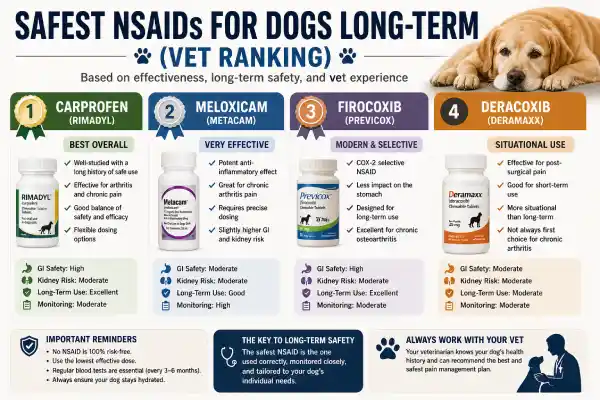
🥇 Carprofen – The Gold Standard
Most commonly used worldwide.
Why vets prefer it:
- predictable safety
- long clinical history
- flexible dosing
👉 Learn more: Carprofen for Dogs: Uses, Dosage & Side Effects
🥈 Meloxicam – Strong but Needs Precision
Very effective for chronic arthritis.
Pros:
- potent anti-inflammatory effect
- good long-term control
Cons:
- dosing must be precise
- slightly higher GI risk
👉 More: Is Meloxicam Safe for Dogs?
🥉 Firocoxib – Modern & Selective
COX-2 selective NSAID:
- less stomach irritation
- designed for long-term use
Very popular in newer protocols.
Deracoxib – Situational Option
Used for:
- post-surgical pain
- short-term inflammation
Not always first choice long-term.
Comparison Table (Long-Term Safety)
| NSAID | GI Safety | Kidney Risk | Long-Term Use | Monitoring |
|---|---|---|---|---|
| Carprofen | High | Moderate | Excellent | Medium |
| Meloxicam | Moderate | Moderate | Good | High |
| Firocoxib | High | Moderate | Excellent | Medium |
| Deracoxib | Moderate | Moderate | Moderate | Medium |
Long-Term Risks Explained (Deep Dive)
1. Kidney Damage
NSAIDs reduce:
👉 renal blood flow regulation
This can lead to:
- acute kidney injury
- chronic kidney disease
Especially in:
- dehydrated dogs
- seniors
- dogs with pre-existing issues
2. Gastrointestinal Damage
Most common issue.
Includes:
- vomiting
- diarrhea
- ulcers
- bleeding
3. Liver Effects
Less common but serious:
- elevated liver enzymes
- rare liver failure
Advanced Risk Timeline
| Timeframe | Risk Level |
|---|---|
| 1–4 weeks | Very low |
| 1–3 months | Low |
| 3–6 months | Moderate |
| 6+ months | Depends on monitoring |
👉 Risk is NOT linear
👉 It depends on management
Blood Monitoring Strategy
Most owners skip this — big mistake.
Ideal Schedule
| Time | Test |
|---|---|
| Before starting | Baseline |
| 1 month | Early check |
| Every 3–6 months | Ongoing monitoring |
Key Values
- BUN
- Creatinine
- ALT
- AST
- ALP
👉 Early detection = prevention
Why NSAIDs Stop Working Over Time
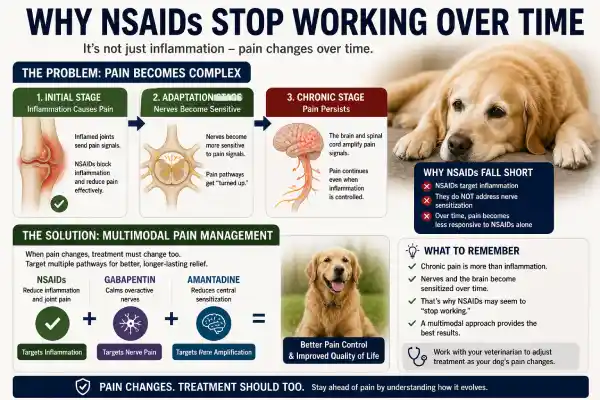
This is one of the most important concepts.
The Real Reason
Pain changes.
It becomes:
👉 centralized (neurological)
Central Sensitization
Over time:
- nerves fire repeatedly
- spinal cord becomes hypersensitive
- brain amplifies pain
👉 Even if inflammation is controlled
👉 Pain continues
This concept is also explained in Why Is My Dog in Pain? Signs, Causes & When to Go to the Vet
Why Increasing NSAID Dose Is WRONG
Many owners think:
👉 “If it’s not working → give more”
This leads to:
- higher toxicity risk
- minimal additional benefit
- serious complications
Correct Strategy: Multimodal Therapy
Modern approach:
👉 target multiple pain pathways
Example Combinations
| Combination | Benefit |
|---|---|
| NSAID + Gabapentin | Adds nerve pain control |
| NSAID + Amantadine | Reduces central sensitization |
| Triple therapy | Maximum effect |
👉 Learn more:
- Gabapentin for Dogs: Uses, Dosage & Safety Guide
- Amantadine for Dogs: A Hidden Pain Management Tool
- Best Pain Medication for Dogs with Arthritis (Comparison Guide)
Case Scenarios
Case 1: Stable Long-Term Dog
- Labrador, 8 years
- on carprofen
- monitored every 6 months
Result:
✔ stable for years
✔ no major side effects
Case 2: Sensitive Dog
- small breed, 10 years
- same medication
Result:
⚠ vomiting after 2 weeks
⚠ dose adjustment needed
👉 Same drug
👉 Different biology
Hydration: The MOST Underrated Factor
This is huge.
Why It Matters
NSAIDs affect kidney blood flow.
If dog is:
- dehydrated
- sick
- not drinking
👉 risk increases dramatically
Golden Rule
👉 Never give NSAIDs to a dehydrated dog
Early Warning Signs (Owners Miss These)
Most people wait for:
- vomiting
- diarrhea
But early signs are:
- reduced appetite
- slight lethargy
- increased thirst
- slower movement
👉 Catching these early = preventing damage
Switching vs Combining NSAIDs
Switching
✔ sometimes helpful
✔ requires washout period
Combining
❌ NEVER safe
Better Alternative
👉 combine with different class drugs
Breed & Age Considerations
Higher Risk Dogs
- seniors
- small breeds
- kidney issues
- dehydrated dogs
Lower Risk Dogs
- healthy adults
- large breeds
- well hydrated
Advanced Safety Strategy
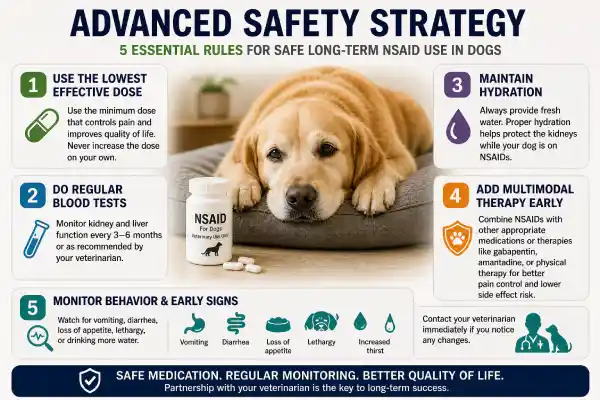
If you want long-term success:
Follow These 5 Rules
- Use lowest effective dose
- Do regular blood tests
- Maintain hydration
- Add multimodal therapy early
- Monitor behavior
👉 This is how vets keep dogs safe for YEARS
Vet Perspective
Vets don’t ask:
👉 “Which NSAID is safest?”
They ask:
👉 “How do we make THIS dog’s treatment safest?”
What You Should NEVER Do
Do NOT give:
- ibuprofen
- naproxen
- diclofenac
👉 extremely toxic to dogs
FAQ – Safest NSAID for Dogs Long-Term
What is the safest NSAID?
Carprofen and firocoxib are often considered safest long-term options.
Can dogs take NSAIDs for life?
Yes — with proper monitoring.
How often should blood tests be done?
Every 3–6 months.
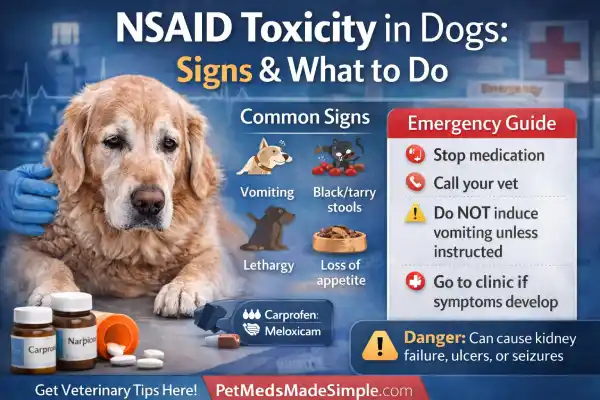
What are early toxicity signs?
Loss of appetite, lethargy, vomiting.
Can I switch NSAIDs?
Yes, but only under vet supervision.
Conclusion
There is no “perfect” NSAID.
But there is:
👉 perfect management
When used correctly, NSAIDs can safely control arthritis pain for years and dramatically improve a dog’s quality of life.
The key is not choosing the “safest drug” — but building the safest strategy.
Medical Disclaimer
This content is for educational purposes only and does not replace veterinary advice. Always consult your veterinarian before starting or adjusting any medication.
Sources
- Plumb’s Veterinary Drug Handbook
- VCA Animal Hospitals
- Veterinary Partner (VIN)
- Journal of Veterinary Internal Medicine