Quick Answer
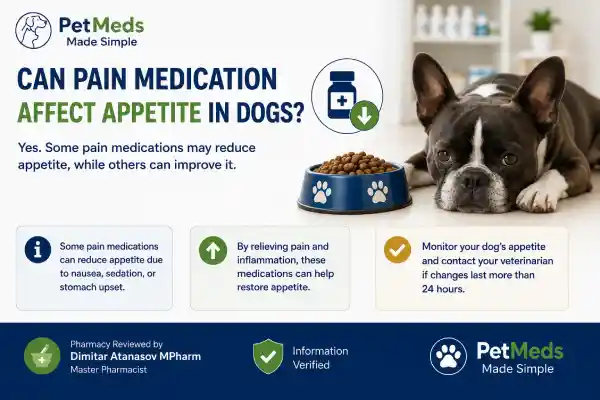
Can Pain Medication Affect Appetite in Dogs? Yes, pain medication can affect a dog’s appetite. Some medications may temporarily decrease appetite by causing nausea, stomach irritation, sedation, or constipation, while others may indirectly improve appetite by relieving pain and allowing a dog to feel more comfortable. A mild decrease in appetite during the first day or two of treatment is not unusual, but dogs that refuse food for more than 24 hours—or develop vomiting, diarrhea, weakness, abdominal pain, or black stools—should be examined by a veterinarian promptly.
When Owners Commonly Ask This Question
Dog owners often begin searching “Can pain medication affect appetite?” after noticing one of these situations:
- Their dog suddenly refuses breakfast after starting a new pain medication.
- A normally food-motivated dog only sniffs food and walks away.
- Their dog is recovering from surgery but has little interest in eating.
- Appetite improves one day but disappears the next.
- Their veterinarian prescribed an NSAID or tramadol, and eating habits changed soon afterward.
Appetite changes are one of the most common concerns reported after starting pain medication. Fortunately, they are not always caused by the medication itself. Pain, stress, anesthesia, underlying disease, and recovery from surgery can all influence how much a dog wants to eat.
Can Pain Medication Affect Appetite in Dogs?
Can Pain Medication Affect Appetite?
The short answer is yes, but not every medication affects appetite in the same way.
Some medications may reduce a dog’s interest in food because they irritate the stomach or cause mild nausea. Others make dogs sleepy, causing them to miss meals simply because they spend more time resting. In contrast, effective pain relief often improves appetite because dogs finally feel comfortable enough to eat again.
This is why veterinarians rarely blame the medication immediately. Instead, they evaluate the entire situation, including:
- Which medication is being used
- Why the medication was prescribed
- How severe the underlying condition is
- Whether surgery was performed recently
- Whether any additional symptoms have developed
If your dog has recently started pain medication but still appears uncomfortable, you may also find our article Why Is My Dog Still in Pain After Medication? helpful because ongoing pain itself is one of the most common reasons dogs stop eating.
How Does Pain Medication Influence Appetite?
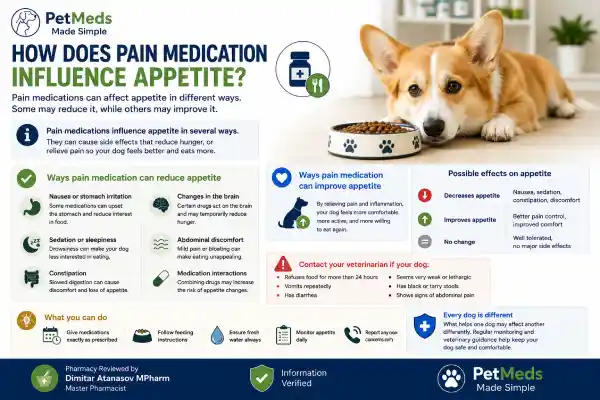
Pain medications can affect appetite in several different ways.
Some act directly on the digestive system.
Others influence the brain, changing how hunger is perceived.
Still others reduce pain so effectively that appetite actually improves.
| Effect on Appetite | Possible Mechanism |
|---|---|
| Appetite decreases | Nausea or stomach irritation |
| Appetite decreases | Sedation or sleepiness |
| Appetite decreases | Constipation or abdominal discomfort |
| Appetite improves | Better pain control |
| Appetite remains unchanged | Medication is well tolerated |
Understanding these differences helps explain why two dogs taking different medications may respond completely differently.
Which Pain Medications Are Most Likely to Affect Appetite?
Not all pain medications carry the same risk.
Some rarely influence eating habits, while others are well known for causing temporary digestive side effects.
| Medication | Appetite Changes Possible? | Most Common Effect |
|---|---|---|
| Carprofen | Yes | Mild appetite loss if stomach irritation develops |
| Meloxicam | Yes | Reduced appetite in sensitive dogs |
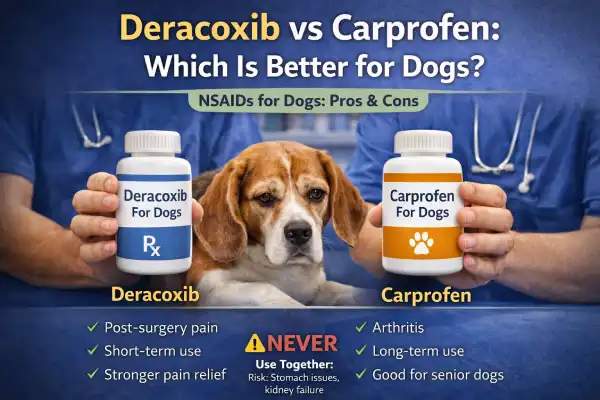
| Deracoxib | Yes | Occasional gastrointestinal upset |
| Gabapentin | Occasionally | Reduced appetite due to sedation |
| Tramadol | Yes | Nausea and decreased appetite |
| Morphine | Yes | Nausea, constipation, reduced appetite |
| Buprenorphine | Sometimes | Mild appetite reduction |
Fortunately, most dogs tolerate these medications well when they are used correctly and monitored appropriately.
If your dog is taking an NSAID, our article Can Meloxicam Cause Kidney Damage in Dogs? also explains why monitoring kidney health is important during long-term treatment.
Likewise, if your dog receives tramadol, our guide Is Tramadol Still Recommended for Dogs? discusses why many veterinarians now use alternative pain management strategies for chronic conditions.
Is Appetite Loss Always Caused by the Medication?
No.
This is one of the biggest misconceptions among pet owners.
Dogs receiving pain medication are usually already dealing with a painful medical condition.
That condition itself may reduce appetite.
For example:
- Arthritis can make it painful to stand long enough to eat.
- Dental disease may make chewing uncomfortable.
- Spinal disease can reduce mobility.
- Cancer frequently decreases appetite.
- Pancreatitis often causes nausea.
- Orthopedic surgery temporarily reduces interest in food.
In these situations, the medication may actually be helping, even though appetite has not yet returned to normal.
If your dog’s recovery seems slower than expected, you may also benefit from reading Why Is My Dog Not Improving on Pain Medication?, where we discuss how veterinarians distinguish medication failure from disease progression.
Could Pain Itself Cause Appetite Loss?
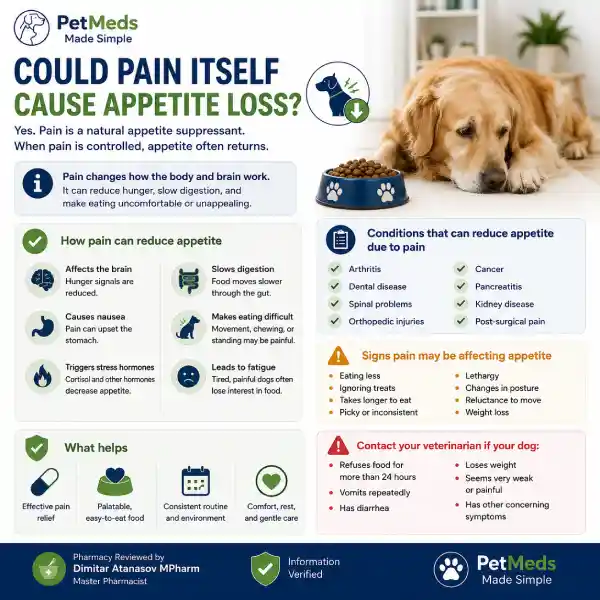
Absolutely.
Pain is one of the body’s strongest natural appetite suppressants.
Dogs experiencing significant discomfort often:
- Eat smaller meals.
- Refuse hard food.
- Lose interest in treats.
- Walk away from the food bowl.
- Eat only when hand-fed.
Many owners are surprised to discover that once pain is controlled more effectively, appetite often returns without changing the diet at all.
This is especially common in dogs with advanced osteoarthritis.
If your dog also seems restless, our article Why Is My Dog Pacing After Pain Medication? explains how ongoing pain sometimes causes pacing, inability to settle, and poor appetite at the same time.
Why Do NSAIDs Sometimes Reduce Appetite?
Non-steroidal anti-inflammatory drugs (NSAIDs) are among the safest and most effective pain medications used in dogs.
However, they can occasionally irritate the stomach.
NSAIDs work by blocking enzymes called cyclooxygenases (COX enzymes), which are involved in inflammation.
Unfortunately, these enzymes also help protect the stomach lining.
In sensitive dogs, reduced stomach protection may lead to:
- Mild nausea
- Stomach discomfort
- Acid irritation
- Gastritis
- Reduced appetite
Fortunately, most cases are mild and improve once the veterinarian adjusts the treatment plan.
However, persistent appetite loss should never be ignored because it may be one of the earliest signs of gastrointestinal complications.
Our guide Can Pain Medication Cause Stomach Bleeding in Dogs? explains the warning signs owners should watch for before more serious problems develop.
Can Gabapentin Affect Appetite?
Although gabapentin is not classified as a traditional pain medication, it has become one of the most commonly prescribed drugs for chronic pain and neuropathic (nerve) pain in dogs.
Most dogs tolerate gabapentin very well.
However, owners occasionally notice that their dog eats less after starting treatment.
In many cases, this happens indirectly rather than because gabapentin suppresses appetite itself.
Dogs receiving gabapentin often become:
- sleepy,
- less active,
- slower to respond,
- more interested in resting than eating.
Some simply sleep through their normal mealtime.
Others appear less enthusiastic about food because they are still adjusting to the medication.
Fortunately, this effect usually improves over the first several days.
If your dog also seems unusually sleepy, our article How Long Does Gabapentin Sedation Last in Dogs? explains why this happens and when excessive drowsiness should be discussed with your veterinarian.
Likewise, if your dog develops weakness while taking gabapentin, Can Gabapentin Cause Weakness in Dogs? discusses which symptoms are expected and which require prompt veterinary attention.
Can Opioids Reduce Appetite?
Yes.
Opioid medications are among the pain relievers most likely to influence appetite.
Examples include:
- Morphine
- Hydromorphone
- Fentanyl
- Buprenorphine
- Tramadol
These medications work by acting on opioid receptors within the brain and spinal cord.
While they are excellent pain relievers, they may also affect the digestive system.
Some dogs develop:
- nausea,
- constipation,
- reduced stomach emptying,
- decreased interest in food,
- mild abdominal discomfort.
Fortunately, many dogs adapt within several days as their bodies become accustomed to the medication.
However, persistent appetite loss should always be discussed with your veterinarian.
Can Better Pain Control Actually Improve Appetite?
Absolutely.
This is something many owners never consider.
Pain itself is a powerful appetite suppressant.
When a painful condition is finally controlled, many dogs begin eating more, not less.
Veterinarians commonly see this in dogs recovering from:
- cruciate ligament surgery,
- fracture repair,
- dental procedures,
- spinal surgery,
- severe arthritis flare-ups.
As discomfort decreases:
- dogs become more active,
- sleep improves,
- stress hormones decrease,
- appetite often returns naturally.
This is one reason veterinarians evaluate the entire dog, not just the medication, when appetite changes occur.
Appetite Changes After Surgery
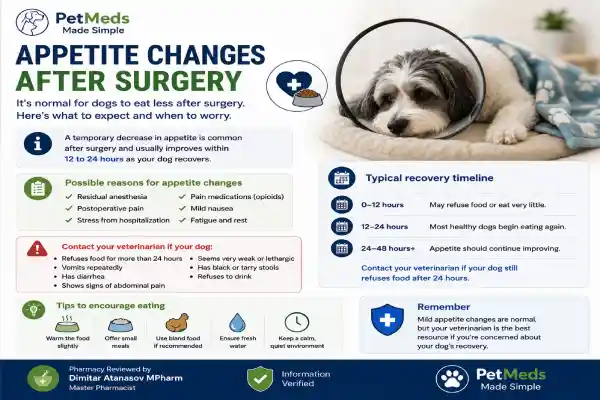
Owners frequently worry when their dog refuses food after surgery.
Fortunately, a temporary reduction in appetite is fairly common.
Several factors may contribute at the same time:
| Possible Cause | Appetite May Decrease? |
|---|---|
| Residual anesthesia | ✔ |
| Postoperative pain | ✔ |
| Stress from hospitalization | ✔ |
| Opioid medications | ✔ |
| Mild nausea | ✔ |
| Fatigue | ✔ |
Most healthy dogs gradually begin eating again within 12 to 24 hours after routine procedures.
Dogs that continue refusing food beyond this period—or develop vomiting, diarrhea, abdominal pain, or extreme lethargy—should be re-examined.
If your dog also appears restless after surgery, you may want to read Why Is My Dog Pacing After Pain Medication?, where we explain why discomfort, dysphoria, or medication side effects sometimes occur during recovery.
Which Dogs Are More Likely to Experience Appetite Changes?
Some dogs are naturally more sensitive than others.
Veterinarians monitor these patients particularly closely:
- Senior dogs
- Puppies
- Dogs with kidney disease
- Dogs with liver disease
- Dogs with chronic gastrointestinal disease
- Dogs receiving multiple medications
- Dogs recovering from major surgery
- Dogs with cancer
- Dogs with pancreatitis
Because these patients already have increased medical risks, even mild appetite loss deserves careful evaluation.
Could Other Medications Be Responsible?
Sometimes the pain medication receives the blame when another medication is actually responsible.
For example, a dog recovering from surgery may receive:
- an NSAID,
- an opioid,
- an antibiotic,
- an anti-nausea medication,
- a sedative.
If appetite changes develop, your veterinarian will consider all medications, not just the pain reliever.
Always bring an updated medication list to your appointment, including supplements and over-the-counter products.
Home Monitoring Checklist
Keeping a simple daily record can help identify whether your dog’s appetite is improving or worsening.
| Monitor Each Day | Yes / No |
|---|---|
| Finished entire meal | ☐ |
| Ate treats normally | ☐ |
| Drank water | ☐ |
| Vomited | ☐ |
| Had diarrhea | ☐ |
| Normal energy level | ☐ |
| Comfortable walking | ☐ |
| Interested in family | ☐ |
| Medication given correctly | ☐ |
| Appetite improving | ☐ |
This information often helps your veterinarian decide whether the medication should be adjusted or whether another medical problem should be investigated.
When Should You Contact Your Veterinarian?
A mild decrease in appetite during the first day of treatment is often temporary.
However, veterinary advice should be sought if your dog:
- refuses food for more than 24 hours,
- repeatedly vomits,
- develops diarrhea,
- becomes weak,
- appears painful,
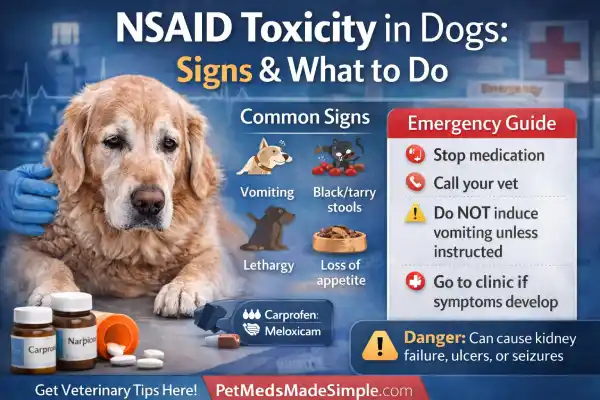
- develops black or tarry stools,
- becomes dehydrated,
- refuses to drink,
- develops abdominal swelling,
- becomes progressively more lethargic.
Never stop prescribed pain medication or increase the dose without first consulting your veterinarian.
If you are concerned that your dog’s treatment is no longer working, our article Can Dogs Build Tolerance to Pain Medication? explains why worsening symptoms are often caused by disease progression rather than true medication tolerance.
When Is Appetite Loss an Emergency?
One of the most common questions veterinarians hear is:
“My dog isn’t eating after starting pain medication. Should I be worried?”
The answer depends on how long the appetite loss lasts and whether it occurs alongside other symptoms.
Missing a single meal is not always an emergency, particularly if your dog has recently undergone surgery or started a new medication.
However, prolonged appetite loss should never be ignored because dogs that stop eating can quickly become dehydrated or develop additional complications.
The following table can help owners understand when immediate veterinary care is recommended.
| Symptom | Monitor at Home | Contact Your Veterinarian | Emergency |
|---|---|---|---|
| Misses one meal | ✔ | ||
| Eats less than usual for 24 hours | ✔ | ||
| Refuses all food for over 24 hours | ✔ | ||
| Vomiting after medication | ✔ | ||
| Repeated vomiting | ✔ | ||
| Black or tarry stools | ✔ | ||
| Vomiting blood | ✔ | ||
| Severe abdominal pain | ✔ | ||
| Collapse or difficulty breathing | ✔ |
If your dog develops any emergency warning signs, do not wait for the next scheduled dose. Contact your veterinarian or the nearest emergency veterinary hospital immediately.
Could Constipation Reduce Appetite?
Yes.
Constipation is an often-overlooked reason why dogs lose interest in food after starting pain medication.
This is particularly common with opioid medications, which slow movement through the digestive tract.
Dogs suffering from constipation may:
- eat only small amounts,
- refuse meals,
- strain to defecate,
- pace around the house,
- repeatedly squat without producing stool,
- appear uncomfortable after eating.
Owners often assume the medication itself is suppressing appetite, when the real problem is constipation caused by the medication.
If your dog is also restless, our guide Why Is My Dog Pacing After Pain Medication? explains why gastrointestinal discomfort and constipation frequently cause dogs to pace and change positions repeatedly.
Can Dehydration Affect Appetite?
Absolutely.
Dogs that drink less because they feel nauseated or uncomfortable often become mildly dehydrated.
Even mild dehydration may cause:
- decreased appetite,
- lethargy,
- dry gums,
- sunken eyes,
- weakness,
- reduced activity.
Encouraging water intake is often just as important as encouraging food intake during recovery.
Always ensure fresh water is available, particularly after surgery or during warm weather.
Could the Underlying Disease Be Responsible?
Sometimes the medication has nothing to do with appetite loss.
Veterinarians always ask whether the underlying illness itself could explain the symptoms.
Common examples include:
- Osteoarthritis
- Hip dysplasia
- Elbow dysplasia
- Cancer
- Kidney disease
- Liver disease
- Pancreatitis
- Dental disease
- Intervertebral disc disease (IVDD)
These conditions may reduce appetite even before treatment begins.
If your dog’s mobility also seems worse despite medication, our article Why Is My Dog Not Improving on Pain Medication? discusses how disease progression sometimes mimics medication side effects.
Can Long-Term Pain Medication Affect Appetite?
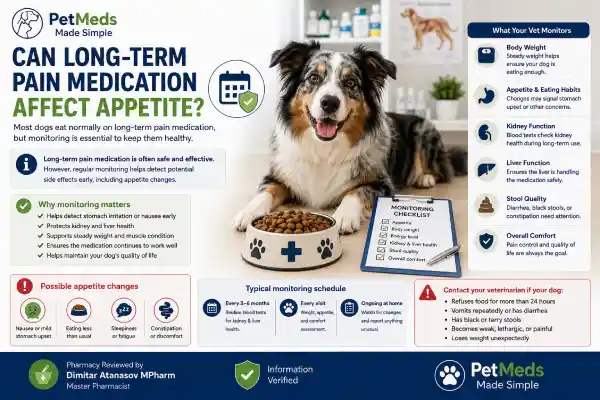
Most dogs receiving long-term pain medication continue eating normally.
However, regular monitoring remains essential.
During long-term treatment, veterinarians periodically evaluate:
- body weight,
- appetite,
- kidney function,
- liver function,
- hydration,
- stool quality,
- overall quality of life.
Routine blood tests allow veterinarians to identify problems before serious complications develop.
If your dog has been taking medication for several months, our article Can Dogs Take Pain Medication Long-Term? explains why regular veterinary monitoring is one of the safest ways to prevent medication-related complications.
Appetite Changes in Senior Dogs
Older dogs deserve special attention.
Senior patients are more likely to experience appetite changes because they often have:
- multiple chronic diseases,
- slower metabolism,
- reduced kidney function,
- decreased liver function,
- dental disease,
- age-related gastrointestinal changes.
For this reason, veterinarians usually investigate appetite loss in senior dogs sooner than they would in a young, otherwise healthy patient.
Even a modest reduction in food intake can contribute to muscle loss and delayed recovery.
How Do Veterinarians Determine the Cause?
There is no single test that confirms whether appetite loss is caused by a pain medication.
Instead, veterinarians combine information from several sources.
Typical evaluation includes:
| Diagnostic Step | Why It Matters |
|---|---|
| Complete physical examination | Identifies pain or illness |
| Medication review | Detects possible side effects or interactions |
| Blood tests | Evaluates kidney and liver function |
| Body weight assessment | Detects ongoing weight loss |
| Abdominal palpation | Checks for gastrointestinal discomfort |
| Appetite history | Identifies patterns over time |
Owners can help tremendously by recording:
- when medication is given,
- when meals are offered,
- how much food is eaten,
- any vomiting or diarrhea,
- changes in energy level.
This information often shortens the diagnostic process considerably.
Should You Stop the Medication?
Usually no.
One of the biggest mistakes owners make is stopping pain medication without speaking to their veterinarian.
Suddenly discontinuing treatment may allow pain to return rapidly, causing:
- decreased mobility,
- worsening inflammation,
- increased stress,
- slower recovery,
- poorer quality of life.
Instead, contact your veterinarian if appetite changes persist.
Depending on the situation, they may recommend:
- adjusting the dose,
- changing to another medication,
- prescribing stomach protectants,
- adding anti-nausea medication,
- performing additional diagnostics.
If your dog appears uncomfortable despite treatment, our article Warning Signs Your Dog Needs Stronger Pain Medication explains when a reassessment of the pain management plan may be necessary instead of simply stopping medication.
Can Appetite Loss Be Prevented?
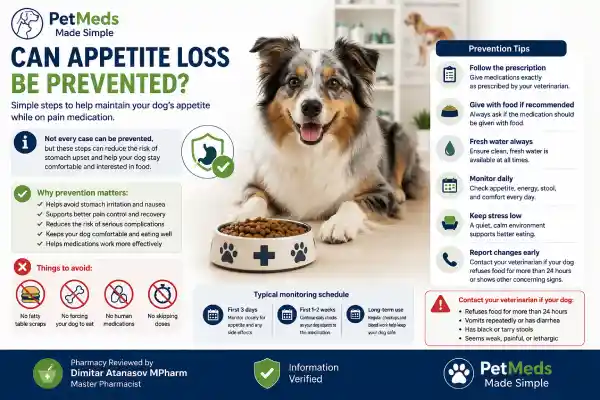
Not every case of appetite loss can be prevented, but owners can significantly reduce the risk of medication-related digestive problems by following a few simple recommendations.
Veterinarians commonly advise owners to:
- Give medications exactly as prescribed.
- Never increase or decrease the dose without veterinary approval.
- Ask whether the medication should be given with food.
- Ensure fresh drinking water is always available.
- Monitor appetite every day during the first week of treatment.
- Report any persistent vomiting, diarrhea, or refusal to eat.
Early recognition of subtle changes often prevents more serious complications from developing.
Tips to Help Encourage Eating
If your veterinarian has confirmed that your dog’s appetite loss is mild and temporary, there are several safe ways to encourage eating while continuing treatment.
| Helpful Tip | Why It May Help |
|---|---|
| Warm the food slightly | Enhances aroma and makes food more appealing |
| Offer smaller meals | Less overwhelming for nauseated dogs |
| Feed bland food if recommended | Easier on the stomach |
| Keep feeding times consistent | Establishes a routine |
| Minimize stress during meals | Encourages relaxed eating |
| Ensure adequate hydration | Supports digestion and recovery |
Never force-feed your dog unless specifically instructed by your veterinarian.
Likewise, avoid offering fatty table scraps simply to encourage eating, as these may worsen gastrointestinal upset or even trigger pancreatitis in susceptible dogs.
Could Stress Affect Appetite More Than the Medication?
Yes.
Many owners immediately blame the medication, but emotional stress often plays a surprisingly large role.
Dogs may experience stress after:
- Surgery
- Hospitalization
- Traveling
- Wearing an Elizabethan collar
- Reduced mobility
- Changes in routine
- Separation from family members
Stress activates hormones that naturally suppress appetite.
As your dog becomes more relaxed at home and pain improves, normal eating habits often return.
Could Multiple Medications Increase the Risk?
Absolutely.
Dogs recovering from surgery frequently receive more than one medication at the same time.
For example:
| Medication Combination | Appetite Changes Possible? |
|---|---|
| NSAID + Antibiotic | ✔ |
| NSAID + Gabapentin | ✔ |
| NSAID + Opioid | ✔ |
| Opioid + Sedative | ✔ |
| Multiple medications | Highest risk |
Although these combinations are commonly prescribed and generally safe, combining medications may increase the likelihood of temporary gastrointestinal side effects.
This is one reason veterinarians carefully review every medication your dog receives before making changes.
Can Reduced Appetite Lead to Weight Loss?
Yes.
If a dog consistently eats less than normal, gradual weight loss is expected.
However, rapid weight loss should never be considered a normal medication side effect.
Veterinarians become particularly concerned when appetite loss continues for several days because prolonged inadequate nutrition may result in:
- Muscle loss
- Delayed wound healing
- Reduced immune function
- Slower recovery
- Decreased energy
Senior dogs are especially vulnerable because they lose muscle mass much more quickly than younger animals.
Appetite Changes in Dogs With Chronic Pain
Dogs living with chronic pain often experience fluctuating appetites.
Good days may alternate with more difficult days depending on:
- Activity level
- Weather
- Arthritis severity
- Progression of disease
- Medication effectiveness
Owners sometimes interpret these normal fluctuations as medication failure.
In reality, chronic pain management often requires periodic reassessment and adjustments.
If you feel your dog’s medication is becoming less effective over time, our article Can Dogs Build Tolerance to Pain Medication? explains why true medication tolerance is less common than most owners believe.
Recovery Timeline
One of the most reassuring things for owners is understanding what to expect.
| Time After Starting Medication | What May Happen |
|---|---|
| First 24 hours | Mild appetite changes may occur |
| Days 2–3 | Many dogs begin adjusting |
| Days 3–7 | Appetite often returns to normal if side effects are mild |
| Beyond one week | Persistent appetite loss should be investigated |
Every dog is different, and recovery depends on both the medication and the underlying medical condition.
Veterinarian Takeaway
A temporary change in appetite after starting pain medication is relatively common, particularly during the first few days of treatment or after surgery. However, appetite loss should never be dismissed automatically as “just a medication side effect.” Pain, stress, gastrointestinal irritation, constipation, underlying disease, or medication interactions may all contribute. Careful monitoring and early communication with your veterinarian allow most problems to be identified and managed before they become serious.
Bottom Line
Can pain medication affect appetite? Yes—but the answer is more complex than many owners realize.
Some medications may temporarily reduce appetite because they cause nausea, stomach irritation, constipation, or sedation. Others actually improve appetite by relieving pain and allowing dogs to feel comfortable enough to eat again.
The most important step is to monitor your dog’s eating habits closely during treatment. Mild appetite changes often resolve naturally, but persistent refusal to eat, repeated vomiting, black stools, abdominal pain, or increasing weakness should always prompt a veterinary examination.
With appropriate monitoring, regular veterinary follow-up, and timely adjustments when needed, most dogs can continue receiving effective pain relief while maintaining a healthy appetite and quality of life.
Frequently Asked Questions – Can Pain Medication Affect Appetite in Dogs?
Can pain medication make my dog stop eating?
Yes. Some pain medications may temporarily reduce appetite because of nausea, stomach irritation, sedation, or constipation.
Which pain medications most commonly affect appetite?
NSAIDs, tramadol, morphine, and other opioids are the medications most commonly associated with temporary appetite changes.
Can gabapentin reduce appetite?
Occasionally. Most dogs tolerate gabapentin well, but some may eat less because they feel sleepy or are still adjusting to the medication.
Should I worry if my dog skips one meal?
Not necessarily. Missing one meal may occur after surgery or when starting a new medication. Persistent appetite loss should always be discussed with your veterinarian.
Can pain itself reduce appetite?
Yes. Pain is a natural appetite suppressant, and many dogs begin eating better once their discomfort is adequately controlled.
Should I stop giving pain medication if my dog won’t eat?
No. Never stop prescribed medication without first consulting your veterinarian.
When should I call my veterinarian?
Contact your veterinarian if your dog refuses food for more than 24 hours, repeatedly vomits, develops diarrhea, becomes weak, or shows signs of abdominal pain.
Can long-term NSAID use affect appetite?
Yes. Although uncommon, long-term NSAID therapy may occasionally lead to gastrointestinal irritation that decreases appetite.
Is appetite loss more common in senior dogs?
Yes. Older dogs often have additional medical conditions that increase their risk of appetite changes during treatment.
Will my dog’s appetite return?
In many cases, yes. Once the body adjusts to the medication or the underlying pain improves, appetite often returns to normal.
Sources
- Plumb’s Veterinary Drug Handbook
- Merck Veterinary Manual
- AAHA Pain Management Guidelines for Dogs and Cats
- WSAVA Global Pain Council Guidelines
- Veterinary Pharmacology and Therapeutics
- Small Animal Clinical Pharmacology
- JAVMA
- Frontiers in Veterinary Science
- Veterinary Anaesthesia and Analgesia
- VIN (Veterinary Information Network)
Medical Review Statement
This article was pharmacy-reviewed by Dimitar Georgiev Atanasov, MPharm, and veterinary-reviewed by Dr. Valcho Georgiev Valchev, DVM. It is intended for educational purposes only and should not replace individualized veterinary diagnosis, treatment, or medical advice.Can Pain Medication Affect Appetite in Dogs?
Important Medical Disclaimer
The information provided on PetMedsMadeSimple.com is for educational purposes only and is not intended to diagnose, treat, cure, or prevent any disease. Always consult your veterinarian before starting, stopping, or changing any medication or supplement. Never adjust your dog’s medication dosage without professional guidance.Can Pain Medication Affect Appetite in Dogs?
Image Disclosure
Some illustrations on PetMedsMadeSimple.com may be created or enhanced using artificial intelligence (AI) to improve visual understanding of veterinary topics. Every article is independently researched, pharmacy-reviewed by Dimitar Georgiev Atanasov, MPharm, and veterinary-reviewed by Dr. Valcho Georgiev Valchev, DVM. AI-generated images are used for educational illustration only and are not intended to represent actual patients or replace professional veterinary examination, diagnosis, or treatment.Can Pain Medication Affect Appetite in Dogs?
Images was created for article – Can Pain Medication Affect Appetite in Dogs?