Quick Answer
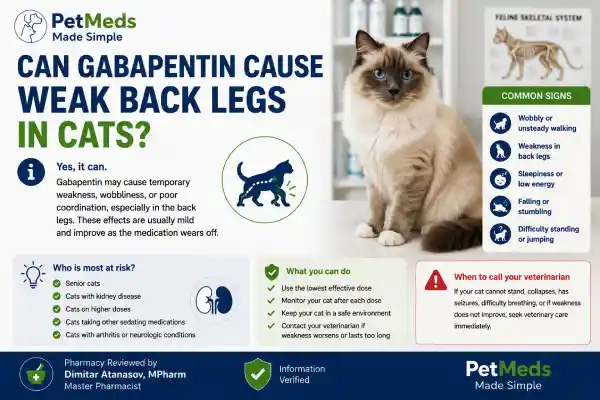
Can gabapentin cause weak back legs in cats? Yes. Temporary weakness in the hind legs is a recognized side effect of gabapentin, particularly in senior cats, cats receiving higher doses, or cats with kidney disease. In most cases, the weakness is mild and improves as the medication wears off. However, sudden inability to stand, complete paralysis, severe collapse, or worsening weakness should never be assumed to be a normal medication effect and requires immediate veterinary evaluation.
When Owners Commonly Ask This Question
Many owners begin searching “Can gabapentin cause weak back legs in cats?” after noticing unexpected changes shortly after giving a dose.
Typical concerns include:
- “My cat can barely walk after taking gabapentin.”
- “Her back legs seem to give out.”
- “He keeps slipping on the floor.”
- “She looks drunk.”
- “My cat is stumbling after medication.”
- “Could gabapentin be causing this?”
- “Should I skip the next dose?”
Watching a cat suddenly lose coordination or appear weak can be frightening. Fortunately, in many cases the weakness is temporary and related to the medication’s effects on the nervous system rather than permanent injury.
The challenge is recognizing when weakness is expected and when it signals a medical emergency.
Can Gabapentin Cause Weak Back Legs in Cats?
Can Gabapentin Cause Weak Back Legs in Cats?
Yes.
Can gabapentin cause weak back legs in cats? It can.
Gabapentin works by reducing activity within certain nerve pathways. While this helps decrease pain and anxiety, it can also temporarily reduce coordination, balance, and muscle control.
Some cats experience:
- Mild hind-leg weakness
- Unsteady walking
- Difficulty jumping
- Slower movements
- Wobbling
- Reluctance to climb stairs
- Trouble landing after jumps
- Brief episodes of stumbling
Most of these signs improve as the drug is metabolized.
However, weakness should never be ignored if it becomes severe or progressively worsens.
Why Does Gabapentin Affect the Back Legs?
Gabapentin primarily affects communication between nerves.
Instead of acting directly on muscles, it decreases abnormal nerve signaling inside the central nervous system.
As a result, some cats temporarily experience:
- reduced coordination,
- slower reflexes,
- decreased balance,
- reduced muscle control,
- mild sedation.
Because the hind limbs are responsible for balance during walking and jumping, owners often notice weakness there first.
This is why Can gabapentin cause weak back legs in cats? is such a common question among owners whose cats appear normal before medication but suddenly begin walking differently afterward.
How Common Is Hind-Leg Weakness?
Fortunately, severe weakness is uncommon.
Mild coordination changes, however, are among the better-known adverse effects of gabapentin.
| Severity | What Owners May Notice | Usually Normal? |
|---|---|---|
| Mild | Slight wobbling | ✅ Usually |
| Mild | Walking slower | ✅ Usually |
| Mild | Missing jumps | ✅ Usually |
| Moderate | Noticeable hind-leg weakness | Often, but monitor |
| Moderate | Difficulty climbing | Sometimes |
| Severe | Cannot stand | ❌ Emergency evaluation |
| Severe | Collapse | ❌ Emergency evaluation |
| Severe | Paralysis | ❌ Not considered a normal side effect |
Is It Weakness or Loss of Balance?
Many owners describe weakness when the actual problem is poor coordination.
These are different conditions.
Weakness
Weakness means the muscles are unable to generate normal strength.
Cats may:
- struggle to rise,
- tire easily,
- drag their feet,
- avoid jumping.
Ataxia (Loss of Coordination)
Gabapentin more commonly causes ataxia, which means poor coordination.
Signs include:
- crossing the legs,
- swaying,
- stumbling,
- walking with a wide stance,
- slipping on smooth floors.
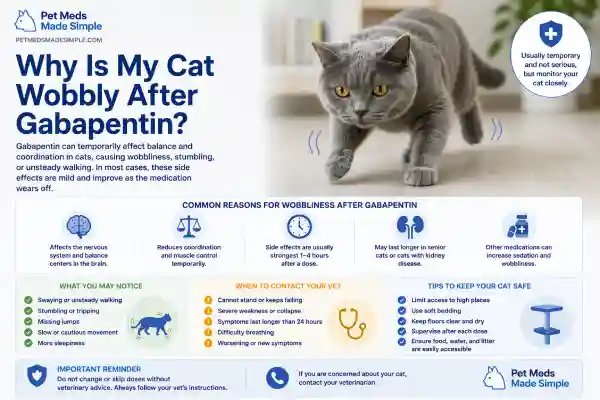
Our guide Why Is My Cat Wobbly After Gabapentin? explains this common side effect in much greater detail.
Which Cats Are Most Likely to Develop Weak Back Legs?
Not every cat responds the same way.
Certain patients are considerably more sensitive.
Higher-risk groups include:
- senior cats,
- cats with kidney disease,
- frail cats,
- dehydrated cats,
- underweight cats,
- cats receiving higher doses,
- cats taking several sedating medications,
- neurologic patients.
These cats often metabolize gabapentin more slowly, allowing the medication to remain active for longer periods.
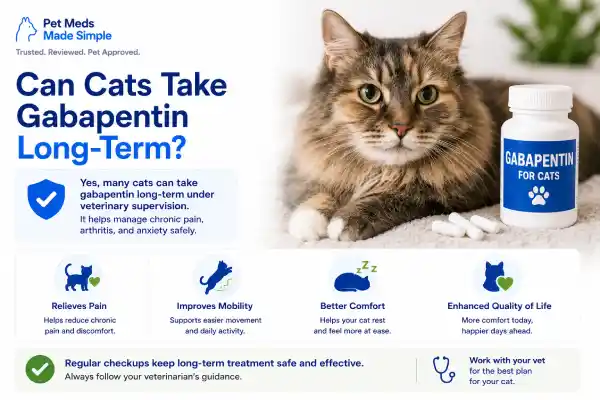
If your cat already has chronic kidney disease, you should also read our guide Can Cats Take Gabapentin Long-Term?, which discusses why dosage adjustments are often necessary for chronic conditions.
Senior Cats May Show More Weakness
Age changes how cats process medications.
Compared with younger adults, senior cats commonly have:
- reduced kidney function,
- lower muscle mass,
- arthritis,
- decreased balance,
- slower drug clearance.
Because of these factors, Can gabapentin cause weak back legs in cats? becomes an even more important question in older pets.
A dose that causes only mild sleepiness in a young adult cat may produce significant wobbliness in a 17-year-old cat.
Veterinarians often prescribe lower starting doses for geriatric patients and adjust treatment based on the individual response.
Could Kidney Disease Make Weakness Worse?
Absolutely.
Kidneys eliminate much of the gabapentin from the body.
When kidney function declines:
- the medication remains in circulation longer,
- drug concentrations may become higher,
- sedation may last longer,
- wobbliness becomes more noticeable,
- weakness may appear more severe.
This does not necessarily mean the medication is unsafe.
Instead, it often means the dosage or dosing interval needs adjustment by the veterinarian.
Owners should never change the dose on their own.
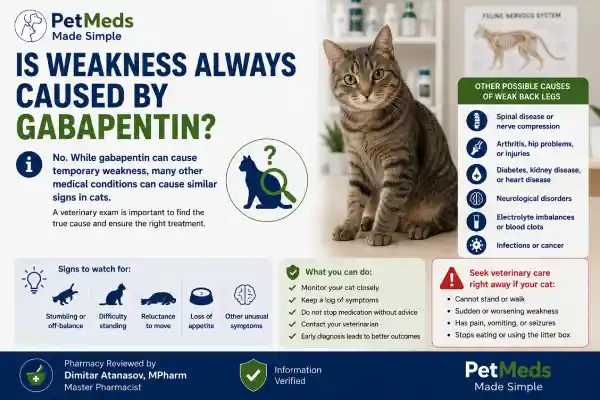
Is Weakness Always Caused by Gabapentin?
No.
This is one of the most important points owners should understand.
Although Can gabapentin cause weak back legs in cats? has the answer “yes,” the medication is only one possible explanation.
Many medical conditions can produce similar signs.
Examples include:
- spinal disease,
- arthritis,
- hip injuries,
- nerve compression,
- diabetes,
- blood clots,
- trauma,
- vestibular disease,
- heart disease affecting circulation,
- electrolyte abnormalities.
If weakness develops suddenly or continues worsening, your veterinarian should determine whether the medication is responsible or whether another condition is present.
Other Signs That May Occur Alongside Weak Back Legs
Owners often notice more than one symptom.
Common accompanying signs include:
- excessive sleepiness,
- hiding,
- decreased activity,
- slower reactions,
- stumbling,
- reluctance to jump,
- decreased appetite,
- reduced interest in play.
Many of these symptoms are discussed individually in our related PMMS guides:
- Gabapentin for Cats: Uses, Dosage, Side Effects & Safety Guide
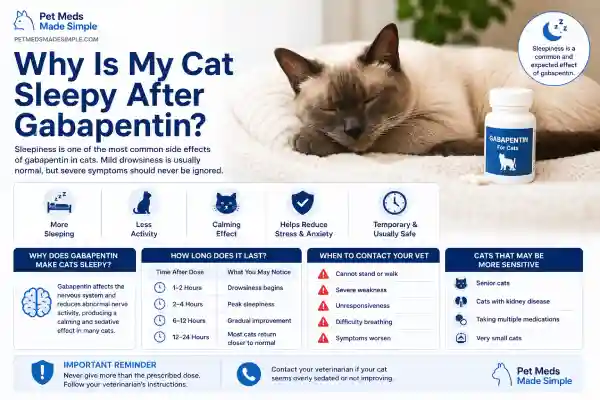
- Why Is My Cat Sleepy After Gabapentin?
- Why Is My Cat Wobbly After Gabapentin?
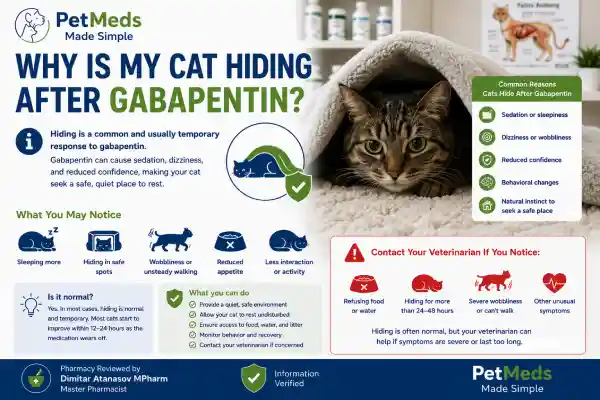
- Why Is My Cat Hiding After Gabapentin?
- Can Gabapentin Cause Aggression in Cats?
- Can Gabapentin Cause Vomiting in Cats?
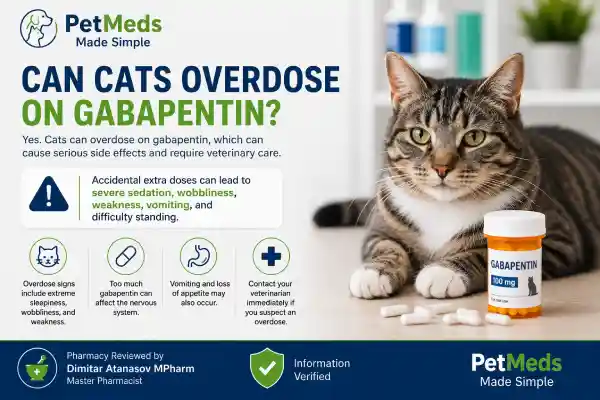
- Can Cats Overdose on Gabapentin?
- Is Human Gabapentin Safe for Cats?
Does the Dose Matter?
Yes.
The likelihood of side effects generally increases as the effective dose increases.
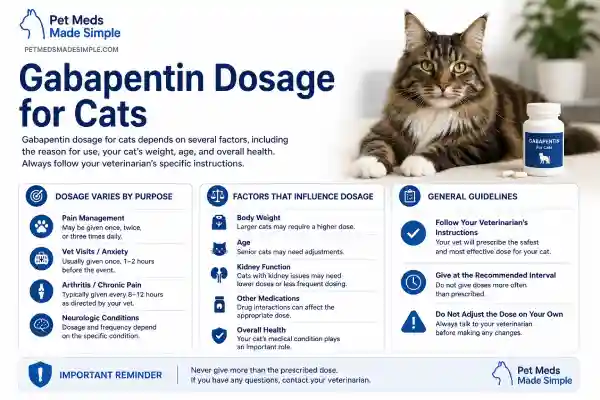
A veterinarian considers many factors before choosing an appropriate dose, including:
- body weight,
- age,
- kidney function,
- reason for treatment,
- concurrent medications,
- overall health.
Higher doses are not automatically better.
The goal is always to use the lowest effective dose that provides adequate pain control or anxiety relief while minimizing unwanted effects such as hind-leg weakness.
Can Other Medications Make Weak Back Legs Worse?
Yes.
Although Can Gabapentin Cause Weak Back Legs in Cats? is most often answered by the effects of gabapentin itself, the risk of weakness may increase when gabapentin is combined with other medications that affect the nervous system.
Veterinarians carefully review every medication your cat receives before prescribing gabapentin.
Examples include:
- Sedatives
- Opioid pain medications
- Certain anti-anxiety medications
- Muscle relaxants
- Anesthetic drugs used during procedures
When several medications that cause drowsiness are used together, a cat may appear much weaker than expected.
For this reason, always tell your veterinarian about:
- Prescription medications
- Over-the-counter products
- Joint supplements
- Herbal products
- CBD products
- Vitamins
Even supplements should be mentioned because they may influence the overall treatment plan.
Could Weak Back Legs Mean My Cat Received Too Much Gabapentin?
Sometimes.
A higher-than-prescribed dose may cause:
- Severe wobbliness
- Marked hind-leg weakness
- Extreme sleepiness
- Difficulty standing
- Poor coordination
- Reduced responsiveness
However, these signs do not automatically mean an overdose has occurred.
Some cats are simply much more sensitive to gabapentin than others.
If you suspect your cat accidentally received an extra dose, contact your veterinarian immediately.
Our guide Can Cats Overdose on Gabapentin? explains the warning signs, treatment options, and recovery expectations in much greater detail.
How Long Does Weakness Usually Last?
Fortunately, in most healthy cats the weakness is temporary.
Many owners notice that their cat begins walking more normally as the medication gradually leaves the body.
The exact duration depends on several factors.
| Factor | Effect on Recovery |
|---|---|
| Dose given | Higher doses may last longer |
| Age | Senior cats often recover more slowly |
| Kidney function | Reduced kidney function prolongs effects |
| Other medications | May increase sedation |
| Individual sensitivity | Some cats metabolize gabapentin more slowly |
Most cats gradually improve without any permanent problems.
Persistent weakness, however, should never be ignored.
Is It Safe to Let My Cat Jump?
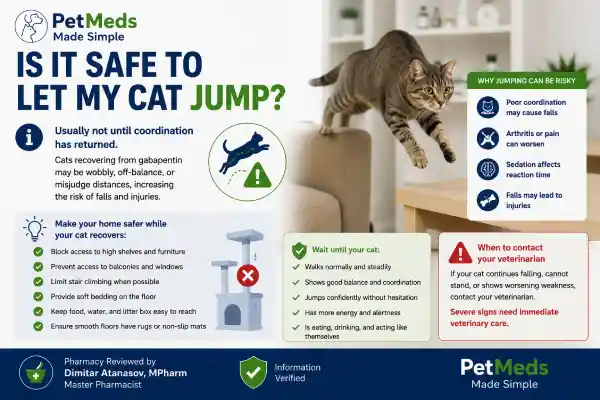
Usually not until coordination has returned.
Cats recovering from gabapentin may misjudge distances or lose balance while climbing.
To reduce injury risk:
- Keep your cat indoors.
- Block access to high shelves.
- Prevent access to balconies.
- Limit stair climbing if possible.
- Provide soft bedding on the floor.
- Ensure food, water, and the litter box are easy to reach.
These simple changes help prevent falls while your cat recovers.
Can Weakness Be Worse After a Veterinary Visit?
Yes.
This is actually very common.
Many cats receive gabapentin before:
- Veterinary examinations
- Blood tests
- Imaging procedures
- Dental procedures
- Surgery
Because owners often see their cat immediately after returning home, the medication is usually near its strongest effect.
A cat may appear:
- Sleepy
- Weak
- Quiet
- Less interested in food
- Reluctant to walk
These effects often improve over the following several hours.
Could Stress Make the Weakness Look Worse?
Absolutely.
Stress itself can temporarily affect posture and movement.
Following a stressful veterinary visit, some cats may:
- Freeze in place.
- Hide under furniture.
- Walk cautiously.
- Move more slowly.
- Refuse to jump.
When mild gabapentin sedation is combined with stress, owners may feel that the medication has caused dramatic weakness when several factors are actually contributing.
If your cat also begins hiding, our article Why Is My Cat Hiding After Gabapentin? explains why this behavior is often expected after veterinary visits.
Could Arthritis Make the Problem More Noticeable?

Definitely.
Older cats with arthritis often already have:
- Reduced muscle strength
- Joint stiffness
- Slower movements
- Difficulty jumping
After gabapentin is administered, these pre-existing mobility problems may become more obvious.
The medication has not necessarily caused a new disease—it may simply make existing weakness easier to recognize.
Home Monitoring Checklist
Owners can safely monitor several signs at home.
| Check Every Few Hours | ✓ |
|---|---|
| Walking normally | ✔ |
| Standing without falling | ✔ |
| Eating normally | ✔ |
| Drinking water | ✔ |
| Using the litter box | ✔ |
| Alertness improving | ✔ |
| Weakness getting better | ✔ |
| No new symptoms developing | ✔ |
Keeping simple notes can help your veterinarian determine whether your cat is improving appropriately.
When Should Owners Contact Their Veterinarian?
Contact your veterinarian if your cat:
- Cannot stand.
- Continues falling repeatedly.
- Stops eating for more than 24 hours.
- Develops repeated vomiting.
- Appears increasingly weak.
- Seems confused or unresponsive.
- Has difficulty breathing.
- Shows weakness lasting much longer than expected.
- Develops new neurological signs.
Never assume prolonged weakness is “just the medication.”
Emergency Warning Signs
Seek emergency veterinary care immediately if your cat develops:
| Emergency Sign | Why It Matters |
|---|---|
| Complete inability to stand | May indicate serious neurological disease or overdose |
| Collapse | Medical emergency |
| Seizures | Immediate evaluation required |
| Difficulty breathing | Life-threatening |
| Loss of consciousness | Emergency |
| Severe continuous vomiting | Risk of dehydration |
| Blue or pale gums | Poor oxygenation or circulation |
| Sudden paralysis | Not considered a normal gabapentin side effect |
These signs require immediate veterinary assessment regardless of when the medication was given.
Could Another Disease Be Responsible?
Yes.
One of the most important messages in Can Gabapentin Cause Weak Back Legs in Cats? is that gabapentin should never become the automatic explanation for every case of hind-leg weakness.
Veterinarians also consider:
- Arthritis
- Intervertebral disc disease
- Spinal trauma
- Blood clots
- Diabetes
- Electrolyte disorders
- Heart disease
- Kidney disease
- Neurological disorders
- Cancer affecting the spine or nerves
If weakness appears suddenly, worsens rapidly, or fails to improve, additional diagnostic testing may be needed.
Does Every Cat Recover Completely?
In the vast majority of cases, yes.
If Can Gabapentin Cause Weak Back Legs in Cats? is caused solely by the medication, the weakness is usually temporary and resolves as gabapentin is eliminated from the body.
Most cats gradually return to their normal mobility without any permanent problems.
Recovery depends on several factors, including:
- The prescribed dose
- Your cat’s age
- Kidney function
- Overall health
- Other medications being given
- The condition being treated
Owners are often relieved to see their cat regain confidence in walking, jumping, and climbing within the expected recovery period.
However, if weakness continues long after the medication should have worn off, another medical problem should be investigated.
Should Owners Stop Gabapentin Immediately?
Usually no.
One of the biggest mistakes owners make after asking “Can Gabapentin Cause Weak Back Legs in Cats?” is stopping the medication without consulting their veterinarian.
Gabapentin is commonly prescribed for:
- Chronic pain
- Nerve pain
- Arthritis
- Anxiety before veterinary visits
- Post-operative recovery
Stopping treatment suddenly may cause the original problem to return.
If your cat receives gabapentin regularly, your veterinarian may recommend gradually reducing the dose instead of stopping it abruptly.
Our article What Happens If Cats Suddenly Stop Gabapentin? explains why sudden discontinuation is sometimes discouraged and how veterinarians safely taper treatment.
Could the Dose Need Adjustment?
Yes.
If weakness repeatedly occurs after every dose, your veterinarian may decide that the current treatment plan should be modified.
Possible adjustments include:
- Lowering the dose
- Increasing the interval between doses
- Changing the treatment schedule
- Using gabapentin only before stressful events
- Choosing an alternative medication when appropriate
Owners should never change the dosage themselves.
Even small dose adjustments should always be guided by a veterinarian.
Can Weak Back Legs Be Prevented?
Sometimes.
Although not every side effect can be prevented, several strategies reduce the likelihood of significant weakness.
| Prevention Strategy | Why It Helps |
|---|---|
| Use the lowest effective dose | Reduces neurological side effects |
| Follow the prescribed schedule | Maintains consistent drug levels |
| Inform your veterinarian about kidney disease | Allows dose adjustment |
| Report previous side effects | Helps individualize treatment |
| Avoid giving extra doses | Prevents excessive sedation |
| Monitor after every new prescription | Detects problems early |
No medication is completely free of side effects, but careful prescribing greatly improves safety.
Could Dehydration Make Weakness Worse?
Yes.
Cats that are dehydrated may appear:
- More lethargic
- Less coordinated
- Less willing to walk
- More reluctant to eat
Although dehydration does not directly cause gabapentin side effects, it can make an already sleepy cat appear significantly weaker.
Owners should always ensure fresh water is available, especially after veterinary visits or surgical procedures.
What If My Cat Already Has Weak Back Legs?

Some cats already have mobility problems before gabapentin is prescribed.
Examples include:
- Arthritis
- Previous spinal injuries
- Hip disease
- Neurological disorders
- Muscle loss associated with aging
In these situations, owners may notice a temporary worsening after medication.
This does not necessarily mean gabapentin is unsafe.
Instead, it may indicate that the treatment plan needs to be individualized.
Veterinarians weigh the benefits of improved pain control against temporary coordination changes.
How Do Veterinarians Determine Whether Gabapentin Is Responsible?
Veterinarians rarely assume the medication is automatically to blame.
Instead, they perform a complete assessment.
This typically includes:
- Medical history
- Physical examination
- Neurological examination
- Review of current medications
- Dose calculation
- Kidney function assessment
- Blood work when indicated
They also ask important questions, including:
- When did the weakness begin?
- How long after the dose did it appear?
- Has it happened after previous doses?
- Is it improving?
- Are any other symptoms present?
Answering these questions helps determine whether Can Gabapentin Cause Weak Back Legs in Cats? is the correct explanation or whether another disease should be investigated.
Does Every Cat React the Same Way?
No.
One of the reasons owners search Can Gabapentin Cause Weak Back Legs in Cats? is because experiences vary enormously.
Some cats show:
- No side effects at all.
Others develop:
- Mild sleepiness.
- Slight wobbliness.
- Temporary hind-leg weakness.
A much smaller number become extremely sensitive to the medication.
Individual differences occur because of:
- Age
- Body weight
- Kidney function
- Overall health
- Genetics
- Concurrent illnesses
This variability is exactly why veterinarians individualize every treatment plan.
Related Symptoms Owners Often Search For
If you’ve been searching Can Gabapentin Cause Weak Back Legs in Cats?, you may also find these PMMS guides helpful:
- Gabapentin for Cats: Uses, Dosage, Side Effects & Safety Guide
- Why Is My Cat Wobbly After Gabapentin?
- Why Is My Cat Sleepy After Gabapentin?
- Why Is My Cat Hiding After Gabapentin?
- Can Gabapentin Cause Vomiting in Cats?
- Can Gabapentin Cause Aggression in Cats?
- Can Cats Take Gabapentin Long-Term?
- What Happens If Cats Suddenly Stop Gabapentin?
- Can Cats Overdose on Gabapentin?
- Is Human Gabapentin Safe for Cats?
Together, these articles provide a comprehensive resource covering the most common questions owners have about gabapentin use in cats.
Veterinarian Takeaway
Can Gabapentin Cause Weak Back Legs in Cats? Yes—but in most cats, the weakness is temporary, mild, and related to the medication’s effects on coordination rather than true muscle damage.
Mild wobbliness and hind-leg weakness are recognized side effects, especially in senior cats, cats with kidney disease, or those receiving higher doses.
However, complete inability to stand, paralysis, collapse, seizures, or worsening neurological signs are not considered normal and require immediate veterinary attention.
Never stop or adjust gabapentin without first consulting your veterinarian. A simple dose adjustment is often all that is needed to maintain effective pain control while minimizing side effects.
Bottom Line
Can Gabapentin Cause Weak Back Legs in Cats? Yes. Temporary hind-leg weakness and poor coordination are among the better-recognized side effects of gabapentin in cats.
Fortunately, most affected cats recover fully as the medication wears off, particularly when the prescribed dose is appropriate for their age, weight, and kidney function.
The most important thing for owners is to distinguish expected mild weakness from serious neurological emergencies.
If your cat cannot stand, becomes progressively weaker, has difficulty breathing, experiences seizures, or fails to improve, contact your veterinarian immediately.
With careful dosing, appropriate monitoring, and regular veterinary follow-up, gabapentin remains one of the most valuable medications available for managing pain and anxiety in cats.
Frequently Asked Questions – Can Gabapentin Cause Weak Back Legs in Cats
Can gabapentin cause weak back legs in cats?
Yes. Can Gabapentin Cause Weak Back Legs in Cats? Yes, temporary hind-leg weakness is a recognized side effect. Most cases are mild and improve as the medication wears off, but severe weakness or inability to stand should always be evaluated by a veterinarian.
Why does gabapentin make my cat’s back legs weak?
Gabapentin affects nerve signaling within the brain and spinal cord. While this helps reduce pain and anxiety, it may also temporarily decrease coordination, balance, and muscle control, making the back legs appear weak.
Is hind-leg weakness the same as paralysis?
No.
Temporary weakness or wobbliness is very different from paralysis.
A cat with medication-related weakness can usually still move its legs, although walking may be unsteady.
Paralysis, dragging the legs, or complete inability to stand is not considered a normal side effect and requires emergency veterinary care.
How long does hind-leg weakness last after gabapentin?
For most healthy cats, the weakness gradually improves as the medication is eliminated from the body.
Recovery time depends on:
Dose administered
Kidney function
Age
Other medications
Individual sensitivity
Senior cats and cats with kidney disease may recover more slowly.
Should I stop giving gabapentin if my cat’s back legs seem weak?
Not without speaking to your veterinarian.
Stopping gabapentin suddenly may allow pain or anxiety to return, and cats receiving long-term treatment may require gradual dose reduction instead of abrupt discontinuation.
Are senior cats more likely to develop weak back legs?
Yes.
Older cats often metabolize medications more slowly and may already have arthritis or reduced muscle mass.
These factors make temporary weakness more noticeable after gabapentin.
Can kidney disease increase gabapentin side effects?
Absolutely.
Because the kidneys remove gabapentin from the body, reduced kidney function allows the medication to remain active longer, increasing the likelihood of sleepiness, wobbliness, and hind-leg weakness.
Veterinarians often prescribe lower doses for these patients.
Can gabapentin be combined with other medications?
Often, yes.
However, combining gabapentin with other medications that cause sedation may increase weakness or coordination problems.
Always tell your veterinarian about every medication and supplement your cat receives.
When should I call my veterinarian?
Arrange a veterinary appointment if your cat:
Cannot walk normally.
Continues falling.
Stops eating.
Appears increasingly weak.
Does not improve after the medication should have worn off.
Develops vomiting or unusual neurological signs.
Early assessment allows your veterinarian to determine whether the weakness is medication-related or caused by another medical condition.
When is weak back leg weakness an emergency?
Seek immediate veterinary care if your cat develops:
Complete inability to stand
Paralysis
Collapse
Seizures
Difficulty breathing
Loss of consciousness
Blue or pale gums
Suspected overdose
These symptoms should never be considered routine gabapentin side effects.
Sources
- Plumb’s Veterinary Drug Handbook
- Merck Veterinary Manual
- BSAVA Small Animal Formulary
- Veterinary Pharmacology and Therapeutics
- Small Animal Clinical Pharmacology
- American Association of Feline Practitioners (AAFP) Clinical Guidelines
- International Society of Feline Medicine (ISFM) Consensus Guidelines
- Journal of Feline Medicine and Surgery (JFMS)
- Journal of the American Veterinary Medical Association (JAVMA)
- Frontiers in Veterinary Science
- Veterinary Anaesthesia and Analgesia
- Veterinary Information Network (VIN)
Medical Review Statement
This article was pharmacy-reviewed by Dimitar Georgiev Atanasov, MPharm (Bulgarian Pharmaceutical Union, UIN: 0210000586) and independently veterinary-reviewed by Dr. Valcho Georgiev Valchev, DVM (Bulgarian Veterinary Union, Registration No. 28000115) to ensure medical accuracy, medication safety, and consistency with current veterinary standards.
Important Medical Disclaimer
The information provided on PetMedsMadeSimple.com is intended for educational purposes only and should not replace professional veterinary advice, diagnosis, or treatment.
Every cat responds differently to medication. Never start, stop, or adjust gabapentin without consulting your veterinarian. If your cat develops severe weakness, collapse, breathing difficulty, seizures, or any other emergency symptoms, seek immediate veterinary care.
For more information about how we create and review our content, please read our Editorial Policy, Medical Review Process, and About Us pages.
Image Disclosure
Some images used in this article may be AI-generated or AI-assisted for educational purposes. Every article is independently researched, pharmacy-reviewed by Dimitar Georgiev Atanasov, MPharm, and veterinary-reviewed by Dr. Valcho Georgiev Valchev, DVM. AI-generated illustrations are intended to improve understanding of veterinary concepts and do not depict actual clinical patients.