Quick Answer
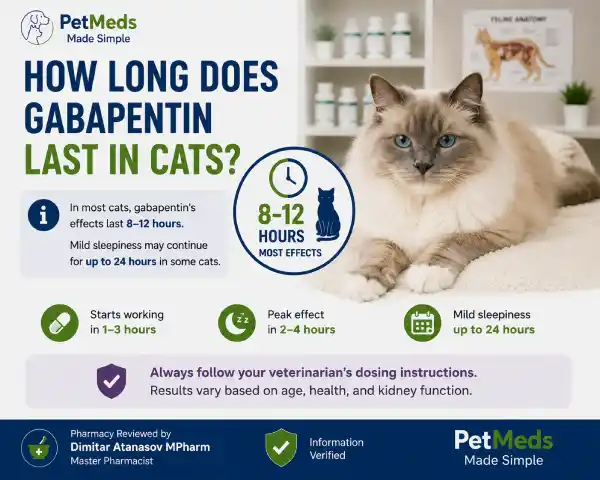
How long does gabapentin last in cats? In most cats, the noticeable effects of gabapentin last approximately 8 to 12 hours, although mild sleepiness or reduced coordination may persist for up to 24 hours in some individuals. Age, kidney function, dosage, and the reason the medication was prescribed all influence how long gabapentin remains effective and how quickly your cat returns to normal.
How Long Does Gabapentin Last in Cats?
How Long Does Gabapentin Last in Cats?
One of the most common questions cat owners ask after giving this medication is “How Long Does Gabapentin Last in Cats?”
Perhaps your cat received gabapentin before a veterinary appointment and is still sleepy several hours later.
Or maybe your veterinarian prescribed it for chronic pain or seizures, and you’re wondering when the medication will wear off.
These are completely normal questions.
Gabapentin is one of the most frequently prescribed neurological medications in feline medicine because it is remarkably versatile. Depending on the situation, veterinarians use it to help manage:
- Chronic pain
- Neuropathic pain
- Arthritis discomfort
- Seizure disorders
- Anxiety before veterinary visits
- Stress associated with travel
- Fear during grooming or handling
Although the medication is considered very safe for most cats, one important fact often surprises owners:
The duration of gabapentin’s effects can vary significantly between individual cats.
Some cats appear completely normal within eight hours, while others may remain sleepy until the following day.
Fortunately, this difference is often completely expected.
If your cat has recently started gabapentin, you may also find our related PMMS guides helpful, including Gabapentin for Cats: Uses, Dosage, Side Effects & Safety, Why Is My Cat Sleepy After Gabapentin?, Why Is My Cat Wobbly After Gabapentin?, and Can Cats Miss a Dose of Gabapentin?
What Determines How Long Gabapentin Lasts?
There isn’t one simple answer.
Several factors influence how long gabapentin lasts in cats, including the way the medication is absorbed, distributed, and eliminated from the body.
The most important factors include:
- Dose administered
- Cat’s age
- Kidney function
- Body weight
- Overall health
- Other medications
- Reason for treatment
- Individual sensitivity
Two cats receiving exactly the same dose may recover at completely different speeds.
This is why veterinarians always interpret medication effects within the context of the individual patient rather than relying on averages alone.
How Does Gabapentin Work?
To understand how long gabapentin lasts in cats, it helps to understand how the medication works.
Despite its name, gabapentin does not directly stimulate GABA receptors.
Instead, it binds to specific calcium channels located on nerve cells.
By reducing calcium movement into neurons, gabapentin decreases the release of several excitatory neurotransmitters responsible for transmitting pain signals and abnormal electrical activity.
This produces several beneficial effects:
- Reduced nerve pain
- Lower seizure activity
- Mild sedation
- Reduced anxiety
- Improved tolerance of stressful situations
Unlike many older sedatives, gabapentin generally provides calming effects without causing complete unconsciousness.
How Long Does Gabapentin Stay Active?
Although owners often ask “How Long Does Gabapentin Last in Cats?”, there are actually two different questions being asked.
The first concerns clinical effects.
The second concerns how long the medication remains inside the body.
These are not always the same.
For most healthy adult cats:
| Stage | Typical Timeline |
|---|---|
| Medication begins working | 1–3 hours |
| Peak calming or sedative effect | Approximately 2–4 hours |
| Most noticeable effects | 8–12 hours |
| Mild residual sleepiness | Up to 24 hours in some cats |
| Medication largely eliminated | Usually within 24–48 hours (varies by kidney function) |
The medication may still be present in the body even after obvious sleepiness has disappeared.
Why Do Some Cats Stay Sleepy Longer?
One of the biggest reasons owners search “How Long Does Gabapentin Last in Cats?” is because their cat seems sleepy much longer than expected.
In many cases, this is completely normal.
Some cats are naturally much more sensitive to gabapentin than others.
Factors that may prolong its effects include:
- Advanced age
- Kidney disease
- Higher prescribed doses
- Obesity
- Concurrent medications
- Individual metabolism
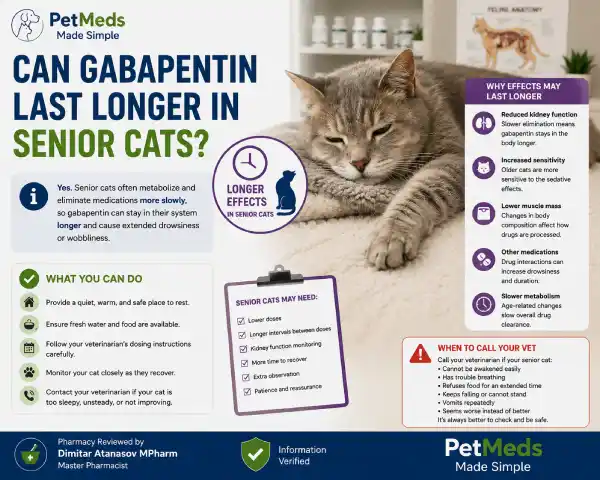
Senior cats deserve particular attention because they often eliminate medications more slowly than younger adults.
Cats with chronic kidney disease may also process gabapentin much more slowly, allowing the medication to remain active for a longer period.
Does the Dose Change How Long Gabapentin Lasts?
Yes.
Generally speaking, higher doses produce:
- Stronger sedation
- Longer-lasting effects
- More noticeable wobbliness
- Greater sleepiness
However, the relationship is not perfectly predictable.
Some cats remain alert after relatively high doses, while others become profoundly sleepy after doses considered relatively low.
This variation is one reason veterinarians often begin with conservative dosing before gradually adjusting treatment.
Does the Reason for Treatment Matter?
Absolutely.
The answer to “How Long Does Gabapentin Last in Cats?” depends partly on why your veterinarian prescribed it.
For example:
| Reason for Treatment | Typical Goal |
|---|---|
| Veterinary visit anxiety | Temporary calming for several hours |
| Travel anxiety | Relaxation throughout transportation |
| Chronic pain | Ongoing daily pain control |
| Neuropathic pain | Continuous symptom management |
| Seizure disorders | Stable blood concentrations through repeated dosing |
A cat receiving gabapentin before a veterinary appointment may only need one dose.
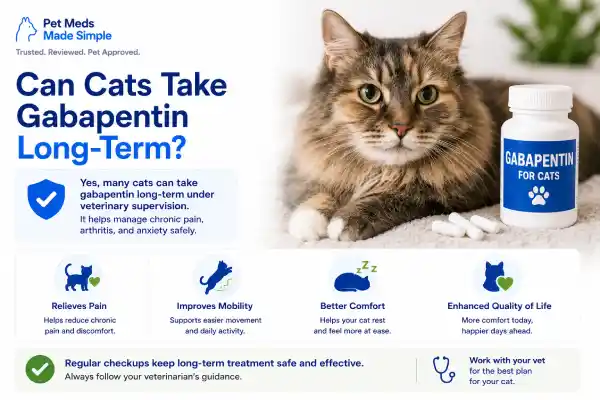
A cat with chronic neurological disease may receive the medication every day for months or even years.
Understanding the treatment goal helps explain why dosing schedules differ between patients.
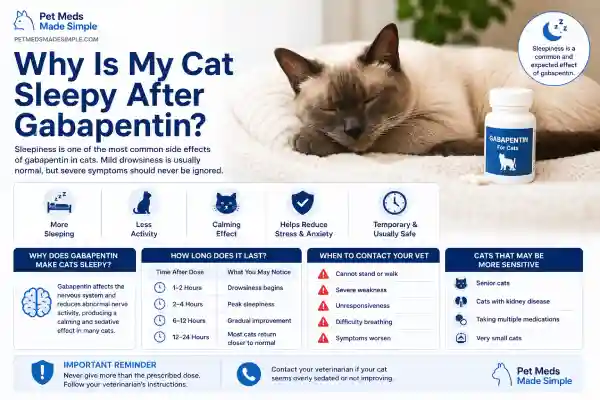
Is It Normal for My Cat to Sleep All Day?
Often, yes.
Owners sometimes become concerned because their normally active cat spends nearly the entire day sleeping after receiving gabapentin.
Fortunately, mild to moderate sleepiness is one of the medication’s best-known side effects.
Most cats continue to:
- Wake up for food
- Respond to familiar voices
- Change sleeping positions
- Walk when encouraged
- Use the litter box
These are reassuring signs that the medication is simply producing its expected calming effects rather than causing an emergency.
However, if your cat becomes impossible to wake, has difficulty breathing, or develops repeated vomiting, immediate veterinary evaluation is warranted.
Can Gabapentin Last Longer in Senior Cats?
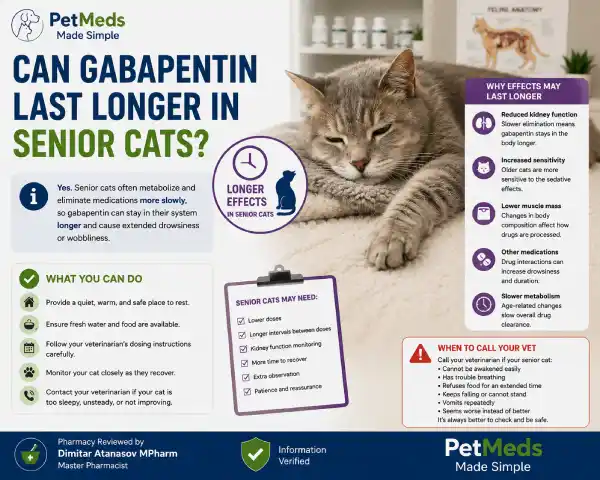
Yes.
Senior cats frequently metabolize and eliminate medications more slowly than younger adults.
Several age-related changes contribute to this:
- Reduced kidney function
- Slower drug clearance
- Altered body composition
- Increased sensitivity of the nervous system
As a result, older cats may remain sleepy longer even when receiving completely appropriate doses.
This is one reason veterinarians often prescribe lower starting doses for geriatric feline patients and monitor their response carefully.
Can Kidney Disease Make Gabapentin Last Longer?
Yes.
One of the most important reasons veterinarians ask about kidney function when prescribing gabapentin is that the kidneys are primarily responsible for removing the medication from the body.
Unlike many drugs that are extensively metabolized by the liver, gabapentin is eliminated largely unchanged through the kidneys.
This means that if kidney function declines, the medication may remain in the bloodstream much longer than expected.
As a result, cats with chronic kidney disease (CKD) may experience:
- Longer-lasting sleepiness
- Extended wobbliness
- More prolonged calming effects
- Delayed recovery after veterinary visits
- Greater sensitivity to standard doses
For this reason, veterinarians often prescribe lower doses or increase the interval between doses in cats with impaired kidney function.
Owners of senior cats may also find our article What About Cats With Kidney Disease? helpful, as it explains why kidney health plays such an important role in gabapentin therapy.
Does Liquid Gabapentin Last Longer Than Capsules?
Many owners assume that liquid gabapentin works differently from capsules.
In reality, the active ingredient is exactly the same.
The formulation mainly affects:
- Ease of administration
- Accuracy of dosing
- Flavoring
- Speed of absorption by a small margin
Once absorbed into the bloodstream, liquid and capsule formulations behave very similarly.
Therefore, the overall duration of action is usually comparable when equivalent doses are given.
The larger difference is often the prescribed dose rather than the dosage form itself.
Does Gabapentin Build Up in the Body?
This is another common question behind “How Long Does Gabapentin Last in Cats?”
When gabapentin is given every day for chronic conditions, owners sometimes worry that the medication keeps accumulating indefinitely.
Fortunately, this is generally not how gabapentin behaves in healthy cats.
Instead, repeated dosing gradually reaches what pharmacologists call a steady state, where:
- New medication enters the body.
- Older medication is eliminated.
- Blood concentrations remain relatively stable.
This predictable balance allows veterinarians to maintain consistent pain control or seizure management without continually increasing drug levels.
However, cats with kidney disease may eliminate gabapentin more slowly, making careful dose adjustments particularly important.
Can Other Medications Make Gabapentin Last Longer?
Yes.
Although gabapentin has relatively few drug interactions compared with many neurological medications, some combinations may increase sedation.
Examples include:
- Opioid pain medications
- Certain sedatives
- Trazodone
- Some anti-anxiety medications
- Other anticonvulsants
- General anesthetics
When these medications are combined, cats may appear sleepy for longer periods even though gabapentin itself has not changed dramatically.
Always tell your veterinarian about every medication and supplement your cat receives.
Does Body Weight Affect How Long Gabapentin Lasts?
Body weight can influence dosing, but it is not the only factor determining how long gabapentin remains effective.
Veterinarians also consider:
- Body condition score
- Lean body mass
- Hydration status
- Kidney function
- Age
- Overall health
For example, two cats weighing 5 kg may respond very differently if one is a healthy young adult and the other is a 16-year-old cat with chronic kidney disease.
This individualized approach is one reason owners should never compare doses between pets.
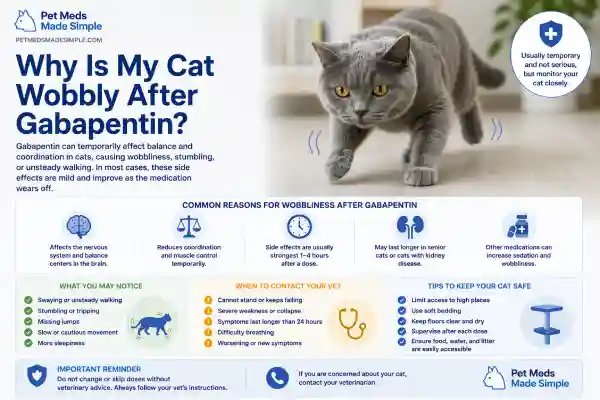
Is It Normal for My Cat to Still Be Wobbly the Next Morning?
Sometimes.
Many owners search “How Long Does Gabapentin Last in Cats?” because their cat is still walking unsteadily after sleeping overnight.
In healthy adult cats receiving routine pre-visit doses, mild wobbliness usually improves within 12–24 hours.
However, longer recovery may occur in:
- Senior cats
- Cats with kidney disease
- Cats receiving high doses
- Cats taking multiple medications
- Particularly sensitive individuals
Temporary wobbliness often improves gradually as the medication is eliminated.
If your cat continues showing severe difficulty walking beyond the expected recovery period, contact your veterinarian for advice.
Our guide Why Is My Cat Wobbly After Gabapentin? discusses this side effect in much greater detail.
What If My Cat Is Still Sleeping After 24 Hours?
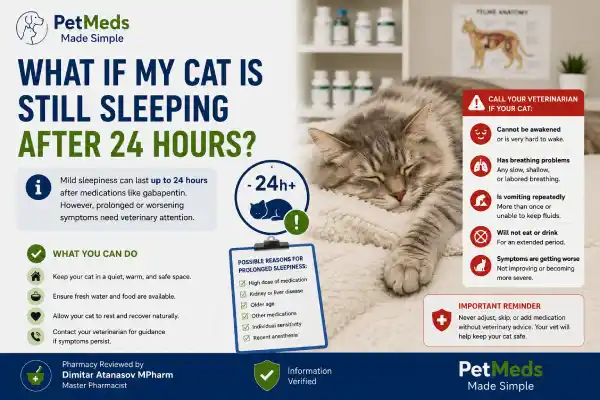
This situation understandably worries many owners.
Most cats begin returning to normal within a day.
However, several factors can prolong recovery.
Contact your veterinarian if your cat:
- Cannot be awakened normally.
- Refuses food for an extended period.
- Has difficulty breathing.
- Experiences repeated vomiting.
- Cannot stand at all.
- Appears to be getting worse instead of better.
Persistent or worsening symptoms deserve professional evaluation rather than continued observation at home.
How Long Does Gabapentin Last Before a Veterinary Visit?
Gabapentin is commonly prescribed before veterinary appointments because its calming effects typically develop gradually.
Many veterinarians recommend administering the medication approximately two to three hours before the visit, allowing the peak calming effect to occur during examination and handling.
Typical timeline:
| Time After Administration | Expected Effect |
|---|---|
| 0–1 hour | Minimal visible effect |
| 1–2 hours | Mild relaxation begins |
| 2–3 hours | Peak calming effect for many cats |
| 4–8 hours | Sedation gradually decreases |
| 8–12 hours | Most cats continue recovering |
| Up to 24 hours | Mild sleepiness may persist in some individuals |
This schedule explains why many cats remain sleepy after returning home from the veterinary clinic.
Can Stress Change How Long Gabapentin Appears to Last?
Interestingly, yes.
Stress does not necessarily change how quickly the body eliminates gabapentin, but it can change how owners perceive its effects.
For example:
- A highly anxious cat may appear energetic despite receiving gabapentin because adrenaline temporarily overrides some calming effects.
- Once safely home, that same cat may suddenly become much sleepier.
This delayed relaxation sometimes makes owners think the medication “started working later,” when in reality the stressful environment temporarily masked its effects.
Understanding this phenomenon helps explain why recovery at home may look very different from behavior observed during the veterinary visit.
Can Gabapentin Last More Than 24 Hours?
One of the most common concerns behind the question “How Long Does Gabapentin Last in Cats?” is when a cat still seems sleepy the following day.
In healthy adult cats, the most noticeable effects usually improve within 8 to 12 hours, although mild sedation may occasionally last up to 24 hours.
However, lasting longer than 24 hours does not automatically mean something is wrong.
Several factors can prolong recovery, including:
- Advanced age
- Chronic kidney disease
- Higher prescribed doses
- Concurrent sedatives
- Individual sensitivity
- Dehydration
- Recent anesthesia
For many senior cats, a slower recovery simply reflects slower drug elimination rather than an overdose.
Nevertheless, owners should always contact their veterinarian if symptoms continue worsening instead of gradually improving.
How Do Veterinarians Decide the Right Dose?
The answer to “How Long Does Gabapentin Last in Cats?” depends greatly on the prescribed dose.
Veterinarians never choose a dose based only on body weight.
Instead, they evaluate the entire patient.
Factors commonly considered include:
- Age
- Weight
- Kidney function
- Liver health
- Reason for treatment
- Previous response to gabapentin
- Other medications
- Overall neurological status
For example, a young healthy cat receiving gabapentin before a routine examination may tolerate a much higher temporary dose than an elderly cat with chronic kidney disease receiving daily treatment for chronic pain.
Every prescription should therefore be individualized.
Can You Make Gabapentin Wear Off Faster?
Owners often ask whether there is a way to speed recovery once their cat becomes sleepy.
Unfortunately, there is no safe method to make gabapentin leave the body faster at home.
Do not attempt to:
- Force your cat to exercise
- Give extra food hoping to “absorb” the medication
- Restrict sleep
- Skip water
- Administer another medication without veterinary approval
Instead, provide:
- A quiet room
- Comfortable bedding
- Easy access to food and water
- A nearby litter box
- Close observation until your cat returns to normal
For most healthy cats, patience is the safest treatment.
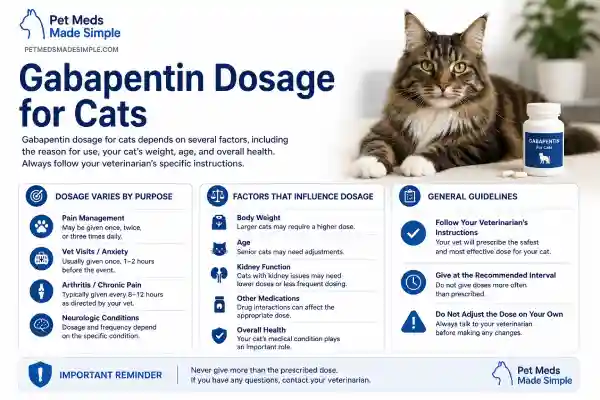
Can You Give Another Dose If Your Cat Still Seems Sleepy?
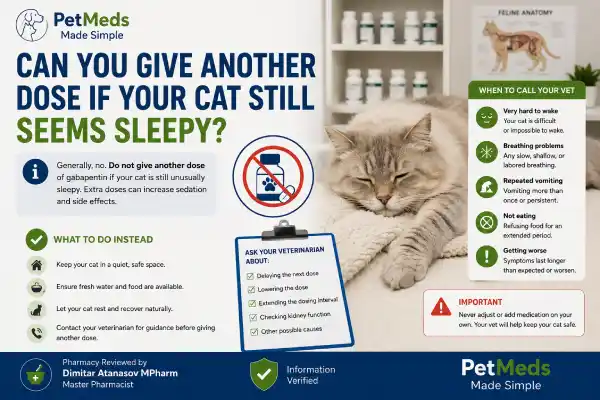
Generally, no.
If your cat remains noticeably sedated when the next scheduled dose is approaching, contact your veterinarian before giving additional medication.
Never assume that more gabapentin is appropriate simply because your cat has not fully recovered.
Your veterinarian may recommend:
- Delaying the next dose
- Reducing the dose
- Extending the dosing interval
- Performing a physical examination
- Evaluating kidney function
Every situation is different, particularly in senior cats.
When Should You Contact Your Veterinarian?
Although gabapentin has an excellent safety profile, owners should know when prolonged effects deserve medical attention.
Contact your veterinarian if your cat:
- Remains severely sedated longer than expected.
- Cannot stand or walk.
- Refuses food for an unusually long period.
- Cannot be awakened normally.
- Has repeated vomiting.
- Develops difficulty breathing.
- Experiences seizures despite treatment.
- Appears to become progressively worse.
These signs are uncommon but should never be ignored.
Related Symptoms Owners Often Notice
Owners searching “How Long Does Gabapentin Last in Cats?” frequently report other temporary side effects as well.
Common observations include:
- Sleepiness
- Wobbliness
- Hiding
- Reduced activity
- Mild confusion
- Larger pupils
- Temporary decrease in coordination
- Increased affection
- Less interest in playing
- Slower responses
Most of these effects gradually improve as the medication wears off.
If you’re experiencing these issues, our related PMMS articles Why Is My Cat Sleepy After Gabapentin?, Why Is My Cat Hiding After Gabapentin?, Can Gabapentin Cause Aggression in Cats?, and Can Gabapentin Cause Vomiting in Cats? provide more detailed guidance.
When Owners Commonly Ask This
Veterinarians hear questions like these every day:
- “My cat is still sleepy 12 hours later. Is that normal?”
- “Why is my cat still wobbly this morning?”
- “Can gabapentin last all day?”
- “How long should I wait before worrying?”
- “Does kidney disease make gabapentin last longer?”
- “Should I skip the next dose?”
- “Can my cat travel while still sleepy?”
- “Why did my friend’s cat recover faster?”
- “How long does liquid gabapentin last?”
- “Can gabapentin still be working tomorrow?”
These are all excellent questions, and the answer depends on your cat’s age, health, kidney function, dosage, and reason for treatment.
Veterinarian Takeaway
If you’re wondering “How Long Does Gabapentin Last in Cats?”, remember that most cats experience the strongest effects for 8–12 hours, while mild sleepiness may continue for up to 24 hours. Older cats and those with kidney disease often recover more slowly because they eliminate the medication less efficiently.
Never adjust the dose on your own simply because your cat seems sleepy longer than expected. Regular communication with your veterinarian helps ensure both safety and effective treatment.
Bottom Line
How Long Does Gabapentin Last in Cats?
For most healthy cats, gabapentin provides noticeable calming or pain-relieving effects for approximately 8 to 12 hours, although complete recovery may take longer in some individuals.
Factors such as age, kidney function, dosage, concurrent medications, and individual sensitivity all influence how long the medication remains active.
While temporary sleepiness is expected, persistent or worsening symptoms should always be discussed with your veterinarian.
Frequently Asked Questions – How Long Does Gabapentin Last in Cats
How long does gabapentin usually last in cats?
Most cats experience the main effects for about 8–12 hours, although mild sedation can persist for up to 24 hours.
Is it normal for my cat to sleep all day after gabapentin?
Yes. Many cats become noticeably sleepy after receiving gabapentin, especially before veterinary visits.
Can kidney disease make gabapentin last longer?
Yes. Cats with chronic kidney disease often eliminate gabapentin more slowly, which may prolong its effects.
How long before gabapentin starts working?
Most cats begin showing effects within 1–3 hours, with peak calming usually occurring around 2–4 hours after administration.
Can gabapentin last longer in older cats?
Yes. Senior cats commonly metabolize and eliminate medications more slowly than younger adults.
Should I wake my cat after giving gabapentin?
No. Allow your cat to rest naturally, but make sure they can be awakened and remain responsive.
Is wobbliness normal after gabapentin?
Yes. Mild incoordination is one of the most common temporary side effects.
Should I give the next dose if my cat is still sleepy?
Contact your veterinarian before giving another dose if your cat remains unusually sedated.
Can gabapentin effects last longer than 24 hours?
They can in some cats, particularly seniors or those with kidney disease. Persistent symptoms should be evaluated by a veterinarian.
When should I call my veterinarian?
Seek veterinary advice if your cat cannot be awakened, has difficulty breathing, develops repeated vomiting, cannot stand, or appears to worsen instead of gradually improving.
Sources
- Plumb’s Veterinary Drug Handbook
- Merck Veterinary Manual
- BSAVA Small Animal Formulary
- Small Animal Clinical Pharmacology (Maddison, Page & Church)
- Veterinary Pharmacology and Therapeutics (Riviere & Papich)
- International Society of Feline Medicine (ISFM) Guidelines
- American Association of Feline Practitioners (AAFP) Guidelines
- Veterinary Information Network (VIN)
- Journal of Feline Medicine and Surgery (JFMS)
- Frontiers in Veterinary Science
- PubMed (peer-reviewed studies on feline gabapentin pharmacokinetics and clinical use)
Medical Review Statement
This article was written by Dimitar Georgiev Atanasov, MPharm, pharmacy and scientifically reviewed by Gergana Krasimirova Atanasova, MPharm, and independently veterinary reviewed by Dr. Valcho Georgiev Valchev, DVM. It is based on current veterinary pharmacology references, peer-reviewed scientific literature, feline medicine guidelines, and evidence-based veterinary recommendations to ensure accurate, practical, and trustworthy information for cat owners.
Important Medical Disclaimer
The information provided on PetMedsMadeSimple.com is intended for educational purposes only and should not replace professional veterinary diagnosis or treatment.
Never start, stop, or adjust your cat’s medication without consulting your veterinarian. If your cat develops seizures, collapse, severe breathing difficulties, repeated vomiting, or becomes impossible to wake, seek emergency veterinary care immediately.
Image Disclosure
Some images used in this article may be AI-generated or AI-assisted for educational purposes. Every PMMS article is independently researched, pharmacy-written, scientifically reviewed, and veterinary-reviewed. AI-generated illustrations are used solely to improve understanding of veterinary medications and should not be interpreted as photographs of actual clinical patients.