If you’re wondering, can cats miss a dose of gabapentin, the answer depends on why your cat is taking the medication, how long the dose has been delayed, and whether the treatment is short-term or long-term.
In many cases, missing a single dose of gabapentin is not an emergency, especially if it was prescribed for anxiety before a veterinary visit. However, if your cat takes gabapentin regularly for chronic pain or seizure management, repeatedly missing doses can reduce its effectiveness and, in some situations, increase the risk of worsening symptoms.
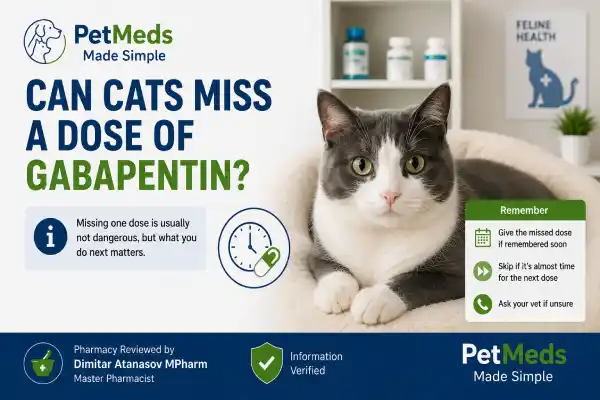
The safest approach is usually to give the missed dose as soon as you remember, unless it is almost time for the next scheduled dose. Never give two doses together unless your veterinarian specifically instructs you to do so.
This guide explains what happens if cats miss a dose of gabapentin, when it becomes a concern, and what owners should do next.
Quick Answer
Can cats miss a dose of gabapentin?
Yes but whether it’s a problem depends on your cat’s medical condition.
- Missing one dose is usually not dangerous.
- Never double the next dose unless instructed.
- Cats receiving gabapentin for seizures require extra caution.
- Repeatedly missing doses may reduce pain control.
- Contact your veterinarian if your cat develops unusual symptoms after missing medication.
Why Do Cats Take Gabapentin?
Before discussing can cats miss a dose of gabapentin, it’s helpful to understand why veterinarians prescribe it.
Gabapentin has become one of the most commonly used medications in feline medicine because it is generally well tolerated and has multiple uses.
Veterinarians commonly prescribe gabapentin for:
- Chronic arthritis pain
- Neuropathic pain
- Post-surgical pain management
- Anxiety during travel
- Fear associated with veterinary visits
- Certain seizure disorders
- Multimodal pain management
Unlike some medications that must maintain extremely precise blood concentrations, gabapentin is relatively forgiving in many situations. However, this does not mean owners should intentionally skip doses.
The importance of staying on schedule depends largely on the medical condition being treated.
Can Cats Miss a Dose of Gabapentin?s
Does One Missed Dose Usually Harm a Cat?
Fortunately, in most healthy cats, one accidentally missed dose is unlikely to cause serious harm.
Many owners panic after realizing they forgot a dose, but the body doesn’t instantly lose all of the medication’s effects.
Instead:
- Blood levels gradually decrease.
- Pain control may slowly lessen.
- Anxiety relief may wear off.
- Sedation gradually disappears.
- The medication continues leaving the body over several hours.
For cats taking gabapentin only before a stressful veterinary appointment, a missed dose usually means the medication simply won’t work as well for reducing anxiety.
For cats taking it daily, however, maintaining a consistent schedule helps provide more stable symptom control.
Why Consistency Matters
Although can cats miss a dose of gabapentin often has a reassuring answer, veterinarians still recommend giving the medication consistently.
Regular dosing helps maintain:
| Benefit | Why It Matters |
|---|---|
| Stable pain control | Prevents pain flare-ups |
| Consistent anxiety reduction | Avoids unpredictable behavior |
| Reliable blood concentrations | Improves treatment effectiveness |
| Better seizure management | Important for neurologic patients |
| Easier monitoring | Helps veterinarians adjust doses accurately |
Skipping doses frequently makes it much harder to determine whether the medication itself is effective.
What Happens Inside the Body After a Missed Dose?
Gabapentin does not stop working the instant a dose is forgotten.
Instead, the concentration slowly declines as the kidneys remove the drug from the body.
As medication levels decrease:
- Sedation gradually fades.
- Pain relief becomes weaker.
- Anxiety protection decreases.
- Nerve pain may return.
- Clinical signs may slowly reappear.
This gradual decline explains why many cats show no obvious problems after missing only one dose.
However, repeated missed doses may allow symptoms to return completely.
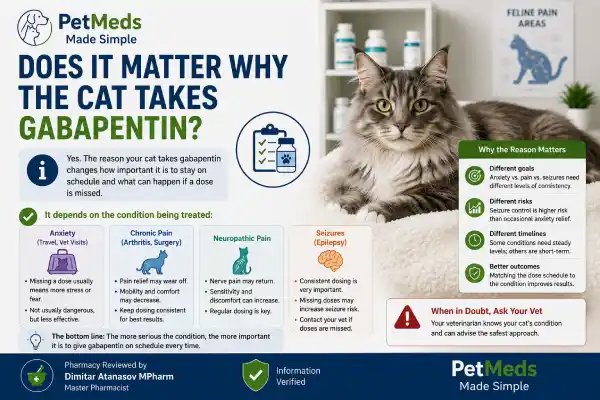
Does It Matter Why the Cat Takes Gabapentin?
Absolutely.
One of the biggest factors when answering can cats miss a dose of gabapentin is the reason it was prescribed.
For Anxiety Before Veterinary Visits
Missing the dose usually means:
- Increased fear
- More stress
- Less sedation
- Greater resistance during handling
While frustrating, this situation is rarely dangerous.
For Chronic Pain
Missing doses may allow:
- Arthritis pain to worsen
- Reduced mobility
- Increased hiding
- Less appetite
- Decreased grooming
Many owners notice these changes gradually over the next several hours.
For Neuropathic Pain
Gabapentin is particularly useful for nerve-related pain.
Missing doses can lead to:
- Increased sensitivity
- Reluctance to jump
- Vocalization
- Irritability
- Reduced activity
Symptoms often return progressively rather than suddenly.
For Seizure Disorders
This situation deserves the greatest attention.
Cats taking gabapentin as part of seizure therapy should generally receive every dose on schedule.
Missing medication may increase seizure risk in susceptible patients, especially if multiple doses are missed.
Owners should always contact their veterinarian if seizure medications have been skipped.
Signs Your Cat May Be Feeling the Effects of a Missed Dose
Not every cat develops noticeable symptoms.
Those that do may show:
- Moving less than usual
- Difficulty jumping
- Increased vocalization
- Hiding
- Reduced appetite
- Irritability
- Anxiety
- Restlessness
- Less willingness to be handled
These signs often resemble the original condition that gabapentin was prescribed to treat.
Can Missing a Dose Cause Withdrawal?
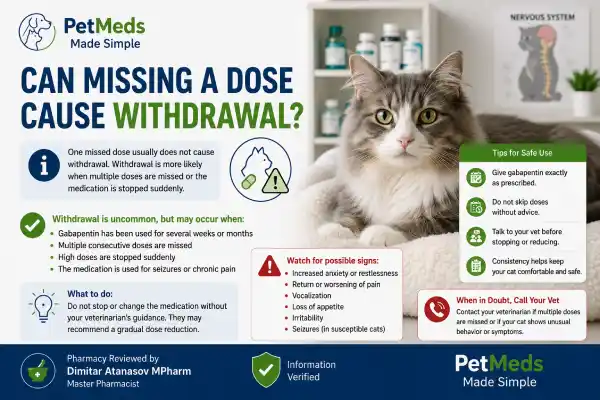
This is a common concern among cat owners.
For most cats, missing one dose does not cause true withdrawal.
Withdrawal is more likely when:
- The medication has been used for many weeks or months.
- Higher doses are involved.
- The drug is stopped suddenly instead of gradually reduced.
- Multiple consecutive doses are missed.
Even then, not every cat experiences withdrawal symptoms.
We’ll discuss withdrawal and sudden discontinuation in more detail later in this guide.
Common Reasons Owners Accidentally Miss a Dose
Veterinarians hear these explanations every day.
Some of the most common include:
- Busy schedules
- Multiple family members assuming someone else gave the medication
- Difficulty medicating the cat
- Vomiting shortly after administration
- Running out of medication
- Travel
- Changes in daily routine
Fortunately, most missed doses can be managed safely when owners know the correct next step.
What Should You Do If Your Cat Misses a Dose of Gabapentin?
After discovering that you’ve forgotten a dose, your first reaction may be to panic. Fortunately, in most situations, missing one dose of gabapentin does not require emergency treatment.
The correct response depends almost entirely on how much time has passed since the scheduled dose.
Veterinarians generally recommend following these principles rather than automatically giving extra medication.
| Situation | Recommended Action |
|---|---|
| You remember within a few hours | Give the missed dose unless your veterinarian has instructed otherwise. |
| It’s almost time for the next scheduled dose | Skip the missed dose and continue with the normal schedule. |
| Multiple doses have been missed | Contact your veterinarian for advice. |
| Your cat takes gabapentin for seizures | Contact your veterinarian if you’re unsure how to proceed. |
| Your cat appears ill after missing medication | Seek veterinary advice promptly. |
The most important rule is simple:
Never give two doses at the same time to “make up” for a forgotten dose unless your veterinarian specifically tells you to do so.
Should You Double the Next Dose?
This is one of the most common questions owners ask after realizing they forgot medication.
The answer is almost always:
No.
Giving two doses together can increase the likelihood of side effects without providing any additional benefit.
Higher-than-prescribed doses may increase the risk of:
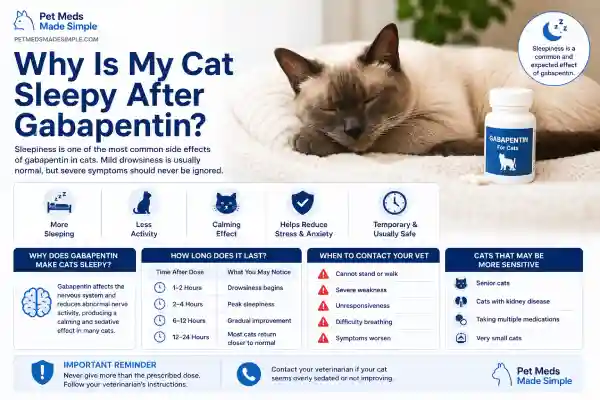
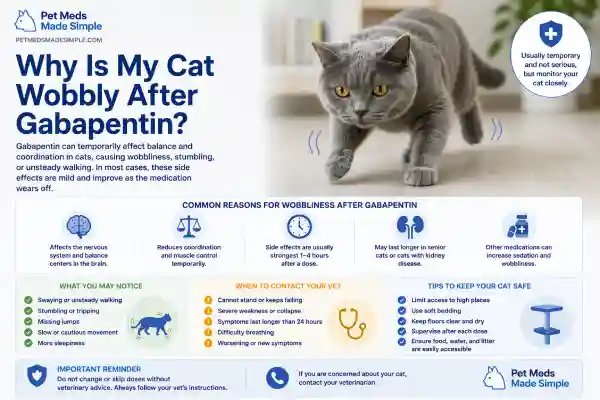
- Excessive sleepiness
- Poor coordination
- Wobbliness
- Weakness
- Temporary confusion
- Increased drooling
- Difficulty walking
Fortunately, gabapentin has a relatively wide margin of safety in cats, but intentionally doubling doses is still not recommended.
Instead, simply return to the regular schedule unless your veterinarian advises otherwise.
How Long Does Gabapentin Stay in a Cat’s Body?
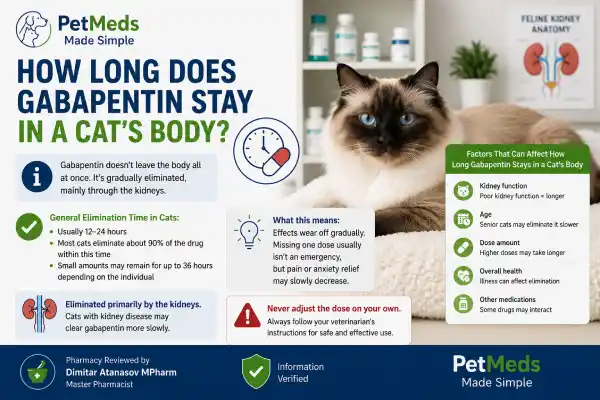
Understanding how long gabapentin remains in the body helps explain why missing one dose usually isn’t immediately dangerous.
After administration, gabapentin is absorbed relatively quickly.
The medication is then gradually eliminated through the kidneys.
Although its effects slowly wear off over several hours, blood concentrations decline gradually rather than disappearing suddenly.
This gradual elimination explains why many cats continue to receive some benefit even after a delayed dose.
However, repeated missed doses allow medication levels to continue falling until the drug is no longer providing effective pain or seizure control.
Can Missing a Dose Cause Seizures?
This depends on why the medication was prescribed.
If your cat receives gabapentin only for:
- Anxiety
- Arthritis
- Chronic pain
missing one dose is unlikely to cause seizures.
However, if gabapentin forms part of your cat’s epilepsy treatment plan, maintaining a consistent dosing schedule becomes much more important.
Suddenly stopping anticonvulsant therapy or repeatedly missing doses may increase the likelihood of breakthrough seizures in susceptible cats.
Owners managing feline epilepsy may also find these PMMS guides helpful:
- Gabapentin for Cats: Uses, Dosage, Side Effects & Safety
- What Happens If Cats Suddenly Stop Gabapentin?
- Can Cats Overdose on Gabapentin?
- Is Human Gabapentin Safe for Cats?
If your cat misses seizure medication and you’re unsure what to do, contact your veterinarian as soon as possible.
What If My Cat Vomits After Taking Gabapentin?
Another common situation occurs when owners aren’t sure whether the medication was absorbed.
The answer depends largely on when the vomiting occurred.
If vomiting occurs within a few minutes
The capsule or liquid may not have been fully absorbed.
Your veterinarian may recommend giving another dose, but this decision depends on the individual patient.
If vomiting occurs an hour or more later
Most of the medication has usually already been absorbed.
Giving another full dose may accidentally result in overdosing.
Whenever you’re uncertain, call your veterinarian before repeating the medication.
What If You Don’t Know Whether the Dose Was Given?
Multi-person households frequently encounter this problem.
One family member believes they gave the medication.
Another isn’t sure.
Instead of risking an accidental double dose, it’s usually safer to:
- Check your medication log.
- Ask everyone in the household.
- Count remaining capsules if possible.
- Contact your veterinarian if uncertainty remains.
Many veterinarians recommend using a medication chart or smartphone reminder to prevent missed or duplicated doses.
Can Cats Become Resistant to Gabapentin If Doses Are Missed?
No.
Missing doses does not cause the body to become resistant to gabapentin.
However, inconsistent dosing can make the medication appear less effective because blood concentrations fluctuate significantly.
This may lead owners to believe the medication has “stopped working,” when the real issue is irregular administration.
Consistent dosing remains one of the simplest ways to maximize treatment success.
Are Some Cats More Sensitive to Missed Doses?
Yes.
Some cats tolerate occasional delays with no noticeable changes.
Others become symptomatic within several hours.
Greater sensitivity is often seen in:
- Senior cats
- Cats with chronic pain
- Cats with advanced arthritis
- Cats receiving multiple medications
- Cats with seizure disorders
- Cats with chronic kidney disease
These cats should follow dosing schedules as closely as possible.
Special Considerations for Senior Cats
Older cats deserve additional attention.
Many senior cats receive gabapentin daily for arthritis and age-related chronic pain.
Because pain often returns gradually, owners may notice:
- Less jumping
- Slower walking
- More sleeping
- Reduced grooming
- Increased hiding
- Less interest in play
These changes may simply indicate that medication levels have fallen after a missed dose.
If missed doses become frequent, your veterinarian may recommend strategies to make administration easier.
What About Cats With Kidney Disease?
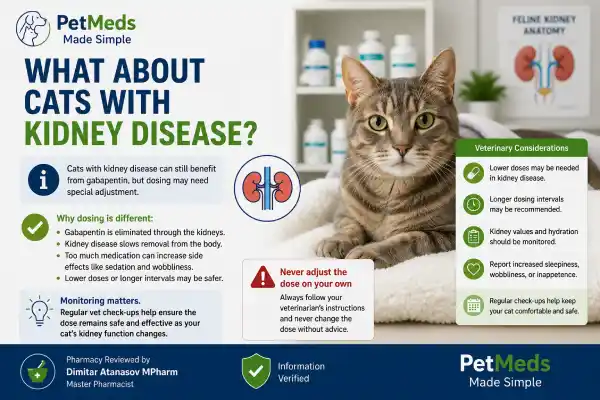
Unlike many medications that are processed primarily by the liver, gabapentin is eliminated mainly through the kidneys.
Cats with chronic kidney disease often clear gabapentin more slowly.
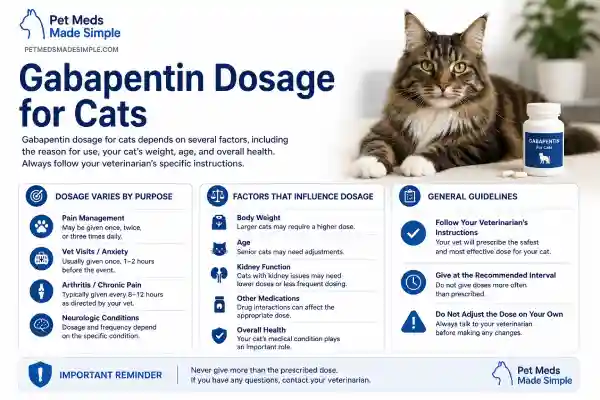
Because of this, veterinarians frequently prescribe:
- Lower doses
- Longer dosing intervals
- More individualized treatment plans
Owners should never adjust the dosing schedule on their own, even if a dose has been missed.
Kidney disease makes individualized veterinary guidance especially important.
Does Missing One Dose Mean the Treatment Has Failed?
Absolutely not.
One missed dose almost never means that the medication has stopped working permanently.
Treatment success depends on:
- Consistent long-term dosing
- Appropriate dose selection
- Correct diagnosis
- Regular veterinary monitoring
An occasional mistake happens to nearly every pet owner.
The goal is simply to return to the prescribed schedule as safely as possible rather than attempting to “catch up” with extra medication.
Can Missing Multiple Doses Become Dangerous?
While missing one dose of gabapentin is usually manageable, repeatedly forgetting doses is a different situation.
The answer to “Can cats miss a dose of gabapentin?” becomes more concerning when several consecutive doses are missed.
Repeated missed doses may lead to:
- Poor pain control
- Increased anxiety
- Return of neuropathic pain
- Reduced mobility
- Breakthrough seizures in epileptic cats
- Difficulty evaluating whether the medication is still effective
Veterinarians are generally much more concerned about repeated missed doses than about a single accidental oversight.
If your cat has missed medication for more than a day, contact your veterinarian before restarting the treatment schedule, particularly if the medication is being used to control seizures.
What Happens If Gabapentin Is Stopped Suddenly?
Many owners searching “Can cats miss a dose of gabapentin?” are also wondering whether stopping the medication altogether is dangerous.
The answer depends on:
- Why the medication was prescribed
- The dose being used
- How long your cat has been taking it
- Whether other medications are being given simultaneously
For cats receiving gabapentin occasionally for travel anxiety or veterinary visits, stopping the medication is usually straightforward.
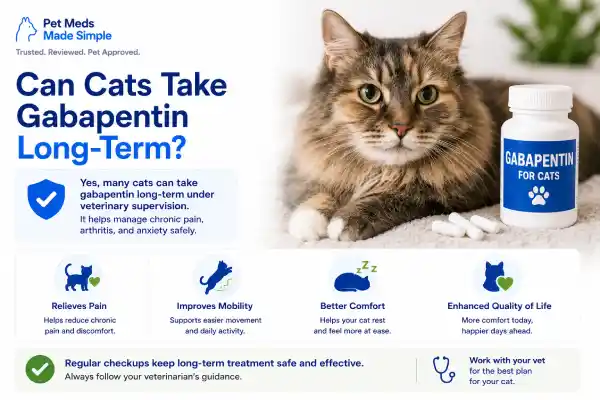
However, cats receiving gabapentin every day for chronic pain or seizure management should never have the medication discontinued suddenly without veterinary advice.
Abrupt discontinuation may increase the risk of:
- Pain flare-ups
- Anxiety returning
- Restlessness
- Reduced appetite
- Increased sensitivity to touch
- Breakthrough seizures in susceptible patients
If long-term treatment needs to be stopped, your veterinarian may recommend gradually reducing the dose instead of stopping it abruptly.
Read more: What Happens If Cats Suddenly Stop Gabapentin?
Can Missing a Dose Affect Chronic Pain Control?
Yes.
Cats with arthritis or chronic nerve pain often rely on consistent medication to remain comfortable.
Because cats naturally hide pain, owners may not immediately notice worsening discomfort.
Instead, subtle changes usually appear first.
These may include:
- Sleeping more than usual
- Jumping less frequently
- Avoiding stairs
- Less interest in playing
- Hiding more often
- Decreased grooming
- Becoming irritable when touched
These signs often indicate that the original pain—not the medication itself—is returning.
Maintaining a regular dosing schedule helps provide continuous pain relief.
Can Missing a Dose Make My Cat Anxious Again?
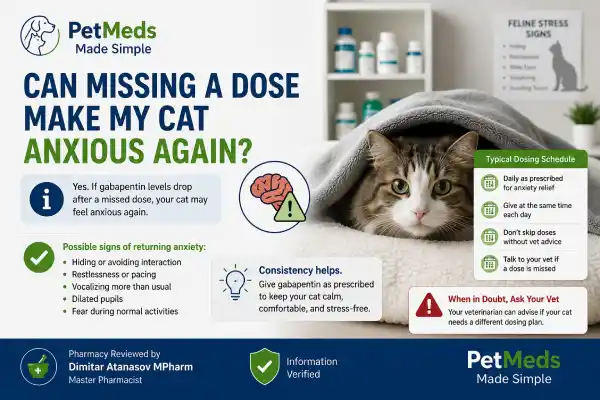
It can.
Gabapentin is widely used to reduce stress before:
- Veterinary visits
- Car travel
- Grooming appointments
- Introducing new pets
- Other stressful situations
If the medication is missed before one of these events, owners may notice:
- Dilated pupils
- Hiding
- Growling
- Hissing
- Increased vocalization
- Resistance to handling
- Attempts to escape
Fortunately, these behaviors are usually temporary and reflect the underlying anxiety rather than harm caused by missing the medication.
Does Missing a Dose Affect Every Cat the Same Way?
No.
Individual responses vary considerably.
Some cats show almost no change after missing one dose.
Others become noticeably uncomfortable within several hours.
Several factors influence the response.
| Factor | Possible Effect |
|---|---|
| Medical condition | Seizure patients are generally more sensitive |
| Dose | Higher maintenance doses require greater consistency |
| Length of treatment | Long-term therapy often benefits from strict scheduling |
| Kidney function | Slower elimination may prolong drug effects |
| Age | Senior cats may respond differently |
| Individual sensitivity | Some cats naturally metabolize medications differently |
This is why veterinarians rarely give identical instructions for every patient.
How Veterinarians Decide What to Do After a Missed Dose
When an owner calls about a forgotten dose, the veterinarian considers several questions before giving advice.
These include:
- Why is the cat taking gabapentin?
- How many doses have been missed?
- When was the last dose given?
- Has the cat developed any symptoms?
- Does the cat have kidney disease?
- Is the cat receiving other medications?
- Has the cat ever had seizures?
- Are there any other underlying illnesses?
Only after reviewing the entire medical picture can the safest recommendation be made.
Tips to Prevent Missing Future Doses
The easiest missed dose to manage is the one that never happens.
Many owners find these strategies helpful:
- Set a daily phone reminder.
- Use a weekly medication organizer.
- Keep a written medication chart.
- Mark each dose immediately after giving it.
- Assign one family member to administer medications.
- Keep medications in the same location.
- Request prescription refills before running out.
These simple habits dramatically reduce medication errors in multi-pet households.
Related Symptoms Owners Often Notice
Owners searching “Can Cats Miss a Dose of Gabapentin?” often notice additional changes after a missed dose.
Common symptoms include:
- Increased hiding
- Less jumping
- Stiff walking
- Restlessness
- Anxiety
- Reduced appetite
- Increased vocalization
- Irritability
- Sleeping more
- Sleeping less
- Reluctance to be touched
- Less grooming
Most of these symptoms are actually caused by the underlying medical condition returning rather than by the missed dose itself.
When Owners Commonly Ask This
Veterinarians frequently hear questions such as:
- “I forgot this morning’s dose. What should I do?”
- “Can I give two doses together?”
- “Should I restart the medication tomorrow?”
- “Will my cat have seizures after missing one dose?”
- “Will arthritis pain come back immediately?”
- “How long can a cat safely miss gabapentin?”
- “Should I call the emergency veterinarian?”
- “Can missing medication cause withdrawal?”
- “Will one missed dose hurt my cat?”
- “Can I change the dosing schedule myself?”
These are excellent questions, and the answers depend on your cat’s diagnosis, current dose, and overall health.
Veterinarian Takeaway
If you’re asking “Can Cats Miss a Dose of Gabapentin?”, remember that one accidentally missed dose is usually not a medical emergency. Most cats experience little or no immediate harm, particularly when gabapentin is prescribed for pain or anxiety.
The safest approach is to give the missed dose when appropriate, avoid doubling the next dose, and return to the normal schedule. Cats receiving gabapentin for seizure disorders require closer attention because maintaining consistent blood levels is more important for seizure control.
Whenever you’re uncertain, your veterinarian is always the best source of advice.
Bottom Line
So, can cats miss a dose of gabapentin?
Yes but the significance depends on why your cat takes the medication.
Missing a single dose is usually not dangerous, and most cats recover simply by returning to their regular dosing schedule. However, repeatedly missing doses can reduce pain control, allow anxiety to return, or increase seizure risk in cats receiving gabapentin as part of epilepsy treatment.
Consistency remains one of the most important factors for successful long-term therapy. If you’re ever unsure whether to give or skip a missed dose, contact your veterinarian rather than guessing.
Frequently Asked Questions – Can Cats Miss a Dose of Gabapentin
Can cats miss one dose of gabapentin?
Yes. In most cases, one missed dose is not dangerous, but you should follow your veterinarian’s instructions on when to give the next dose.
Should I double the next gabapentin dose?
No. Never double a dose unless your veterinarian specifically instructs you to do so.
What happens if my cat misses gabapentin for arthritis?
Your cat’s pain may gradually return, leading to reduced mobility, less jumping, increased hiding, or reluctance to play.
Can missing gabapentin trigger seizures?
For cats taking gabapentin as part of seizure treatment, repeated missed doses may increase the risk of breakthrough seizures.
What if I don’t know whether I gave the dose?
Avoid giving an extra dose until you’re certain. If in doubt, contact your veterinarian for guidance.
Can I change the dosing schedule myself?
No. Always consult your veterinarian before changing your cat’s medication schedule.
Is it safe to stop gabapentin suddenly?
Cats receiving long-term gabapentin should not have the medication stopped abruptly without veterinary advice.
What if my cat vomits after taking gabapentin?
The appropriate response depends on how soon vomiting occurred. Contact your veterinarian before giving another dose.
Does kidney disease change how gabapentin is used?
Yes. Cats with kidney disease often require individualized dosing because gabapentin is eliminated primarily through the kidneys.
When should I call my veterinarian after a missed dose?
Call your veterinarian if multiple doses have been missed, your cat develops unusual symptoms, or the medication is being used to control seizures.
Sources
- Plumb’s Veterinary Drug Handbook
- Merck Veterinary Manual
- BSAVA Small Animal Formulary
- Small Animal Clinical Pharmacology (Maddison, Page & Church)
- Veterinary Pharmacology and Therapeutics (Riviere & Papich)
- American Association of Feline Practitioners (AAFP) Guidelines
- International Society of Feline Medicine (ISFM) Guidelines
- Veterinary Information Network (VIN)
- Journal of Feline Medicine and Surgery (JFMS)
- Frontiers in Veterinary Science
- PubMed (peer-reviewed studies on feline gabapentin pharmacokinetics, chronic pain management, anxiety reduction, and seizure therapy)
Medical Review Statement
This article was written by Dimitar Georgiev Atanasov, MPharm, pharmacy and scientifically reviewed by Gergana Krasimirova Atanasova, MPharm, and independently veterinary reviewed by Dr. Valcho Georgiev Valchev, DVM. It is based on current veterinary pharmacology references, peer-reviewed scientific literature, feline medicine guidelines, and evidence-based veterinary recommendations to ensure accurate, practical, and trustworthy information for cat owners.
Important Medical Disclaimer
The information provided on PetMedsMadeSimple.com is intended for educational purposes only and should not replace professional veterinary diagnosis or treatment.
Never start, stop, or adjust your cat’s medication without consulting your veterinarian. If your cat develops seizures, collapse, severe breathing difficulties, repeated vomiting, or becomes impossible to wake, seek emergency veterinary care immediately.
Image Disclosure
Some images used in this article may be AI-generated or AI-assisted for educational purposes. Every PMMS article is independently researched, pharmacy-written, scientifically reviewed, and veterinary-reviewed. AI-generated illustrations are used solely to improve understanding of veterinary medications and should not be interpreted as photographs of actual clinical patients.