Quick Answer
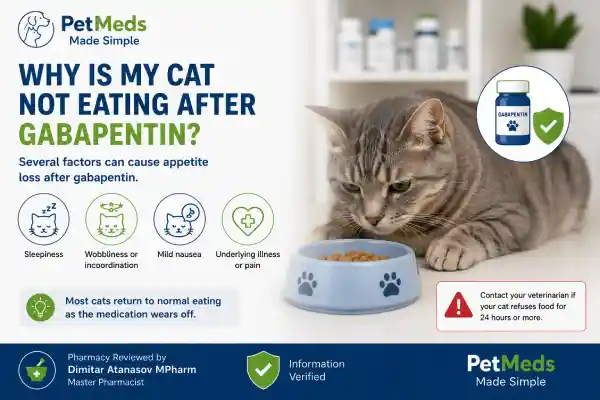
Why Is My Cat Not Eating After Gabapentin? A cat may eat less after taking gabapentin because the medication can cause sleepiness, wobbliness, reduced activity, mild nausea, or temporary disorientation. In many cases, however, the medication is not the only reason. Pain, stress, dental disease, arthritis, kidney disease, or the condition being treated may also reduce your cat’s appetite. Mild appetite loss lasting a few hours is often not unusual, but cats that refuse food for more than 24 hours or develop severe lethargy, vomiting, or other concerning symptoms should be examined by a veterinarian promptly.
Why Is My Cat Not Eating After Gabapentin?
Many owners become worried when their cat suddenly refuses food after receiving gabapentin. Because cats are particularly sensitive to prolonged fasting, this concern is completely understandable.
The good news is that decreased appetite after gabapentin is often temporary. The challenging part is determining whether the medication itself is responsible or whether another medical problem is contributing.
Common reasons include:
- Sleepiness caused by gabapentin
- Temporary wobbliness
- Mild nausea
- Stress from travel or a veterinary visit
- Pain from the underlying condition
- Dental disease
- Arthritis
- Kidney disease
- Recovery after surgery
- Individual sensitivity to the medication
Understanding these possibilities helps owners know when appetite loss is expected and when veterinary attention is needed.
For a complete overview of the medication, read our Gabapentin for Cats: Uses, Dosage, Side Effects & Safety Guide.
Why Is My Cat Not Eating After Gabapentin?
Is Appetite Loss a Common Side Effect of Gabapentin?
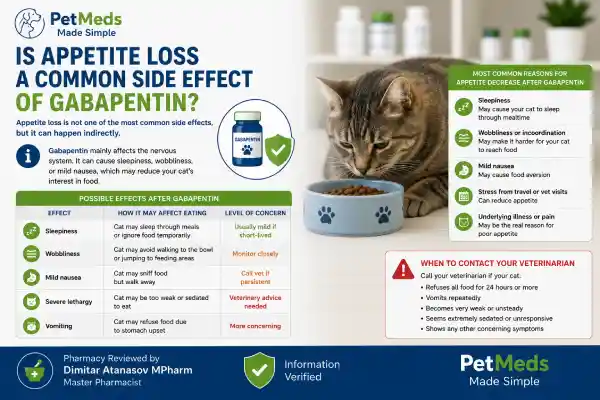
Unlike sedation, appetite loss is not considered one of the most common side effects of gabapentin. However, some cats temporarily eat less because the medication changes how they feel.
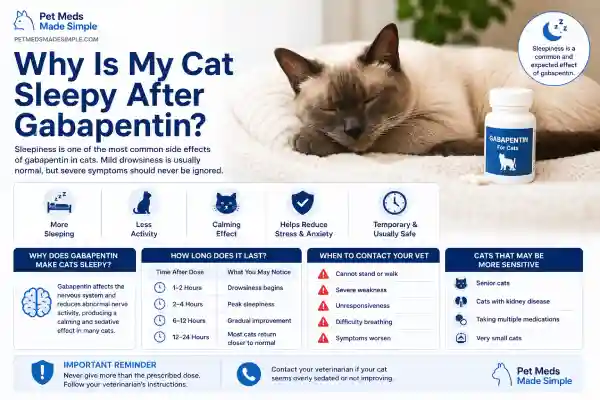
Gabapentin mainly affects the nervous system, making many cats calmer and sleepier. A sleepy cat may simply ignore its food bowl until the medication begins wearing off.
In other cases, mild nausea or temporary incoordination may reduce the desire to eat.
| Possible Side Effect | Can It Affect Appetite? |
|---|---|
| Sleepiness | Yes |
| Wobbliness | Yes |
| Reduced activity | Yes |
| Mild nausea | Yes |
| Vomiting | Yes |
| Mild disorientation | Sometimes |
Fortunately, most cats return to their normal eating habits once the medication’s effects decrease.
Could Sleepiness Be the Main Reason?
Yes.
Sleepiness is by far the most common explanation.
Gabapentin slows certain nerve signals within the brain, helping reduce pain, anxiety, and overstimulation. As a result, many cats become much more relaxed than usual.
Owners often notice that their cat:
- Sleeps through mealtime
- Ignores favorite treats
- Stays in one location for several hours
- Responds slowly when called
- Eats much later than normal
Rather than having no appetite, these cats may simply be too sleepy to bother eating immediately.
If your cat mainly appears relaxed and comfortable, appetite often returns once the sedation wears off.
You may also find our article Why Is My Cat Sleepy After Gabapentin? helpful.
Could Wobbliness Make Eating Difficult?
Absolutely.
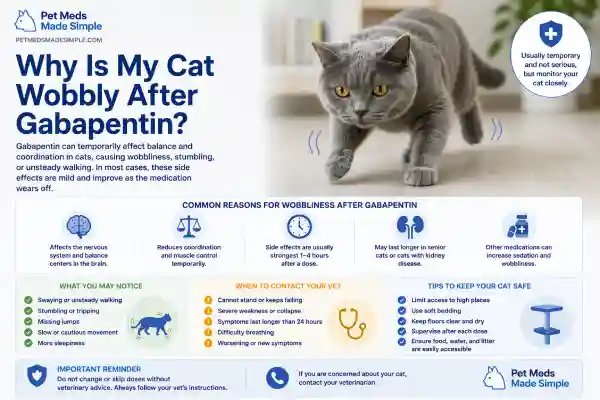
Some cats experience temporary incoordination after gabapentin.
Walking across the room, climbing stairs, or jumping onto elevated feeding stations may suddenly feel challenging.
This can make it appear that your cat has lost its appetite when, in reality, it simply does not want to move.
During this period it may help to:
- Place food near your cat.
- Offer meals on the floor.
- Reduce the need for jumping.
- Keep water easily accessible.
- Allow your cat to rest quietly.
If wobbliness is severe or lasts longer than expected, contact your veterinarian.
Our guide Why Is My Cat Wobbly After Gabapentin? explains this side effect in greater detail.
Could Gabapentin Cause Nausea?
Although uncommon, yes.
Some cats develop mild stomach upset after taking gabapentin.
Signs that nausea—not true appetite loss—may be the problem include:
- Sniffing food but refusing it
- Lip licking
- Drooling
- Swallowing repeatedly
- Walking away after taking one or two bites
- Vomiting
If nausea persists or your cat begins vomiting repeatedly, veterinary evaluation is recommended.
You can also read Can Gabapentin Cause Vomiting in Cats? for additional information.
Could the Underlying Disease Be Responsible?
Very often, yes.
One of the biggest mistakes owners make is assuming gabapentin is automatically responsible whenever appetite decreases.
Remember, gabapentin is prescribed because your cat already has a medical problem.
Common conditions that reduce appetite include:
- Arthritis
- Dental disease
- Cancer
- Chronic kidney disease
- Pancreatitis
- Nerve injuries
- Recovery after surgery
- Chronic pain
In these situations, poor appetite may reflect the illness itself rather than the medication.
Could the Dose Be Too High?
Possibly.
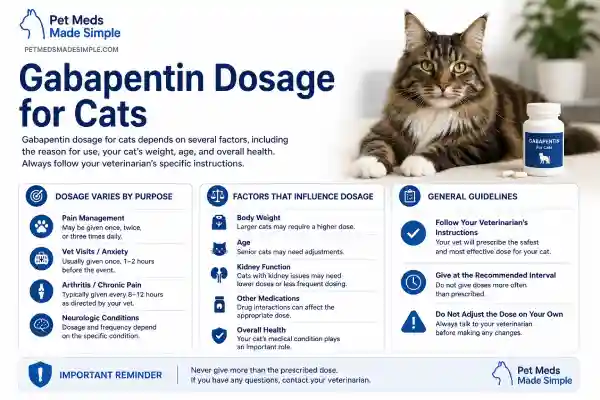
Cats vary tremendously in their sensitivity to gabapentin.
A dose that causes only mild relaxation in one cat may produce significant sedation in another.
A dose may be too high if your cat develops:
- Extreme sleepiness
- Difficulty walking
- Very little interest in food
- Marked weakness
- Confusion
- Prolonged recovery after each dose
Never adjust the dose on your own.
Instead, contact your veterinarian, who can determine whether the dosage should be modified.
Are Senior Cats More Likely to Stop Eating?
Yes.
Older cats are generally more sensitive to medications because they often have:
- Reduced kidney function
- Lower muscle mass
- Multiple chronic illnesses
- Slower drug metabolism
- Several medications taken at the same time
These changes can make gabapentin remain in the body longer, resulting in prolonged sleepiness and reduced appetite.
Senior cats should therefore be monitored particularly closely after each dose.
Can Kidney Disease Make Appetite Loss Worse?
Definitely.
Gabapentin is eliminated primarily through the kidneys.
Cats with chronic kidney disease may clear the medication more slowly, causing sedation to last longer than expected.
At the same time, kidney disease itself commonly causes poor appetite.
This means two separate factors may be reducing your cat’s interest in food:
- The medication lasts longer.
- The kidney disease already decreases appetite.
Veterinarians often prescribe adjusted gabapentin doses for cats with reduced kidney function to minimize excessive side effects.
When Owners Commonly Ask This
Most owners begin searching Why Is My Cat Not Eating After Gabapentin? after situations such as:
- “My cat hasn’t eaten since taking gabapentin.”
- “My cat is only sleeping after today’s dose.”
- “She sniffs food but walks away.”
- “My senior cat refuses treats after gabapentin.”
- “Should I stop giving gabapentin because my cat won’t eat?”
These concerns are understandable because cats should never go without food for prolonged periods. Monitoring your cat carefully during the first several doses can help determine whether the appetite change is temporary or whether further veterinary evaluation is needed.
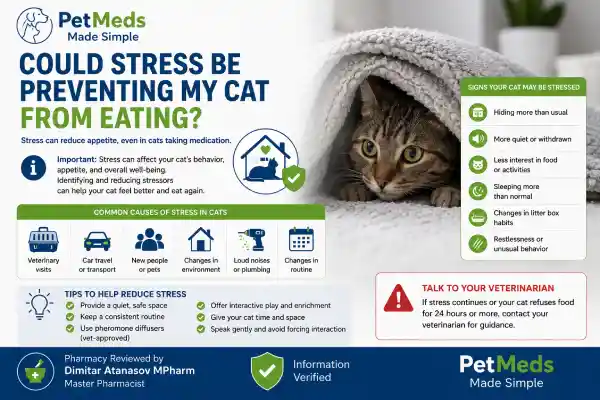
Could Stress Be Preventing My Cat from Eating?
Yes.
Many cats receive gabapentin before situations that are naturally stressful, including:
- Veterinary visits
- Long car rides
- Grooming appointments
- Diagnostic imaging
- Blood collection
- Surgery
Although gabapentin helps reduce anxiety, the stressful event itself may still affect appetite.
Cats are creatures of routine, and even a small disruption can make them reluctant to eat for several hours.
You may notice your cat:
- Hiding under furniture
- Avoiding family members
- Remaining unusually quiet
- Sleeping more than normal
- Showing little interest in food
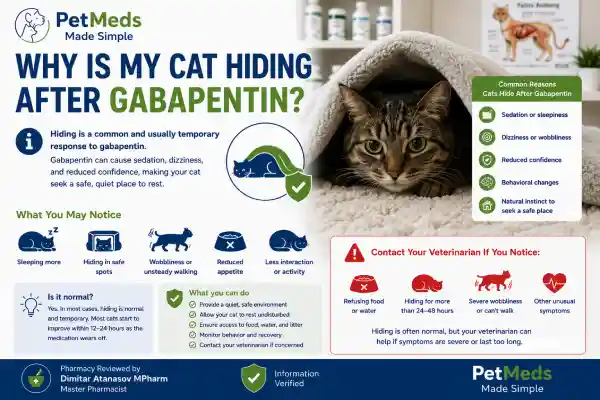
If your cat seems anxious in addition to eating less, our article Why Is My Cat Hiding After Gabapentin? explains why this happens and when it should become a concern.
Can Pain Reduce Appetite Even After Taking Gabapentin?
Absolutely.
One of the biggest misconceptions is that gabapentin immediately removes all pain.
While it is an excellent medication for many painful conditions, it does not completely eliminate discomfort in every cat.
If pain is still present, your cat may continue eating poorly.
Conditions commonly associated with decreased appetite include:
- Osteoarthritis
- Dental disease
- Nerve pain
- Cancer
- Pancreatitis
- Soft tissue injuries
- Orthopedic surgery
If your cat continues eating poorly despite receiving gabapentin, your veterinarian may need to reassess whether additional pain control is necessary.
Our article Can Gabapentin Cause Aggression in Cats? also discusses how untreated pain may sometimes affect behavior.
Can Other Medications Make Appetite Loss Worse?
Yes.
Many cats receiving gabapentin are also prescribed additional medications.
Examples include:
- Anti-inflammatory medications
- Antibiotics
- Anti-nausea medications
- Appetite stimulants
- Sedatives
- Pain medications
Sometimes the combination of medications—not gabapentin alone—can increase sleepiness or reduce appetite.
Always tell your veterinarian about:
- Prescription medications
- Supplements
- Herbal products
- Over-the-counter medications
This helps avoid potential drug interactions.
Could My Cat Be Dehydrated?
Sometimes.
Cats that stop eating may also drink less.
Dehydration can quickly make them feel even worse, creating a cycle where they become:
- More tired
- More nauseous
- Less interested in food
- Less active
Watch for signs such as:
- Dry or sticky gums
- Sunken eyes
- Reduced skin elasticity
- Weakness
- Little interest in drinking
Fresh water should always be available, especially after your cat receives gabapentin.
When Does Appetite Loss Become an Emergency?
Cats are very different from dogs.
While many dogs can safely miss a meal, prolonged fasting in cats may lead to hepatic lipidosis (fatty liver syndrome), a potentially life-threatening condition.
For this reason, appetite loss should never be ignored.
Contact your veterinarian promptly if your cat:
- Refuses all food for 24 hours
- Eats only tiny amounts for more than one day
- Vomits repeatedly
- Cannot keep water down
- Becomes extremely weak
- Has difficulty walking
- Shows difficulty breathing
- Develops yellow gums, skin, or eyes
- Appears confused or unresponsive
Early treatment is much safer than waiting until severe illness develops.
What Is Hepatic Lipidosis?
Hepatic lipidosis is one of the most important reasons veterinarians take appetite loss in cats so seriously.
When cats stop eating, their bodies begin breaking down fat for energy.
Unfortunately, the liver cannot always process this fat efficiently.
Fat accumulates inside liver cells, eventually reducing normal liver function.
Without treatment, hepatic lipidosis can become life-threatening.
Cats that are overweight before they stop eating are at even greater risk.
How Can I Encourage My Cat to Eat?
If your veterinarian has determined that your cat is stable, several simple strategies may help encourage eating.
Try to:
- Offer small meals more frequently.
- Warm wet food slightly to enhance its aroma.
- Provide a quiet place to eat.
- Place food close to your cat if mobility is reduced.
- Offer highly palatable canned food if approved by your veterinarian.
- Ensure fresh water is always available.
- Minimize loud noises and household stress.
Never force-feed your cat unless your veterinarian specifically instructs you to do so.
Foods That May Encourage Appetite
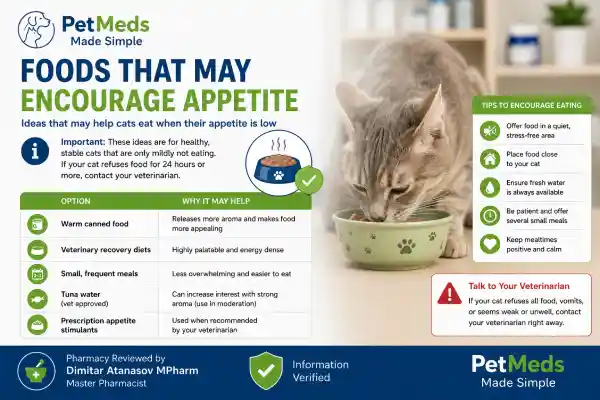
| Option | Why It May Help |
|---|---|
| Warm canned food | Stronger smell increases interest |
| Veterinary recovery diets | Highly palatable and energy dense |
| Small frequent meals | Less overwhelming |
| Tuna water (vet approved) | May increase aroma |
| Prescription appetite stimulants | Used when recommended by a veterinarian |
Always introduce new foods carefully, especially in cats with digestive disease or food allergies.
Should I Stop Giving Gabapentin?
Usually no.
Many owners immediately wonder whether they should stop the medication after noticing appetite loss.
However, stopping gabapentin without veterinary guidance may allow pain or anxiety to return and may complicate your cat’s treatment plan.
Instead:
- Monitor your cat carefully.
- Record when the medication was given.
- Note when your cat last ate.
- Watch for vomiting or worsening symptoms.
- Contact your veterinarian before making any medication changes.
Our guide What Happens If Cats Suddenly Stop Gabapentin? explains why medication should never be discontinued abruptly without professional advice.
When Should I Call My Veterinarian?
You should contact your veterinarian if:
- Your cat refuses food for more than 24 hours.
- Appetite continues worsening.
- Vomiting develops.
- Severe wobbliness occurs.
- Your cat cannot stand normally.
- Breathing becomes abnormal.
- Your cat becomes difficult to wake.
- You suspect an overdose.
- Your cat has kidney disease and seems excessively sleepy.
Prompt evaluation often prevents more serious complications.
Can Appetite Loss Last for More Than One Day?
Sometimes, but it should never be ignored.
For many cats, appetite returns within several hours after the sedative effects of gabapentin begin to wear off. However, if your cat continues eating poorly into the following day, it is important to determine whether the medication is truly responsible or whether another medical condition is contributing.
Factors that may prolong appetite loss include:
- Chronic kidney disease
- Persistent pain
- Dental disease
- Ongoing nausea
- Recovery after surgery
- Stress following hospitalization
- An underlying illness that has worsened
Cats that continue refusing food for more than 24 hours should be evaluated by a veterinarian.
How Long Does Gabapentin Stay in a Cat’s System?
Gabapentin usually begins working within a few hours after administration, but the sedative effects vary considerably between cats.
Several factors influence how long the medication lasts, including:
- Age
- Body weight
- Kidney function
- Dosage
- Individual sensitivity
- Other medications
Senior cats and cats with kidney disease often remain sleepy for longer because the medication is eliminated more slowly.
If your cat seems unusually sedated for much longer than expected, your veterinarian may recommend adjusting the dosage.
Can My Cat Become Dehydrated If It Stops Eating?
Yes.
Although food and water intake are different, many cats that refuse food also drink less than usual.
This increases the risk of dehydration, especially if vomiting is also present.
Signs of dehydration include:
- Sticky gums
- Dry mouth
- Sunken eyes
- Reduced skin elasticity
- Weakness
- Increased sleeping
- Less frequent urination
Cats with kidney disease are particularly vulnerable to dehydration and should be monitored carefully.
Should I Offer Different Foods?
Sometimes.
If your veterinarian has determined that your cat is medically stable, offering a more appealing food may encourage eating.
Many owners have success with:
- Warm canned food
- Highly aromatic wet diets
- Veterinary recovery diets
- Small, frequent meals
- Food served in a quiet location
Avoid making repeated dramatic diet changes, as these can sometimes cause digestive upset.
If your cat refuses every type of food, veterinary assessment is recommended.
Should I Force My Cat to Eat?
No.
Force-feeding should only be performed if your veterinarian specifically instructs you to do so.
Attempting to force food into a reluctant cat may:
- Increase stress
- Cause aspiration
- Damage trust between you and your cat
- Make future feeding even more difficult
Instead, contact your veterinarian if appetite does not improve.
Could My Cat Need a Lower Dose?
Possibly.
Some cats are naturally more sensitive to gabapentin than others.
Your veterinarian may consider adjusting the dose if your cat repeatedly develops:
- Extreme sleepiness
- Poor coordination
- Difficulty eating
- Excessive weakness
- Very prolonged sedation
Never reduce or increase the dose yourself.
The safest approach is to discuss your observations with your veterinarian, who can determine whether the medication or dosage should be modified.
Can Cats Continue Taking Gabapentin Long-Term?
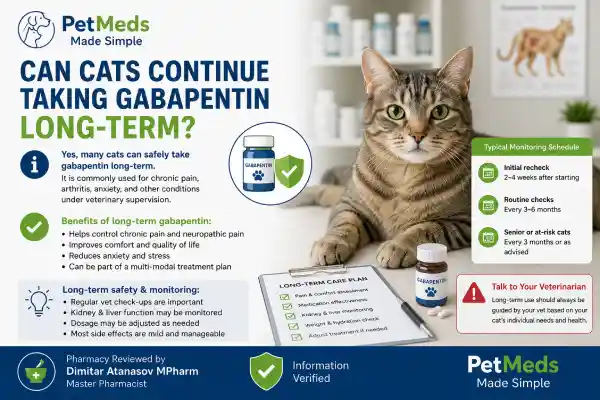
Yes.
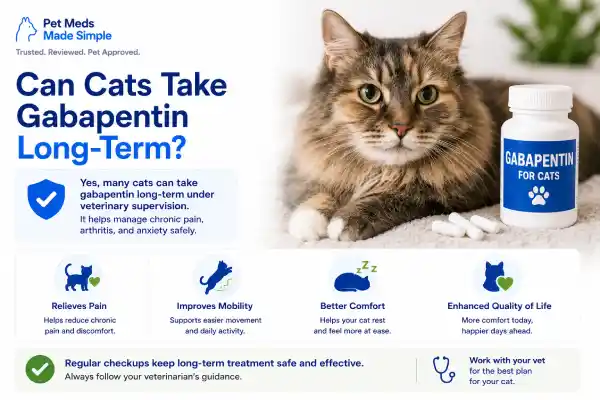
Many cats safely receive gabapentin for months or even years, particularly for chronic pain conditions such as arthritis or neuropathic pain.
Long-term treatment is generally well tolerated when:
- The dose is appropriate.
- Kidney function is monitored when indicated.
- Regular veterinary examinations are performed.
- Appetite and body weight remain stable.
You may also find our article Can Cats Take Gabapentin Long-Term? helpful if your cat is expected to remain on treatment for an extended period.
Related Symptoms Owners Often Notice
Owners searching Why Is My Cat Not Eating After Gabapentin? often notice additional symptoms.
You may also find these PMMS guides helpful:
- Gabapentin for Cats: Uses, Dosage, Side Effects & Safety Guide
- Why Is My Cat Sleepy After Gabapentin?
- Why Is My Cat Wobbly After Gabapentin?
- Why Is My Cat Hiding After Gabapentin?
- Can Gabapentin Cause Vomiting in Cats?
- Can Gabapentin Cause Aggression in Cats?
- Can Gabapentin Cause Anxiety in Cats?
- Can Cats Take Gabapentin Long-Term?
- What Happens If Cats Suddenly Stop Gabapentin?
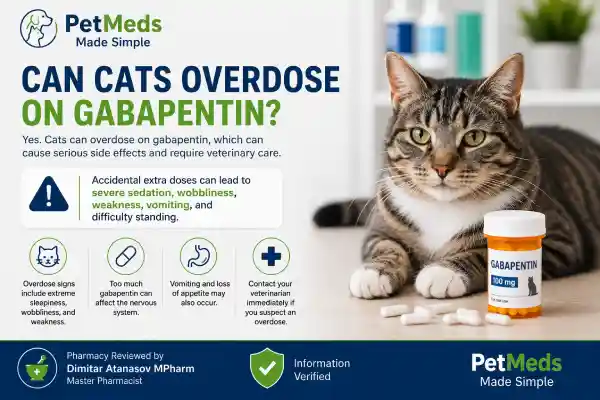
- Can Cats Overdose on Gabapentin?
- Is Human Gabapentin Safe for Cats?
- Can Gabapentin Cause Weak Back Legs in Cats?
Reading these related guides can help you better understand how gabapentin affects cats and when side effects require veterinary attention.
Veterinarian Takeaway
Why Is My Cat Not Eating After Gabapentin? In many cases, temporary appetite loss is related to sedation, mild nausea, or reduced activity caused by the medication. However, gabapentin is often prescribed because a cat already has an underlying medical condition that can also reduce appetite.
Because cats are particularly susceptible to complications from prolonged fasting, owners should monitor food intake closely. If appetite does not return within approximately 24 hours—or if vomiting, severe lethargy, breathing difficulties, or other concerning symptoms develop—a veterinary examination is recommended. Early intervention can prevent more serious complications and help determine whether the medication, dosage, or underlying illness requires adjustment.
Bottom Line
If you’ve been wondering Why Is My Cat Not Eating After Gabapentin?, remember that mild appetite loss can be a temporary effect of the medication, especially when accompanied by sleepiness or wobbliness.
Most cats begin eating normally again as the medication wears off. However, cats should never go prolonged periods without food. Persistent appetite loss, repeated vomiting, severe weakness, or marked behavioral changes should always be evaluated by a veterinarian.
By carefully monitoring your cat, administering gabapentin exactly as prescribed, and maintaining regular communication with your veterinarian, you can help ensure both safe pain management and a healthy recovery.
Frequently Asked Questions – Why Is My Cat Not Eating After Gabapentin
Can gabapentin make my cat stop eating?
Yes, it can. Although appetite loss is not the most common side effect, gabapentin may indirectly reduce your cat’s interest in food by causing sleepiness, mild nausea, or temporary wobbliness. In many cases, appetite returns once the medication wears off.
How long can a cat safely go without eating after taking gabapentin?
Cats should never go without food for an extended period. If your cat refuses all food for 24 hours or longer, contact your veterinarian immediately. Cats are at risk of developing hepatic lipidosis (fatty liver disease), especially if they are overweight.
Should I stop giving gabapentin if my cat won’t eat?
No.
Never stop gabapentin without consulting your veterinarian. Suddenly discontinuing medication may worsen pain or anxiety and could interfere with your cat’s treatment plan. Instead, contact your veterinarian for advice if appetite does not return.
Is it normal for my cat to sleep instead of eating after gabapentin?
Yes.
Sleepiness is the most common side effect of gabapentin in cats. Some cats simply sleep through their normal mealtime and begin eating once they become more alert.
If your cat is difficult to wake, extremely weak, or difficult to rouse, veterinary evaluation is recommended.
Can kidney disease make gabapentin side effects worse?
Yes.
Because gabapentin is eliminated primarily through the kidneys, cats with chronic kidney disease may clear the medication more slowly.
This can increase:
Sleepiness
Wobbliness
Reduced appetite
Recovery time after each dose
Veterinarians often adjust the dosage for cats with reduced kidney function.
Could my cat’s illness be causing the appetite loss instead of gabapentin?
Absolutely.
Many conditions for which gabapentin is prescribed also reduce appetite.
Examples include:
Arthritis
Dental disease
Cancer
Chronic kidney disease
Pancreatitis
Recovery after surgery
Chronic pain
Your veterinarian will consider the entire clinical picture rather than assuming the medication is solely responsible.
Can I tempt my cat to eat?
If your veterinarian has determined your cat is otherwise stable, you may try:
Warming canned food slightly
Offering smaller meals more frequently
Feeding in a quiet room
Placing food close to your cat
Using a veterinary-approved recovery diet
Never force-feed your cat unless instructed by your veterinarian.
When should I call my veterinarian?
Contact your veterinarian promptly if your cat:
Refuses food for more than 24 hours
Vomits repeatedly
Becomes extremely sleepy
Has difficulty standing
Appears dehydrated
Has difficulty breathing
Develops yellow gums or eyes
Seems to worsen after every dose
Early treatment usually leads to better outcomes.
Can cats take gabapentin long-term?
Yes.
Many cats safely take gabapentin for months or years, particularly for chronic pain and arthritis.
Long-term treatment is generally considered safe when:
The correct dose is used.
Kidney function is monitored when appropriate.
Regular veterinary examinations are performed.
Appetite and body weight remain stable.
Will my cat start eating again?
Most cats do.
If appetite loss is caused primarily by temporary sedation, many cats begin eating normally once the medication wears off.
However, if appetite continues to decline or your cat develops additional symptoms, further veterinary evaluation is needed to determine whether another illness or medication adjustment is required.
Sources – Why Is My Cat Not Eating After Gabapentin?
- Plumb’s Veterinary Drug Handbook (10th Edition)
- Merck Veterinary Manual – Analgesic Drugs and Pain Management in Cats
- Merck Veterinary Manual – Feline Hepatic Lipidosis
- BSAVA Small Animal Formulary (11th Edition)
- Small Animal Clinical Pharmacology and Therapeutics
- Veterinary Pharmacology and Therapeutics (10th Edition)
- American Association of Feline Practitioners (AAFP) Feline Pain Management Guidelines
- American Animal Hospital Association (AAHA) Pain Management Guidelines for Dogs and Cats
- International Society of Feline Medicine (ISFM) Consensus Guidelines
- Journal of Feline Medicine and Surgery (JFMS)
- Journal of Veterinary Internal Medicine (JVIM)
- Veterinary Information Network (VIN)
Medical Review Statement
This article was pharmacy-reviewed by Dimitar Georgiev Atanasov, MPharm (Bulgarian Pharmaceutical Union, UIN: 0210000586) and independently veterinary-reviewed by Dr. Valcho Georgiev Valchev, DVM (Bulgarian Veterinary Union, Registration No. 28000115) to ensure medical accuracy, medication safety, and consistency with current veterinary guidelines and evidence-based veterinary medicine.
Important Medical Disclaimer
The information provided on PetMedsMadeSimple.com is intended for educational purposes only and should not replace professional veterinary advice, diagnosis, or treatment.
Loss of appetite in cats should always be taken seriously, especially if it persists for more than 24 hours. Never start, stop, or change your cat’s medication without first consulting your veterinarian. If your cat develops severe lethargy, repeated vomiting, difficulty breathing, collapse, jaundice, or refuses food for an extended period, seek veterinary care immediately.
For more information about how our content is researched, written, and medically reviewed, please visit our Editorial Policy, Medical Review Process, and About Us pages.
Image Disclosure – Why Is My Cat Not Eating After Gabapentin?
Some images used in this article may be AI-generated or AI-assisted for educational purposes. Every article is independently researched, pharmacy-reviewed by Dimitar Georgiev Atanasov, MPharm, and veterinary-reviewed by Dr. Valcho Georgiev Valchev, DVM. AI-generated illustrations are intended to improve understanding of veterinary conditions and medications and do not depict actual clinical patients.