Quick Answer
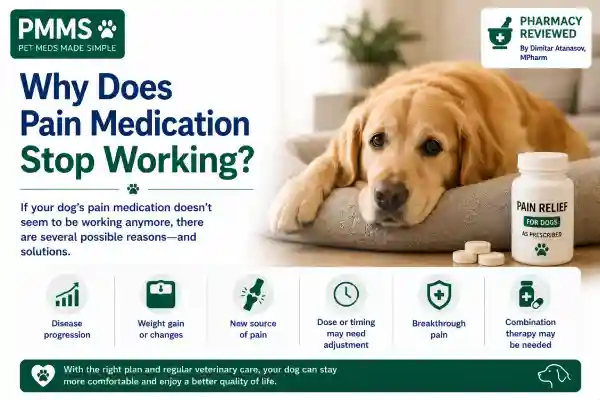
Why does pain medication stop working? In many cases, the medication itself has not actually stopped working. More commonly, the underlying condition has progressed, pain has increased, the dose is no longer sufficient, or a new source of pain has developed. Some dogs may also require medication adjustments or combination therapy over time to maintain effective pain control.
Why does pain medication stop working in dogs?
Pain medication may appear to stop working when the underlying disease progresses, pain becomes more severe, the dosage is no longer adequate, or additional conditions develop. In some cases, dogs may benefit from medication adjustments, multimodal pain management, or further diagnostic evaluation by a veterinarian.
When Owners Commonly Ask This
Many owners notice the same pattern.
At first:
- The medication works well.
- Their dog seems happier.
- Mobility improves.
- Sleeping improves.
- Limping decreases.
Then weeks or months later:
- Limping returns.
- Panting increases.
- Stiffness worsens.
- Activity levels drop.
Naturally, owners begin asking:
“Why does pain medication stop working?”
Fortunately, the answer is often more reassuring than people expect.
Why Does Pain Medication Stop Working?
Does Pain Medication Actually Stop Working?
Sometimes.
But surprisingly, this is not the most common explanation.
In many situations, the medication continues working exactly as intended.
Instead, the disease causing the pain progresses over time.
Common Reality
| Situation | More Common? |
|---|---|
| Medication suddenly stops working | Less Common |
| Disease progresses | Very Common |
| Pain increases | Common |
| Additional treatment needed | Common |
This distinction is important because it affects how veterinarians adjust treatment plans.
Could the Underlying Disease Be Getting Worse?
Very often.
This is probably the most common reason owners believe medication has stopped working.
Conditions that naturally progress include:
- Arthritis
- Hip dysplasia
- Elbow dysplasia
- IVDD
- Cancer
- Degenerative joint disease
As the disease advances, pain levels may increase beyond what the original treatment plan can control.
Owners managing chronic pain often also read:
Can Dogs Take Pain Medication Long-Term?
Best Pain Medication for Dogs with Arthritis
Why Is My Dog Still in Pain After Medication?
Could My Dog Need a Higher Dose?
Sometimes.
As dogs age or conditions change, treatment requirements may change as well.
However, owners should never adjust medication doses without veterinary guidance.
Factors That May Affect Dosing
- Weight changes
- Disease progression
- New medical conditions
- Medication interactions
- Age-related changes
Veterinarians carefully evaluate these factors before making adjustments.
Could My Dog Have Developed a New Source of Pain?
Absolutely.
This is another commonly overlooked possibility.
Many owners focus on the original diagnosis.
However, dogs can develop additional problems such as:
- New arthritis joints
- Muscle injuries
- Dental pain
- Spinal disease
- Soft tissue injuries
In these situations, the medication may still be helping the original problem while a new problem develops.
Can Arthritis Progress Despite Medication?
Yes.
Pain medication helps manage symptoms.
It does not stop arthritis from progressing.
This is one of the most important concepts for dog owners to understand.
What Pain Medication Can Do
- Reduce inflammation
- Improve mobility
- Improve comfort
- Improve quality of life
What Pain Medication Cannot Do
- Reverse arthritis
- Repair damaged cartilage
- Cure degenerative joint disease
This explains why some dogs eventually require treatment adjustments.
Could Weight Gain Make Pain Medication Seem Less Effective?
Definitely.
Even modest weight gain can increase stress on painful joints.
Extra Weight Can Increase
- Joint pressure
- Inflammation
- Mobility challenges
- Arthritis discomfort
This can create the impression that medication has stopped working when body weight is actually contributing to worsening symptoms.
Can Dogs Develop Tolerance to Pain Medication?
Sometimes.
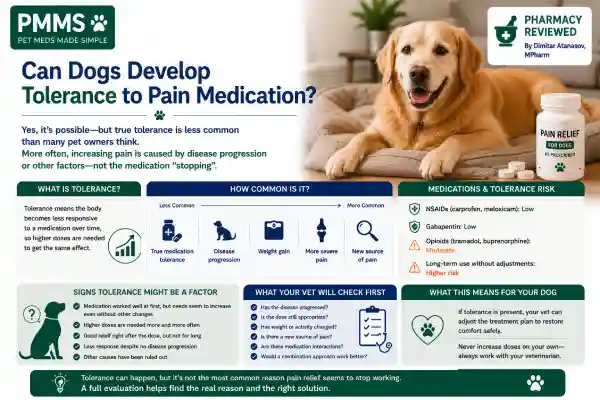
Tolerance means the body becomes less responsive to a medication over time.
However, true tolerance is less common than owners often assume.
More Common Explanations
| Cause | Frequency |
|---|---|
| Disease progression | Very Common |
| Increased pain | Common |
| Weight gain | Common |
| New pain source | Common |
| True medication tolerance | Less Common |
Veterinarians usually investigate other explanations before assuming tolerance has developed.
Could the Medication Be Wearing Off Too Early?
Yes.
Owners often notice:
- Good comfort shortly after a dose
- Worsening symptoms later in the day
This may indicate breakthrough pain.
Signs of Breakthrough Pain
- Panting
- Crying
- Restlessness
- Difficulty sleeping
- Limping
Related reading:
Why Is My Dog Panting After Pain Medication?
Why Is My Dog Crying Even After Pain Medication?
Warning Signs Your Dog Needs Stronger Pain Medication
Could My Dog Need More Than One Medication?
Very often.
Modern veterinary pain management frequently uses a multimodal approach.
This means combining therapies rather than relying on a single medication.
Examples
- NSAID + Gabapentin
- NSAID + Amantadine
- Medication + Physical Therapy
- Medication + Weight Management
Owners may also find useful:
Can Dogs Take Gabapentin and NSAIDs Together? Vet Safety Guide
Amantadine vs Gabapentin for Dogs: Which One Works Better?
Carprofen vs Gabapentin for Dogs: Which One Works Better?
Can Certain Pain Medications Lose Effectiveness Faster?
Yes.
Some medications may appear to lose effectiveness faster than others, although the reason is often more complex than the medication itself.
Factors That Influence Effectiveness
- Severity of the condition
- Duration of treatment
- Individual response
- Body weight changes
- Disease progression
Examples
| Medication Type | Long-Term Effectiveness |
|---|---|
| NSAIDs | Often Good |
| Gabapentin | Often Good |
| Amantadine | Often Used as Add-On |
| Opioids | May Require Adjustments |
| Combination Therapy | Often Most Effective |
Owners comparing medications often read:
Safest Pain Medication for Dogs
Carprofen vs Meloxicam for Dogs: Which NSAID Is Safer and More Effective?
NSAIDs vs Opioids for Dogs: What’s the Difference?
Could Medication Interactions Affect Pain Control?
Absolutely.
Many dogs receive multiple medications at the same time.
Examples include:
- Pain medications
- Anxiety medications
- Seizure medications
- Antibiotics
- Joint supplements
While most combinations are safe when prescribed by a veterinarian, interactions can occasionally affect how well a medication works.
Common Situations
- New medication added
- Dosage changes
- Underlying disease changes
- Supplement use without veterinary guidance
This is why veterinarians always review a complete medication list when pain control changes.
Could My Dog Simply Need a Different Medication?
Sometimes.
Not every dog responds equally well to every medication.
A medication that works extremely well for one dog may provide only modest relief for another.
Reasons Veterinarians Switch Medications
- Inadequate pain control
- Side effects
- Disease progression
- Better alternatives available
Related articles include:
When to Switch Dog Medication (Signs to Watch) (Vet-Backed Guide)
Safest Pain Medication for Dogs
What Is the Safest Anti-Inflammatory for Dogs?
How Veterinarians Evaluate Pain Medication Failure
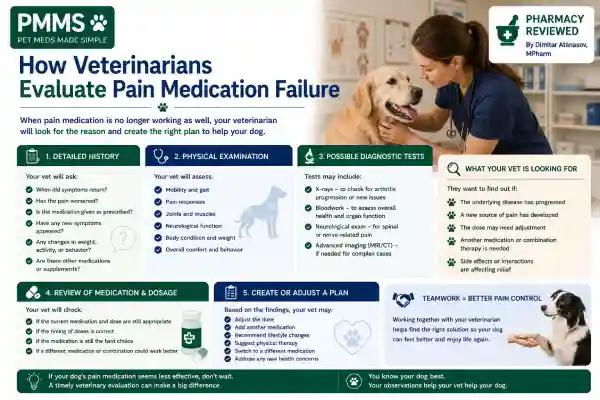
When owners report that treatment is no longer working, veterinarians investigate several possible explanations.
Common Questions
- When did symptoms return?
- Has the condition worsened?
- Has the dose changed?
- Is the dog taking all medications as prescribed?
- Have new symptoms appeared?
Physical Examination
Veterinarians often assess:
- Mobility
- Joint pain
- Muscle condition
- Neurological function
- Body weight
- Overall comfort
Additional Testing
Depending on the situation:
| Test | Purpose |
|---|---|
| X-rays | Evaluate joint progression |
| Bloodwork | Assess overall health |
| Neurological exam | Evaluate nerve function |
| Advanced imaging | Investigate complex cases |
The goal is determining whether:
- The disease progressed
- A new condition developed
- Medication adjustments are needed
Could Lifestyle Changes Help Restore Pain Control?
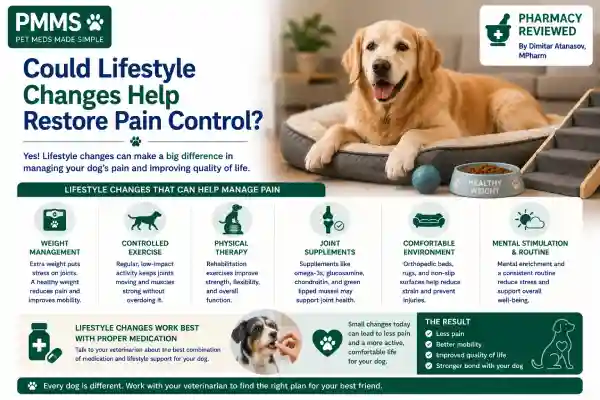
Very often.
Medication is only one part of chronic pain management.
Helpful Non-Medication Strategies
- Weight management
- Controlled exercise
- Physical therapy
- Rehabilitation programs
- Joint supplements
- Environmental modifications
Many dogs experience significant improvement when these approaches are combined with medication.
Related reading:
Natural Pain Relief for Dogs: What Works & What Doesn’t
Best Pain Medication for Dogs with Arthritis
When Should Owners Contact Their Veterinarian?
Owners should contact their veterinarian if:
- Pain symptoms return
- Limping worsens
- Mobility declines
- Panting increases
- Crying returns
- Appetite decreases
- Medication appears ineffective
Early intervention often prevents further deterioration.
When Does Loss of Pain Control Become an Emergency?
Most cases are not emergencies.
However, some situations require immediate veterinary attention.
Severe Pain
Signs may include:
- Constant vocalization
- Inability to rest
- Refusal to move
Sudden Inability to Walk
This may indicate:
- Neurological disease
- Severe orthopedic injury
- Spinal problems
Severe Weakness
Unexpected weakness should always be evaluated promptly.
Emergency Warning Signs
| Symptom | Emergency? |
|---|---|
| Mild limping | Usually No |
| Increased stiffness | Contact Vet |
| Persistent pain | Contact Vet |
| Inability to stand | Yes |
| Collapse | Yes |
| Severe pain | Yes |
| Difficulty breathing | Yes |
| Unresponsiveness | Yes |
Related Symptoms Owners Often Search For
Owners searching Why Does Pain Medication Stop Working? frequently search for related concerns.
Persistent Pain
Related reading:
Why Is My Dog Still in Pain After Medication?
Crying
Many dogs vocalize when pain increases.
Related reading:
Why Is My Dog Crying Even After Pain Medication?
Panting
Pain commonly causes:
- Panting
- Restlessness
- Difficulty sleeping
Related reading:
Why Is My Dog Panting After Pain Medication?
Long-Term Treatment
Owners often wonder:
Can Dogs Take Pain Medication Long-Term?
Anxiety
Some dogs become restless when pain increases.
Related reading:
Can Pain Medication Cause Anxiety in Dogs?
Medication Adjustments
Owners frequently search:
What to Do If Dog Medication Is Not Working
Warning Signs Your Dog Needs Stronger Pain Medication
Bottom Line
Why does pain medication stop working? In many cases, it doesn’t actually stop working. More commonly, the underlying disease progresses, pain increases, a new source of pain develops, or treatment adjustments become necessary. Chronic conditions such as arthritis naturally worsen over time, meaning a medication that worked well initially may eventually need support from additional therapies or dosage changes.
The key is recognizing the change early and discussing it with your veterinarian.
Veterinarian Takeaway
When owners feel that pain medication has stopped working, the medication is often not the true problem. Disease progression, increased pain, weight gain, new medical conditions, and breakthrough pain are far more common explanations. Regular veterinary evaluations, monitoring, and individualized treatment plans help maintain long-term comfort and quality of life for dogs with chronic pain.
Frequently Asked Questions – Why Does Pain Medication Stop Working?
Why does pain medication stop working in dogs?
Most often because the underlying disease progresses rather than the medication completely losing effectiveness.
Can dogs develop tolerance to pain medication?
Yes, but true tolerance is less common than disease progression.
Can arthritis get worse even with medication?
Absolutely. Medication controls symptoms but does not cure arthritis.
Does weight gain affect pain control?
Yes. Extra weight increases stress on joints and may worsen pain.
Can my dog need a stronger medication later?
Sometimes. Treatment plans often require adjustments over time.
Could another condition be causing the pain?
Yes. Dogs can develop new orthopedic, neurological, or medical problems.
Can veterinarians combine medications?
Yes. Multimodal pain management is extremely common.
When should I contact my veterinarian?
If symptoms return, worsen, or new concerns develop.
Can physical therapy help?
Yes. Many dogs benefit from rehabilitation and exercise programs.
When is loss of pain control an emergency?
Seek immediate veterinary care for collapse, inability to stand, severe pain, breathing difficulties, or unresponsiveness.
Reviewed By
Pharmacy Reviewed By
Dimitar Atanasov, MPharm
Master Pharmacist | Medication Safety Educator
Editorial Policy
At Pet Meds Made Simple, we are committed to providing accurate, evidence-based information about pet medications, veterinary treatments, medication safety, and common health concerns affecting dogs and cats.Why Does Pain Medication Stop Working?
For more information, see our Editorial Policy:
Sources
- Plumb’s Veterinary Drug Handbook
- American Animal Hospital Association (AAHA)
- American Veterinary Medical Association (AVMA)
- Merck Veterinary Manual
- Veterinary Pharmacology and Therapeutics
- Small Animal Clinical Pharmacology
- Journal of the American Veterinary Medical Association (JAVMA)
- Frontiers in Veterinary Science
- Veterinary Anaesthesia and Analgesia
- Veterinary Information Network (VIN)
Medical Review Statement
This article was pharmacy-reviewed by Dimitar Atanasov, MPharm, Master Pharmacist, using current veterinary pharmacology references, canine pain-management guidelines, and published veterinary literature available at the time of review.Why Does Pain Medication Stop Working?
images created with AI – Why Does Pain Medication Stop Working?