
Quick Answer
Can dogs build tolerance to pain medication? Yes, but only with certain medications. True medication tolerance is well recognized with opioid pain medications and may occasionally occur with drugs like tramadol or gabapentin. However, most dogs receiving NSAIDs such as carprofen or meloxicam do not develop true tolerance. More commonly, owners notice worsening pain because the underlying disease has progressed, a new medical problem has developed, or the current treatment plan is no longer sufficient. If your dog seems less comfortable despite taking medication exactly as prescribed, your veterinarian should evaluate the cause before any medication changes are made.
When Owners Commonly Ask This Question
Many owners begin searching “Can dogs build tolerance to pain medication?” after noticing changes like:
- “The medication used to work much better.”
- “My dog is limping again.”
- “Pain seems to return before the next dose.”
- “My senior dog is struggling to stand.”
- “Should my veterinarian increase the dose?”
These concerns are understandable, but true medication tolerance is only one possible explanation.
Can Dogs Build Tolerance to Pain Medication?
What Does Medication Tolerance Mean?
When discussing chronic pain management, veterinarians use the term tolerance to describe a situation where the body gradually becomes less responsive to a medication after repeated exposure. As tolerance develops, the same dose no longer produces the same degree of pain relief.
Many owners assume this automatically means the medication has “stopped working.”
In reality, that is rarely the full story.
When owners ask “Can dogs build tolerance to pain medication?”, veterinarians also consider several other possibilities before concluding that true tolerance has developed.
For example, if you’ve already read our guide Why Does Pain Medication Stop Working?, you’ll know that worsening arthritis, progression of spinal disease, or an incorrect diagnosis are often much more likely explanations than true medication tolerance.
Understanding the difference is important because every cause requires a different treatment strategy.
Can Dogs Build Tolerance to Pain Medication?
Yes—but not every medication behaves the same way.
Some pain medications interact directly with receptors inside the brain and spinal cord. Over time, those receptors may become less responsive, causing the medication to provide less pain relief.
Other medications work by reducing inflammation rather than changing how pain is processed by the nervous system. These medications are much less likely to produce true tolerance.
This distinction explains why the answer to “Can dogs build tolerance to pain medication?” depends largely on which medication your dog is taking.
Which Pain Medications Can Cause Tolerance?
| Medication | Can Tolerance Develop? | Risk |
|---|---|---|
| Carprofen | Rare | Low |
| Meloxicam | Rare | Low |
| Deracoxib | Rare | Low |
| Gabapentin | Sometimes | Moderate |
| Tramadol | Possible | Moderate |
| Morphine | Yes | High |
| Fentanyl | Yes | High |
| Hydromorphone | Yes | High |
| Amantadine | No | Very Low |
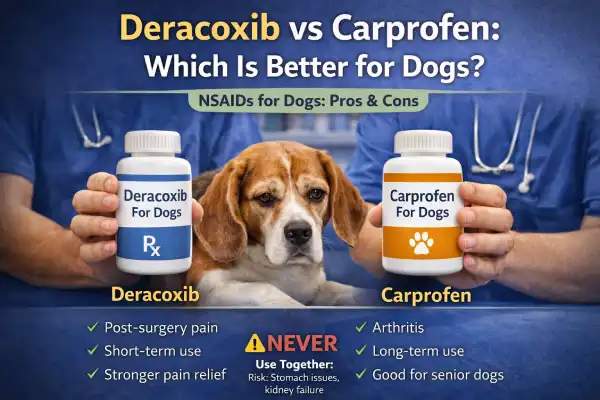
Many owners are surprised that NSAIDs such as carprofen rarely cause true medication tolerance.
If your dog’s arthritis medication appears less effective after several months, your veterinarian is much more likely to suspect disease progression than medication tolerance.
Our article How Long Does Carprofen Stay in a Dog’s System? explains why the duration of action of a medication is completely different from developing tolerance over time.
Why Owners Think Their Dog Has Developed Tolerance
One of the biggest challenges in veterinary medicine is that chronic pain naturally changes over time.
Owners often notice their dog slowing down and immediately wonder:
“Has my dog built tolerance to pain medication?”
Sometimes the answer is yes.
Most of the time, however, something else is happening.
The Disease Is Getting Worse
This is the most common explanation.
Arthritis, hip dysplasia, elbow dysplasia, degenerative joint disease, and intervertebral disc disease (IVDD) continue to progress even while medication helps control pain.
As joints become more damaged, inflammation increases.
The medication may still be working exactly as expected—it simply has more pain to control than it did six months earlier.
Owners frequently notice:
- stiffness after sleeping
- difficulty climbing stairs
- slower walks
- reluctance to jump
- limping after exercise
These signs often indicate progression of disease rather than medication tolerance.
If your dog seems uncomfortable despite treatment, you may also find our article Why Is My Dog Not Improving on Pain Medication? helpful because it explains several other reasons recovery may stall.
Your Dog May Have Another Source of Pain
Dogs, especially senior dogs, commonly suffer from more than one painful condition.
For example, a dog receiving medication for arthritis may later develop:
- a cruciate ligament tear
- spinal arthritis
- dental disease
- pancreatitis
- muscle injury
- nerve compression
The medication continues treating the original arthritis, but it cannot relieve pain from a completely different condition.
Veterinarians therefore perform a complete examination rather than immediately increasing the medication dose.
The Medication Never Fully Controlled the Pain
Many owners mistake improvement for complete pain control.
Their dog becomes more active.
Walks become longer.
The dog begins playing again.
Eventually the remaining pain becomes noticeable.
Owners then assume the medication has “stopped working.”
In reality, the medication was helping—but it never completely eliminated the underlying pain.
Dogs showing this pattern often develop signs discussed in our article Warning Signs Your Dog Needs Stronger Pain Medication, where we explain when treatment adjustments may be necessary.
Tolerance Is Not the Same as Resistance
These terms are often confused.
They actually describe two completely different biological processes.
| Tolerance | Resistance |
|---|---|
| Body gradually responds less to medication | Medication cannot affect its target properly |
| Seen with some pain medications | Common with antibiotics |
| May improve by adjusting treatment | Often requires a different medication |
| Develops gradually | Depends on the underlying cause |
Veterinarians almost always discuss tolerance, not resistance, when evaluating chronic pain medications.
Which Dogs Have a Higher Risk?
Although any dog receiving long-term pain treatment should be monitored regularly, some patients are more likely to require medication adjustments over time.
Higher-risk groups include:
- senior dogs
- dogs with advanced osteoarthritis
- dogs with cancer
- dogs with chronic neurological disease
- dogs recovering from major orthopedic surgery
- dogs requiring opioid therapy
These dogs usually receive regular recheck examinations to ensure their pain remains well controlled.
If your dog has already been taking medication for months, you may also benefit from reading Can Dogs Take Pain Medication Long-Term?, where we discuss long-term safety, monitoring, and expected veterinary follow-up.
Can NSAIDs Stop Working?
This is one of the most common questions veterinarians hear.
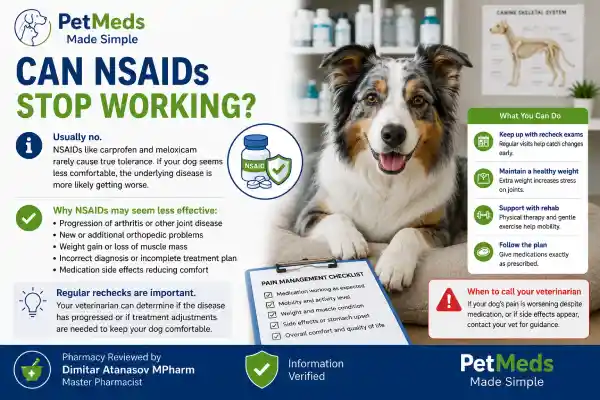
Fortunately, the answer is usually no.
NSAIDs such as:
- Carprofen
- Meloxicam
- Deracoxib
- Firocoxib
reduce inflammation by blocking cyclooxygenase (COX) enzymes.
Unlike opioids, they do not primarily work by stimulating receptors within the brain.
Because of this mechanism, true medication tolerance is uncommon.
If your dog’s NSAID seems less effective, veterinarians usually investigate:
- progression of arthritis
- obesity
- muscle loss
- ligament injury
- spinal disease
- incorrect diagnosis
- medication compliance
before concluding that tolerance has developed.
Likewise, long-term NSAID therapy requires monitoring for potential side effects. For example, our guide Can Meloxicam Cause Kidney Damage in Dogs? explains why kidney function should be evaluated during prolonged treatment, while Can Pain Medication Cause Stomach Bleeding in Dogs? discusses gastrointestinal complications that owners should never ignore.
What About Gabapentin?
Gabapentin is different from NSAIDs because it mainly treats neuropathic (nerve) pain.
Some dogs appear to respond less well after prolonged treatment.
However, veterinarians must determine whether this represents:
- worsening spinal disease,
- progression of nerve damage,
- increasing arthritis,
- or genuine medication tolerance.
If your veterinarian recommends adding gabapentin to your dog’s treatment plan, our articles How Fast Does Gabapentin Work in Dogs? and Can Gabapentin Cause Weakness in Dogs? explain what owners can expect during treatment and which side effects should be monitored.
Is Tramadol Different?
Yes.
Years ago, tramadol was one of the most commonly prescribed pain medications for dogs.
Today, veterinarians understand that dogs metabolize tramadol differently from humans, meaning its pain-relieving effects can be much less predictable.
When owners believe tramadol has stopped working, veterinarians often ask whether the medication was providing adequate pain relief in the first place.
Our detailed guide Is Tramadol Still Recommended for Dogs? explains why veterinary recommendations have changed over the past decade and which alternatives may provide better long-term pain control.
How Do Veterinarians Determine Whether Tolerance Has Developed?
There is no single blood test or X-ray that confirms medication tolerance.
Instead, veterinarians perform a complete assessment to determine Why Is My Dog Not Improving on Pain Medication?
During the appointment, your veterinarian will often ask questions such as:
- When did the medication seem less effective?
- Has the pain become worse gradually or suddenly?
- Does the medication still help for a few hours?
- Has your dog’s activity level changed?
- Has your dog gained weight?
- Have any doses been missed?
- Are there any new symptoms?
A thorough physical examination is usually followed by additional diagnostics if necessary.
These may include:
- Orthopedic examination
- Neurological examination
- Blood work
- X-rays
- Joint evaluation
- Advanced imaging (CT or MRI)
- Pain scoring
Only after ruling out disease progression and other medical conditions will a veterinarian consider true medication tolerance.
Can Increasing the Dose Solve the Problem?
Not always.
Many owners assume that if the medication seems less effective, simply increasing the dose will restore pain relief.
Unfortunately, this can sometimes create far more serious problems.
Increasing the dose without veterinary supervision may increase the risk of:
- Kidney injury
- Liver damage
- Gastrointestinal ulcers
- Stomach bleeding
- Excessive sedation
- Weakness
- Difficulty walking
- Medication overdose
For NSAIDs especially, increasing the dose above the recommended range can be dangerous.
If you’ve ever wondered whether stronger medication is necessary, our article Warning Signs Your Dog Needs Stronger Pain Medication explains the situations where veterinarians may recommend adjusting treatment instead of simply increasing the dosage.
What If My Dog Is Still in Pain?
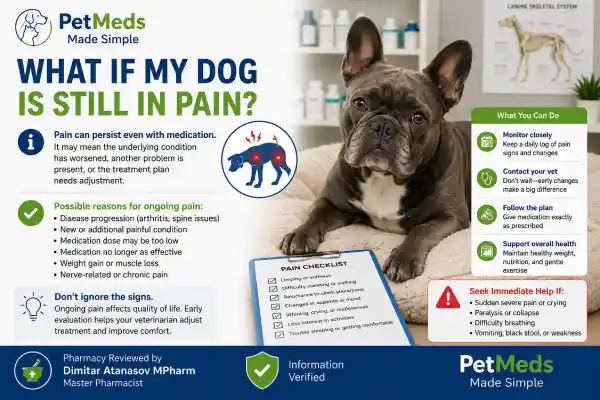
If your dog continues to struggle despite treatment, don’t automatically assume the medication has failed.
Ask yourself several questions.
- Is my dog limping more?
- Is the stiffness worse only in the morning?
- Is my dog refusing walks?
- Does my dog cry when standing?
- Has my dog stopped jumping onto furniture?
These changes often indicate progression of the underlying disease.
If your dog continues limping despite medication, our guide Why Is My Dog Still Limping After Medication? discusses the most common reasons mobility may not improve.
Likewise, if your dog seems painful even after taking every dose correctly, you may also find Why Is My Dog Still in Pain After Medication? useful because it explains several medical conditions that can mimic medication failure.
Why Veterinarians Often Add Another Medication Instead of Increasing One
Modern pain management rarely relies on a single medication.
Instead, veterinarians use multimodal pain management, meaning several therapies work together to control pain through different mechanisms.
Rather than simply increasing one medication, your veterinarian may recommend combining:
- NSAIDs
- Gabapentin
- Amantadine
- Joint supplements
- Physical rehabilitation
- Controlled exercise
- Weight management
- Laser therapy
- Hydrotherapy
This approach often provides better pain relief while reducing the risk of side effects associated with high doses of one drug.
If your veterinarian recommends adding gabapentin, you may also want to read How Fast Does Gabapentin Work in Dogs? to understand when improvement should be expected.
Why Is Amantadine Sometimes Added?
Many owners are surprised when their veterinarian prescribes amantadine together with another pain medication.
Unlike NSAIDs or opioids, amantadine works by blocking NMDA receptors, which are involved in chronic pain sensitization.
This means amantadine doesn’t simply replace another medication—it helps improve the effectiveness of the overall pain management plan.
For dogs with advanced arthritis, veterinarians frequently add amantadine when NSAIDs alone no longer provide sufficient comfort.
Our article Can Amantadine Be Used for Arthritis in Dogs? explains this treatment strategy in greater detail.
Could Weight Gain Make Medication Seem Less Effective?
Absolutely.
One of the most overlooked reasons owners believe dogs build tolerance to pain medication is simple weight gain.
Even a few extra pounds place additional stress on painful joints.
As body weight increases:
- Joint inflammation worsens.
- Mobility decreases.
- Exercise becomes more difficult.
- Arthritis progresses faster.
- Pain appears to increase despite medication.
Weight management remains one of the most effective long-term treatments for canine arthritis.
Can Muscle Loss Affect Pain Control?
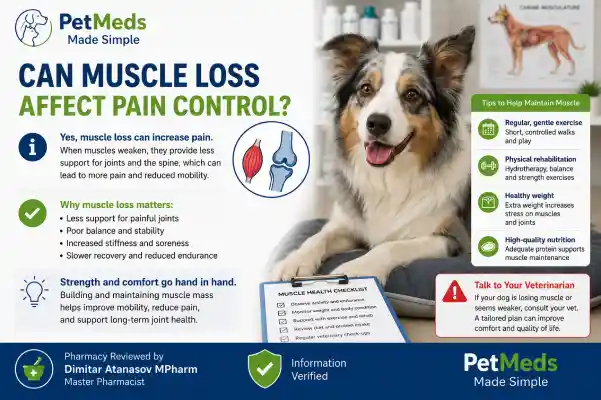
Yes.
Dogs with chronic orthopedic disease often become less active.
As activity decreases, muscle mass gradually declines.
Weak muscles provide less support for painful joints, making movement more difficult even if the medication continues working.
Veterinarians commonly recommend:
- Controlled leash walks
- Physical therapy
- Underwater treadmill therapy
- Strengthening exercises
- Home rehabilitation programs
Improving muscle strength often improves mobility without changing the medication at all.
Home Checklist: Is Your Dog’s Pain Really Getting Worse?
Before your next veterinary visit, monitor your dog’s condition for several days.
| Sign | Check Daily |
|---|---|
| Limping | ✔ |
| Difficulty standing | ✔ |
| Climbing stairs | ✔ |
| Jumping | ✔ |
| Appetite | ✔ |
| Sleeping comfortably | ✔ |
| Panting at rest | ✔ |
| Crying or whining | ✔ |
| Activity level | ✔ |
| Medication side effects | ✔ |
Keeping a simple daily record often helps your veterinarian determine whether your dog’s condition is truly changing or simply fluctuating from day to day.
When Should Owners Contact Their Veterinarian?
Arrange a veterinary appointment if your dog:
- Appears increasingly painful.
- Stops enjoying walks.
- Develops new limping.
- Cries when moving.
- Becomes reluctant to stand.
- Begins refusing food.
- Develops vomiting or diarrhea after medication.
- Shows weakness or difficulty walking.
- Seems less comfortable for several weeks despite treatment.
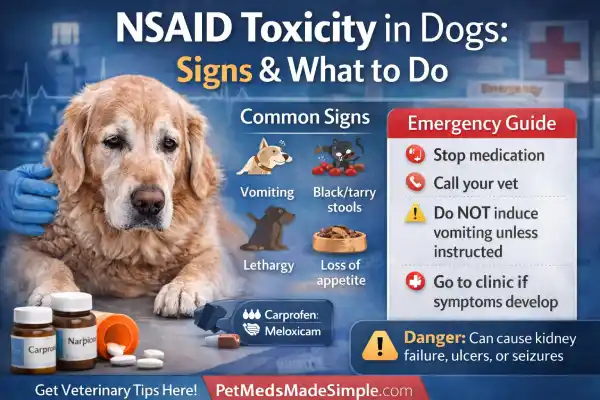
Owners should never increase medication doses without professional advice.
If your dog develops loss of appetite while taking pain medication, don’t assume it’s related to tolerance. Our guide Can Pain Medication Cause Loss of Appetite in Dogs? explains why decreased appetite should always be investigated.
Emergency Warning Signs
Seek immediate veterinary care if your dog develops:
- Collapse
- Difficulty breathing
- Vomiting blood
- Black or tarry stools
- Severe weakness
- Sudden paralysis
- Continuous crying
- Seizures
- Inability to stand
- Suspected medication overdose
These signs suggest a medical emergency—not simple medication tolerance.
If your dog accidentally receives the wrong medication, our article Can Dogs Take Ibuprofen Instead of Carprofen? explains why certain human pain medications can be extremely dangerous.
Veterinarian Takeaway
Although owners frequently ask “Can dogs build tolerance to pain medication?”, true medication tolerance is less common than most people think. In the majority of dogs receiving NSAIDs, worsening pain reflects progression of arthritis, another orthopedic problem, weight gain, or an underlying medical condition rather than the medication suddenly becoming ineffective. Never increase your dog’s medication dose without veterinary guidance. A re-evaluation allows your veterinarian to identify the real cause and recommend the safest long-term pain management strategy.
Bottom Line
Can dogs build tolerance to pain medication? Yes—but only certain medications commonly produce true tolerance.
Opioids carry the greatest risk, while NSAIDs such as carprofen and meloxicam rarely lose effectiveness because of true physiological tolerance.
In most dogs, increasing pain is caused by progression of arthritis, spinal disease, cancer, obesity, or another medical problem rather than the body becoming “immune” to the medication.
Fortunately, veterinarians have many options available, including multimodal pain management, rehabilitation, weight control, and additional medications when appropriate.
With regular monitoring and individualized treatment, many dogs with chronic pain continue enjoying an active and comfortable life for years.
Frequently Asked Questions – Can Dogs Build Tolerance to Pain Medication
Can dogs build tolerance to pain medication?
Yes. Some medications, particularly opioids, may cause tolerance over time. NSAIDs rarely do.
Does carprofen stop working after long-term use?
Usually not. Most dogs that seem less responsive are experiencing progression of their underlying disease rather than medication tolerance.
Can gabapentin become less effective?
Sometimes. However, worsening neurological disease is often responsible instead of true tolerance.
Is tramadol still effective for dogs?
Research suggests tramadol is less effective in dogs than previously believed, which is why veterinarians increasingly use other pain management strategies.
Should I increase my dog’s medication dose?
No. Dose changes should always be made by your veterinarian.
Why is my dog still painful despite medication?
Possible causes include disease progression, another painful condition, incorrect diagnosis, insufficient pain control, or, less commonly, medication tolerance.
Can weight gain make pain medication seem less effective?
Yes. Extra weight increases stress on joints and may worsen arthritis.
What is multimodal pain management?
It is the use of multiple treatments that target pain through different mechanisms, improving pain control while reducing side effects.
How often should dogs receiving long-term pain medication be monitored?
Your veterinarian will recommend regular rechecks, especially for senior dogs or those receiving NSAIDs for extended periods.
When should I seek emergency veterinary care?
Immediately if your dog collapses, develops breathing difficulty, vomits blood, passes black stools, experiences paralysis, or shows signs of medication overdose
Sources
- Plumb’s Veterinary Drug Handbook
- Merck Veterinary Manual
- AAHA Pain Management Guidelines for Dogs and Cats
- WSAVA Global Pain Council Guidelines
- Veterinary Pharmacology and Therapeutics
- Small Animal Clinical Pharmacology
- JAVMA
- Frontiers in Veterinary Science
- Veterinary Anaesthesia and Analgesia
- VIN (Veterinary Information Network)
Medical Review Statement
This article was pharmacy-reviewed by Dimitar Georgiev Atanasov, MPharm, and veterinary-reviewed by Dr. Valcho Georgiev Valchev, DVM. It is intended for educational purposes only and should not replace individualized veterinary diagnosis, treatment, or medical advice.
Important Medical Disclaimer
The information provided on PetMedsMadeSimple.com is for educational purposes only and is not intended to diagnose, treat, cure, or prevent any disease. Always consult your veterinarian before starting, stopping, or changing any medication or supplement. Never adjust your dog’s medication dosage without professional guidance.
Image Disclosure
Some illustrations on PetMedsMadeSimple.com may be created or enhanced using artificial intelligence (AI) to support educational content. All medical information, medication safety guidance, and veterinary recommendations in this article are independently researched, pharmacy-reviewed by Dimitar Georgiev Atanasov, MPharm, and veterinary-reviewed by Dr. Valcho Georgiev Valchev, DVM. Images are intended for educational illustration only and should not be used as a substitute for professional veterinary examination or diagnosis.