Quick Answer
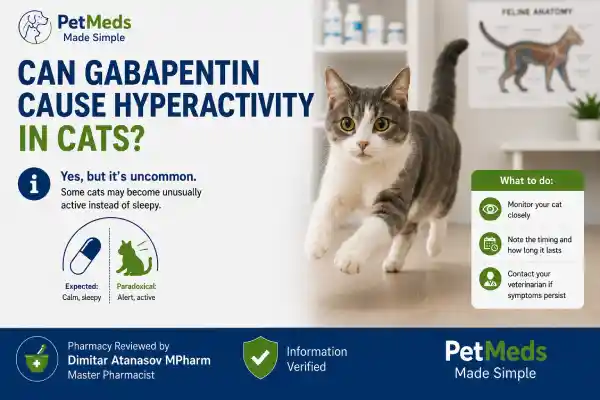
Can gabapentin cause hyperactivity in cats? Yes, but it is uncommon. Most cats become sleepy, quieter, and less reactive after taking gabapentin. However, a small number experience the opposite reaction, becoming unusually energetic, restless, vocal, or even hyperactive. Veterinarians refer to this as a paradoxical reaction, meaning the medication produces the opposite of the expected effect.
In many cases, the behavior is temporary and improves as the medication wears off. However, persistent hyperactivity, severe agitation, or signs of neurological illness should always be discussed with your veterinarian.
Why Do Most Cats Become Sleepy Instead?
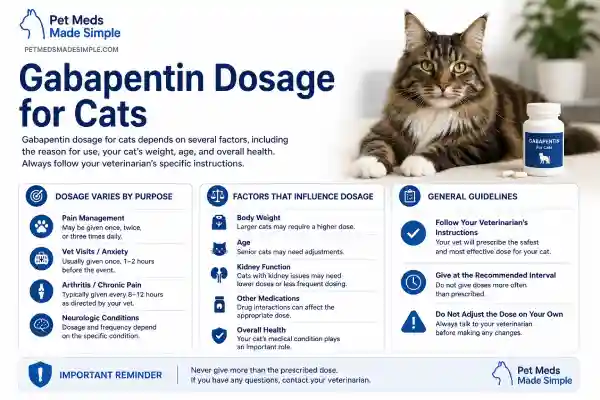
Gabapentin is primarily prescribed to cats for:
- Reducing anxiety before veterinary visits
- Managing chronic pain
- Treating certain neurological conditions
- Helping cats remain calmer during travel
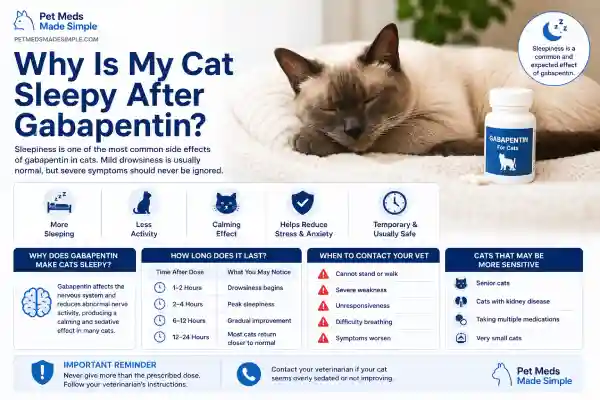
Because gabapentin decreases nerve excitability, sleepiness is by far the most common side effect.
Many owners actually become worried because their normally active cat suddenly sleeps for most of the day. If you’ve experienced that situation, our guide Why Is My Cat Sleepy After Gabapentin? explains why this usually happens and when excessive sleepiness requires veterinary attention.
For that reason, owners are often surprised when their cat reacts in exactly the opposite way.
Can Gabapentin Cause Hyperactivity in Cats?
Can Gabapentin Really Make Some Cats Hyperactive?
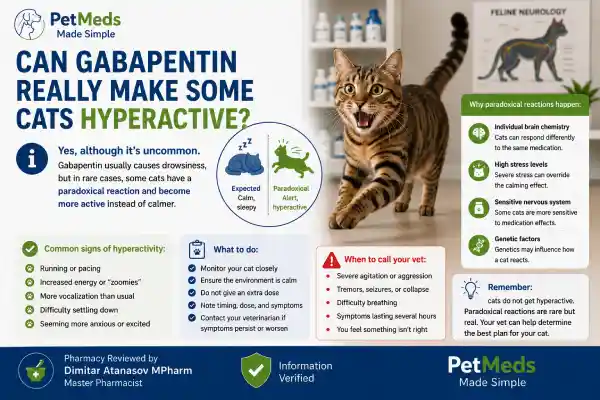
Yes.
Although uncommon, veterinarians occasionally see cats that become:
- Extremely active
- Restless
- Unable to settle
- More vocal than usual
- Constantly pacing
- Running through the house
- Jumping on furniture repeatedly
- Acting unusually excited
Owners sometimes describe it like this:
“I gave the medication because I expected my cat to relax, but instead she started racing around the house.”
That type of description often suggests a paradoxical response rather than a typical side effect.
What Is a Paradoxical Reaction?
A paradoxical reaction occurs when a medication causes the opposite of its expected effect.
Instead of causing calmness, gabapentin may occasionally produce:
| Expected Effect | Paradoxical Effect |
|---|---|
| Calmness | Restlessness |
| Sleepiness | Hyperactivity |
| Relaxation | Agitation |
| Reduced movement | Constant pacing |
| Quiet behavior | Increased vocalization |
These reactions are uncommon but well recognized with several medications that affect the nervous system.
Fortunately, they are usually temporary.
Why Does This Happen?
Researchers still don’t fully understand why a small percentage of cats respond differently.
Several factors are believed to contribute.
Individual Brain Chemistry
No two cats process medications in exactly the same way.
Small differences in brain chemistry may explain why one cat becomes deeply relaxed while another appears unusually energetic.
Individual Sensitivity
Some cats are naturally far more sensitive to medications affecting the central nervous system.
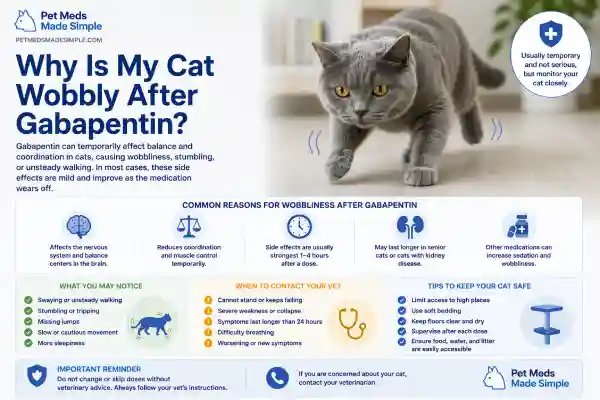
This sensitivity may also explain why certain cats develop wobbliness or drooling after taking gabapentin. If you’ve noticed either symptom, our articles Why Is My Cat Wobbly After Gabapentin? and Why Is My Cat Drooling After Gabapentin? explain what owners should expect and when veterinary care is recommended.
Stress May Mask the Medication’s Effects
One of the most interesting situations veterinarians encounter is the highly anxious cat visiting the clinic.
Owners sometimes say:
“The gabapentin didn’t work at all.”
However, after asking more questions, the veterinarian discovers something different.
The cat was still frightened—but instead of hiding, it responded by moving constantly, vocalizing, and trying to escape.
In these cases, the behavior may reflect fear combined with the medication, rather than true hyperactivity caused solely by gabapentin.
Is Hyperactivity More Common After the First Dose?
It can be.
The first dose is often unpredictable because neither the owner nor the veterinarian knows exactly how that individual cat will respond.
Some cats become sleepy within an hour.
Others appear almost unaffected.
A small percentage may briefly become unusually active before eventually settling down.
Because of this variability, many veterinarians recommend giving the first dose at home on a quiet day whenever possible rather than immediately before an important veterinary appointment.
How Soon Can Hyperactivity Begin?
Most behavioral changes occur relatively soon after administration.
| Time After Giving Gabapentin | What Owners May Notice |
|---|---|
| 30–60 minutes | Early behavioral changes |
| 1–3 hours | Peak medication effects |
| 4–8 hours | Most side effects begin improving |
| Later the same day | Many cats gradually return to normal |
The exact timing varies depending on:
- Dose
- Age
- Kidney function
- Concurrent medications
- Individual metabolism
Could the Dose Be Too Low?
Interestingly, some owners assume hyperactivity means the medication “isn’t working.”
That isn’t always true.
A cat may still receive the correct dose but simply experience an uncommon paradoxical response.
On the other hand, if gabapentin was prescribed to reduce anxiety before a veterinary visit and the cat remains extremely reactive, your veterinarian may decide that a different dosing schedule—or, in some cases, a different medication is more appropriate.
Which Cats May Be More Likely to Experience Hyperactivity?
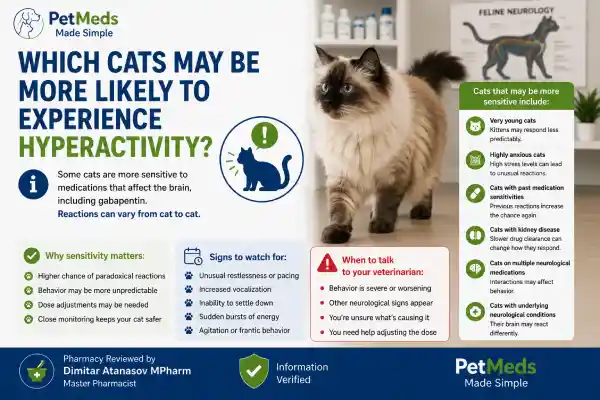
Although predicting this reaction is difficult, veterinarians often pay closer attention to:
- Very young cats
- Highly anxious cats
- Cats with previous medication sensitivities
- Cats receiving multiple neurological medications
- Cats with underlying neurological disease
These cats don’t necessarily develop hyperactivity, but they may respond less predictably to medications affecting the brain.
Is Hyperactivity Dangerous?
Usually, no.
For most cats, the behavior is temporary and resolves as the medication is metabolized.
However, if hyperactivity is accompanied by:
- Repeated falling
- Tremors
- Seizures
- Collapse
- Difficulty breathing
- Continuous vocalization that cannot be interrupted
- Aggression toward people or other pets
the cat should be examined by a veterinarian as soon as possible.
Can Gabapentin Cause “Zoomies” in Cats?
Owners often don’t describe the behavior as hyperactivity.
Instead, they say things like:
- “My cat has the zoomies.”
- “She’s running around like crazy.”
- “He can’t settle down.”
- “She keeps racing from room to room.”
- “He’s acting like a kitten again.”
Although these descriptions sound alarming, they don’t always indicate a medical emergency.
Veterinarians first try to determine whether the cat is actually hyperactive or simply responding to excitement, stress, or environmental stimulation.
For example, some cats become energetic after returning home from a stressful veterinary visit. Once the fear begins to fade, they may suddenly release pent-up energy by running through the house.
In these situations, the behavior may not be caused entirely by gabapentin.
Hyperactivity or Anxiety?
One of the most challenging parts of evaluating behavior after gabapentin is distinguishing true hyperactivity from ongoing anxiety.
Although the two can look similar, they often have different causes.
| Hyperactivity | Anxiety |
|---|---|
| Running without obvious triggers | Constant scanning of surroundings |
| Curious and playful | Fearful and tense |
| Interested in toys | Trying to hide |
| Normal appetite | May refuse food |
| Easily distracted | Remains focused on perceived threats |
Owners sometimes assume their cat is “wired” after gabapentin when, in reality, the medication reduced inhibition just enough for an already frightened cat to express its anxiety more openly.
If your cat received gabapentin before a veterinary appointment but still appeared frightened afterward, our article Does Gabapentin Always Calm Cats? explains why responses can vary between individuals.
Could Stress Be Making the Behavior Worse?
Absolutely.
Stress changes how the brain responds to many medications.
Imagine a cat that:
- Dislikes traveling.
- Hates the carrier.
- Becomes frightened in the waiting room.
- Encounters unfamiliar smells and animals.
Even after receiving gabapentin, that level of stress may still overwhelm the medication’s calming effects.
Veterinarians often remind owners that gabapentin reduces anxiety—it doesn’t erase fear completely.
Because of that, a highly stressed cat may appear restless despite receiving an appropriate dose.
Could Pain Make a Cat Seem Hyperactive?
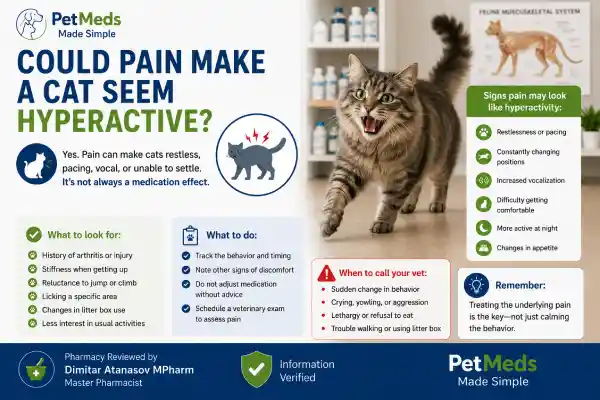
Surprisingly, yes.
Pain doesn’t always cause cats to become quiet.
Some painful cats become:
- Restless
- Unable to get comfortable
- Constantly changing sleeping locations
- Walking around the house repeatedly
- Vocalizing more than usual
Owners may mistake this behavior for hyperactivity when the underlying problem is discomfort.
If gabapentin was prescribed for chronic pain but your cat still seems unusually restless, your veterinarian may reassess whether the pain is being adequately controlled.
Could Another Medication Be Responsible?
Sometimes gabapentin isn’t the only medication involved.
Your veterinarian will ask whether your cat is also receiving:
- Opioid pain medications
- Sedatives
- Anti-anxiety medications
- Corticosteroids
- Appetite stimulants
- Other neurological medications
Drug interactions don’t always cause hyperactivity, but they can sometimes change how a cat behaves.
Providing a complete medication list helps your veterinarian determine whether another drug may be contributing.
Does Age Affect the Risk?
Yes.
Age influences how cats metabolize many medications.
Kittens
Young cats sometimes respond less predictably because their nervous systems are still developing.
Adult Cats
Most healthy adults experience the expected calming effects of gabapentin.
Senior Cats
Older cats deserve special attention.
Kidney disease becomes increasingly common with age, and because gabapentin is eliminated primarily through the kidneys, reduced kidney function may prolong the medication’s effects.
Interestingly, prolonged drug exposure doesn’t always mean increased sleepiness. Occasionally, altered drug handling may contribute to unusual behavioral responses.
If your senior cat also seems excessively sleepy, our guide Why Is My Cat Sleepy After Gabapentin? discusses how age and kidney function can influence recovery.
Could Kidney Disease Change How Gabapentin Works?
Yes.
Cats with chronic kidney disease clear gabapentin more slowly.
This may lead to:
- Longer-lasting sedation
- Prolonged wobbliness
- Delayed recovery
- Occasionally unpredictable behavioral effects
This is one reason veterinarians frequently adjust gabapentin doses for cats with kidney disease.
Rather than assuming the medication has “stopped working,” they evaluate the entire patient—including kidney function, body weight, and other medical conditions.
Should I Give Another Dose If My Cat Seems Hyperactive?
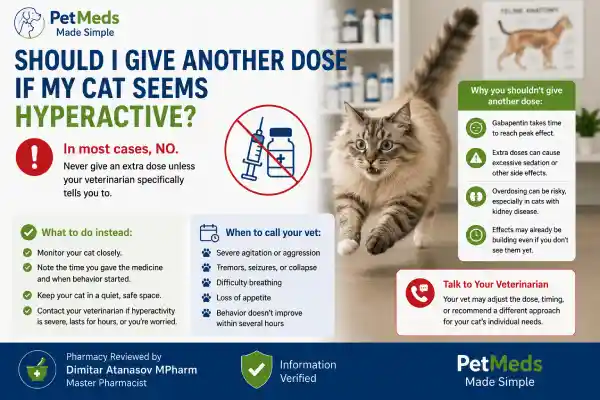
Generally, no.
Owners sometimes think:
“Maybe the first dose wasn’t enough.”
Giving an extra dose without veterinary advice could increase the risk of excessive sedation or other side effects once the medication reaches its full effect.
Instead:
- Observe your cat carefully.
- Record when the medication was given.
- Note when the unusual behavior started.
- Contact your veterinarian if the hyperactivity is severe or persistent.
This information helps determine whether the medication should be adjusted before the next dose.
When Do Veterinarians Change the Medication?
Fortunately, most cats tolerate gabapentin extremely well.
However, if paradoxical hyperactivity occurs repeatedly, your veterinarian may consider:
- Adjusting the dose.
- Changing the timing of administration.
- Using gabapentin only in specific situations.
- Trying a different medication for anxiety or pain.
- Investigating another medical or behavioral cause.
The decision always depends on balancing the medication’s benefits against any unwanted effects.
Other Signs Owners May Notice
Hyperactivity isn’t the only unexpected reaction owners ask about.
Some cats experience:
- Temporary wobbliness
- Increased drooling
- Mild disorientation
- Changes in vocalization
- Altered sleep patterns
These signs are often temporary, but they help veterinarians understand how each individual cat responds to gabapentin.
Our PMMS guides on Why Is My Cat Wobbly After Gabapentin?, Why Is My Cat Drooling After Gabapentin?, and Can Gabapentin Cause Vomiting in Cats? explain these reactions in more detail.
Related PMMS Guides
While researching Can Gabapentin Cause Hyperactivity in Cats?, you may also find these articles helpful:
- Gabapentin for Cats: Uses, Dosage, Side Effects & Safety
- Why Is My Cat Sleepy After Gabapentin?
- Why Is My Cat Wobbly After Gabapentin?
- Why Is My Cat Drooling After Gabapentin?
- Can Gabapentin Cause Vomiting in Cats?
- Can Gabapentin Cause Aggression in Cats?
- Can Gabapentin Cause Anxiety in Cats?
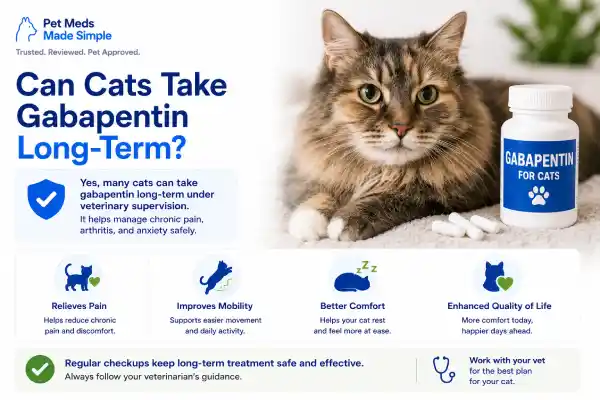
- Can Cats Take Gabapentin Long-Term?
- Can Cats Overdose on Gabapentin?
- Is Human Gabapentin Safe for Cats?
Could My Cat Simply Be Excited?
One thing veterinarians learn quickly is that cats don’t all respond to stressful situations in the same way.
When owners imagine an anxious cat, they often picture one hiding under the bed or freezing in a corner.
But some cats do exactly the opposite.
Instead of becoming quiet, they become busier than usual.
They may:
- Walk from room to room.
- Jump onto furniture repeatedly.
- Follow their owners constantly.
- Explore every corner of the house.
- Vocalize more than normal.
Owners sometimes describe this as “hyperactivity,” but the behavior may actually be a release of nervous energy rather than a direct side effect of gabapentin.
One veterinarian explained it to an owner this way:
“Imagine someone who’s been holding their breath during a stressful event. Once it’s over, they suddenly can’t sit still. Some cats react in a very similar way.”
If your cat was given gabapentin before a veterinary visit, travel, or grooming appointment, a short period of increased activity afterward isn’t necessarily unusual.
Can Hyperactivity Happen Every Time My Cat Takes Gabapentin?
Usually, no.
One of the interesting things about gabapentin is that the same cat doesn’t always respond exactly the same way.
Veterinarians frequently hear comments like:
“The first dose made her sleepy, but the second dose barely seemed to do anything.”
Or:
“She was energetic after the first appointment, but completely relaxed the next time.”
That’s because several factors influence how gabapentin affects the brain, including:
- Stress levels.
- Sleep quality.
- Pain.
- Kidney function.
- Environmental changes.
- Other medications.
- Individual sensitivity.
This variability is one reason veterinarians usually avoid changing the treatment plan after a single unexpected reaction.
Instead, they look for patterns over several doses.
Could My Cat Be Having a Paradoxical Reaction Again?
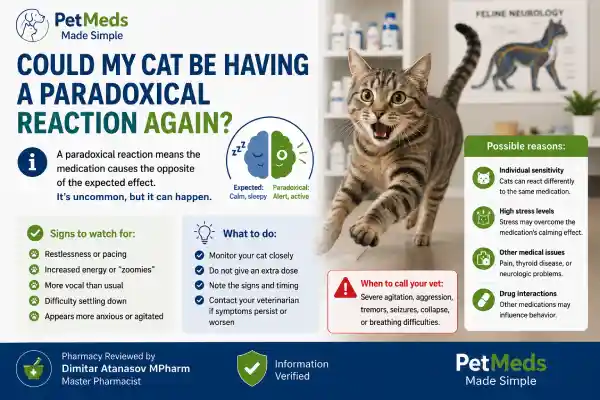
Yes.
Cats that have experienced one paradoxical reaction may experience a similar response in the future, although this isn’t guaranteed.
If your veterinarian believes gabapentin is still the best medication for your cat, they may recommend:
- Giving the medication earlier before travel.
- Adjusting the dose.
- Changing the timing of administration.
- Reducing other sources of stress.
- Trying the medication at home before another veterinary visit.
Owners are often surprised that small adjustments can completely change how well the medication works.
Should I Stop Giving Gabapentin?
In most cases, no.
This is one of the biggest mistakes owners can make.
After seeing unexpected hyperactivity, it’s tempting to decide:
“This medication obviously isn’t right for my cat.”
However, one unusual reaction doesn’t necessarily mean gabapentin should never be used again.
Your veterinarian will consider several questions first:
- Was the behavior actually caused by gabapentin?
- Was the cat extremely stressed at the time?
- Was the dose appropriate?
- Did the behavior resolve on its own?
- Did the medication still provide pain relief or reduce anxiety?
Only after answering those questions can an informed decision be made.
Never stop or change a prescribed medication without discussing it with your veterinarian first.
When Should Owners Contact Their Veterinarian?
Most episodes of mild hyperactivity improve without treatment.
However, you shouldn’t simply “wait and see” if your cat develops more concerning signs.
Contact your veterinarian promptly if your cat:
- Cannot settle for several hours.
- Becomes aggressive toward people or other pets.
- Develops repeated tremors.
- Has a seizure.
- Collapses.
- Has difficulty breathing.
- Becomes severely disoriented.
- Stops eating or drinking.
- Cannot be safely handled.
Likewise, if hyperactivity occurs every time gabapentin is administered, your veterinarian may wish to adjust the treatment plan.
What Do Veterinarians Usually Do Next?
The good news is that most cats don’t need to stop gabapentin.
Instead, veterinarians often make relatively small adjustments based on the cat’s response.
Depending on the situation, they may recommend:
- A slightly different dose.
- Giving the medication earlier before a stressful event.
- Administering it with food if appropriate.
- Combining environmental stress reduction with medication.
- Investigating another medical condition if the behavior seems unrelated to gabapentin.
This individualized approach is one reason gabapentin remains one of the most widely used medications for feline anxiety and pain management.
A Conversation We Hear From Owners Again and Again
One of the most rewarding follow-up appointments often begins with an owner saying:
“I was convinced the medication wasn’t working.”
After discussing exactly what happened, the veterinarian explains that the cat’s response wasn’t dangerous—it was simply different from what the owner expected.
A week later, after making a few small adjustments, many owners return saying:
“This time everything went much more smoothly.”
That doesn’t happen because gabapentin suddenly changed.
It happens because the treatment plan was tailored to that individual cat, rather than assuming every cat responds the same way.
Understanding these individual differences is one of the most important parts of successfully using gabapentin in feline medicine.
Veterinarian Takeaway – Can Gabapentin Cause Hyperactivity in Cats?
Can Gabapentin Cause Hyperactivity in Cats? Yes but it’s uncommon.
When veterinarians prescribe gabapentin, they usually expect cats to become calmer, sleepier, and easier to handle. However, medicine doesn’t affect every patient in exactly the same way. A small percentage of cats experience what is known as a paradoxical reaction, becoming unusually active, restless, or vocal instead of relaxed.
The most important thing isn’t simply asking:
“Is my cat hyperactive?”
It’s asking:
“Is my cat otherwise behaving normally, and is the behavior improving as the medication wears off?”
If the hyperactivity is mild, short-lived, and your cat continues eating, drinking, walking normally, and interacting appropriately, careful observation is often all that’s needed.
On the other hand, persistent agitation, aggression, tremors, seizures, collapse, difficulty walking, or breathing problems are not typical responses to gabapentin and should prompt immediate veterinary evaluation.
Fortunately, truly serious reactions remain uncommon, and most cats continue to tolerate gabapentin extremely well.
Bottom Line – Can Gabapentin Cause Hyperactivity in Cats?
If you’ve searched “Can Gabapentin Cause Hyperactivity in Cats?”, the short answer is yes—but it’s rare.
Most cats become sleepy after receiving gabapentin, particularly when it’s prescribed before veterinary visits or for pain management. However, a small number may appear unusually energetic, restless, or more vocal than expected. In many cases, this represents a temporary paradoxical reaction or reflects the cat’s underlying anxiety rather than a dangerous medication side effect.
The good news is that these episodes often resolve without treatment as the medication wears off. The best approach is to observe your cat closely, avoid giving extra doses unless instructed by your veterinarian, and report any unexpected reactions before the next scheduled dose.
Remember, every cat responds differently. Finding the right treatment sometimes requires small adjustments, but gabapentin remains one of the safest and most widely used medications in feline medicine.Can Gabapentin Cause Hyperactivity in Cats?
Frequently Asked Questions – Can Gabapentin Cause Hyperactivity in Cats
Can gabapentin really make cats hyperactive?
Yes. Although uncommon, some cats experience a paradoxical reaction and become unusually active or restless instead of sleepy.
Why does my cat get the zoomies after gabapentin?
Some cats release nervous energy after stressful events, while others experience an uncommon paradoxical response to the medication. Not every episode of “zoomies” is caused directly by gabapentin.
Is hyperactivity more common after the first dose?
It can be. The first dose is often the most unpredictable because neither the owner nor the veterinarian knows exactly how that individual cat will respond.
How long does hyperactivity usually last?
Most behavioral changes improve within several hours as the medication reaches its peak and is gradually eliminated from the body.
Should I give another dose if my cat seems hyperactive?
No. Never give an extra dose unless your veterinarian specifically instructs you to do so.
Could anxiety be mistaken for hyperactivity?
Absolutely. Cats experiencing fear or stress may pace, vocalize, or move constantly, making anxiety appear very similar to hyperactivity.
Can kidney disease change how cats respond to gabapentin?
Yes. Because gabapentin is eliminated primarily through the kidneys, chronic kidney disease may prolong its effects and sometimes alter how cats respond to the medication.
Will my cat react this way every time?
Not necessarily. Many cats respond differently depending on stress levels, health status, environment, and other medications.
Is hyperactivity dangerous?
Usually not. Mild restlessness often resolves on its own. However, severe agitation, tremors, seizures, collapse, or breathing difficulties require immediate veterinary attention.
Should I stop giving gabapentin if my cat becomes hyperactive?
No. Contact your veterinarian before making any changes. In many cases, a simple adjustment to the dose or timing is all that’s needed.
Sources
- Plumb’s Veterinary Drug Handbook (10th Edition)
- BSAVA Small Animal Formulary (11th Edition)
- Merck Veterinary Manual – Feline Neurologic Disorders
- American Association of Feline Practitioners (AAFP) Feline Anesthesia and Pain Management Guidelines
- Veterinary Pharmacology and Therapeutics (10th Edition)
- Small Animal Clinical Pharmacology
- Journal of Feline Medicine and Surgery (JFMS)
- Journal of Veterinary Internal Medicine (JVIM)
- Veterinary Information Network (VIN)
- Frontiers in Veterinary Science
Medical Review Statement
This article was written by Dimitar Georgiev Atanasov, MPharm, pharmacy and scientifically reviewed by Gergana Krasimirova Atanasova, MPharm, and independently veterinary reviewed by Dr. Valcho Georgiev Valchev, DVM. It is based on current veterinary pharmacology references, peer-reviewed scientific literature, feline medicine guidelines, and evidence-based veterinary recommendations to ensure accurate, practical, and trustworthy information for cat owners.Can Gabapentin Cause Hyperactivity in Cats?
Important Medical Disclaimer
The information provided on PetMedsMadeSimple.com is intended for educational purposes only and should not replace professional veterinary diagnosis or treatment.
Never start, stop, or adjust your cat’s medication without consulting your veterinarian. If your cat develops seizures, collapse, severe breathing difficulties, repeated vomiting, or becomes impossible to wake, seek emergency veterinary care immediately.
Image Disclosure – Can Gabapentin Cause Hyperactivity in Cats?
Some images used in this article may be AI-generated or AI-assisted for educational purposes. Every PMMS article is independently researched, pharmacy-written, scientifically reviewed, and veterinary-reviewed. AI-generated illustrations are used solely to improve understanding of veterinary medications and should not be interpreted as photographs of actual clinical patients.