
Quick Answer
Why Is My Dog Wobbly After Phenobarbital? If your dog is wobbly after taking phenobarbital, the most likely cause is ataxia, a common side effect that occurs because the medication slows activity within the central nervous system. Many dogs appear unsteady, stumble, sway, or have difficulty walking during the first several days after starting treatment or after a dosage increase. In many cases, these signs gradually improve as the body adapts to the medication.
However, severe wobbliness, inability to stand, collapse, worsening neurological signs, or sudden changes after a dog has been stable on phenobarbital should never be ignored. These signs may indicate overdose, excessively high blood levels, liver disease, another neurological condition, or progression of the underlying seizure disorder and require prompt veterinary evaluation.
Why Does Phenobarbital Make Dogs Wobbly?
Phenobarbital is one of the most commonly prescribed medications for controlling seizures in dogs. It has been used safely in veterinary medicine for decades and remains a first-line treatment for epilepsy.
Its job is to calm excessive electrical activity inside the brain.
Unfortunately, this calming effect doesn’t affect only seizure activity—it also slows many normal neurological functions responsible for balance, coordination, muscle control, and alertness.
As a result, many dogs temporarily develop:
- Walking like they’re drunk
- Crossing their legs
- Swaying from side to side
- Difficulty climbing stairs
- Trouble jumping
- Slower reactions
- Poor coordination
Veterinarians refer to this as ataxia, and it is among the most frequently reported early side effects of phenobarbital therapy.
Why Is My Dog Wobbly After Phenobarbital?
How Phenobarbital Affects the Brain

Understanding why your dog becomes wobbly helps reduce unnecessary panic.
Normally, the brain constantly balances two opposing systems:
| Excitatory Signals | Inhibitory Signals |
|---|---|
| Keep nerve cells active | Slow nerve cell activity |
| Promote movement | Prevent overstimulation |
| Allow rapid responses | Maintain stability |
During a seizure, excessive electrical activity overwhelms normal brain function.
Phenobarbital increases the activity of GABA (gamma-aminobutyric acid), the brain’s primary inhibitory neurotransmitter.
This causes neurons to fire less frequently.
While this reduces seizures, it also temporarily slows normal communication between:
- The brain
- The spinal cord
- Peripheral nerves
- Muscles responsible for coordinated movement
The result is reduced coordination and balance.
What Does “Wobbly” Actually Look Like?
Owners often use different words to describe the same problem.
Common descriptions include:
- “My dog walks like he’s drunk.”
- “She keeps falling over.”
- “His back legs seem weak.”
- “He sways when standing.”
- “He can’t walk straight.”
- “He’s stumbling everywhere.”
- “His legs cross when he walks.”
- “He looks dizzy.”
These descriptions usually represent varying degrees of ataxia.
Some dogs only appear mildly clumsy, while others may temporarily struggle to walk without assistance.
What Is Ataxia?
Ataxia is not a disease itself.
It is a clinical sign that indicates poor coordination of voluntary movement.
Phenobarbital-related ataxia occurs because the medication temporarily suppresses communication within the nervous system.
Signs may include:
- Wide-based stance
- Swaying while standing
- Delayed paw placement
- Knuckling
- Crossing limbs
- Misjudging distances
- Difficulty turning
- Slow walking
- Occasional stumbling
Importantly, many affected dogs remain mentally aware despite appearing physically uncoordinated.
Is This a Normal Side Effect?
Yes mild to moderate wobbliness is considered one of the expected early side effects of phenobarbital.
It is especially common:
- During the first week of treatment
- After increasing the dose
- When blood concentrations rise
- In older dogs
- In dogs receiving multiple seizure medications
Many owners worry that something has gone terribly wrong when they first see their dog walking abnormally.
Fortunately, for many dogs, this represents the brain adapting to the medication rather than permanent damage.
When Does Wobbliness Usually Begin?
The timing can provide important clues.
| Timing | Possible Explanation |
|---|---|
| Within hours of first dose | Normal initial medication effect |
| First 2–5 days | Very common adjustment period |
| After dose increase | Expected temporary side effect |
| Weeks after stable treatment | May require veterinary evaluation |
| Suddenly after months of stability | Not considered typical and should be investigated |
If a previously stable dog suddenly becomes wobbly without any medication changes, your veterinarian may recommend blood testing to evaluate phenobarbital levels and rule out other medical problems.
How Long Does the Wobbliness Last?

One of the biggest concerns owners have is whether the side effects will ever improve.
Fortunately, many dogs gradually adapt.
A typical timeline looks like this:
| Time After Starting Phenobarbital | What Owners May Notice |
|---|---|
| Day 1–3 | Significant sedation and wobbliness |
| Days 4–7 | Mild improvement in coordination |
| Week 2 | Many dogs begin adjusting |
| Weeks 2–4 | Side effects often continue improving |
| After one month | Many dogs are much steadier than when treatment began |
Every dog responds differently.
Some improve within several days.
Others require several weeks before balance noticeably returns.
Which Dogs Are More Likely to Become Wobbly?
Although any dog can develop ataxia, certain patients are more susceptible.
Higher-risk groups include:
Senior Dogs
Older dogs often metabolize medications more slowly and may already have mild arthritis or neurological changes that reduce stability.
Dogs Starting High Initial Doses
Dogs beginning treatment with larger doses may experience more noticeable neurological effects before the body adapts.
Small Breeds
Small dogs may appear more dramatically affected because even minor balance disturbances become obvious.
Dogs Taking Multiple Neurological Medications
The combination of phenobarbital with medications such as gabapentin, levetiracetam (Keppra), pregabalin, trazodone, or certain sedatives can increase nervous system depression.
Dogs With Liver Disease
Because phenobarbital is processed primarily by the liver, impaired liver function can allow the drug to accumulate, increasing side effects.
Could My Dog Be Having Another Seizure Instead?
Sometimes owners mistake post-seizure weakness for medication side effects.
After a seizure, many dogs experience the postictal period, during which they may appear:
- Weak
- Disoriented
- Blind
- Unsteady
- Confused
- Sleepy
This can last anywhere from minutes to several hours.
Phenobarbital-related wobbliness differs because it is usually:
- More consistent
- Present even without a recent seizure
- Closely associated with starting treatment or increasing the dose
If your dog becomes wobbly immediately after every seizure—even before receiving medication—the seizures themselves may be contributing to the problem.
Can Phenobarbital Cause Weak Back Legs?
Yes.
Many owners specifically notice weakness in the hind limbs.
This happens because:
- Coordination decreases.
- Muscle control becomes slower.
- Reflexes may be temporarily depressed.
- Dogs compensate by widening their stance.
Owners often believe their dog has developed hip disease overnight.
In reality, many cases reflect temporary neurological suppression caused by the medication rather than damage to the joints or muscles.
However, persistent hind limb weakness that continues worsening should always be evaluated by a veterinarian, especially if accompanied by pain, paralysis, or loss of bladder or bowel control.
Is Wobbliness the Same as Sedation?

Not exactly.
Although they frequently occur together, they describe different effects.
| Wobbliness (Ataxia) | Sedation |
|---|---|
| Poor coordination | Sleepiness |
| Difficulty walking | Reduced alertness |
| Stumbling | Sleeping more |
| Balance problems | Low energy |
| Crossing legs | Less interest in activity |
A dog may be:
- Wobbly but fully awake
- Sleepy without balance problems
- Both sleepy and wobbly simultaneously
Recognizing the difference helps veterinarians determine whether the medication is causing expected side effects or whether dosage adjustments may be needed.
When Is Wobbliness NOT Normal?
Although mild ataxia is expected in many dogs starting phenobarbital, there is an important point where normal side effects end and a medical problem begins.
One of the questions veterinarians ask themselves isn’t simply:
“Is the dog wobbly?”
Instead, they ask:
“Is the wobbliness getting better—or worse?”
Improvement over several days is reassuring.
Progressive deterioration is not.
You should contact your veterinarian immediately if your dog:
- Cannot stand without falling.
- Repeatedly collapses.
- Appears unconscious.
- Cannot be awakened.
- Has repeated vomiting.
- Stops eating completely.
- Develops yellow gums or eyes.
- Has another seizure despite medication.
- Suddenly becomes much more uncoordinated after previously doing well.
These signs suggest something more serious than routine adjustment to phenobarbital.
Could the Dose Be Too High?
Yes.
One of the most common reasons for persistent wobbliness is that the phenobarbital blood concentration has become higher than intended.
This doesn’t necessarily mean your veterinarian prescribed the wrong dose.
Drug levels can change over time because of:
- Weight loss
- Aging
- Liver disease
- Medication interactions
- Individual metabolism
- Accidental dosing errors
Dogs with excessively high phenobarbital concentrations often develop:
- Severe ataxia
- Marked sleepiness
- Slow responses
- Weakness
- Difficulty standing
- Reduced appetite
Fortunately, blood testing usually provides the answer.
Why Blood Level Monitoring Is So Important
Phenobarbital is one of the few veterinary medications that is routinely monitored using therapeutic drug concentrations.
Rather than guessing whether a dose is too high or too low, veterinarians can measure the medication directly.
Blood testing helps answer questions such as:
- Is the dose too low?
- Is the dose too high?
- Is the medication still within the therapeutic range?
- Should the dose be adjusted?
- Could another disease be affecting metabolism?
This is one of the reasons phenobarbital remains a safe long-term medication despite being an older drug.
How Often Are Blood Levels Checked?
The exact schedule varies between patients, but many veterinarians recommend monitoring similar to the following.
| Time | Typical Purpose |
|---|---|
| Before treatment | Baseline blood work |
| Around 2 weeks | Initial phenobarbital level |
| Around 6 weeks | Confirm therapeutic concentration |
| Every 6 months | Routine monitoring |
| Anytime new side effects appear | Re-evaluation |
Dogs that remain stable for years still benefit from regular blood testing.
Can Liver Disease Make Wobbliness Worse?
Absolutely.
Phenobarbital is metabolized primarily by the liver.
If liver function declines, the medication may remain in the bloodstream longer than expected.
This can lead to:
- Increased sleepiness
- Poor coordination
- Weakness
- Reduced appetite
- More pronounced neurological side effects
Fortunately, serious liver complications are relatively uncommon when dogs receive routine monitoring.
Most veterinarians identify abnormal liver values long before dogs become seriously ill.
Warning Signs That May Suggest Liver Problems
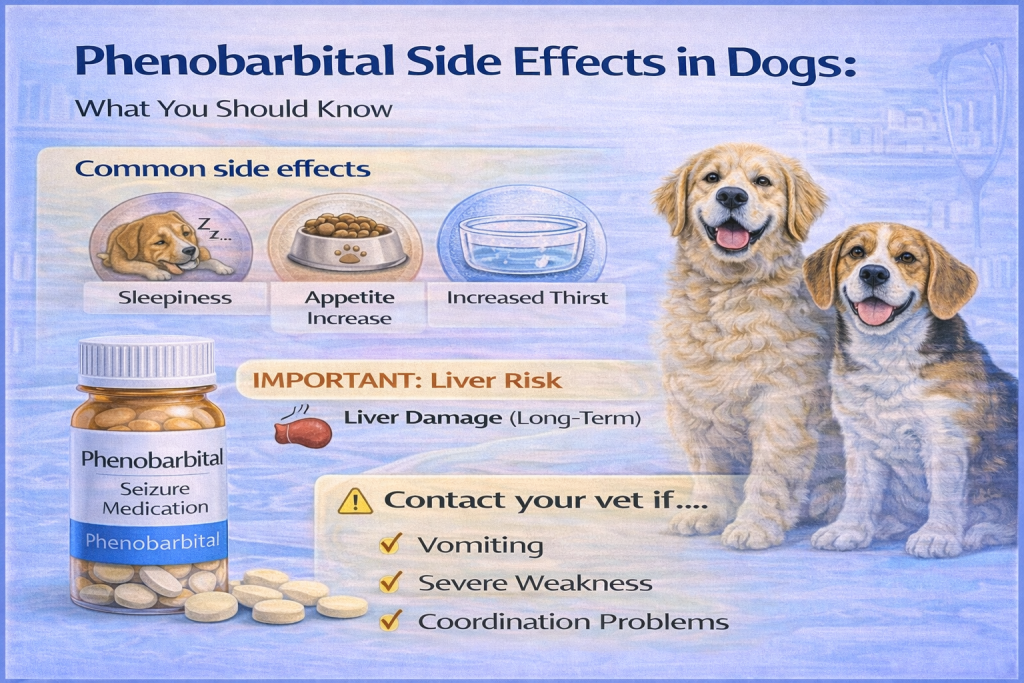
Although uncommon, owners should watch for:
- Yellow eyes
- Yellow gums
- Yellow skin
- Persistent vomiting
- Poor appetite
- Weight loss
- Extreme lethargy
- Swollen abdomen
These signs require prompt veterinary examination.
Could Another Medication Be Making My Dog More Wobbly?

Yes.
Phenobarbital is frequently combined with other medications.
Some combinations increase nervous system depression.
Examples include:
- Gabapentin
- Pregabalin
- Levetiracetam (Keppra®)
- Potassium bromide
- Diazepam
- Trazodone
- Certain pain medications
- Some antihistamines
This doesn’t mean these combinations are unsafe.
Many epileptic dogs require combination therapy for excellent seizure control.
However, veterinarians may adjust doses when excessive sedation or ataxia develops.
Could My Dog Simply Still Be Adjusting?
Very often, yes.
This is actually one of the most reassuring explanations.
The brain needs time to adapt to phenobarbital.
Many owners become frightened during the first several days because their dog appears dramatically different.
Then something interesting happens.
Around the second or third week they begin saying:
“He’s still a little wobbly, but he’s much better than last week.”
Veterinarians hear this story every day.
The nervous system gradually adapts, allowing many dogs to regain much of their normal coordination without changing the medication.
Can Older Dogs Take Longer to Recover?
Yes.
Senior dogs often require a longer adjustment period.
Several factors contribute:
- Slower drug metabolism
- Arthritis
- Reduced muscle mass
- Existing neurological disease
- Age-related balance changes
Because several problems may occur simultaneously, veterinarians evaluate senior dogs particularly carefully when wobbliness develops.
How Can I Keep My Dog Safe at Home?
Until coordination improves, a few simple changes around the home can greatly reduce the risk of injury.
Veterinarians commonly recommend:
- Using rugs or non-slip mats on smooth floors.
- Blocking access to stairs.
- Assisting dogs into vehicles.
- Using a support harness for larger dogs if necessary.
- Keeping food and water within easy reach.
- Avoiding rough play while balance is poor.
- Supervising outdoor walks.
These measures are usually temporary until your dog’s coordination improves.
Should I Reduce the Dose Myself?
No.
Even if your dog appears extremely sleepy or unsteady, never reduce or skip phenobarbital without speaking to your veterinarian first.
Many owners assume:
“If I give a little less medication, he’ll walk better.”
Unfortunately, that same change may also allow seizures to return.
The safest approach is always to let your veterinarian determine whether the medication truly needs adjustment based on:
- Clinical examination
- Blood phenobarbital levels
- Liver values
- Seizure history
- Overall neurological status
If you’ve been wondering whether lowering the dose might help, it’s far safer to make that decision together with your veterinarian than to experiment at home.
Related PMMS Guides
If your dog is taking phenobarbital, these articles may also answer questions owners commonly ask during treatment:
- Phenobarbital for Dogs: Uses, Dosage, Side Effects & Safety (Vet-Backed Guide)
- Can Dogs Take Seizure Medication Long-Term Safely?
- Why Is My Dog Sleeping All Day on Keppra?
- Can Seizure Medication Cause Aggression?
- Can Seizure Medication Cause Anxiety in Dogs? (Vet-Backed Guide)
- Why Is My Dog Pacing After Seizure Medication?
- Why Is My Dog Still Confused After a Seizure
- Dog Seizure Symptoms: Signs, Causes & When to Seek Emergency Care
These internal links help owners understand not only why wobbliness occurs but also how phenobarbital fits into long-term seizure management.
Can the Wobbliness Become Permanent?
This is one of the first questions owners ask after watching their dog struggle to walk.
Fortunately, the answer is usually no.
For most dogs, phenobarbital-related wobbliness is temporary. As the brain adapts to the medication, coordination often improves significantly over the first two to four weeks.
Veterinarians sometimes describe this period as the dog’s nervous system “finding its new normal.”
Many owners notice something like this:
Week 1: “My dog can barely walk across the room.”
Week 2: “He’s still a little clumsy, but much steadier.”
Week 4: “He’s almost back to normal.”
This gradual improvement is exactly what veterinarians hope to see.
However, if severe ataxia continues for weeks without improvement, further investigation is needed. Persistent wobbliness may indicate that the medication dose is too high, another disease has developed, or the seizures themselves are affecting the brain.
Normal Side Effect vs Phenobarbital Overdose
One of the most important jobs of your veterinarian is determining whether your dog’s symptoms represent a normal adjustment period or excessively high phenobarbital levels.
Although the signs can overlap, there are often important differences.
| Typical Adjustment | Possible Overdose |
|---|---|
| Mild to moderate wobbliness | Unable to stand |
| Improving over days | Getting progressively worse |
| Mild sleepiness | Extreme unresponsiveness |
| Eating and drinking normally | Refusing food and water |
| Walking slowly | Repeated collapse |
| Responds normally to owners | Difficult to wake |
Owners should never try to diagnose overdose at home.
If your dog suddenly becomes profoundly weak or unresponsive, emergency veterinary evaluation is essential.
What Happens If Blood Levels Are Too High?
If testing shows that phenobarbital concentrations exceed the therapeutic range, your veterinarian will decide the safest way to correct the problem.
Depending on the situation, they may recommend:
- Adjusting the daily dose.
- Changing how often the medication is given.
- Repeating blood tests after several weeks.
- Checking liver function.
- Reviewing every medication your dog receives.
- Referring complicated cases to a veterinary neurologist.
The goal is never simply to lower the dose.
Instead, veterinarians try to maintain the lowest effective dose that still provides good seizure control.
Can Wobbliness Return Years Later?

Yes.
Even dogs that have taken phenobarbital successfully for years can occasionally become wobbly again.
Common reasons include:
- Age-related changes
- Weight loss
- Liver disease
- Medication interactions
- New neurological disease
- Accidental double dosing
- Progression of epilepsy
This is another reason routine blood monitoring remains important throughout your dog’s life—not only during the first few months of treatment.
Does Every Dog React the Same Way? – Why Is My Dog Wobbly After Phenobarbital?
Not at all.
One of the fascinating aspects of veterinary neurology is how differently individual dogs respond to the same medication.
For example:
One Labrador may start phenobarbital on Monday and be running normally by Friday.
Another dog of the same age and weight may require three weeks before balance returns.
Neither response is necessarily abnormal.
Individual differences in metabolism, genetics, liver function, age, and overall health all influence how quickly a dog adjusts.
This is why veterinarians avoid comparing one patient with another.
The most meaningful comparison is how your own dog is improving over time.
A Conversation Veterinarians Have Every Week
One of the most reassuring conversations in practice often sounds something like this:
Owner: “Doctor, I think the medication is making everything worse.”
The veterinarian asks:
“Is your dog having fewer seizures?”
“Yes.”
“Is he a little steadier than last week?”
“…Actually, yes.”
That gradual improvement often changes the entire discussion.
Phenobarbital doesn’t work overnight, and neither does the nervous system’s adaptation to it.
Looking at trends over days and weeks is usually far more helpful than judging a single difficult day.
Veterinarian Takeaway – Why Is My Dog Wobbly After Phenobarbital?
Why Is My Dog Wobbly After Phenobarbital? In most cases, the answer is reassuring: mild to moderate wobbliness is one of the most common early side effects of this medication.
Phenobarbital slows excessive electrical activity within the brain to prevent seizures, but that same effect can temporarily reduce coordination and balance. Most dogs begin improving over the first several weeks as their nervous system adapts.
The key question isn’t simply whether your dog is wobbly—it’s whether your dog is gradually improving.
If coordination continues to improve, appetite remains normal, and seizures are controlled, the medication is often doing exactly what it’s supposed to do.
However, severe ataxia, collapse, inability to stand, worsening neurological signs, or sudden changes after months of stable treatment should always prompt immediate veterinary evaluation.
Bottom Line
If you’ve searched “Why Is My Dog Wobbly After Phenobarbital?”, you’re certainly not alone.
This is one of the most common concerns owners have after starting seizure medication, and fortunately, it’s often one of the most temporary.
Most dogs experience their greatest degree of wobbliness during the first several days of treatment. As the brain adjusts, balance and coordination frequently improve without changing the medication.
The safest approach is to monitor your dog’s progress closely, attend every scheduled blood test, give phenobarbital exactly as prescribed, and contact your veterinarian whenever the wobbliness becomes severe, suddenly worsens, or fails to improve over time. Why Is My Dog Wobbly After Phenobarbital?
Frequently Asked Questions – Why Is My Dog Wobbly After Phenobarbital
Why is my dog wobbly after phenobarbital?
Phenobarbital commonly causes temporary ataxia because it slows activity within the central nervous system while controlling seizures.
How long does wobbliness usually last?
Many dogs improve over two to four weeks, although every patient responds differently.
Is wobbliness a normal side effect?
Yes. Mild to moderate wobbliness is one of the most common early side effects of phenobarbital.
Should I stop giving phenobarbital?
No. Never stop phenobarbital without veterinary guidance because sudden withdrawal can trigger life-threatening seizures.
Can phenobarbital cause weak back legs?
Yes. Many owners notice hind limb weakness or poor coordination, particularly during the adjustment period.
When should I call my veterinarian?
Seek veterinary advice if your dog cannot stand, repeatedly falls, becomes extremely sleepy, stops eating, develops jaundice, or suddenly becomes much worse.
Can blood tests determine whether the dose is too high?
Yes. Measuring phenobarbital blood concentrations is one of the best ways to determine whether dosage adjustments are needed.
Can other medications make wobbliness worse?
Yes. Medications such as gabapentin, pregabalin, potassium bromide, trazodone, and certain sedatives may increase nervous system depression when combined with phenobarbital.
Can older dogs take longer to adjust?
Absolutely. Senior dogs often require a longer adaptation period because of age-related changes in metabolism and balance.
Will my dog always be wobbly while taking phenobarbital?
Usually not. Most dogs become noticeably steadier after the first few weeks of treatment while continuing to benefit from seizure control.
Sources
- Plumb’s Veterinary Drug Handbook (10th Edition)
- Merck Veterinary Manual – Seizure Disorders in Dogs
- ACVIM Consensus Statement on Seizure Management in Dogs
- BSAVA Small Animal Formulary (11th Edition)
- Veterinary Pharmacology and Therapeutics (10th Edition)
- Small Animal Clinical Pharmacology
- Journal of Veterinary Internal Medicine (JVIM)
- Journal of the American Veterinary Medical Association (JAVMA)
- Veterinary Information Network (VIN)
- Frontiers in Veterinary Science
Medical Review Statement
This article was written by Dimitar Georgiev Atanasov, MPharm, pharmacy and scientifically reviewed by Gergana Krasimirova Atanasova, MPharm, and independently veterinary reviewed by Dr. Valcho Georgiev Valchev, DVM. It is based on current veterinary pharmacology references, ACVIM consensus recommendations, and evidence-based veterinary literature to provide accurate, practical guidance for pet owners.
Important Medical Disclaimer
The information on PetMedsMadeSimple.com is intended for educational purposes only and should not replace professional veterinary diagnosis or treatment.
Never adjust or discontinue phenobarbital without your veterinarian’s guidance. If your dog develops prolonged seizures, repeated collapse, severe weakness, difficulty breathing, or becomes unresponsive, seek emergency veterinary care immediately.
Image Disclosure – Why Is My Dog Wobbly After Phenobarbital?
Some images used in this article may be AI-generated or AI-assisted for educational purposes. Every article is independently researched, pharmacy-written, scientifically reviewed, and veterinary-reviewed. AI-generated illustrations are intended to improve understanding of veterinary medications and neurological conditions and do not depict actual clinical patients.