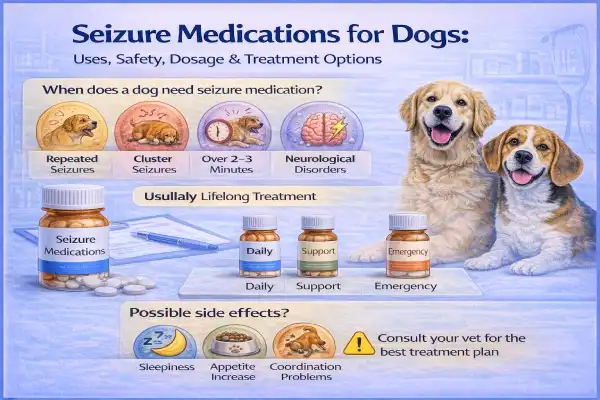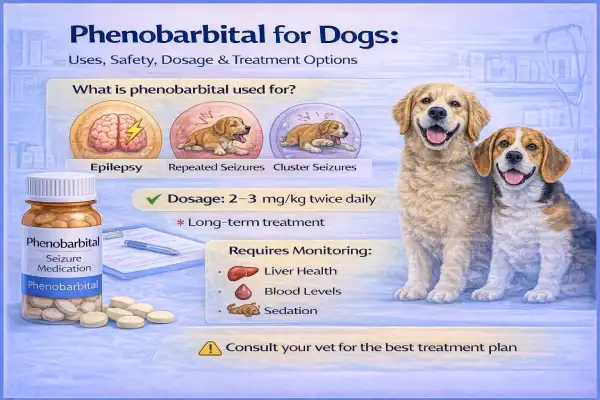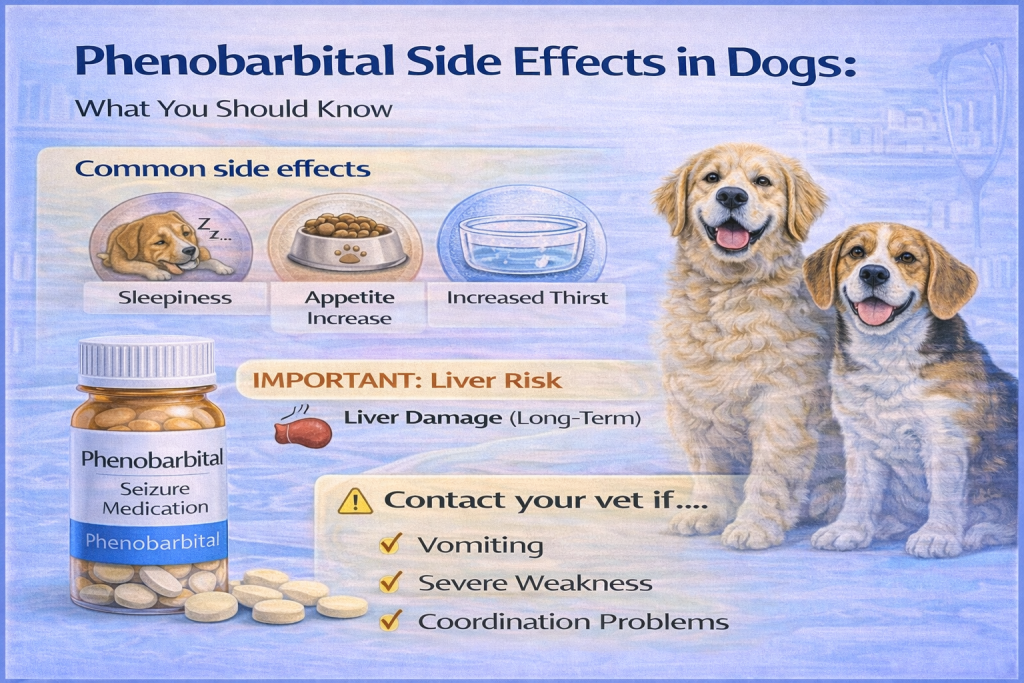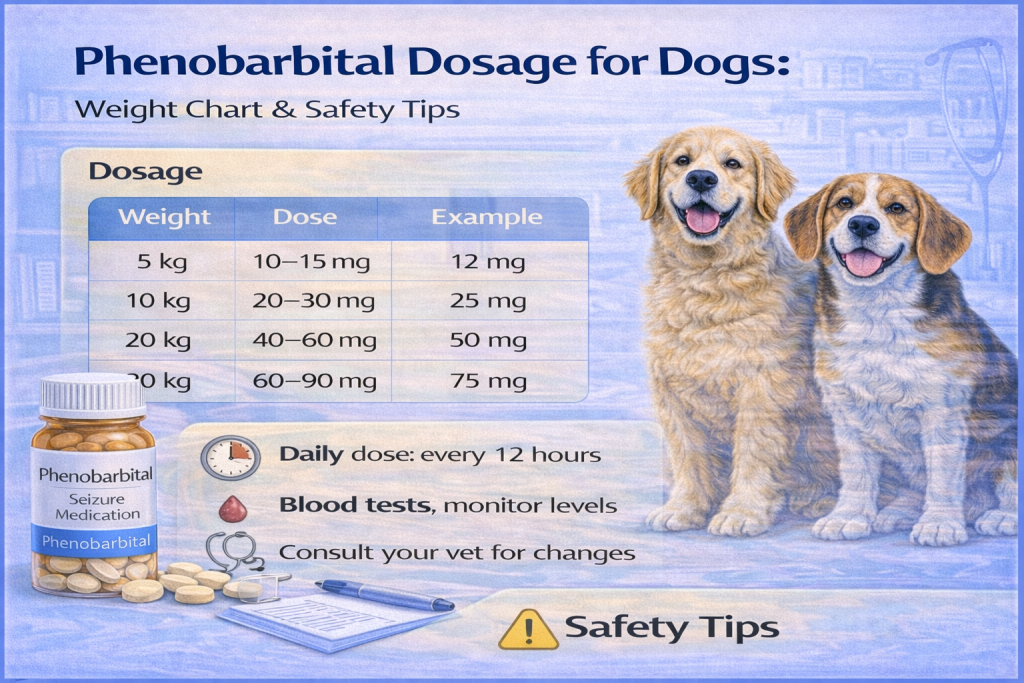
Quick Answer
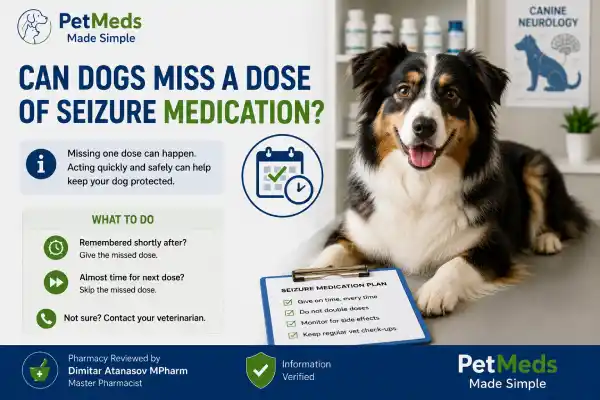
Can dogs miss a dose of seizure medication? In most cases, missing a single dose of seizure medication is not immediately life-threatening, but it can reduce your dog’s protection against future seizures. The safest action depends on which medication your dog takes, how much time has passed, and whether the medication is used alone or with other anticonvulsants. Never double the next dose unless your veterinarian specifically instructs you to do so.
Can Dogs Miss a Dose of Seizure Medication
Why Missing a Dose of Seizure Medication Can Be Serious
Many owners accidentally discover they have forgotten a dose and immediately search “Can Dogs Miss a Dose of Seizure Medication?” The good news is that one missed dose does not automatically mean your dog will have another seizure.
However, seizure medications work best when they are given consistently at the same times every day. Their purpose is not to stop a seizure once it has already started but to maintain stable drug concentrations that reduce the likelihood of abnormal electrical activity developing in the brain.
When a dose is delayed or forgotten, medication levels gradually begin to fall. Depending on the drug involved, this reduction may have little immediate effect—or it may significantly increase the chance of a breakthrough seizure.
This is why veterinarians stress that consistency is one of the most important parts of successful epilepsy management.
Why Dogs Take Seizure Medication Every Day
Dogs with epilepsy often require long-term anticonvulsant therapy to keep seizures under control.
The goal is not simply to treat seizures after they happen, but to prevent them from occurring in the first place.
Common reasons veterinarians prescribe seizure medications include:
- Idiopathic epilepsy
- Structural brain disease
- Previous cluster seizures
- Status epilepticus
- Reactive seizures caused by certain diseases
- Long-term seizure prevention
Many dogs receiving anticonvulsants enjoy an excellent quality of life when medication schedules are followed consistently.
Missing doses unnecessarily places that seizure control at risk.
Owners who are new to epilepsy may also benefit from reading our complete guide on Seizure Medications for Dogs: Uses, Side Effects & Safety, which explains how different anticonvulsants work and when veterinarians recommend each one.
How Seizure Medications Work
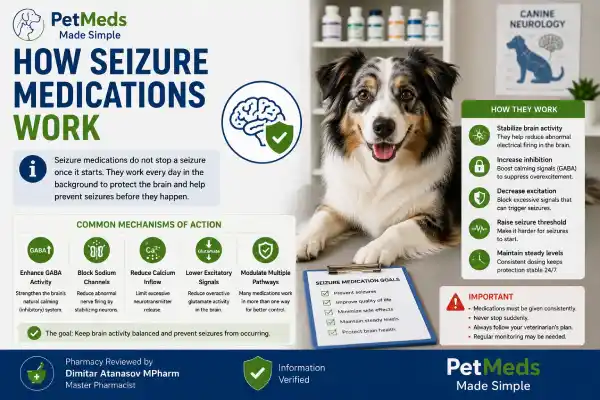
To understand can dogs miss a dose of seizure medication, it helps to understand how these medications protect the brain.
Although each anticonvulsant works differently, they all have the same overall objective:
Reduce excessive electrical activity within the brain.
Different medications accomplish this by:
- Increasing inhibitory neurotransmission
- Reducing excessive neuronal firing
- Stabilizing nerve cell membranes
- Decreasing abnormal electrical impulses
- Raising the seizure threshold
When blood concentrations remain stable, the brain is less likely to generate seizures.
If medication levels fall too far because doses are repeatedly missed, this protective effect may weaken.
Does Every Seizure Medication Behave the Same Way?
No.
One of the biggest misconceptions is that all anticonvulsants respond identically to a missed dose.
In reality, every medication has unique pharmacokinetic properties.
Some remain in the body for many hours.
Others leave the bloodstream relatively quickly.
This means the urgency of a missed dose varies considerably depending on the medication prescribed.
| Medication | Importance of Consistent Dosing | General Concern if One Dose Is Missed |
|---|---|---|
| Phenobarbital | Very High | Moderate to High |
| Levetiracetam (Keppra) | Very High | Moderate |
| Potassium Bromide | High | Usually Lower (long half-life) |
| Zonisamide | High | Moderate |
| Gabapentin (when used as adjunct therapy) | Moderate | Variable |
Your veterinarian will consider these differences when advising what to do after a missed dose.
What Happens Inside the Brain After a Missed Dose?
A missed dose does not immediately remove all medication from the bloodstream.
Instead, drug concentrations gradually decline.
As levels decrease:
- Protection against abnormal electrical activity slowly weakens.
- Brain cells become easier to stimulate.
- The seizure threshold may gradually decrease.
- Dogs susceptible to epilepsy become more vulnerable to breakthrough seizures.
Fortunately, this process usually occurs gradually rather than instantly.
This explains why many dogs remain completely normal after missing a single dose.
Does One Missed Dose Always Cause Another Seizure?
Thankfully, no.
One missed dose does not guarantee that your dog will experience another seizure.
Many dogs accidentally miss medication once during their lifetime and never develop any problems.
The likelihood depends on several important factors.
These include:
- The underlying cause of epilepsy.
- How well seizures are currently controlled.
- Which anticonvulsant is prescribed.
- Whether multiple medications are being used.
- How long the medication has been delayed.
- The dog’s overall health.
Dogs whose seizures have been well controlled for months generally have a lower immediate risk than dogs with severe or poorly controlled epilepsy.
Factors That Influence the Risk After Missing a Dose
Not every dog faces the same level of risk.
Veterinarians evaluate several variables before deciding whether additional treatment is necessary.
| Factor | Effect on Risk |
|---|---|
| Medication used | Some drugs require stricter timing than others |
| Number of missed doses | Multiple missed doses greatly increase concern |
| Seizure history | Dogs with frequent seizures require closer attention |
| Current seizure control | Poorly controlled epilepsy increases risk |
| Other medications | Combination therapy changes recommendations |
| Overall health | Concurrent illnesses may affect seizure control |
These factors explain why two dogs receiving different medications may receive completely different advice after missing a dose.
Can Missing a Dose Cause Cluster Seizures?
For some dogs, unfortunately, yes.
Dogs with a previous history of cluster seizures are generally considered higher-risk patients.
Cluster seizures occur when:
- Two or more seizures happen within 24 hours.
- Recovery between seizures is incomplete.
- Emergency treatment is sometimes required.
If a dog with this history misses anticonvulsant medication, veterinarians often recommend contacting the clinic sooner rather than later.
Owners of these dogs should always keep an updated seizure diary and emergency plan.
Which Dogs Are Most Sensitive to Missed Medication?
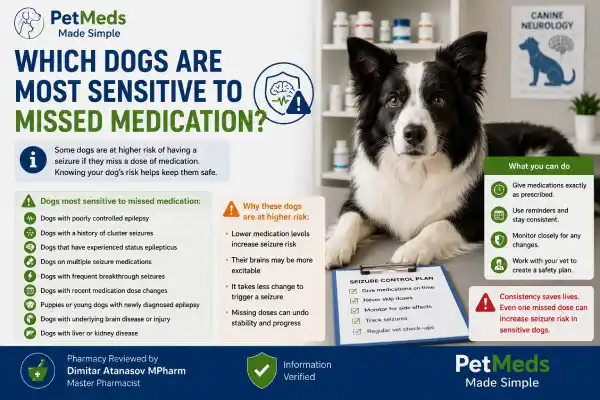
Some dogs tolerate occasional delays surprisingly well.
Others are much more vulnerable.
Higher-risk patients include:
- Dogs with poorly controlled epilepsy
- Dogs receiving multiple anticonvulsants
- Dogs with frequent breakthrough seizures
- Dogs that have previously experienced status epilepticus
- Dogs with cluster seizures
- Dogs whose medication doses were recently adjusted
These patients benefit the most from maintaining an extremely consistent medication schedule.
Can Dogs Build a Tolerance If Doses Are Missed?
No.
Missing medication does not cause the body to become resistant to seizure medication.
However, inconsistent administration may make it appear that the medication has “stopped working.”
In reality, fluctuating blood concentrations simply provide less reliable seizure protection.
This is one reason veterinarians emphasize giving anticonvulsants at approximately the same time every day.
Related PMMS Guides
If your dog receives seizure medication, you may also find these guides helpful:
- Can Seizure Medication Damage the Liver?
- Why Is My Dog Crying After a Seizure?
- Why Is My Dog Weak After Seizure Medication?
- Can Seizure Medication Cause Aggression in Dogs?
- Can Dogs Take Seizure Medication Long-Term
- Phenobarbital for Dogs: Uses, Dosage, Side Effects & Safety
- Levetiracetam (Keppra) for Dogs: Uses, Dosage, Side Effects & Safety
- Potassium Bromide for Dogs: Uses, Dosage, Side Effects & Safety
- Gabapentin for Dogs: Uses, Dosage, Side Effects & Safety
- Can Dogs Take Gabapentin and NSAIDs Together?
These resources explain common seizure medications, side effects, monitoring recommendations, and long-term treatment strategies in greater detail.
What Should You Do If Your Dog Misses a Dose of Seizure Medication?
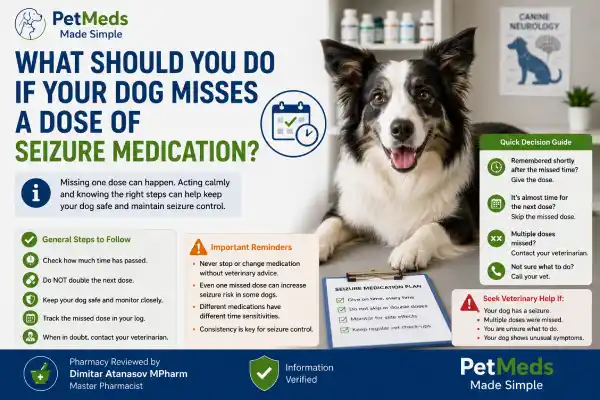
After realizing you’ve forgotten a dose, it’s natural to panic. Fortunately, in most situations, there is a safe way to respond, and acting calmly is usually far more helpful than making sudden changes to your dog’s medication schedule.
The correct action depends on several important factors:
- Which seizure medication your dog takes
- How long ago the dose was due
- Whether your dog receives one or multiple anticonvulsants
- Your veterinarian’s previous instructions
- Your dog’s seizure history
For this reason, there is no single answer that applies to every dog.
Never Double the Next Dose
One of the biggest mistakes owners make after searching “Can Dogs Miss a Dose of Seizure Medication?” is assuming they should simply give extra medication later.
This is usually NOT recommended.
Giving two doses together can significantly increase the risk of medication-related side effects without restoring stable drug concentrations.
Potential consequences include:
- Excessive sedation
- Difficulty standing
- Poor coordination
- Wobbliness
- Confusion
- Weakness
- Increased liver stress with certain medications
- Higher risk of adverse reactions
Unless your veterinarian specifically instructs otherwise, never attempt to “catch up” by giving double doses.
General Guidance After Missing a Dose
Although every patient is different, veterinarians often follow general principles similar to these.
| Situation | Typical Recommendation |
|---|---|
| You remember shortly after the scheduled time | Give the dose unless instructed otherwise by your veterinarian. |
| It’s almost time for the next dose | Skip the missed dose and continue the regular schedule. |
| Multiple doses have been missed | Contact your veterinarian before restarting treatment. |
| Your dog has a seizure after missing medication | Seek veterinary advice immediately. |
| You are unsure what to do | Call your veterinary clinic rather than guessing. |
These are general recommendations only and should never replace instructions from the veterinarian managing your dog’s epilepsy.
Why Timing Matters
One reason Can Dogs Miss a Dose of Seizure Medication is such an important question is that anticonvulsants depend on maintaining relatively stable blood concentrations.
Every medication has a characteristic half-life, which is the time required for approximately half of the drug to leave the bloodstream.
Medications with shorter half-lives lose their protective effects more quickly if doses are delayed.
Others remain in the body much longer.
This is one reason why veterinarians may respond differently depending on which anticonvulsant your dog receives.
Which Medications Are Most Sensitive to Missed Doses?
Not every anticonvulsant behaves the same way.
Some require much stricter timing than others.
| Medication | Approximate Concern After One Missed Dose | Reason |
|---|---|---|
| Phenobarbital | High | Blood concentrations gradually fall, reducing seizure protection. |
| Levetiracetam (Keppra) | High | Shorter duration means delayed doses may become significant sooner. |
| Zonisamide | Moderate to High | Consistent dosing improves seizure control. |
| Potassium Bromide | Lower after one missed dose | Very long half-life provides greater buffering. |
| Gabapentin (adjunct therapy) | Variable | Depends on why it is prescribed and whether other anticonvulsants are used. |
This table illustrates why veterinarians individualize treatment recommendations instead of using the same advice for every patient.
What If Your Dog Misses Phenobarbital?
Phenobarbital remains one of the most commonly prescribed anticonvulsants in dogs.
Because it must maintain relatively stable blood levels, consistent administration is extremely important.
Missing a single dose does not automatically cause a seizure, but repeated missed doses can significantly reduce seizure control.
Owners taking care of dogs receiving phenobarbital should also read our guide:
Phenobarbital for Dogs: Uses, Dosage, Side Effects & Safety
That article explains monitoring, blood testing, liver health, and long-term treatment in greater detail.
What If Your Dog Misses Levetiracetam (Keppra)?
Levetiracetam has a shorter duration of action than several other seizure medications.
For this reason, delayed doses may become clinically important sooner.
Many neurologists recommend maintaining particularly consistent dosing schedules for dogs receiving levetiracetam.
If your dog repeatedly misses doses, discuss practical scheduling strategies with your veterinarian rather than adjusting the medication yourself.
What If Your Dog Misses Potassium Bromide?
Potassium bromide behaves differently.
Unlike most anticonvulsants, it has an exceptionally long half-life.
This means blood concentrations change much more slowly.
As a result, one missed dose is often less concerning than with some other seizure medications.
However, this does not mean owners should intentionally skip doses.
Long-term consistency remains essential for maintaining seizure control.
What If Your Dog Takes More Than One Seizure Medication?
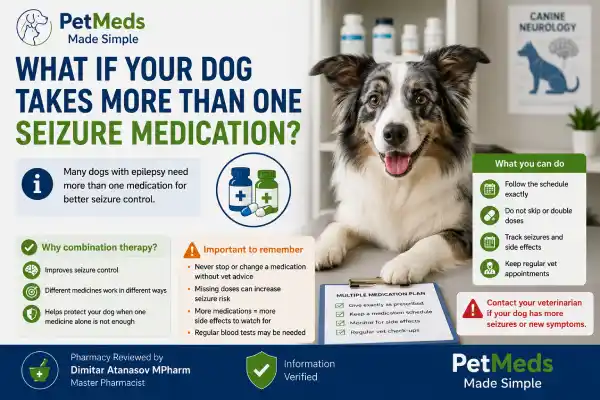
Many dogs with difficult-to-control epilepsy receive combination therapy.
Examples include:
- Phenobarbital plus potassium bromide
- Phenobarbital plus levetiracetam
- Levetiracetam plus zonisamide
- Multiple anticonvulsants with gabapentin as adjunct therapy
These dogs generally require even greater attention to medication schedules.
Missing one medication may reduce the overall effectiveness of the treatment plan.
Owners should avoid making independent adjustments without veterinary guidance.
Can Missing a Dose Trigger Breakthrough Seizures?
Unfortunately, it can.
A breakthrough seizure is a seizure that occurs despite ongoing anticonvulsant therapy.
Possible triggers include:
- Missed medication
- Severe illness
- Fever
- Metabolic disease
- Drug interactions
- Progression of epilepsy
- Significant stress in susceptible dogs
However, it is important to remember that not every breakthrough seizure is caused by a missed dose.
Even perfectly medicated dogs may occasionally experience seizures because epilepsy is often unpredictable.
Does Missing Medication Increase the Risk of Status Epilepticus?
Status epilepticus is one of the most serious neurological emergencies in veterinary medicine.
It involves:
- A seizure lasting several minutes without stopping
or
- Multiple seizures occurring without full recovery between them.
Although missing one dose does not automatically cause status epilepticus, repeated missed doses may increase seizure risk in susceptible patients.
Dogs with a previous history of prolonged seizures should follow medication schedules especially carefully and have an emergency plan established with their veterinarian.
Can Stress Make Missing a Dose Even Worse?
Yes.
Stress alone does not usually cause epilepsy, but it may contribute to seizure occurrence in some predisposed dogs.
Examples include:
- Boarding
- Long-distance travel
- Veterinary visits
- Major household changes
- Illness
- Surgery
If these stressful events occur at the same time a seizure medication dose is missed, the combined effect may further reduce seizure stability in susceptible patients.
For this reason, maintaining the regular medication schedule during stressful periods is especially important.
Can Missing Several Doses Become Dangerous?
While owners often search “Can Dogs Miss a Dose of Seizure Medication?” after forgetting a single tablet, veterinarians become much more concerned when multiple consecutive doses are missed.
Every missed dose allows anticonvulsant concentrations to decline further.
Eventually, medication levels may fall below the therapeutic range needed to help prevent seizures.
Repeated missed doses may increase the risk of:
- Breakthrough seizures
- Cluster seizures
- Status epilepticus
- More frequent seizure episodes
- Loss of previously stable seizure control
- Emergency hospitalization
Dogs that have missed medication for an entire day—or longer—should generally be evaluated by their veterinarian before the normal schedule is resumed.
What Happens If Seizure Medication Is Stopped Suddenly?
Many owners asking “Can Dogs Miss a Dose of Seizure Medication?” are also wondering whether stopping the medication altogether is dangerous.
For most dogs receiving long-term anticonvulsant therapy, the answer is yes.
Seizure medications should never be discontinued suddenly without veterinary supervision.
Abrupt discontinuation may lead to:
- Rapid loss of seizure protection
- Increased seizure frequency
- Cluster seizures
- Status epilepticus
- Severe neurological emergencies
This is especially true for medications such as phenobarbital, where gradual dose reduction is often recommended if treatment must be discontinued.
If your veterinarian decides the medication should be stopped, a carefully planned tapering schedule is usually much safer than sudden withdrawal.
Can Missing a Dose Cause Withdrawal?
True withdrawal reactions are uncommon after a single missed dose.
However, dogs receiving anticonvulsants for months or years may become physiologically accustomed to steady medication levels.
Repeatedly missing doses or suddenly stopping treatment may contribute to:
- Increased nervous system excitability
- Return of seizures
- Anxiety
- Restlessness
- Tremors
- Increased sensitivity to external stimuli
Fortunately, these situations are largely preventable by maintaining a consistent medication schedule.
What If Your Dog Has a Seizure After Missing Medication?
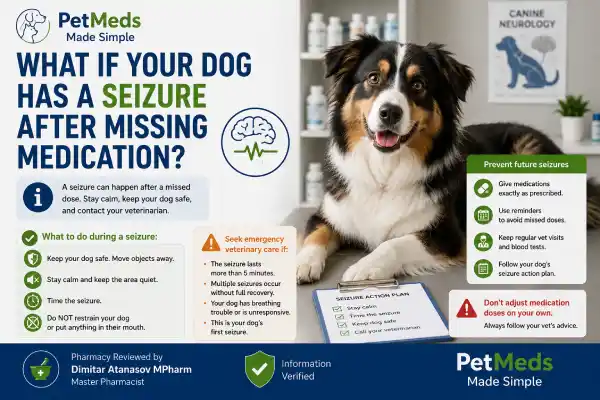
If your dog experiences a seizure after missing medication, remain as calm as possible.
Your first priority is your dog’s safety.
During the seizure
- Move nearby furniture away if possible.
- Keep your hands away from your dog’s mouth.
- Dim bright lights.
- Reduce loud noises.
- Time the seizure using a phone or watch.
Never attempt to restrain your dog during the seizure.
After the seizure
Many dogs enter a post-ictal phase, during which they may appear:
- Confused
- Blind temporarily
- Restless
- Hungry
- Thirsty
- Unsteady
- Vocal
- Disoriented
This recovery period is often more frightening for owners than the seizure itself.
If you’re unfamiliar with this stage, our PMMS guide Why Is My Dog Crying After a Seizure? explains what owners can expect during post-ictal recovery.
When Should You Seek Emergency Veterinary Care?
Some situations require immediate veterinary attention.
Seek emergency care if:
- A seizure lasts longer than five minutes.
- Multiple seizures occur within 24 hours.
- Your dog fails to recover between seizures.
- Severe breathing difficulty develops.
- Your dog remains unconscious.
- A toxin exposure is suspected.
- The seizure follows significant trauma.
- Your veterinarian has instructed you to seek emergency care after missed medication.
These situations should never be managed at home without professional guidance.
How Veterinarians Decide What To Recommend
When owners call after missing seizure medication, veterinarians rarely give identical advice to every patient.
Instead, they consider the entire clinical picture.
Questions commonly include:
- Which anticonvulsant is being used?
- How many doses have been missed?
- When was the last seizure?
- Has the dog ever had cluster seizures?
- Has status epilepticus occurred previously?
- Is this newly diagnosed epilepsy?
- Are other anticonvulsants being administered?
- Does the dog have liver or kidney disease?
- Have recent blood drug concentrations been checked?
This individualized approach helps minimize seizure risk while avoiding unnecessary medication complications.
Tips to Avoid Missing Future Doses
Preventing missed doses is far easier than dealing with the consequences afterward.
Many owners successfully use:
- Smartphone alarms
- Medication reminder apps
- Weekly pill organizers
- Written medication logs
- Calendar reminders
- Automatic pill dispensers
- Family medication schedules
Consistency is particularly important for dogs receiving long-term epilepsy treatment.
Related Symptoms Owners Often Notice
Owners searching “Can Dogs Miss a Dose of Seizure Medication?” frequently report additional concerns.
Common symptoms include:
- Restlessness
- Increased pacing
- Anxiety
- Temporary weakness
- Mild disorientation
- Reduced appetite
- Excessive sleepiness
- Hyperactivity
- Increased vocalization
- Shaking
- Trembling
Many of these symptoms may result from the underlying neurological disease rather than the missed medication itself.
When Owners Commonly Ask This
Veterinary clinics frequently receive questions such as:
- “I forgot my dog’s seizure medication this morning. What should I do?”
- “Can I give two doses together?”
- “My dog missed yesterday’s medication—is that dangerous?”
- “Will missing one dose cause another seizure?”
- “Should I restart the medication today?”
- “How late is too late to give a seizure medication?”
- “Does phenobarbital have to be given exactly on time?”
- “Can Keppra be delayed by a few hours?”
- “Should I call the emergency veterinarian?”
- “What happens if my dog misses medication while we’re traveling?”
These are all common questions, and the safest answer depends on your dog’s diagnosis, seizure history, and specific medication.
Veterinarian Takeaway
If you’re wondering “Can Dogs Miss a Dose of Seizure Medication?”, remember that one accidentally missed dose does not automatically mean your dog will have another seizure. However, anticonvulsants work best when they are given consistently, and repeatedly missing doses can significantly reduce seizure control.
Never double the next dose unless specifically instructed by your veterinarian. Dogs with poorly controlled epilepsy, previous cluster seizures, or status epilepticus require especially careful medication management. When in doubt, contact your veterinarian rather than guessing.
Bottom Line
Can Dogs Miss a Dose of Seizure Medication?
Yes but the answer depends on the medication, your dog’s medical history, and how much time has passed.
Most dogs will not experience immediate complications after missing a single dose, but maintaining a consistent dosing schedule remains one of the most effective ways to reduce seizure frequency and improve long-term seizure control.
If multiple doses have been missed or your dog develops seizures after a missed dose, seek veterinary guidance promptly rather than attempting to adjust the medication yourself.
Frequently Asked Questions – Can Dogs Miss a Dose of Seizure Medication
Can dogs miss one dose of seizure medication?
Yes. Most dogs tolerate one missed dose without immediate problems, but you should follow your veterinarian’s instructions and avoid making up doses on your own.
Should I give two doses if I forget one?
No. Double dosing can increase the risk of side effects and is generally not recommended unless specifically instructed by your veterinarian.
Can missing one dose trigger a seizure?
It can in some dogs, especially those with poorly controlled epilepsy, but many dogs will not have a seizure after a single missed dose.
Which seizure medication is most sensitive to missed doses?
Phenobarbital and levetiracetam generally require particularly consistent dosing because maintaining stable blood concentrations is important for seizure control.
Is potassium bromide different?
Yes. Potassium bromide has a very long half-life, so one missed dose is often less significant than with some other anticonvulsants, although regular dosing is still essential.
What if my dog misses medication while traveling?
Contact your veterinarian if you’re unsure how to proceed. Planning ahead and carrying extra medication can help prevent missed doses during trips.
Can I change the medication schedule myself?
No. Any changes to seizure medication should always be discussed with your veterinarian first.
What if my dog has a seizure after missing medication?
Keep your dog safe, time the seizure, and contact your veterinarian immediately. Seek emergency care for prolonged or repeated seizures.
How can I prevent missed doses?
Medication reminders, alarms, pill organizers, and written treatment schedules are all excellent ways to reduce medication errors.
When should I call the emergency veterinarian?
Seek emergency care if seizures last longer than five minutes, occur repeatedly without full recovery, or if your veterinarian has advised emergency evaluation based on your dog’s history.
Sources
- Plumb’s Veterinary Drug Handbook
- Merck Veterinary Manual
- BSAVA Small Animal Formulary
- Veterinary Pharmacology and Therapeutics (Riviere & Papich)
- Small Animal Clinical Pharmacology (Maddison, Page & Church)
- American College of Veterinary Internal Medicine (ACVIM) Consensus Statement on Seizure Management
- International Veterinary Epilepsy Task Force (IVETF) Consensus Guidelines
- Veterinary Information Network (VIN)
- Journal of Veterinary Internal Medicine (JVIM)
- Frontiers in Veterinary Science
- PubMed (peer-reviewed studies on canine epilepsy, anticonvulsant pharmacokinetics, and long-term seizure management)
Medical Review Statement
This article was written by Dimitar Georgiev Atanasov, MPharm, pharmacy and scientifically reviewed by Gergana Krasimirova Atanasova, MPharm, and independently veterinary reviewed by Dr. Valcho Georgiev Valchev, DVM. It is based on current veterinary pharmacology references, peer-reviewed scientific literature, canine epilepsy guidelines, and evidence-based veterinary recommendations to ensure accurate, practical, and trustworthy information for dog owners.
Important Medical Disclaimer
The information provided on PetMedsMadeSimple.com is intended for educational purposes only and should not replace professional veterinary diagnosis or treatment.
Never start, stop, or adjust your dog’s seizure medication without consulting your veterinarian. If your dog develops prolonged seizures, repeated seizures without recovery, collapse, severe breathing difficulties, or becomes unresponsive, seek emergency veterinary care immediately.
Image Disclosure
Some images used in this article may be AI-generated or AI-assisted for educational purposes. Every PMMS article is independently researched, pharmacy-written, scientifically reviewed, and veterinary-reviewed. AI-generated illustrations are used solely to improve understanding of veterinary medications and should not be interpreted as photographs of actual clinical patients.