
Quick Answer
Can Dogs Take Gabapentin Every 8 Hours? Yes many dogs are prescribed gabapentin every 8 hours when veterinarians need consistent pain control or stable medication levels throughout the day. The ideal dosing interval depends on the dog’s medical condition, age, kidney function, and treatment goals. Some dogs receive gabapentin every 8 hours, while others may take it every 12 or even every 24 hours under veterinary supervision.
Why Owners Ask This Question
One of the most confusing parts of bringing home a new prescription is reading the label.
Many owners expect to see:
“Give once daily.”
Instead, they discover instructions like:
Give every 8 hours.
Immediately, several questions arise.
- Why does my dog need three doses a day?
- Couldn’t I just give it twice daily?
- Do I have to wake up during the night?
- What happens if I’m an hour late?
- Can I adjust the schedule to fit my work?
- Is every 8 hours really necessary?
These are excellent questions because the dosing interval is just as important as the dose itself.
Understanding why veterinarians recommend specific schedules helps owners administer gabapentin safely while avoiding common medication mistakes.
Throughout this guide, you may also find these PMMS articles helpful:
- What Happens If Gabapentin Is Given Too Early?
- What Happens If Gabapentin Is Given Too Late?
- Can Dogs Miss a Dose of Gabapentin?
- Does Gabapentin Build Up in a Dog’s System?
- Can Dogs Take Gabapentin Long-Term Safely?
- Gabapentin for Dogs: Vet Guidelines, Uses, Dosage & Safety
Can Dogs Take Gabapentin Every 8 Hours?
Why Some Dogs Need Three Daily Doses

One of the biggest misconceptions is that every dog should receive gabapentin on the same schedule.
In reality, veterinarians individualize treatment based on the dog’s medical condition.
An every-8-hour schedule is often chosen because it helps maintain more consistent medication levels throughout the day.
This may be especially helpful for dogs receiving gabapentin for:
- chronic neuropathic pain
- severe osteoarthritis
- postoperative pain
- spinal disorders
- neurological conditions
- seizure management as part of combination therapy
Rather than allowing medication levels to fluctuate widely, shorter dosing intervals can provide steadier symptom control for certain patients.
Why Gabapentin Does Not Work All Day in Every Dog
Many medications remain effective for 24 hours after a single dose.
Gabapentin is different.
Although every dog processes medications differently, gabapentin is generally eliminated from the body much sooner than many owners expect.
This is one reason veterinarians sometimes recommend:
- every 8 hours
- every 12 hours
- every 24 hours
instead of relying on a single daily dose.
The goal is not to give more medication than necessary.
Instead, it is to maintain an appropriate level of symptom control while minimizing side effects.
How Veterinarians Choose the Right Dosing Interval
When deciding whether a dog should receive gabapentin every 8 hours, veterinarians evaluate much more than body weight.
Important considerations include:
- the medical condition being treated
- severity of pain
- neurological disease
- kidney function
- age
- concurrent medications
- previous response to treatment
For example, a young dog recovering from orthopedic surgery may require a different schedule than a senior dog receiving long-term treatment for chronic arthritis.
The interval is always chosen to match the individual patient’s needs rather than following one universal rule.
Why Arthritis and Nerve Pain Often Require Consistent Coverage

Dogs living with chronic arthritis or neuropathic pain often benefit from maintaining relatively stable medication levels.
Unlike sudden injuries that gradually heal, chronic conditions produce ongoing discomfort.
If medication levels fluctuate significantly, owners may notice:
- increased stiffness before the next dose
- difficulty standing
- reluctance to exercise
- restlessness
- reduced mobility
Maintaining a consistent schedule may help reduce these fluctuations and provide steadier pain control throughout the day.
Does Every Dog Need Gabapentin Every 8 Hours?
No.
One of the most important points in this article is that every 8 hours is not automatically the best schedule for every dog.
Some dogs respond very well to:
- every 12 hours
Others may require:
- every 24 hours
Certain patients may even need temporary schedule adjustments during recovery from surgery or while another medical condition is being treated.
This flexibility is one reason owners should never compare their dog’s prescription with another pet’s medication schedule.
Can the Schedule Be Adjusted to Fit Daily Life?
Owners frequently ask whether they can simply move the dosing times to better match work or family routines.
Sometimes the answer is yes, but any changes should be planned rather than made randomly.
Veterinarians often help owners create schedules that are:
- practical
- consistent
- easy to remember
- appropriate for the prescribed dosing interval
For example, if a dog truly requires medication every 8 hours, the veterinarian may recommend administration times that fit the household’s daily routine while still maintaining consistent intervals.
The key is avoiding large day-to-day changes that cause medication levels to fluctuate unnecessarily.
Why Consistency Matters More Than Perfect Precision
Many owners become anxious if they administer a dose a few minutes later than planned.
Fortunately, veterinarians understand that real life is not perfectly predictable.
The goal is consistency, not perfection.
A schedule that remains reasonably stable from day to day is usually much more valuable than constantly changing administration times in an attempt to achieve exact precision.
This consistency helps veterinarians better evaluate:
- symptom control
- possible side effects
- whether dose adjustments are needed
- long-term treatment success
One Schedule Does Not Fit Every Medical Condition
Another important reason veterinarians individualize gabapentin schedules is that the medication is prescribed for many different purposes.
For example, the dosing frequency may differ between dogs receiving gabapentin for:
- chronic arthritis
- postoperative recovery
- neuropathic pain
- spinal disease
- seizure disorders
- anxiety before veterinary visits
Although the same medication is being used, the treatment goals are often very different.
This is why two dogs of similar size may legitimately receive completely different dosing schedules.
Can Every 12 Hours Be Enough Instead?

One of the most common follow-up questions after “Can Dogs Take Gabapentin Every 8 Hours?” is whether the medication could simply be given twice a day instead.
The answer is:
Sometimes but not always.
Some dogs achieve excellent symptom control with dosing every 12 hours.
Others begin showing signs of discomfort several hours before the next scheduled dose.
Veterinarians determine the most appropriate interval by considering:
- the condition being treated
- severity of pain
- response to previous therapy
- kidney function
- concurrent medications
- overall treatment goals
Rather than assuming every dog requires the same schedule, veterinarians individualize treatment for each patient.
Why Some Dogs Benefit From More Frequent Dosing
Gabapentin is often prescribed to control continuous symptoms, not occasional discomfort.
For example, dogs suffering from chronic neuropathic pain or advanced arthritis may experience pain throughout both the day and the night.
If medication levels decrease too much before the next scheduled dose, owners may notice:
- limping
- stiffness
- restlessness
- reluctance to walk
- crying before the next dose
- difficulty getting comfortable
For these patients, maintaining steadier medication levels may provide more consistent pain relief.
This is one reason an every-8-hour schedule is sometimes recommended.
What Happens If You Cannot Follow an Every-8-Hour Schedule?
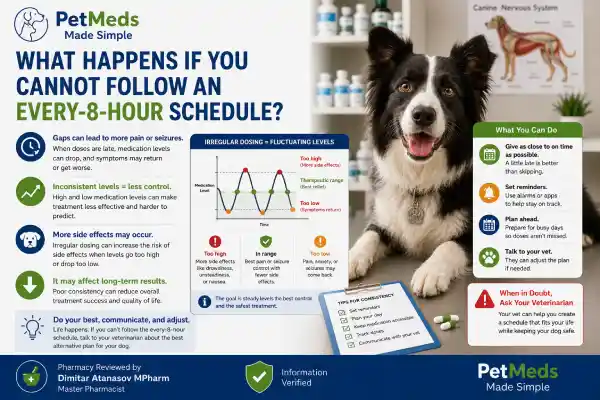
Many owners worry that work, school, or family responsibilities make an every-8-hour schedule impossible.
This is an important conversation to have with your veterinarian.
Rather than changing the schedule independently, discuss practical concerns before starting treatment.
Depending on your dog’s medical condition, your veterinarian may decide to:
- maintain the current schedule
- adjust administration times
- modify the treatment plan
- add another therapy
- recommend a different dosing interval
The goal is always to develop a treatment plan that is both effective and realistic for long-term success.
Can Dogs Sleep Through the Night?
One question veterinarians hear surprisingly often is:
“If my dog takes gabapentin every 8 hours, do I need to wake up during the night?”
The answer depends entirely on the prescribed schedule.
Some treatment plans naturally fit within normal waking hours.
For example:
- 6:00 AM
- 2:00 PM
- 10:00 PM
Other dogs with different medical conditions may require a schedule specifically recommended by their veterinarian.
Owners should never adjust the interval simply to avoid nighttime dosing without discussing it first.
Fortunately, many schedules can be planned to minimize disruption while still maintaining consistent medication coverage.
How Kidney Disease Can Change the Dosing Interval
One of the reasons veterinarians individualize gabapentin schedules is that the medication is eliminated primarily through the kidneys.
Dogs with reduced kidney function may eliminate gabapentin more slowly than healthy dogs.
Because of this, veterinarians may recommend:
- longer intervals between doses
- lower doses
- closer monitoring
- periodic reassessment
This adjustment is intended to maintain appropriate medication levels while reducing the likelihood of excessive accumulation.
Owners of dogs with kidney disease should never change the schedule on their own.
Why One Missed or Delayed Dose Does Not Automatically Mean the Schedule Is Wrong
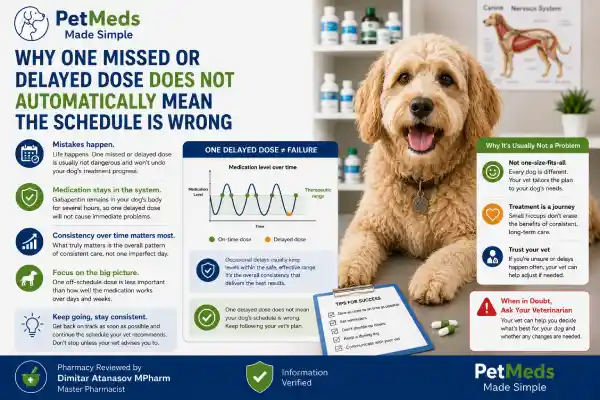
Owners sometimes assume that one delayed dose means the prescribed schedule is too complicated.
Usually, this is not the case.
Life happens.
Appointments run late.
Traffic delays occur.
People occasionally forget.
One isolated mistake does not necessarily mean your dog needs a completely different treatment plan.
Instead, veterinarians look for patterns.
Questions they commonly ask include:
- Does your dog remain comfortable between doses?
- Are symptoms returning before the next scheduled administration?
- Are medication reminders helping?
- Have multiple timing errors occurred recently?
These answers provide much more useful information than a single late dose.
If you’ve recently administered gabapentin later or earlier than planned, our companion articles What Happens If Gabapentin Is Given Too Late? and What Happens If Gabapentin Is Given Too Early? explain how veterinarians evaluate these common medication timing mistakes.
Comparing Common Gabapentin Dosing Intervals
The following table illustrates why different schedules are used for different patients.
| Dosing Interval | Common Situations | Veterinary Goal |
|---|---|---|
| Every 8 hours | Chronic neuropathic pain, severe arthritis, some seizure management plans | Maintain steadier medication levels throughout the day |
| Every 12 hours | Many chronic pain conditions, moderate arthritis, long-term outpatient treatment | Balance symptom control with owner convenience |
| Every 24 hours | Selected patients, individualized treatment plans, certain medical conditions | Simplify treatment while meeting therapeutic goals |
The correct interval always depends on the individual dog rather than a universal dosing rule.
Why Veterinarians Sometimes Adjust the Schedule Over Time
Gabapentin schedules are not always permanent.
As your dog’s condition changes, the veterinarian may recommend adjustments.
Examples include:
- improvement after surgery
- progression of chronic arthritis
- changes in kidney function
- addition of another pain medication
- weight changes
- changes in overall health
Rather than continuing the exact same schedule indefinitely, veterinarians regularly reassess whether the current dosing interval still provides the best balance between effectiveness and safety.
Does Every Dog Respond the Same Way to Gabapentin?

No.
Even dogs with the same diagnosis may respond differently.
For example:
Two Labradors of similar age and weight may both have osteoarthritis.
One remains comfortable with medication every 12 hours.
The other develops noticeable stiffness several hours before the next dose and benefits from an every-8-hour schedule.
Individual variation is completely normal.
This is why veterinarians evaluate each patient’s response instead of relying solely on standardized dosing schedules.
What If an Every-8-Hour Schedule Isn’t Practical?
Life doesn’t always fit neatly into an every-8-hour medication schedule.
Many owners work full-time, travel, or have family responsibilities that make perfectly timed dosing difficult.
If you think maintaining the prescribed schedule will be challenging, the best approach is to discuss it with your veterinarian before making any changes.
Depending on your dog’s condition, your veterinarian may recommend:
- adjusting the administration times
- changing the dosing interval
- adding another medication
- using a different pain management strategy
- scheduling follow-up monitoring
The goal is to create a treatment plan that your family can realistically follow every day.
A schedule that works consistently is almost always better than one that is frequently interrupted.
Can Owners Change the Schedule Without Veterinary Advice?

One of the biggest mistakes owners make is assuming they can simply adjust the schedule themselves.
For example, changing from:
- every 8 hours
to
- every 12 hours
may seem like a small difference.
However, depending on the condition being treated, this change could reduce symptom control.
Likewise, giving doses much closer together than prescribed may increase the likelihood of side effects.
Rather than making changes independently, contact your veterinarian whenever:
- work schedules change
- travel is planned
- medication administration becomes difficult
- side effects develop
- symptom control appears inadequate
Small schedule adjustments are sometimes appropriate—but they should always be planned.
Can an Every-8-Hour Schedule Change Later?
Yes.
One important aspect of long-term veterinary care is that treatment plans evolve.
As your dog’s condition changes, the veterinarian may decide that a different dosing interval is more appropriate.
Examples include:
- recovery after surgery
- improvement following rehabilitation
- progression of arthritis
- weight changes
- changes in kidney function
- addition of another pain medication
This flexibility allows treatment to remain individualized throughout your dog’s life.
How Owners Can Make an Every-8-Hour Schedule Easier

Consistency becomes much easier when medication is incorporated into daily routines.
Helpful strategies include:
- setting recurring phone alarms
- using a written medication chart
- keeping medication in the same location
- assigning one family member to each scheduled dose
- recording each administration immediately
- preparing medication before busy mornings
Many owners also find that linking medication times with regular daily activities—such as meals or evening walks—helps reduce forgotten doses.
These simple habits often prevent both early and late dosing mistakes.
Why Communication With Your Veterinarian Matters
Medication schedules are not meant to make life difficult.
They are designed to provide the best possible symptom control for your individual dog.
If the prescribed schedule becomes difficult to maintain, tell your veterinarian.
In many cases, there are several options available.
Rather than viewing the conversation as “asking permission,” think of it as working together to develop a treatment plan that is:
- effective
- practical
- safe
- sustainable
This partnership is one of the foundations of successful long-term pain management.
Veterinarian Takeaway
Can Dogs Take Gabapentin Every 8 Hours?
For many dogs, yes.
Veterinarians commonly prescribe an every-8-hour schedule when more consistent medication coverage is needed for chronic pain, neuropathic pain, postoperative recovery, or certain neurological conditions.
However, not every dog requires the same dosing interval.
The most appropriate schedule depends on:
- the condition being treated
- the dog’s response to therapy
- kidney function
- concurrent medications
- overall health
Owners should follow the prescribed schedule as closely as possible and discuss any practical difficulties before making changes on their own.
Bottom Line
Can Dogs Take Gabapentin Every 8 Hours? Yes many dogs safely receive gabapentin every 8 hours when this dosing interval best supports consistent symptom control.
The schedule is chosen for a reason.
Rather than following a universal rule, veterinarians individualize dosing based on each dog’s medical condition, response to treatment, and overall health.
If maintaining an every-8-hour schedule becomes difficult, the safest solution is to work with your veterinarian rather than changing the interval independently.
Consistent administration, regular follow-up evaluations, and open communication help ensure gabapentin remains both safe and effective throughout treatment.
Frequently Asked Questions – Can Dogs Take Gabapentin Every 8 Hours?
Can dogs take gabapentin every 8 hours?
Yes. Many dogs receive gabapentin every 8 hours when veterinarians want to maintain more consistent medication levels and symptom control.
Why does my veterinarian recommend every 8 hours instead of every 12 hours?
Some medical conditions require more consistent medication coverage. Your veterinarian chooses the interval based on your dog’s individual needs rather than using the same schedule for every patient.
Can I change the schedule to every 12 hours on my own?
No. Any changes to the dosing interval should first be discussed with your veterinarian.
What if I cannot follow an every-8-hour schedule?
Contact your veterinarian. In some cases, adjustments may be possible depending on your dog’s condition and treatment goals.
Does every dog need gabapentin three times a day?
No. Some dogs receive gabapentin every 12 hours or every 24 hours. The correct schedule depends on the individual patient.
Can kidney disease affect how often gabapentin is given?
Yes. Because gabapentin is primarily eliminated through the kidneys, dogs with kidney disease may require individualized dosing schedules.
Is it dangerous if one dose is slightly late?
A single slightly delayed dose is often not an emergency, but owners should avoid making additional schedule changes without veterinary guidance.
How can I remember an every-8-hour medication schedule?
Smartphone reminders, medication logs, written calendars, and consistent daily routines are among the most effective ways to prevent missed or delayed doses.
Sources
- Plumb DC. Plumb’s Veterinary Drug Handbook. Latest Edition.
- Papich MG. Saunders Handbook of Veterinary Drugs: Small and Large Animal.
- 2022 AAHA Pain Management Guidelines for Dogs and Cats.
- Merck Veterinary Manual – Gabapentin.
- Merck Veterinary Manual – Pain Management in Dogs.
- BSAVA Small Animal Formulary.
- Veterinary Information Network (VIN).
- Grimm KA, Lamont LA, Tranquilli WJ, Greene SA, Robertson SA. Veterinary Anesthesia and Analgesia.
- WSAVA Global Pain Council Guidelines.
- Frontiers in Veterinary Science – Pain Management and Analgesia in Companion Animals.
Medical Review Statement – Can Dogs Take Gabapentin Every 8 Hours?
This article was written by Dimitar Georgiev Atanasov, MPharm, scientifically reviewed by Gergana Krasimirova Atanasova, MPharm, and independently veterinary reviewed by Dr. Valcho Georgiev Valchev, DVM. It is intended for educational purposes only and should never replace individualized veterinary diagnosis, medication management, or professional treatment recommendations.
Image Disclosure
Image Disclosure: Some images used in this article may be AI-generated to illustrate veterinary concepts, medication timing, and dosing schedules. They are intended for educational purposes only and should not replace professional veterinary advice.