Quick Answer
Can Pain Medication Cause Panting at Night? Yes, pain medication can sometimes contribute to panting at night in dogs, but it is far from the only explanation. In clinical practice, veterinarians more commonly find that nighttime panting is related to the painful condition being treated, breakthrough pain as medication begins wearing off, anxiety, overheating, postoperative discomfort, or another medical problem rather than a direct medication side effect. The timing of the panting, the specific medication used, your dog’s overall behavior, and any additional symptoms are all important factors when determining the true cause.
Key Takeaways
| Question | Short Answer |
|---|---|
| Can pain medication cause panting at night? | Yes, but it is not the most common cause. |
| Should you stop the medication? | No. Never stop prescription pain medication without veterinary advice. |
| Is panting always a medication side effect? | No. Pain, anxiety, heart disease, respiratory disease, and overheating are often more likely explanations. |
| Can arthritis cause nighttime panting? | Yes. Many dogs become stiffer and more uncomfortable after resting for several hours. |
| When is it an emergency? | If panting is accompanied by breathing difficulty, collapse, blue gums, abdominal swelling, or repeated vomiting. |
Why This Question Is More Common Than Most Owners Realize
One of the interesting things about the search query “Can Pain Medication Cause Panting at Night?” is that owners rarely ask it immediately after giving medication.
Instead, the scenario usually unfolds like this:
Your dog receives a prescribed pain medication in the evening or earlier in the day.
Everything appears normal for several hours.
The house becomes quiet.
Everyone goes to bed.
Then, sometime during the night, your dog starts breathing faster than usual, begins pacing around the room, repeatedly changes sleeping positions, or starts panting despite the room feeling comfortably cool.
Within minutes, many owners begin wondering whether they accidentally caused the problem by giving the medication.
That concern is understandable because panting is one of those symptoms that can range from completely harmless to potentially life-threatening.
Unlike vomiting or diarrhea, panting does not point toward one specific disease. It is a general response that can occur for many different reasons, including pain, emotional stress, fever, overheating, heart disease, respiratory disease, metabolic disorders, and occasionally medication-related effects.
The challenge is that these causes often look very similar without a physical examination.
Can Pain Medication Cause Panting at Night?
Why Veterinarians Rarely Blame the Medication First
One of the biggest misconceptions surrounding Can Pain Medication Cause Panting at Night is assuming that the medication must be responsible simply because the panting happened after the dose was given.
Veterinarians try to avoid this type of thinking because timing alone does not prove causation.
For example, consider a senior Golden Retriever with chronic osteoarthritis.
The dog receives carprofen every morning.
Throughout the day the medication controls inflammation effectively, allowing the dog to walk comfortably.
By late evening, however, the anti-inflammatory effect gradually decreases while the dog’s joints have also become stiff after lying down for several hours.
The dog begins panting.
Many owners conclude:
“The medication caused the panting.”
From a veterinary perspective, the opposite explanation is often more likely.
The medication may no longer be providing enough pain relief to cover the entire night.
Recognizing this difference is extremely important because the treatment plan changes completely depending on the underlying cause.
Stopping an effective medication unnecessarily may actually worsen your dog’s discomfort.
Why Nighttime Makes Panting More Noticeable
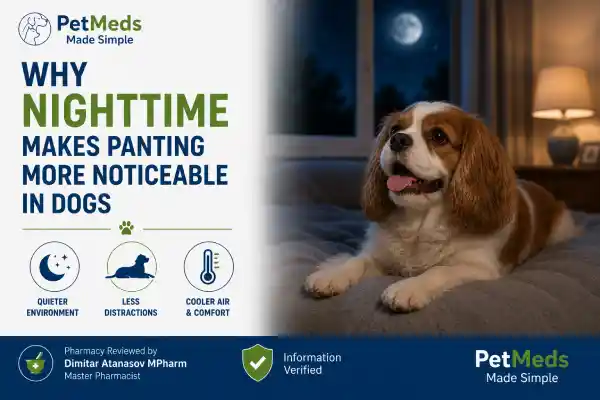
Many owners are convinced their dog only pants after taking medication.
Sometimes that is true.
However, nighttime itself changes both the dog’s behavior and the owner’s perception.
Several factors contribute.
Less Household Activity
During the day dogs are distracted by:
- family members,
- meals,
- walks,
- toys,
- outdoor activity,
- normal household sounds.
Pain and mild discomfort may be less obvious because the dog remains occupied.
Once the house becomes quiet, subtle behavioral changes become much easier to notice.
Joint Stiffness After Rest
Dogs with arthritis often feel reasonably comfortable while moving.
After remaining still for several hours, however, inflamed joints become stiffer.
Many dogs repeatedly stand up, circle the room, lie back down, and then repeat the process.
Panting commonly accompanies this restlessness.
Owners Are Watching More Closely
At night there are fewer distractions for owners as well.
A breathing pattern that would have gone unnoticed during a busy afternoon suddenly becomes very obvious in a quiet bedroom.
This psychological effect is well recognized in both veterinary and human medicine.
Common Causes of Nighttime Panting in Dogs Receiving Pain Medication
Before concluding that medication is responsible, veterinarians consider a wide range of possibilities.
| Possible Cause | Relative Frequency | Veterinary Evaluation Recommended? |
|---|---|---|
| Arthritis pain becoming more noticeable overnight | Very Common | Yes |
| Breakthrough pain before the next dose | Very Common | Yes |
| Medication-related restlessness | Occasional | Yes |
| Gastrointestinal discomfort | Occasional | Yes |
| Anxiety or stress | Common | Yes |
| Warm sleeping environment | Common | Usually not urgent |
| Heart disease | Less Common | Yes |
| Respiratory disease | Less Common | Yes |
| Fever or systemic illness | Less Common | Yes |
| Emergency medical condition | Rare | Immediate care |
Notice that medication is only one item on this list.
That is why veterinarians almost never diagnose a medication side effect based solely on panting.
How the Underlying Pain Can Mimic a Medication Side Effect
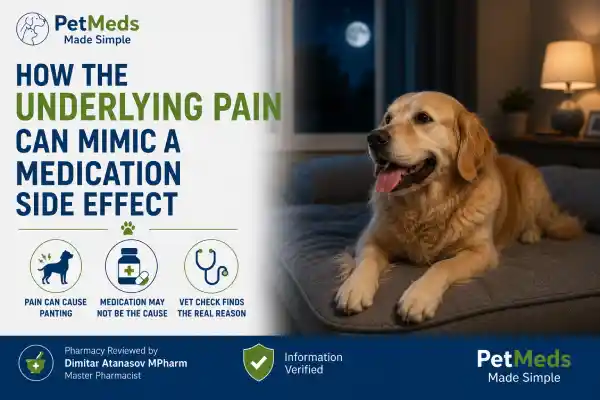
One of the most common reasons dogs pant at night while receiving pain medication is that the pain itself has not been completely controlled.
Pain activates the sympathetic nervous system.
As discomfort increases, several physiologic responses occur:
- heart rate increases,
- respiratory rate increases,
- muscles become tense,
- stress hormones are released,
- dogs become restless,
- panting develops.
From an owner’s perspective, this can easily resemble a medication reaction.
In reality, it may indicate that the current pain management plan needs adjustment rather than discontinuation.
This is particularly common in dogs with:
- advanced osteoarthritis,
- hip dysplasia,
- spinal disease,
- cancer-related pain,
- postoperative discomfort,
- chronic orthopedic injuries.
If your dog also shows stiffness, reluctance to stand, difficulty climbing stairs, or hesitation to jump, uncontrolled pain becomes a much more likely explanation than medication alone.
For owners already reading about other pain medication side effects, it is also helpful to compare your dog’s symptoms with our guides on Why Is My Dog Panting After Pain Medication?, Why Is My Dog Restless at Night Despite Pain Medication?, and Why Is My Dog Pacing After Pain Medication?, as these conditions often overlap and may point toward breakthrough pain rather than a true adverse drug reaction.
Questions Veterinarians Ask Before Changing Any Medication
Before adjusting or discontinuing pain medication, veterinarians usually gather a detailed history.
Some of the most important questions include:
| Question | Why It Matters |
|---|---|
| When did the panting first begin? | Helps establish whether the timing matches medication administration. |
| Does panting occur every night? | Looks for consistent patterns. |
| Does it improve after walking? | May indicate stiffness rather than medication. |
| Has the medication dose recently changed? | New side effects are more likely after dose adjustments. |
| Is your dog eating normally? | Appetite changes may suggest gastrointestinal adverse effects. |
| Is coughing also present? | Raises concern for heart or respiratory disease. |
| Has your dog become weaker? | Could indicate progression of disease or another medical problem. |
These questions frequently provide more useful diagnostic information than the medication name itself.
Which Pain Medications Are Most Likely to Cause Panting at Night?
Not all canine pain medications affect the body in the same way.
Some primarily reduce inflammation, while others change how the nervous system processes pain signals. Because of these differences, the likelihood that a medication contributes to nighttime panting also varies considerably.
One of the biggest mistakes owners make is assuming that every episode of panting after medication is automatically a side effect. In reality, veterinarians are much more likely to ask:
“Is the medication causing the panting, or is the medication no longer controlling the pain well enough?”
That question guides the entire diagnostic process.
Not Every Pain Medication Carries the Same Risk
| Medication Type | Common Veterinary Examples | Directly Causes Panting? | More Likely Explanation |
|---|---|---|---|
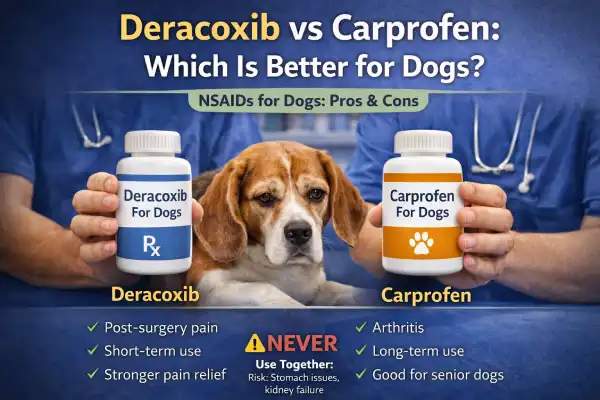
| NSAIDs | Carprofen, Meloxicam, Deracoxib, Firocoxib | Rarely | Breakthrough pain, stomach irritation, unrelated disease |
| Gabapentin | Gabapentin | Occasionally | Mild excitement in sensitive dogs, returning nerve pain |
| Tramadol | Tramadol | Sometimes | Excitement, dysphoria, altered sleep patterns |
| Amantadine | Amantadine | Occasionally | Behavioral stimulation in some dogs |
| Multimodal therapy | Combination therapy | Variable | Difficult to identify a single cause |
The medication is only one piece of the puzzle.
Veterinarians also consider:
- your dog’s age,
- breed,
- underlying disease,
- activity level,
- environmental temperature,
- concurrent medications,
- liver and kidney function,
- previous reactions to medication.
Can NSAIDs Cause Panting at Night?
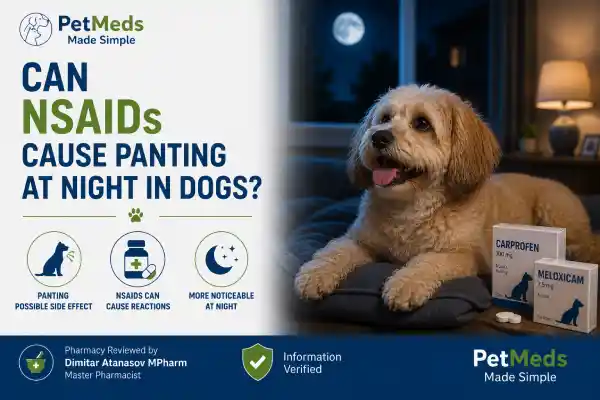
NSAIDs are the medications most owners think about when asking Can Pain Medication Cause Panting at Night?
Common veterinary NSAIDs include:
- Carprofen
- Meloxicam
- Deracoxib
- Firocoxib
- Grapiprant (technically not a traditional NSAID but often discussed alongside them)
These medications are considered the foundation of long-term arthritis treatment because they reduce inflammation directly inside painful joints.
Fortunately, panting is not considered one of their common adverse effects.
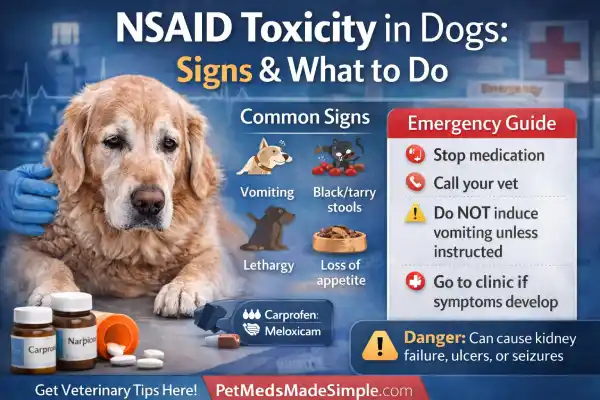
Instead, veterinarians monitor more closely for:
- vomiting,
- diarrhea,
- reduced appetite,
- stomach ulcers,
- black stools,
- kidney problems,
- liver enzyme elevations.
If panting develops while taking an NSAID, veterinarians usually investigate several other possibilities before concluding the medication itself is responsible.
Breakthrough Pain Is Often the Real Culprit
One of the most overlooked explanations is breakthrough pain.
Imagine a Labrador receiving carprofen once every 24 hours.
During the afternoon:
- walking improves,
- stiffness decreases,
- appetite returns,
- activity increases.
Late that evening, however, inflammation gradually begins returning as the medication approaches the end of its dosing interval.
Instead of limping dramatically, many dogs simply begin:
- panting,
- pacing,
- changing sleeping positions,
- refusing to settle.
Owners naturally assume:
“The medication is making my dog pant.”
The veterinarian often reaches a different conclusion.
The medication may actually be wearing off, allowing pain to return.
This is one reason owners experiencing several nighttime symptoms may also find it helpful to read our articles Why Is My Dog Panting After Pain Medication? and Why Is My Dog Restless at Night Despite Pain Medication?, since breakthrough discomfort frequently causes both signs together.
Could NSAIDs Cause Stomach Discomfort Instead?
Yes.
Although uncommon, NSAIDs may irritate the stomach lining.
Dogs rarely express nausea the way humans do.
Instead they may:
- pant,
- repeatedly swallow,
- lick their lips,
- pace,
- refuse food,
- repeatedly stand up and lie back down.
This can easily resemble nighttime anxiety.
If stomach irritation progresses, additional warning signs usually appear.
| Mild Signs | Serious Signs |
|---|---|
| Lip licking | Vomiting blood |
| Restlessness | Black, tarry stools |
| Mild panting | Severe abdominal pain |
| Reduced appetite | Collapse |
| Frequent swallowing | Weakness |
If severe gastrointestinal signs develop, veterinary attention should not be delayed.
Can Gabapentin Cause Panting at Night?
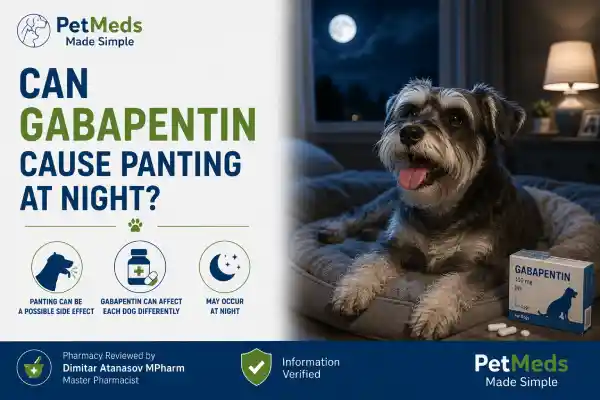
Gabapentin works very differently from NSAIDs.
Rather than reducing inflammation, it decreases abnormal pain signaling within the nervous system.
Most dogs taking gabapentin become:
- calmer,
- sleepier,
- less reactive,
- more comfortable.
However, veterinary medicine rarely deals in absolutes.
A small percentage of dogs experience the opposite response.
These dogs may become:
- unusually alert,
- restless,
- excitable,
- vocal,
- unable to settle comfortably.
Although uncommon, this reaction can make owners wonder whether pain medication is causing panting at night.
Timing Is Extremely Important
Veterinarians pay close attention to when the panting begins.
Consider these examples.
| Timing of Panting | Most Likely Interpretation |
|---|---|
| 30–60 minutes after gabapentin | Possible medication-related excitement |
| Six to eight hours later | Medication likely still working; investigate other causes |
| Shortly before the next scheduled dose | Returning neuropathic pain becomes more likely |
| Every night at exactly the same time | Review dosing schedule with the veterinarian |
Timing often provides more useful information than the medication itself.
Returning Pain May Look Like a Side Effect
Many dogs receive gabapentin for:
- spinal disease,
- intervertebral disc disease,
- chronic arthritis,
- cancer pain,
- postoperative pain.
As the medication gradually leaves the body, nerve pain may become noticeable again.
Instead of whining, some dogs simply:
- breathe faster,
- pace,
- pant,
- repeatedly reposition themselves.
Again, the medication may not be causing the panting.
The medication may no longer be providing adequate pain control.
Owners whose dogs are receiving gabapentin may also benefit from our related PMMS guides, including Can Dogs Stay on Gabapentin for Arthritis Forever?, Can Dogs Exercise After Taking Gabapentin?, and Why Is My Dog Weak After Gabapentin?, because changes in mobility and comfort often occur together.
Can Tramadol Cause Nighttime Panting?
Tramadol produces more variable responses than most other canine pain medications.
Some dogs become sleepy.
Others become mildly stimulated.
Possible behavioral changes include:
- pacing,
- agitation,
- vocalization,
- confusion,
- inability to relax.
These behavioral effects may increase respiratory rate and lead to panting without indicating a breathing disorder.
Because tramadol’s effectiveness for chronic osteoarthritis is limited compared with NSAIDs, veterinarians often evaluate whether another pain management strategy would better control the dog’s discomfort.
What About Amantadine?
Amantadine is usually added when chronic pain remains difficult to control.
Its role is different from NSAIDs or gabapentin.
Rather than replacing them, it helps reduce central sensitization, allowing other pain medications to work more effectively.
Most dogs tolerate amantadine well.
Occasionally, mild behavioral changes occur, including:
- increased alertness,
- mild restlessness,
- temporary excitement.
Because amantadine is rarely used alone, determining whether it contributes to nighttime panting often requires reviewing the dog’s entire medication regimen.
Why Combination Therapy Can Make the Answer Less Obvious
Modern veterinary pain management increasingly relies on multimodal therapy.
A dog with advanced arthritis might receive:
- Carprofen
- Gabapentin
- Fish oil
- Glucosamine
- Weight management
- Physical rehabilitation
When panting develops, owners frequently blame whichever medication was started most recently.
Unfortunately, that assumption is often incorrect.
Several things may have changed simultaneously:
- arthritis progression,
- weather,
- activity level,
- body weight,
- sleeping habits,
- another illness,
- medication timing.
Veterinarians evaluate all of these factors before recommending medication changes.
This is also why dogs receiving combination therapy should have periodic rechecks rather than relying solely on symptom observation at home.
Why Your Dog’s Medical History Matters More Than the Medication Name
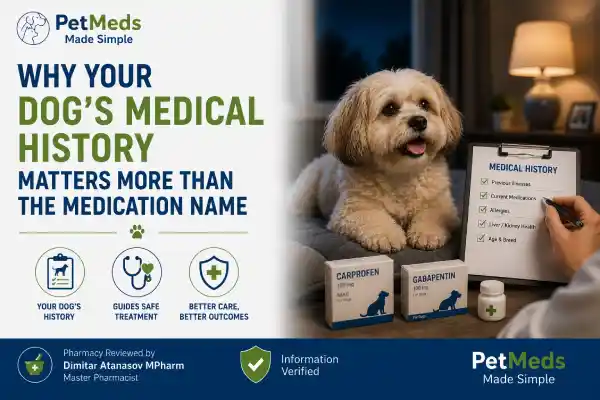
Two dogs can receive the same medication at the same dose and have completely different experiences.
For example:
Dog A
- Two-year-old Labrador
- Recovering from orthopedic surgery
- Otherwise healthy
Dog B
- Fourteen-year-old mixed breed
- Arthritis
- Heart murmur
- Mild kidney disease
- Cognitive dysfunction
If both dogs develop nighttime panting, veterinarians approach them very differently.
Age, concurrent diseases, and overall health often influence the diagnosis far more than the medication itself.
How Can You Tell Whether Nighttime Panting Is Caused by the Medication or Something Else?
This is one of the most important questions veterinarians answer when owners ask “Can Pain Medication Cause Panting at Night?”
Panting is not a diagnosis it is a clinical sign.
A dog may pant because of pain, excitement, fear, nausea, fever, heart disease, lung disease, medication effects, or even because the room is too warm. Since so many different conditions produce the same symptom, veterinarians avoid making conclusions based on panting alone.
Instead, they look for patterns.
That pattern-based approach is what separates a true medication reaction from a completely unrelated medical condition.
The First Question Is Simple: Does Your Dog Look Sick?
Before thinking about medications, veterinarians first determine whether the dog appears stable.
A dog that is panting but otherwise bright, alert, eating normally, and walking comfortably is approached very differently from a dog that is struggling to breathe or collapsing.
Initial Assessment
| Observation | Usually Less Concerning | More Concerning |
|---|---|---|
| Gum color | Pink | Pale, blue, or gray |
| Breathing | Mild panting | Labored breathing or gasping |
| Alertness | Bright and responsive | Weak, confused, collapsed |
| Walking | Normal | Staggering or unable to stand |
| Appetite | Normal | Refusing food completely |
| Behavior | Calm between panting episodes | Continuous distress |
If any emergency signs are present, determining whether medication caused the problem becomes secondary. Stabilizing the dog always comes first.
Pain Versus Medication Side Effect
The biggest diagnostic challenge is distinguishing persistent pain from a true adverse drug reaction.
Although both may cause panting, the rest of the clinical picture is often different.
Comparison of Common Features
| Finding | Ongoing Pain | Medication Side Effect |
|---|---|---|
| Difficulty lying down | ✓ | Occasionally |
| Frequently changing positions | ✓ | Occasionally |
| Limping | ✓ | Rare |
| Stiffness after resting | ✓ | Rare |
| Panting improves after gentle movement | Sometimes | Usually No |
| Panting begins immediately after every dose | Rare | More likely |
| Vomiting or diarrhea | Occasionally | More likely with NSAIDs |
| Excessive sedation | No | Possible depending on medication |
This comparison is why veterinarians never diagnose medication reactions from panting alone.
Could Anxiety Be the Real Cause?
Anxiety is frequently overlooked.
Dogs experiencing anxiety may:
- pant heavily,
- pace around the house,
- follow their owners constantly,
- refuse to settle,
- tremble,
- vocalize,
- repeatedly change sleeping locations.
Interestingly, some dogs only become anxious after dark.
Nighttime triggers may include:
- thunderstorms,
- fireworks,
- unfamiliar sounds,
- separation anxiety,
- cognitive dysfunction in senior dogs.
Owners often assume medication caused these behaviors because the medication happened to be given earlier that day.
If your dog is also showing behavioral changes, you may find our PMMS article Can Pain Medication Cause Anxiety in Dogs? helpful, as anxiety and panting frequently occur together.
Could the Pain Medication Simply Be Wearing Off?
This is one of the most common explanations veterinarians encounter.
Pain medications have a limited duration of action.
As the next dose approaches:
- inflammation may increase,
- painful joints stiffen,
- muscles tighten,
- dogs become restless,
- panting develops.
Instead of indicating a medication reaction, nighttime panting may actually suggest that pain control is no longer lasting until the next scheduled dose.
Clues That Suggest Breakthrough Pain
| Observation | Suggests Breakthrough Pain |
|---|---|
| Panting occurs just before the next dose | ✓ |
| Dog struggles to stand after sleeping | ✓ |
| Symptoms improve after the next scheduled dose | ✓ |
| Panting is worse after active days | ✓ |
| Difficulty climbing stairs | ✓ |
These dogs may need a review of their pain management plan rather than discontinuation of medication.
Heart Disease Can Look Surprisingly Similar
Heart disease is another reason veterinarians rarely blame medication immediately.
Dogs with developing heart disease may show:
- nighttime panting,
- increased resting respiratory rate,
- coughing while lying down,
- reduced exercise tolerance,
- fatigue,
- reluctance to exercise.
Because these signs often develop gradually, owners may first notice them after starting pain medication—even though the heart disease was already progressing.
Heart Disease Warning Signs
| Symptom | Veterinary Evaluation |
|---|---|
| Persistent nighttime panting | Yes |
| Coughing during sleep | Yes |
| Exercise intolerance | Yes |
| Collapse | Emergency |
| Blue gums | Emergency |
| Difficulty breathing | Emergency |
Respiratory Disease Should Never Be Ignored
Panting caused by lung disease often looks different from panting caused by pain.
Veterinarians pay attention to whether the dog is:
- breathing faster,
- working harder to breathe,
- extending the neck,
- using abdominal muscles,
- coughing,
- producing noisy breathing.
Potential causes include:
- chronic bronchitis,
- pneumonia,
- tracheal collapse,
- laryngeal paralysis,
- pulmonary fibrosis,
- airway obstruction.
Medication may have nothing to do with these conditions.
Could Overheating Be Responsible?
Dogs regulate body temperature primarily through panting.
Sometimes the explanation is surprisingly simple.
Environmental factors include:
- warm bedrooms,
- thick bedding,
- sleeping near heating vents,
- poor airflow,
- high humidity,
- obesity,
- heavy coats.
Environmental Checklist
| Question | Yes | No |
|---|---|---|
| Is the bedroom warmer than usual? | ☐ | ☐ |
| Is your dog sleeping near a heater? | ☐ | ☐ |
| Did your dog exercise shortly before bedtime? | ☐ | ☐ |
| Does your dog have a thick double coat? | ☐ | ☐ |
| Is your dog overweight? | ☐ | ☐ |
Correcting these factors may reduce panting without changing medication.
Gastrointestinal Discomfort May Present as Panting
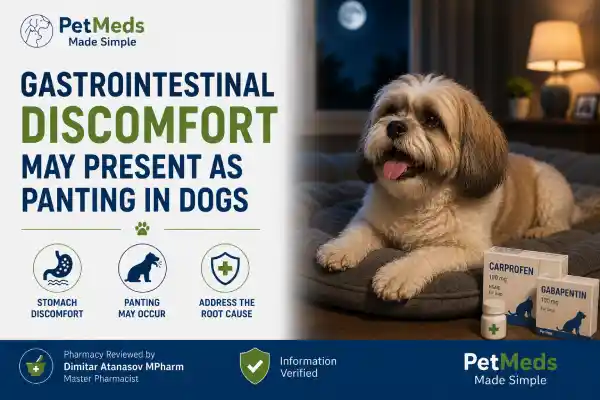
Dogs with stomach discomfort often do not cry or point to their abdomen.
Instead they may:
- pant,
- swallow repeatedly,
- lick their lips,
- stretch frequently,
- pace,
- refuse food,
- appear unable to settle.
This is particularly relevant for dogs taking NSAIDs, which can occasionally irritate the gastrointestinal tract.
If your dog also develops vomiting, black stools, or loss of appetite, prompt veterinary evaluation is recommended.
Senior Dogs Often Have More Than One Cause
Most dogs receiving long-term pain medication are older adults.
Older dogs frequently have multiple health conditions simultaneously.
For example:
- osteoarthritis,
- heart disease,
- kidney disease,
- cognitive dysfunction,
- muscle loss,
- endocrine disorders.
Because of this, nighttime panting often has more than one contributing factor.
Common Causes in Senior Dogs
| Cause | Frequency |
|---|---|
| Arthritis progression | Very Common |
| Breakthrough pain | Very Common |
| Cognitive dysfunction | Common |
| Heart disease | Common |
| Anxiety | Moderate |
| Medication adverse effect | Less Common |
This is why veterinarians rarely focus on the medication alone in senior patients.
When Should Owners Seek Emergency Care?
Although many episodes of nighttime panting are not emergencies, some situations require immediate attention.
Go to an Emergency Veterinarian Immediately If Your Dog Has:
| Emergency Sign | Why It Is Serious |
|---|---|
| Blue, gray, or white gums | Poor oxygen delivery |
| Severe difficulty breathing | Respiratory emergency |
| Collapse | Possible circulatory emergency |
| Continuous vomiting with panting | Possible serious adverse reaction |
| Swollen abdomen with unsuccessful retching | Possible GDV (bloat) |
| Loss of consciousness | Critical emergency |
| Seizures | Immediate medical attention required |
These signs should never be attributed to pain medication without emergency evaluation.
Related PMMS Articles
If your dog’s nighttime panting is accompanied by other symptoms, these guides may also help:
- Why Is My Dog Panting After Pain Medication?
- Why Is My Dog Breathing Hard After Medication?
- Why Is My Dog Restless at Night Despite Pain Medication?
- Why Is My Dog Pacing After Pain Medication?
- Can Pain Medication Cause Anxiety in Dogs?
- Why Is My Dog Weak After Pain Medication?
Reading related symptoms together often provides a much clearer understanding of what your dog may be experiencing than focusing on panting alone.
What Should You Do If Your Dog Starts Panting at Night After Taking Pain Medication?
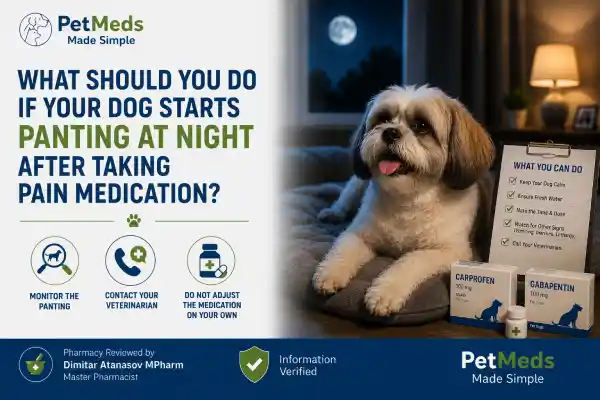
By the time most owners search “Can Pain Medication Cause Panting at Night?”, the panting is already happening.
The question is no longer whether it could happen it is what should I do right now?
The answer depends on two things:
- How your dog looks overall.
- Whether the panting is accompanied by other abnormal signs.
Most episodes of mild nighttime panting are not life-threatening, but they should never be ignored, especially if they are new, becoming more frequent, or occurring alongside other symptoms.
Step 1: Stay Calm and Observe Before Making Medication Changes
One of the biggest mistakes owners make is immediately assuming the medication is dangerous.
That often leads to another mistake:
Skipping the next dose without speaking to the veterinarian.
Although this reaction is understandable, it can sometimes make the situation worse.
For example, if the panting is actually caused by breakthrough pain, missing the next dose may allow inflammation and discomfort to increase even further.
Instead, spend several minutes observing your dog before making any decisions.
Five-Minute Home Assessment
| What to Check | Normal Finding | Concerning Finding |
|---|---|---|
| Gum color | Pink | Pale, blue, gray, or white |
| Breathing | Mild panting but comfortable | Labored breathing or gasping |
| Walking | Normal | Weakness, staggering, collapse |
| Alertness | Bright and responsive | Difficult to wake, disoriented |
| Appetite | Normal | Refuses food completely |
| Abdomen | Soft | Distended or painful |
If your dog appears stable, continue monitoring while preparing to contact your veterinarian.
If severe abnormalities are present, seek emergency care immediately.
Step 2: Think About Timing
Veterinarians often say that timing tells the story.
Knowing exactly when panting begins provides valuable clues.
Timing Guide
| When Panting Starts | Possible Interpretation |
|---|---|
| Within 30–60 minutes after medication | Possible medication-related effect |
| Several hours after dosing | Evaluate pain and other illnesses |
| Shortly before the next scheduled dose | Breakthrough pain becomes more likely |
| Every night regardless of medication time | Consider another medical condition |
Keeping track of these patterns often helps veterinarians identify the cause much faster.
Should You Skip the Next Dose?
For most dogs, the answer is no.
Unless your veterinarian specifically instructs you otherwise, do not stop prescription pain medication simply because panting occurred once.
Abruptly stopping medication can result in:
- worsening arthritis pain,
- increased inflammation,
- reduced mobility,
- more restlessness,
- even more nighttime panting.
Instead, contact the prescribing veterinarian and describe exactly what happened.
Situations Where You Should Contact Your Veterinarian the Same Day
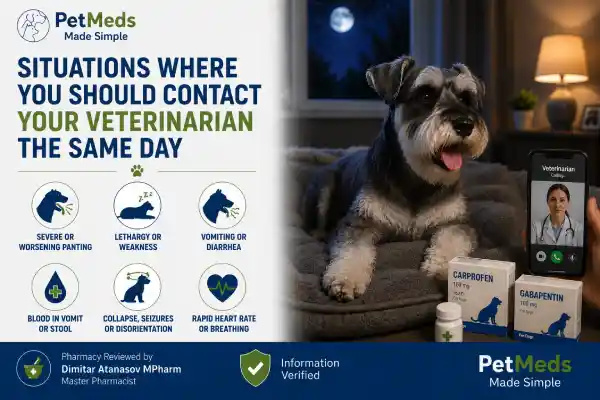
Even if your dog does not require emergency care, some situations deserve prompt attention.
Call Your Veterinarian If:
- panting continues for several hours,
- it occurs repeatedly over several nights,
- appetite decreases,
- vomiting develops,
- diarrhea occurs,
- your dog appears painful,
- your dog suddenly refuses to walk,
- you notice weakness,
- the medication was recently started or the dose was increased.
These situations may indicate that the treatment plan should be adjusted.
Should You Give an Extra Dose?
No.
Owners sometimes believe that if panting means pain has returned, giving additional medication must help.
Unfortunately, this can be dangerous.
Never:
- give an extra NSAID dose,
- increase gabapentin without veterinary advice,
- combine prescription medications on your own,
- give human pain medication.
Incorrect dosing significantly increases the risk of adverse effects.
Never Give Human Pain Medication
One of the most dangerous owner mistakes is substituting human medication when prescribed medication appears ineffective.
Common human NSAIDs such as:
- ibuprofen,
- naproxen,
- diclofenac,
can cause:
- stomach ulcers,
- gastrointestinal bleeding,
- kidney failure,
- liver injury,
- life-threatening poisoning.
Even one tablet can be harmful for some dogs.
Veterinary pain medications are specifically selected because their safety profiles differ significantly from those of human drugs.
What Information Should You Record Before Calling the Veterinarian?
The more information you provide, the easier it is for your veterinarian to determine whether the medication is truly responsible.
Home Monitoring Checklist
| Information | Record |
|---|---|
| Medication name | ______ |
| Dose | ______ |
| Time medication was given | ______ |
| Time panting began | ______ |
| Time panting stopped | ______ |
| Room temperature | ______ |
| Appetite | Normal / Reduced |
| Water intake | Normal / Increased |
| Vomiting | Yes / No |
| Diarrhea | Yes / No |
| Activity level | Normal / Reduced |
Many owners are surprised how much these details help identify patterns.
Should You Count Your Dog’s Resting Respiratory Rate?
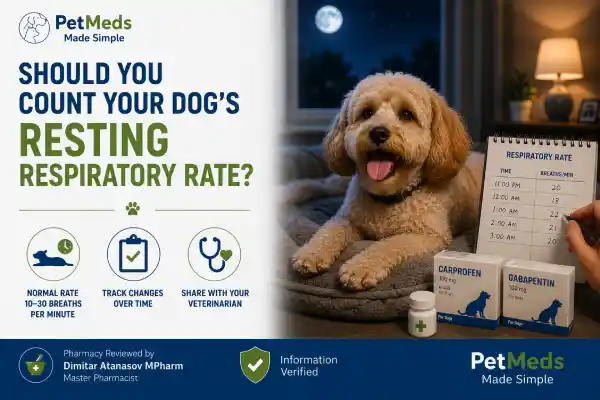
Yes.
One of the most useful things owners can monitor at home is the resting respiratory rate (RRR).
Wait until your dog is asleep or resting quietly.
Then:
- Watch the chest rise and fall.
- Count the number of breaths over 30 seconds.
- Multiply that number by two.
Record the result.
A consistently increased resting respiratory rate should always be discussed with your veterinarian, particularly in senior dogs or dogs with heart disease.
Can a Video Help?
Absolutely.
Many episodes of nighttime panting stop before the veterinary appointment.
A short smartphone video showing:
- the breathing pattern,
- body posture,
- gum color if possible,
- whether your dog is pacing,
- how responsive your dog appears,
can provide information that is impossible to recreate later.
Veterinarians often find videos extremely valuable when evaluating intermittent symptoms.
Common Owner Mistakes
Mistake #1: Assuming Every Episode Is a Medication Side Effect
Medication is only one possible explanation.
Pain progression, anxiety, heart disease, respiratory disease, overheating, and gastrointestinal discomfort are often more likely.
Mistake #2: Ignoring Other Symptoms
Panting should always be evaluated alongside:
- appetite,
- mobility,
- breathing effort,
- gum color,
- vomiting,
- diarrhea,
- energy level.
Looking at the entire clinical picture is much more informative than focusing on a single symptom.
Mistake #3: Stopping Medication Abruptly
Owners sometimes discontinue effective medication after one episode of panting.
This may allow arthritis pain or postoperative discomfort to worsen considerably.
Medication changes should be guided by your veterinarian.
Mistake #4: Assuming Supplements Can Replace Prescription Pain Medication
Fish oil, glucosamine, omega-3 fatty acids, and joint supplements can be valuable parts of a multimodal pain management plan, but they do not replace prescription analgesics for dogs with moderate to severe pain.
In many cases, veterinarians recommend combining these therapies rather than choosing one over another. As discussed in our articles Can Dogs Take Fish Oil With Pain Medication? and Can Dogs Take Glucosamine With NSAIDs?, supplements work best as supportive treatments rather than standalone pain relievers.
Long-Term Monitoring for Dogs Receiving Pain Medication
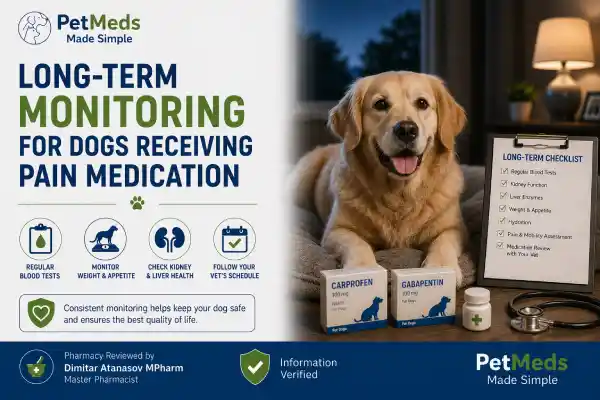
Dogs taking pain medication for weeks or months benefit from routine monitoring.
Long-Term Monitoring Checklist
| Parameter | Why It Matters |
|---|---|
| Appetite | Detects medication intolerance or disease progression |
| Body weight | Excess weight worsens arthritis |
| Mobility | Measures treatment effectiveness |
| Water intake | May indicate kidney or endocrine disease |
| Urination | Helps identify kidney problems |
| Breathing pattern | Detects heart or respiratory disease |
| Sleep quality | Reveals breakthrough pain or anxiety |
| Blood work | Monitors kidney and liver health during long-term NSAID therapy |
Routine rechecks allow veterinarians to adjust treatment before small problems become major ones.
Related PMMS Articles
If your dog’s nighttime panting is accompanied by additional symptoms, you may also find these guides helpful:
- Why Is My Dog Panting After Pain Medication?
- Why Is My Dog Breathing Hard After Medication?
- Why Is My Dog Restless at Night Despite Pain Medication?
- Why Is My Dog Pacing After Pain Medication?
- Why Is My Dog Weak After Pain Medication?
- Can Pain Medication Cause Anxiety in Dogs?
- Can Dogs Take Fish Oil With Pain Medication?
- Can Dogs Take Glucosamine With NSAIDs?
These articles address many of the symptoms that commonly occur alongside nighttime panting and help owners understand when the issue is more likely related to pain, medication, or another underlying medical condition.
Veterinarian Takeaway
When owners ask “Can Pain Medication Cause Panting at Night?”, they are often looking for a simple yes-or-no answer. In reality, veterinary medicine is rarely that straightforward.
Yes, some pain medications can contribute to nighttime panting in certain dogs. Mild behavioral changes, gastrointestinal discomfort, or medication-specific effects occasionally make panting more noticeable after a dose. However, in everyday clinical practice, veterinarians are far more likely to find that nighttime panting is caused by the underlying condition being treated rather than the medication itself.
Dogs with osteoarthritis frequently become stiffer after several hours of rest. Dogs recovering from surgery may become uncomfortable overnight as anesthetic effects wear off. Dogs with chronic spinal disease or neuropathic pain may experience breakthrough pain before their next scheduled dose.
For these reasons, veterinarians rarely recommend stopping pain medication after a single episode of panting. Instead, they evaluate the entire patient, looking at:
- when the panting began,
- how long it lasts,
- whether it occurs after every dose,
- mobility,
- appetite,
- breathing effort,
- concurrent diseases,
- medication history,
- and any additional clinical signs.
This systematic approach helps distinguish a true medication-related problem from pain progression, anxiety, heart disease, respiratory disease, or another medical condition.
Bottom Line
Can Pain Medication Cause Panting at Night?
Yes but it is usually not the first explanation veterinarians consider.
For many dogs, nighttime panting reflects:
- breakthrough pain,
- arthritis becoming more noticeable after rest,
- postoperative discomfort,
- anxiety,
- overheating,
- heart disease,
- respiratory disease,
- or another unrelated medical problem.
Rather than assuming the medication is dangerous, monitor your dog’s overall condition and contact your veterinarian if the panting is new, persistent, worsening, or accompanied by other concerning symptoms.
Never stop or change prescription pain medication without professional guidance, as doing so may worsen your dog’s pain and reduce their quality of life.
Prompt evaluation allows veterinarians to identify the underlying cause and develop a treatment plan that keeps your dog both comfortable and safe.
Frequently Asked Questions – Can Pain Medication Cause Panting at Night?
Can pain medication cause panting at night in dogs?
Yes. Some pain medications may contribute to nighttime panting, but this is not one of the most common side effects. Persistent pain, anxiety, or another medical condition are often more likely explanations.
Why does my dog only pant at night after taking pain medication?
Nighttime panting may occur because painful joints become stiffer after several hours of rest, medication effects begin wearing off before the next scheduled dose, or the quiet nighttime environment makes subtle symptoms easier to notice.
Should I stop my dog’s pain medication if panting starts?
No. Unless your veterinarian specifically advises otherwise, do not discontinue prescription pain medication based on panting alone. Abruptly stopping treatment may worsen pain and inflammation.
Which pain medications are most likely to cause panting?
Behavioral changes are reported more often with medications such as tramadol or, less commonly, gabapentin in sensitive dogs. Panting is generally not considered a common direct side effect of veterinary NSAIDs such as carprofen or meloxicam.
Can arthritis itself cause panting at night?
Yes. Arthritis pain often becomes more noticeable after prolonged rest, causing dogs to pant, pace, and repeatedly change sleeping positions.
How can I tell if my dog is panting because of pain instead of medication?
Dogs experiencing breakthrough pain often show additional signs such as stiffness, reluctance to stand, limping, difficulty climbing stairs, or improvement after the next scheduled medication dose.
Is nighttime panting after surgery normal?
Mild panting may occur during postoperative recovery because of discomfort, stress, or residual anesthetic effects. However, persistent or worsening panting should always be discussed with your veterinarian.
Can anxiety make dogs pant at night?
Yes. Anxiety, cognitive dysfunction, thunderstorms, fireworks, and unfamiliar environments may all cause nighttime panting, even in dogs receiving pain medication.
When should nighttime panting be considered an emergency?
Immediate veterinary care is recommended if panting occurs together with:
blue or pale gums,
severe breathing difficulty,
collapse,
abdominal swelling,
repeated vomiting,
seizures,
or loss of consciousness.
Should I count my dog’s breathing rate?
Yes. Measuring your dog’s resting respiratory rate while asleep can provide valuable information for your veterinarian, especially if panting occurs repeatedly.
Can senior dogs be more likely to pant at night?
Yes. Older dogs often have several medical conditions simultaneously, including arthritis, heart disease, kidney disease, and cognitive dysfunction, all of which may contribute to nighttime panting.
Can supplements like fish oil or glucosamine prevent nighttime panting?
Joint supplements and omega-3 fatty acids may support long-term joint health, but they should not replace prescribed pain medication. They work best as part of a multimodal pain management plan recommended by your veterinarian.
Clinical Pearls
- Panting is a clinical sign, not a diagnosis.
- Medication timing is often one of the most valuable diagnostic clues.
- Breakthrough pain is more common than true medication-induced panting.
- Dogs with arthritis frequently become more uncomfortable after several hours of rest.
- Videos recorded at home can be extremely helpful because panting often resolves before the veterinary appointment.
- Never administer human pain medications such as ibuprofen or naproxen unless specifically directed by a veterinarian.
- Regular rechecks and blood work help ensure long-term pain medications remain both effective and safe.
Sources
- Plumb DC. Plumb’s Veterinary Drug Handbook. Latest edition.
- Epstein ME, Rodan I, Griffenhagen G, et al. 2022 AAHA Pain Management Guidelines for Dogs and Cats. Journal of the American Animal Hospital Association.
- Merck Veterinary Manual. Pain Management in Small Animals.
- Merck Veterinary Manual. Osteoarthritis in Dogs.
- Papich MG. Saunders Handbook of Veterinary Drugs.
- Grimm KA, Lamont LA, Tranquilli WJ, Greene SA, Robertson SA. Veterinary Anesthesia and Analgesia.
- Riviere JE, Papich MG. Veterinary Pharmacology and Therapeutics.
- Maddison JE, Page SW, Church DB. Small Animal Clinical Pharmacology.
- WSAVA Global Pain Council educational resources.
- AVMA. Pain Management Resources for Companion Animals.
Medical Review Statement
This article was written by Dimitar Georgiev Atanasov, MPharm, pharmacy and scientific reviewed by Gergana Krasimirova Atanasova, MPharm, and veterinary reviewed by Dr. Valcho Georgiev Valchev, DVM. The information is intended for educational purposes only and should never replace an examination, diagnosis, or treatment plan provided by a licensed veterinarian.
Image Disclosure
Image Disclosure: Some images used in this article may be AI-generated or AI-assisted for educational and illustrative purposes. They are designed to improve understanding of veterinary concepts and should not replace professional veterinary advice.