Quick Answer
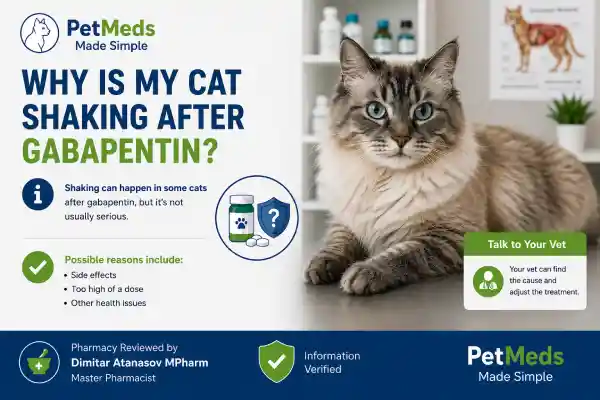
Why is my cat shaking after gabapentin? Mild shaking or trembling can occasionally occur after gabapentin in cats, particularly during the first few doses or when the medication causes temporary sedation and loss of coordination. However, shaking is not considered one of the most common side effects of gabapentin. Trembling may instead be related to stress, pain, anxiety, low body temperature, an underlying neurological disorder, medication interactions, or, in rare cases, an overdose. If your cat develops severe shaking, collapses, has seizures, struggles to breathe, or cannot stand, seek veterinary care immediately.
Table of Contents
When Cat Owners Commonly Ask This
Many owners are surprised the first time they give gabapentin to their cat.
The medication is commonly prescribed before veterinary visits, for chronic pain, arthritis, nerve pain, and sometimes as part of seizure management. After receiving the medication, many cats become sleepy, quieter than usual, and less interested in moving around.
Occasionally, however, owners notice something unexpected.
Their cat may:
- tremble while lying down
- shake slightly when trying to walk
- have twitching muscles
- appear unsteady
- seem nervous or frightened
- vibrate while resting
Naturally, owners begin asking questions such as:
- Why is my cat shaking after gabapentin?
- Is this a normal side effect?
- Did I give too much?
- Is my cat having a seizure?
- Should I skip the next dose?
Fortunately, most cases of mild shaking are not emergencies, but they should never be ignored—especially if they are severe, persistent, or accompanied by other neurological signs.
Owners who have already noticed sleepiness or balance problems may also find these PMMS guides useful:
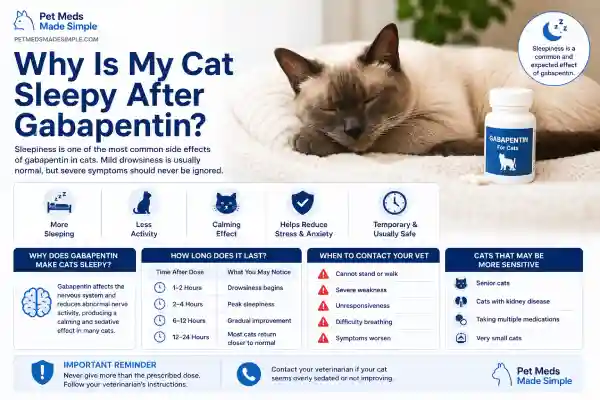
- Why Is My Cat Sleepy After Gabapentin?
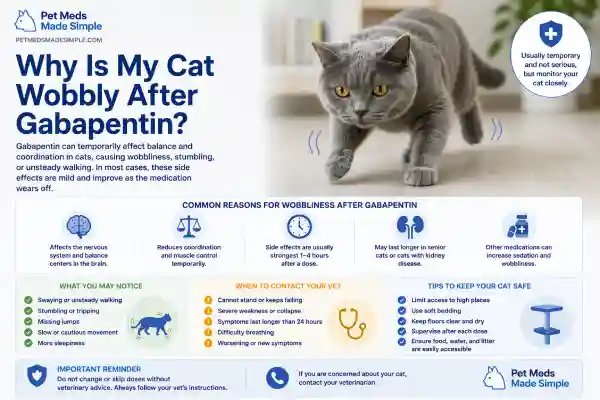
- Why Is My Cat Wobbly After Gabapentin?
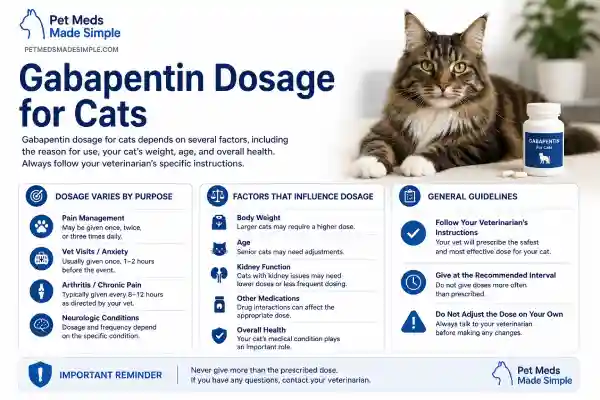
- Gabapentin for Cats: Uses, Dosage, Side Effects & Safety
Why Is My Cat Shaking After Gabapentin?
The answer depends on what kind of shaking your cat is experiencing.
Not every movement that owners describe as “shaking” is actually the same.
Veterinarians distinguish between:
| Type of Movement | What It May Mean |
|---|---|
| Fine trembling | Mild medication effect, stress, anxiety |
| Muscle twitching | Local muscle contraction or nerve irritation |
| Whole-body tremors | Neurological disease, toxicity, severe pain |
| Shivering | Cold, fear, pain, fever |
| Seizure activity | Abnormal electrical activity in the brain |
Because owners often use the word “shaking” to describe all of these situations, your veterinarian will usually ask for a detailed description—or, even better, a video of the episode.
Recording the shaking on your phone can be one of the most helpful things you do before your appointment.
Is Shaking a Normal Side Effect of Gabapentin?
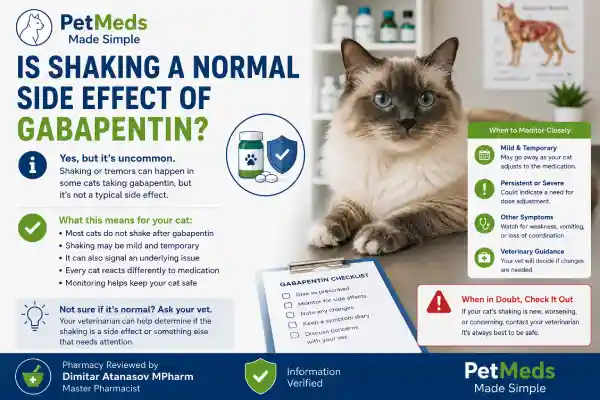
Not exactly.
The most common side effects of gabapentin in cats are:
- sleepiness
- sedation
- wobbliness
- reduced coordination
- temporary lethargy
Shaking is considered less common.
However, gabapentin affects the central nervous system, and every cat responds differently.
Some cats become deeply relaxed.
Others remain fully alert.
A small number may appear to tremble slightly, particularly when:
- standing up
- trying to jump
- walking after sedation
- recovering from stress
This is why shaking should always be interpreted alongside your cat’s overall behavior.
For example:
| Situation | More Likely Explanation |
|---|---|
| Mild shaking while sleepy | Temporary medication effect |
| Shaking only when standing | Coordination changes |
| Continuous violent shaking | Requires veterinary assessment |
| Shaking with collapse | Medical emergency |
| Shaking with seizures | Immediate emergency |
Owners wondering whether other neurological signs may occur should also read:
- Can Gabapentin Cause Anxiety in Cats?
- Can Gabapentin Cause Aggression in Cats?
- Can Cats Overdose on Gabapentin?
How Does Gabapentin Affect the Nervous System?
Gabapentin works by reducing excessive nerve activity.
Although many people believe it works like the neurotransmitter GABA, its mechanism is actually different.
Instead of directly increasing GABA activity, gabapentin binds to specific calcium channels found on nerve cells.
This reduces the release of several excitatory neurotransmitters.
As a result:
- pain signals decrease
- nerve hypersensitivity is reduced
- anxious cats often become calmer
- seizure activity may be reduced in some patients
Because the medication changes communication between nerve cells, temporary neurological effects can occur while the body adjusts.
These effects are usually mild and improve as the medication wears off.
Common Causes of Shaking After Gabapentin
Although gabapentin may contribute to trembling in some cats, it is important to remember that the medication is often not the primary cause.
Several other factors should also be considered.
1. Temporary Sedation
One of the most common explanations is simple sedation.
After receiving gabapentin, some cats become so relaxed that their muscles appear slightly unsteady.
Owners may describe this as:
- shaking
- wobbling
- trembling
- weakness
In reality, the cat is experiencing temporary muscle relaxation rather than true neurological disease.
This is closely related to the symptoms discussed in:
2. Stress From Veterinary Visits
Many cats receive gabapentin before traveling to the veterinary clinic.
Although the medication reduces anxiety, the visit itself can still trigger:
- fear
- increased adrenaline
- muscle trembling
- rapid breathing
Some owners assume the medication caused the shaking, when in fact the cat is still responding to stress.
Cats that normally dislike travel often recover quickly once they return home.
3. Pain That Has Not Fully Resolved
Gabapentin helps manage pain.
It does not eliminate every source of discomfort.
Cats with:
- arthritis
- spinal disease
- nerve injuries
- dental pain
- cancer
may continue trembling because they are still uncomfortable.
Pain-related trembling often improves after the underlying condition receives better treatment.
4. Individual Sensitivity
No two cats metabolize medications in exactly the same way.
Some cats appear almost unaffected by gabapentin.
Others become extremely sleepy after relatively small doses.
Factors influencing sensitivity include:
| Factor | Possible Effect |
|---|---|
| Age | Senior cats may respond more strongly |
| Body weight | Dose must be individualized |
| Kidney function | Medication may remain in the body longer |
| Other medications | May increase neurological effects |
| Overall health | Influences drug metabolism |
This is one reason veterinarians often recommend starting with the lowest effective dose.
Could My Cat Simply Be Cold?
Yes.
Sedated cats often move less than usual.
Because they remain inactive, some cats lose body heat more quickly, especially after returning home from a veterinary visit.
Mild shivering caused by feeling cold usually improves after:
- resting in a warm room
- lying on familiar bedding
- relaxing as the medication wears off
However, persistent shaking should never be assumed to be caused by temperature alone.
Does Age Increase the Risk?
Senior cats deserve special attention.
Older cats are more likely to have:
- kidney disease
- arthritis
- hypertension
- neurological disease
- multiple chronic illnesses
Because gabapentin is eliminated primarily through the kidneys, reduced kidney function may increase the medication’s effects.
This does not mean senior cats cannot safely receive gabapentin.
It simply means they often require closer monitoring and individualized dosing.
Owners of older cats may also find these PMMS articles helpful:
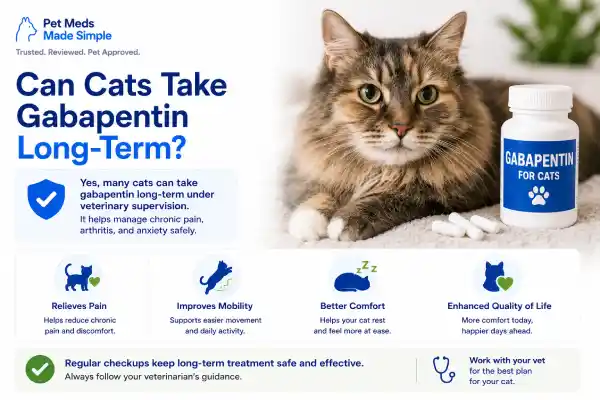
- Can Cats Take Gabapentin Long-Term?
- Can Cats Overdose on Gabapentin?
- What Happens If Cats Suddenly Stop Gabapentin?
Could My Cat Be Having a Seizure Instead of Shaking?
One of the biggest concerns owners have after noticing shaking is whether their cat is actually having a seizure.
Fortunately, most cats experiencing mild shaking after gabapentin are not having seizures.
However, distinguishing between the two is extremely important because seizures require immediate veterinary evaluation.
Although both conditions involve abnormal movement, they behave very differently.
Shaking vs. Seizures
| Sign | Mild Shaking | Generalized Seizure |
|---|---|---|
| Cat remains conscious | ✔ Usually | ✖ Usually not |
| Responds to your voice | ✔ Yes | ✖ No |
| Can look at you | ✔ Yes | ✖ Usually no |
| Rhythmic trembling | ✔ Often | Variable |
| Collapse | Rare | Common |
| Paddling limbs | No | Often |
| Loss of bladder control | Rare | Possible |
| Confusion afterward | Rare | Common |
A cat that briefly trembles while remaining awake, alert, and responsive is far more likely to be experiencing tremors or temporary neurological effects than a seizure.
However, if you are ever uncertain, record the episode on your phone. Videos are often invaluable in helping veterinarians distinguish tremors from seizures.
Cats diagnosed with seizure disorders may also benefit from reading:
- Can Cats Overdose on Gabapentin?
- What Happens If Cats Suddenly Stop Gabapentin?
- Gabapentin for Cats: Uses, Dosage, Side Effects & Safety
Could My Cat Have Received Too Much Gabapentin?
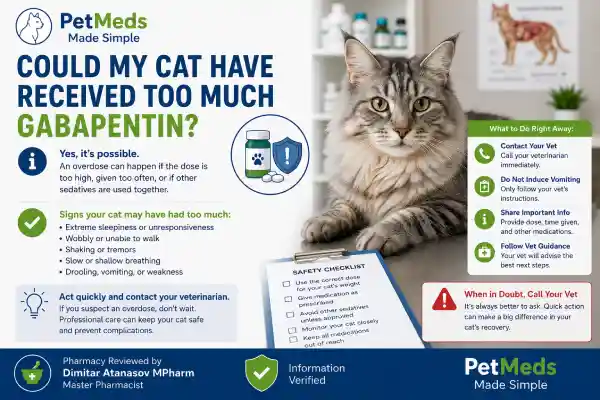
Although gabapentin has a relatively wide safety margin in cats, accidental overdoses do occur.
This may happen when:
- two family members both give a dose
- the wrong strength capsule is administered
- a dosing syringe is misread
- human medication is used incorrectly
Fortunately, most mild overdoses cause sedation rather than life-threatening toxicity, but larger overdoses can produce significant neurological symptoms.
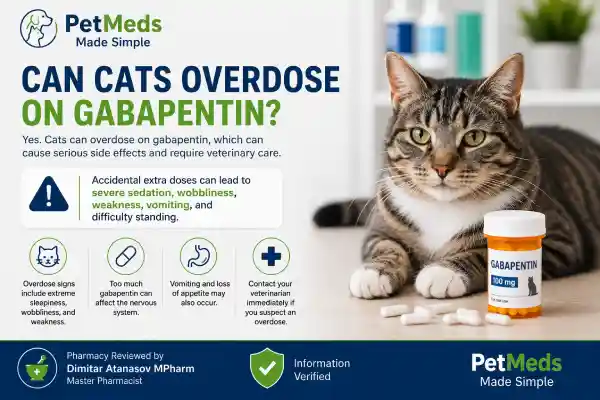
Possible overdose signs include:
- severe sleepiness
- inability to stand
- marked wobbliness
- continuous trembling
- muscle twitching
- confusion
- vomiting
- poor coordination
In severe cases, emergency veterinary treatment may be necessary.
If you suspect an overdose, do not wait to see whether the shaking improves on its own.
Owners should immediately contact their veterinarian or an emergency veterinary clinic.
You should also review:
Can Kidney Disease Make Shaking More Likely?
Yes.
Kidney disease is one of the most important medical conditions to consider whenever a cat develops stronger-than-expected effects after taking gabapentin.
Gabapentin is eliminated primarily through the kidneys.
If kidney function is reduced, the medication may remain in the bloodstream longer, increasing its effects.
This can make cats more prone to:
| Possible Effect | Why It Happens |
|---|---|
| Excessive sleepiness | Slower drug clearance |
| Wobbliness | Higher circulating drug levels |
| Weakness | Greater nervous system effects |
| Trembling | Increased medication sensitivity |
| Poor coordination | Drug accumulation |
This is particularly important in senior cats because chronic kidney disease is extremely common in older felines.
Fortunately, veterinarians routinely adjust gabapentin doses when kidney disease is present.
Could Another Medication Be Responsible?
Absolutely.
Many cats receiving gabapentin are also taking other medications.
Examples include:
- pain medications
- anti-inflammatory drugs
- seizure medications
- sedatives
- anxiety medications
These combinations are often completely appropriate.
However, they can sometimes produce additive neurological effects, making a cat appear sleepier, weaker, or less coordinated than expected.
This does not necessarily mean the medications are incompatible.
Instead, your veterinarian may simply need to:
- adjust the dosage
- separate administration times
- monitor more closely
- reassess the treatment plan
Never stop one medication simply because shaking develops.
Could Stress Cause My Cat to Shake?
Yes.
Cats are extremely sensitive to stress.
Many receive gabapentin specifically because veterinary visits cause significant anxiety.
Even after receiving gabapentin, stress hormones may still trigger:
- trembling
- rapid breathing
- crouching
- hiding
- dilated pupils
- vocalization
Owners sometimes assume gabapentin caused the shaking when the true cause is ongoing fear.
Stress-related trembling usually improves once the cat returns to its familiar environment.
Cats showing behavioral changes may also benefit from reading:
Does Age Increase the Risk of Shaking?
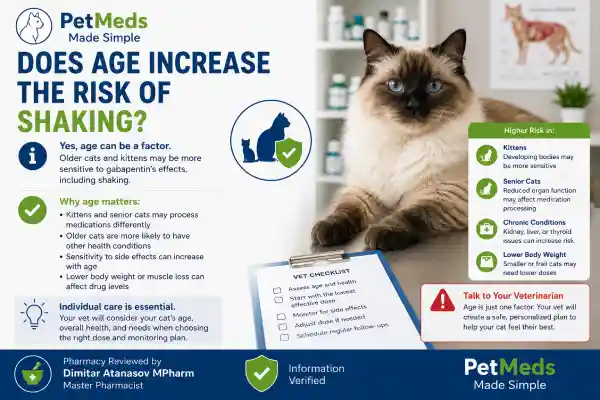
Age alone does not cause shaking.
However, older cats are more likely to have conditions that make neurological side effects more noticeable.
These include:
- chronic kidney disease
- arthritis
- hypertension
- neurological disorders
- muscle loss
- multiple medications
Senior cats also metabolize medications differently than younger animals.
For this reason, veterinarians often begin with lower doses and increase gradually only when necessary.
When Should You Contact Your Veterinarian?
Most mild shaking resolves as the medication wears off.
Nevertheless, you should contact your veterinarian if your cat:
- continues shaking for several hours
- shakes after every dose
- develops worsening tremors
- refuses food for more than 24 hours
- becomes unable to walk normally
- appears increasingly weak
- seems painful despite treatment
- develops any new neurological signs
Prompt communication often allows small treatment adjustments before the problem becomes more serious.
When Is Shaking an Emergency?
Some situations require immediate veterinary attention.
Seek emergency care if your cat develops:
| Emergency Sign | Why Immediate Care Is Needed |
|---|---|
| Collapse | Possible neurological emergency |
| Repeated seizures | Medical emergency |
| Difficulty breathing | Requires immediate treatment |
| Blue or pale gums | Poor oxygenation |
| Loss of consciousness | Possible seizure or severe illness |
| Sudden paralysis | Possible spinal or neurological emergency |
| Persistent vomiting | Risk of dehydration or toxicity |
| Suspected overdose | Requires urgent assessment |
| Severe continuous tremors | Possible neurological crisis |
These symptoms are not typical side effects of routine gabapentin therapy and should never be ignored.
Can Shaking Be Prevented?
In many cases, yes.
Although not every episode can be avoided, owners can reduce the likelihood of medication-related shaking by following several simple recommendations.
Prevention Tips
✔ Give gabapentin exactly as prescribed.
✔ Never administer extra doses.
✔ Store medications safely to prevent accidental overdoses.
✔ Inform your veterinarian about every medication and supplement your cat receives.
✔ Keep senior cats well hydrated.
✔ Attend recommended follow-up appointments.
✔ Monitor your cat closely after starting treatment or changing the dose.
✔ Record any shaking episodes to help your veterinarian evaluate the problem.
These simple steps greatly improve medication safety while helping veterinarians make informed treatment decisions.
How Veterinarians Diagnose Shaking After Gabapentin
When a cat develops shaking after receiving gabapentin, veterinarians avoid assuming that the medication is automatically responsible.
Instead, they try to answer one important question:
“Is the shaking caused by gabapentin, or is gabapentin simply revealing another medical problem?”
Because cats often receive gabapentin for painful or neurological conditions, the medication may only be one part of the overall picture.
Step 1: A Detailed Medical History
Your veterinarian will begin by asking several important questions.
These include:
- When did the shaking first start?
- Did it occur after the very first dose?
- Does it happen after every dose?
- How long does each episode last?
- Is your cat still eating normally?
- Has your cat vomited?
- Has the dose recently changed?
- Is your cat taking any other medications?
- Has your cat ever experienced seizures before?
The timing of the shaking is often one of the biggest clues.
For example:
| Timing | Possible Interpretation |
|---|---|
| 30–90 minutes after dosing | Medication effect may be contributing |
| Several hours later | Less likely to be directly caused by peak drug levels |
| Only during stressful events | Anxiety or fear may play a larger role |
| Constant shaking all day | Underlying disease should be investigated |
Step 2: Complete Physical Examination
A thorough physical examination helps determine whether the shaking is related to pain, weakness, neurological disease, or another illness.
Your veterinarian will assess:
- body temperature
- hydration
- heart rate
- respiratory rate
- muscle tone
- joint pain
- spinal pain
- body condition
Cats experiencing arthritis or spinal pain may tremble because movement itself is uncomfortable rather than because of the medication.
Owners may also wish to review:
since these signs often occur together.
Step 3: Neurological Examination
Because shaking involves the nervous system, a neurological examination is one of the most valuable parts of the evaluation.
Your veterinarian may examine:
- mental status
- balance
- coordination
- conscious proprioception
- spinal reflexes
- cranial nerves
- muscle strength
- pain sensation
These findings help determine whether the shaking originates from:
- the brain
- spinal cord
- peripheral nerves
- muscles
- metabolic disease
Cats showing abnormal neurological findings may require additional diagnostic testing.
Step 4: Laboratory Testing
Blood work is commonly recommended, especially for senior cats or cats receiving long-term medication.
Typical laboratory tests include:
| Test | Why It Is Important |
|---|---|
| Complete Blood Count (CBC) | Detects infection or inflammation |
| Blood Chemistry Profile | Evaluates organ function |
| Kidney Values (BUN & Creatinine) | Important because gabapentin is cleared through the kidneys |
| Electrolytes | Detects abnormalities that may contribute to tremors |
| Blood Glucose | Low blood sugar may cause shaking |
| Thyroid Testing (when appropriate) | Helps identify metabolic disease |
Many owners are surprised to learn that kidney disease not gabapentin itself—is sometimes responsible for exaggerated neurological effects.
How Is Shaking After Gabapentin Treated?
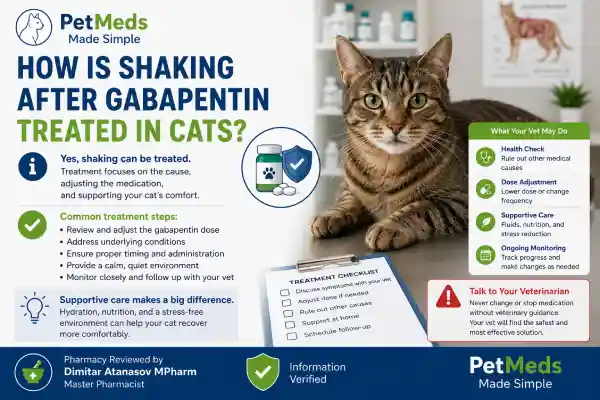
Treatment depends entirely on why the shaking is occurring.
There is no single treatment that works for every cat.
Mild Medication Effects
If the shaking is mild and appears to be a temporary response while your cat adjusts to gabapentin, your veterinarian may simply recommend close monitoring.
Many cats improve within the next several hours or after the first few doses.
Owners should continue observing:
- appetite
- walking ability
- responsiveness
- frequency of shaking
- overall comfort
Dose Adjustment
If your veterinarian determines that the current dose is contributing to excessive neurological effects, several options may be considered.
These may include:
- lowering the dose
- increasing the time between doses
- adjusting the treatment schedule
- switching to another medication if necessary
Never change the dose yourself without veterinary guidance.
Stopping gabapentin abruptly can create additional problems in some patients.
Owners should also review:
Treating the Underlying Disease
Sometimes the medication is not the problem.
Instead, the underlying disease requires additional treatment.
Examples include:
| Underlying Disease | Possible Treatment |
|---|---|
| Osteoarthritis | Improved pain management and environmental modifications |
| Dental disease | Dental treatment |
| Kidney disease | Fluid therapy and dose adjustments |
| Neurological disorders | Referral to a veterinary neurologist |
| Hyperthyroidism | Disease-specific medical management |
Addressing the primary illness often resolves the shaking more effectively than changing gabapentin alone.
Hospitalization
Fortunately, hospitalization is uncommon.
However, it may become necessary if a cat develops:
- repeated seizures
- severe tremors
- inability to stand
- collapse
- suspected overdose
- significant dehydration
- difficulty breathing
Hospital care allows continuous monitoring while supportive treatment is provided.
Can Shaking After Gabapentin Be Prevented?
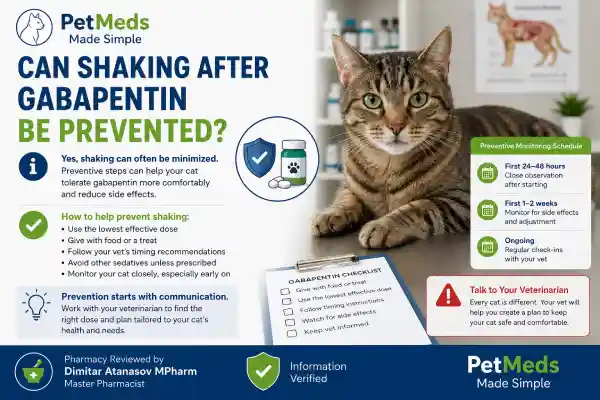
Although prevention is not always possible, owners can significantly reduce the risk of medication-related problems.
Prevention Checklist
✔ Give gabapentin exactly as prescribed.
✔ Never double a missed dose.
✔ Never use another pet’s medication.
✔ Inform your veterinarian about every medication and supplement your cat receives.
✔ Monitor senior cats more closely during the first few doses.
✔ Attend recommended recheck appointments.
✔ Keep medications stored safely away from pets.
✔ Record any unusual shaking episodes on your phone.
Videos frequently help veterinarians distinguish tremors from seizures, stress responses, and medication effects.
Veterinarian Takeaway
Gabapentin remains one of the most commonly prescribed and safest medications for cats when used appropriately under veterinary supervision.
Although mild shaking or trembling can occasionally occur, it is not considered one of the medication’s most common side effects. In many cases, shaking is instead related to stress, pain, neurological disease, kidney dysfunction, or another underlying medical condition.
Cats that remain bright, alert, responsive, and comfortable often recover uneventfully with monitoring and, if necessary, minor adjustments to their treatment plan.
However, shaking accompanied by collapse, seizures, difficulty breathing, severe weakness, or loss of consciousness should always be treated as a veterinary emergency.
Bottom Line
Why is my cat shaking after gabapentin?
The answer depends on the individual cat.
Some cats experience mild temporary trembling as they adjust to the medication, while others may be reacting to stress, pain, kidney disease, medication interactions, or an unrelated neurological condition.
Most mild episodes improve without long-term complications.
However, persistent, worsening, or severe shaking should always be discussed with your veterinarian to ensure your cat receives the safest and most appropriate care.
Frequently Asked Questions – Why Is My Cat Shaking After Gabapentin
Can gabapentin directly cause shaking in cats?
Yes, but it is considered an uncommon side effect. Most cats are more likely to become sleepy, mildly unsteady, or less active than to develop noticeable shaking. If shaking occurs shortly after starting gabapentin or following a dose increase, your veterinarian should determine whether it is a temporary medication effect or a sign of another medical condition.
Is it normal for my cat to shake after the first dose of gabapentin?
Some cats may experience mild trembling, slight muscle twitching, or temporary unsteadiness after their first dose while their nervous system adjusts to the medication.
These signs are usually mild and improve as the medication wears off.
However, severe shaking, collapse, or seizures are not considered normal and require immediate veterinary evaluation.
Why is my cat shaking after gabapentin but still acting normal?
If your cat remains:
alert
responsive
eating normally
breathing comfortably
walking without major difficulty
the shaking may simply represent a mild medication effect, stress response, or temporary muscle tremor.
Even so, it is still worth informing your veterinarian, especially if the shaking occurs after every dose.
Can gabapentin make senior cats shake more easily?
Yes.
Senior cats are generally more sensitive to medications because they are more likely to have:
chronic kidney disease
arthritis
muscle loss
neurological disorders
multiple chronic illnesses
These conditions can increase the intensity of neurological side effects, making careful dose selection especially important.
Owners of older cats may also wish to read:
Can Cats Take Gabapentin Long-Term?
What Happens If Cats Suddenly Stop Gabapentin?
Could stress from the veterinary visit be causing the shaking instead?
Absolutely.
Many cats receive gabapentin specifically because veterinary visits are stressful.
Despite the medication reducing anxiety, some cats still experience:
trembling
crouching
rapid breathing
hiding
muscle tension
Once they return home and relax, these signs often improve without any additional treatment.
Should I give the next dose if my cat shook after the previous one?
Do not skip or delay doses without speaking to your veterinarian.
Stopping gabapentin suddenly may interfere with your cat’s treatment plan, particularly if it is being used for chronic pain or seizure management.
Instead:
monitor the shaking
record a video
contact your veterinarian before making changes
Can kidney disease make gabapentin side effects worse?
Yes.
Because gabapentin is eliminated primarily through the kidneys, cats with reduced kidney function may process the medication more slowly.
This may increase the likelihood of:
excessive sleepiness
wobbliness
weakness
trembling
poor coordination
This is one reason veterinarians often prescribe lower or individualized doses for cats with chronic kidney disease.
Could another medication be interacting with gabapentin?
Yes.
Although gabapentin is generally compatible with many veterinary medications, combining several drugs that affect the nervous system may increase sedation or coordination problems.
Always tell your veterinarian about:
prescription medications
supplements
herbal products
over-the-counter medications
Never assume that “natural” products are automatically safe alongside gabapentin.
How long does shaking usually last?
If the shaking is related to mild medication effects, it often improves as gabapentin concentrations gradually decrease.
Many cats return to their normal behavior within several hours.
Persistent, worsening, or repeated shaking after every dose should always be investigated.
When should I seek emergency veterinary care?
eek immediate veterinary attention if shaking occurs together with:
collapse
repeated seizures
inability to stand
severe weakness
difficulty breathing
blue or pale gums
persistent vomiting
loss of consciousness
suspected overdose
These signs suggest a condition far more serious than routine medication side effects.
Reviewed By
Written by
Dimitar Georgiev Atanasov, MPharm
Master Pharmacist | Medication Safety Educator
Bulgarian Pharmaceutical Union (BPhU)
UIN: 0210000586
Pharmacy & Scientific Review by
Gergana Krasimirova Atanasova, MPharm
Assistant Lecturer, Faculty of Pharmacy
University “Prof. Dr. Asen Zlatarov” – Burgas
Master Pharmacist
Bulgarian Pharmaceutical Union (BPhU)
UIN: 0210000587
Veterinary Reviewed by
Dr. Valcho Georgiev Valchev, DVM
Licensed Veterinarian
Bulgarian Veterinary Union (BVS)
Registration No.: 28000115
Editorial Policy
At Pet Meds Made Simple, every article follows a rigorous editorial process designed to provide pet owners with trustworthy, evidence-based medication information.
Our content is:
- Written by a licensed Master Pharmacist.
- Scientifically reviewed by a second licensed Master Pharmacist.
- Independently reviewed by a licensed veterinarian.
- Updated as new veterinary evidence and clinical recommendations become available.
Learn more by visiting our Editorial Policy page.
Medical Review Statement
This article was written by a licensed Master Pharmacist, scientifically reviewed by a second licensed Master Pharmacist, and independently veterinary reviewed by a licensed Doctor of Veterinary Medicine.
The information is intended for educational purposes only and should never replace professional veterinary diagnosis or treatment. Always consult your veterinarian before starting, stopping, or changing any medication prescribed for your cat.
Sources
- Plumb DC. Plumb’s Veterinary Drug Handbook. Latest Edition.
- Papich MG. Saunders Handbook of Veterinary Drugs: Small and Large Animal.
- Merck Veterinary Manual. Feline Pain Management.
- Merck Veterinary Manual. Neurologic Disorders in Cats.
- Grimm KA, Lamont LA, Tranquilli WJ, Greene SA, Robertson SA. Veterinary Anesthesia and Analgesia.
- AAHA/AAFP Pain Management Guidelines for Dogs and Cats.
- ISFM (International Society of Feline Medicine) Consensus Guidelines on the Long-Term Use of NSAIDs in Cats.
- Veterinary Information Network (VIN). Clinical discussions on gabapentin use in feline patients.
- Journal of Feline Medicine and Surgery (JFMS). Publications on feline analgesia and gabapentin.
- Frontiers in Veterinary Science. Current reviews on feline pain management, neurology, and multimodal analgesia.
Image Disclosure
Image Disclosure: Some images used in this article may be AI-generated to illustrate veterinary concepts and medication safety information. They are intended for educational purposes only and should not replace professional veterinary examination, diagnosis, or treatment.