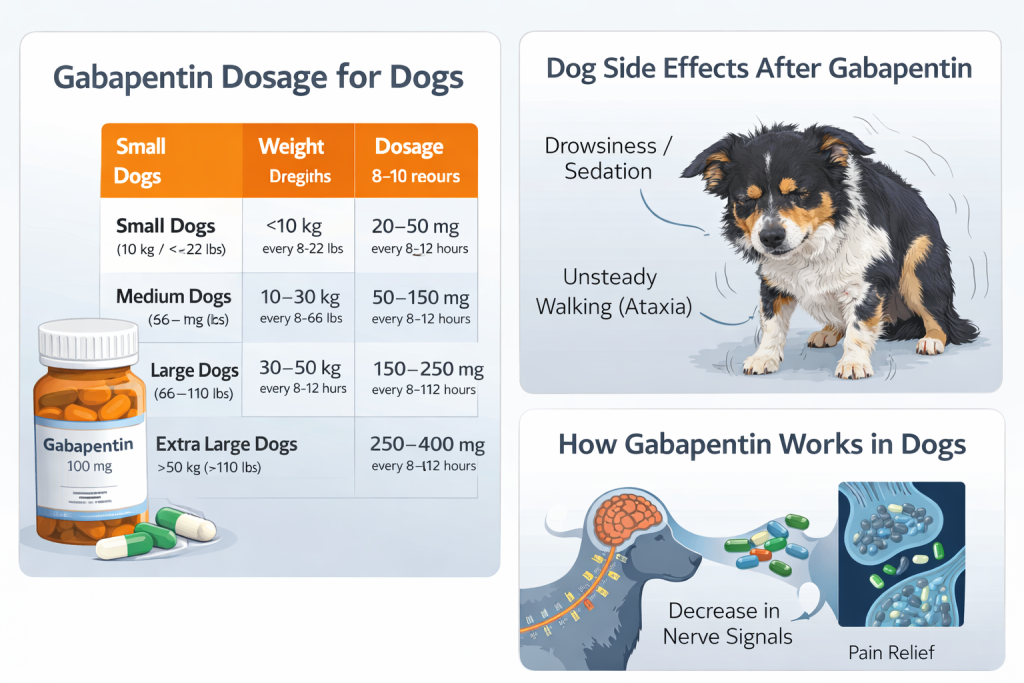

Quick Answer
Why is my dog crying before the next gabapentin dose? In many dogs, crying or whining before the next scheduled gabapentin dose is caused by breakthrough pain, meaning the medication’s effects begin to wear off before the next dose is due. However, this is not the only possible explanation. Your dog may also be experiencing progression of the underlying disease, neuropathic pain that is no longer fully controlled, an inadequate dosage, medication interactions, anxiety, or an entirely different medical problem. Never increase the dose or give gabapentin earlier unless your veterinarian specifically instructs you to do so.
Why Is My Dog Crying Before the Next Gabapentin Dose?
When Owners Commonly Ask This
This is one of the most common situations owners describe after their dog has been taking gabapentin for several days or weeks.
Many conversations sound almost identical:
“My dog feels great for several hours after taking gabapentin, but starts crying again right before the next dose.”
Others notice that their dog:
- begins pacing during the last hour before medication
- becomes restless every evening
- starts whining while lying down
- refuses to settle comfortably
- follows them around the house crying
- suddenly appears painful again
Then, after the next gabapentin dose, everything improves.
This pattern understandably makes owners wonder:
- Is gabapentin wearing off?
- Has my dog become resistant?
- Is the dose too low?
- Should I give the medication earlier?
- Is my dog’s condition getting worse?
The reassuring news is that this situation is relatively common, especially in dogs receiving gabapentin for chronic pain.
It does not automatically mean that gabapentin has stopped working.
For owners wondering whether the medication is becoming less effective overall, our guide Why Does Gabapentin Stop Working in Dogs? discusses the most common reasons treatment may appear less successful over time.
Why Does My Dog Cry Before the Next Gabapentin Dose?
The answer often lies in how gabapentin works inside the body.
Unlike antibiotics, which continue killing bacteria long after they are swallowed, gabapentin works only while enough medication remains in the bloodstream to reduce abnormal nerve signaling.
As drug concentrations gradually decline between doses, pain signals begin reaching the brain more easily again.
If the underlying disease is still painful, your dog may begin showing discomfort before the next scheduled dose.
Typical behaviors include:
| Common Behavior | Possible Explanation |
|---|---|
| Crying | Returning pain |
| Whining | Neuropathic discomfort |
| Restlessness | Pain becoming noticeable again |
| Constant repositioning | Difficulty getting comfortable |
| Reluctance to lie down | Joint or spinal pain |
| Licking one area repeatedly | Localized pain |
These signs are often referred to as end-of-dose breakthrough pain.
This does not necessarily mean gabapentin has failed.
Instead, it may simply indicate that pain is returning as medication levels decrease.
Owners who also notice limping may find Why Is My Dog Still Limping After Gabapentin? useful, while dogs showing persistent pain despite treatment may relate more closely to Why Is My Dog Still in Pain on Gabapentin?
Understanding Breakthrough Pain
One of the biggest misconceptions is that pain medication should eliminate pain continuously throughout the day.
Unfortunately, chronic pain rarely behaves that way.
Instead, many dogs experience periods where pain briefly “breaks through” despite appropriate medication.
Veterinarians call this breakthrough pain.
Think of gabapentin like an umbrella during a rainstorm.
While the umbrella is fully open, you stay dry.
As the umbrella gradually closes, more rain begins reaching you.
The rain has not become heavier.
The protection has simply decreased.
Pain behaves similarly.
Immediately after a gabapentin dose:
- nerve activity decreases
- painful signals are reduced
- movement becomes easier
- dogs often appear calmer
Several hours later:
- medication levels slowly decline
- nerve signaling increases
- painful sensations return
- crying may begin
The next dose raises medication levels again, reducing discomfort once more.
How Long Does Gabapentin Usually Last?

One reason owners notice this pattern is that gabapentin has a relatively short duration of action in many dogs.
Although every patient is different, veterinarians commonly prescribe gabapentin every:
- 8 hours
- 12 hours
- occasionally every 6 hours in selected cases
Exactly how long one dose provides relief depends on several factors.
Factors That Influence Duration
| Factor | Possible Effect |
|---|---|
| Body weight | May influence dosage requirements |
| Age | Senior dogs often respond differently |
| Kidney function | Reduced clearance may prolong effects |
| Pain severity | Severe pain may return sooner |
| Disease type | Neuropathic pain behaves differently than arthritis |
| Other medications | May enhance or reduce perceived effects |
Some dogs remain comfortable for twelve hours.
Others begin showing discomfort after only seven or eight hours.
Neither situation automatically means something is wrong.
Instead, it tells your veterinarian how your individual dog responds to treatment.
For owners wondering whether medication timing affects comfort, How Fast Does Gabapentin Work in Dogs? and Gabapentin Dosage for Dogs: Vet Guidelines, Weight Chart & Safety Tips provide additional background.
Why Every Dog Responds Differently
Gabapentin is not a one-size-fits-all medication.
Even dogs weighing exactly the same can require very different treatment plans.
Several biological factors influence how each patient responds.
Individual Differences Include
- metabolism
- kidney function
- nervous system sensitivity
- severity of disease
- concurrent illnesses
- genetic variation
This explains why one Labrador may remain comfortable throughout the day while another begins crying before every evening dose despite receiving a similar amount of medication.
It also explains why veterinarians adjust treatment based on the individual dog, not simply the number on the scale.
Could the Crying Mean the Dose Is Too Low?
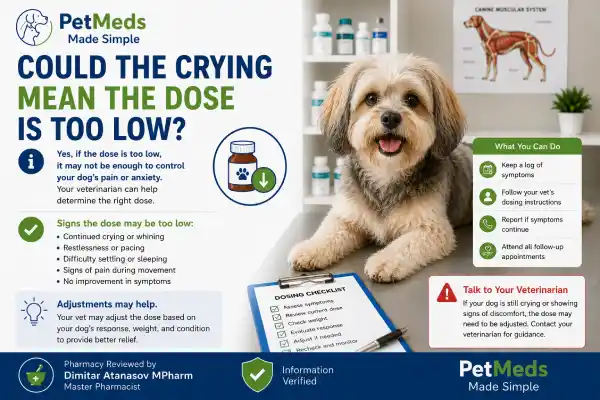
Possibly but not always.
This is one of the first questions owners ask.
The answer depends on several factors.
A dose that controlled arthritis six months ago may no longer provide adequate relief if the disease has progressed.
Similarly, dogs recovering from spinal surgery may require different pain control during different stages of healing.
However, increasing the dose without professional guidance can create new problems.
Higher doses may increase the risk of:
| Possible Side Effect | Why It Matters |
|---|---|
| Excessive sleepiness | Reduced quality of life |
| Wobbliness | Increased fall risk |
| Weak back legs | Mobility problems |
| Muscle tremors | Neurological side effects |
| Panting | May indicate discomfort or medication effects |
If your dog develops any of these signs, you may also find these PMMS guides helpful:
- Why Is My Dog Wobbly After Gabapentin?
- Can Gabapentin Cause Muscle Tremors in Dogs?
- Can Gabapentin Cause Weak Back Legs?
- Why Is My Dog Panting After Gabapentin?
Never increase the dose simply because your dog cries before the next scheduled medication.
The correct solution may involve changing the dosing interval, combining therapies, treating the underlying disease more effectively, or investigating an entirely different cause of pain.
Could My Dog’s Underlying Condition Be Getting Worse?
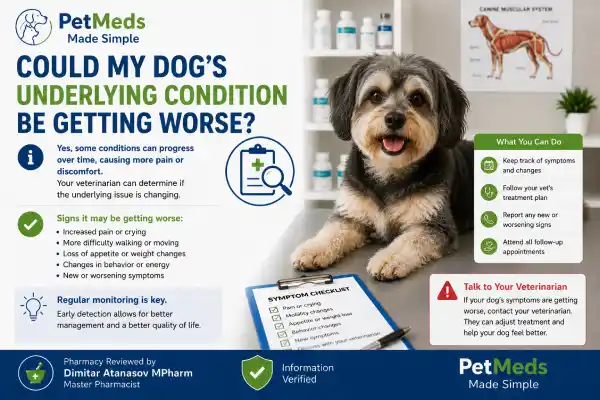
One of the biggest mistakes owners make is assuming that every episode of crying before the next gabapentin dose means the medication is failing.
In many cases, the medication is still working exactly as expected but the underlying disease has progressed.
Gabapentin treats pain. It does not cure arthritis, spinal disease, nerve injuries, or cancer.
As these conditions advance, they may produce more pain than the original treatment plan can comfortably control.
This is why veterinarians regularly reassess dogs receiving long-term pain medication.
Arthritis Progression
Osteoarthritis is a progressive disease.
Over time:
- cartilage continues to wear away
- inflammation increases
- joint stiffness worsens
- muscles become weaker
- movement becomes more painful
A dog that was comfortable six months ago may suddenly begin crying before the next gabapentin dose—not because the medication has stopped working, but because the arthritis has become more severe.
Owners may also notice:
| New Symptom | Possible Meaning |
|---|---|
| Difficulty standing | Arthritis progression |
| Slower walks | Increased joint pain |
| Less interest in stairs | Hip or knee discomfort |
| Crying before bedtime | Medication wearing off combined with worsening pain |
| Reluctance to jump | Pain progression |
If your dog is showing these signs, you may also benefit from reading Can Dogs Take Gabapentin Long-Term Safely?, Why Is My Dog Still Limping After Gabapentin?, and Why Is My Dog Still in Pain on Gabapentin?
Intervertebral Disc Disease (IVDD)
Dogs receiving gabapentin for IVDD or spinal pain may also begin crying before their next dose.
Pain from spinal disease is often unpredictable.
Small movements may suddenly increase pressure on inflamed nerves, leading to:
- whining
- trembling
- difficulty standing
- reluctance to walk
- muscle spasms
- vocalization when changing position
Because IVDD pain can change rapidly, veterinarians often recommend reassessment whenever pain appears to be increasing.
Cancer Pain
Cancer pain rarely remains constant.
As tumors grow, they may:
- compress nerves
- invade surrounding tissue
- increase inflammation
- reduce mobility
Many cancer patients eventually require multimodal pain management rather than relying on gabapentin alone.
This does not mean gabapentin has failed.
Instead, additional therapies may simply become necessary.
Could Neuropathic Pain Be Returning?
Gabapentin is especially useful for treating neuropathic pain, which develops when damaged nerves continue sending pain signals to the brain.
Unlike ordinary inflammation, nerve pain behaves differently.
It may:
- fluctuate throughout the day
- worsen at night
- become more noticeable during rest
- increase without obvious movement
Because of this, some owners notice their dog crying shortly before each scheduled dose.
This does not necessarily indicate worsening disease.
Instead, it may reflect the natural fluctuations of nerve pain as medication levels slowly decrease.
Neuropathic pain is one reason gabapentin has become such an important medication in veterinary medicine.
Does This Mean My Dog Has Become Resistant to Gabapentin?
Usually not.
Owners often worry that their dog has “built up a tolerance.”
Although this can happen with certain medications, true resistance to gabapentin appears to be uncommon in dogs.
More commonly, one of these situations is occurring:
| Possible Cause | More Likely Than True Resistance? |
|---|---|
| Disease progression | ✔ Yes |
| Breakthrough pain | ✔ Yes |
| Incorrect dosing interval | ✔ Yes |
| Increased activity level | ✔ Yes |
| New painful condition | ✔ Yes |
| Medication interactions | ✔ Sometimes |
| True drug tolerance | Less common |
Could My Dog Have Missed a Dose?
Sometimes the explanation is surprisingly simple.
Owners occasionally discover that:
- one family member thought another had given the medication
- the capsule was spit out
- the tablet was hidden in food
- the dog vomited shortly after administration
Even missing a single scheduled dose can allow pain to return.
Signs may include:
- whining
- pacing
- trembling
- increased sensitivity
- reluctance to move
If you think your dog missed a dose, do not automatically double the next dose.
Instead, contact your veterinarian for guidance.
Our article What Happens If Dogs Suddenly Stop Gabapentin? explains why suddenly interrupting treatment may cause problems in some dogs.
Could Anxiety Be Causing the Crying?
Absolutely.
Not every dog cries because of pain.
Some dogs vocalize because they are:
- anxious
- confused
- stressed
- lonely
- experiencing cognitive dysfunction
- reacting to environmental changes
This can make diagnosis surprisingly difficult.
For example, a senior dog may begin crying every evening.
Owners assume the medication is wearing off.
In reality, the dog may be experiencing canine cognitive dysfunction, worsening anxiety, or even changes in vision or hearing.
Pain and anxiety can also occur together.
That is why veterinarians consider the entire patient, not just one symptom.
If your dog seems restless rather than painful, these PMMS guides may also help:
- Can Gabapentin Cause Anxiety in Dogs?
- Why Is My Dog Hyper After Gabapentin?
- Why Is My Dog Crying Despite Gabapentin?
- Can Dogs Take Gabapentin With Trazodone?
Could Another Medication Be Affecting Pain Control?
Many dogs receiving gabapentin also take:
- NSAIDs
- trazodone
- tramadol
- anti-seizure medications
- muscle relaxants
- joint supplements
These combinations are often beneficial.
However, treatment plans sometimes need adjustment over time.
For example:
- a medication may have been discontinued
- another drug may have been started
- disease progression may require combination therapy
- side effects may limit further dose increases
Your veterinarian will review every medication your dog receives before deciding whether gabapentin should be adjusted.
Related reading includes:
- Can Dogs Take Gabapentin and NSAIDs Together?
- Can Gabapentin Be Given With Other Dog Medications?
- Can Dogs Take Human Gabapentin Capsules?
Is It Safe to Give the Next Dose Early?
This is probably the most common question owners ask after noticing crying before the next scheduled dose.
The answer is:
Not unless your veterinarian specifically recommends it.
Although it may seem logical to give the medication early, changing the schedule without guidance can create problems.
Potential risks include:
| Possible Risk | Why It Matters |
|---|---|
| Excessive sedation | Increased fall risk |
| Wobbliness | Reduced coordination |
| Drug accumulation | More likely in dogs with kidney disease |
| Confusing treatment response | Makes future dose adjustments more difficult |
Instead of changing the schedule yourself, keep a diary for several days.
Record:
- the exact time each dose is given
- when crying begins
- how long it lasts
- activity level
- appetite
- mobility
- any additional symptoms
This information allows your veterinarian to determine whether the issue is breakthrough pain, disease progression, or something entirely different.
When Crying Before the Next Gabapentin Dose Is a Medical Emergency
Most episodes of crying before the next scheduled gabapentin dose are not emergencies. In many dogs, they simply indicate that pain is returning as the medication gradually wears off.
However, there are situations where crying may be the first sign of a serious medical problem that requires immediate veterinary attention.
Owners should never assume that every episode of crying is “just the medication wearing off.”
Instead, look at the whole dog, not just one symptom.
Emergency Warning Signs
Seek immediate veterinary care if your dog is crying and also develops:
| Warning Sign | Why It Is Concerning |
|---|---|
| Collapse | May indicate severe neurological disease or shock |
| Difficulty breathing | Medical emergency requiring immediate treatment |
| Pale, white or blue gums | Poor oxygenation or circulation |
| Repeated vomiting | Possible toxicity or severe illness |
| Unable to stand | Severe neurological or orthopedic disease |
| Continuous screaming | Extreme pain or neurological emergency |
| Loss of consciousness | Possible seizure or severe systemic disease |
| Sudden paralysis | Emergency spinal disease |
| Repeated seizures | Immediate emergency |
| Suspected overdose | Requires urgent veterinary evaluation |
These symptoms are not typical breakthrough pain and should never be monitored at home without speaking to a veterinarian.
If you suspect your dog received too much medication, also review Can Dogs Overdose on Gabapentin? Warning Signs, Treatment & Emergency Steps and Gabapentin Overdose in Dogs: Signs, Safety Risks & What To Do Immediately.
How Veterinarians Determine Why a Dog Is Crying

One of the reasons veterinarians rarely change a gabapentin dose over the phone is that crying has many possible causes.
The goal is to determine whether the vocalization is caused by:
- breakthrough pain
- worsening disease
- inadequate pain control
- medication side effects
- a new medical condition
- anxiety or behavioral changes
This process starts long before any medication adjustments are made.
Medical History
Your veterinarian will often ask questions including:
- When does the crying begin?
- How long after the previous dose?
- How long after the next dose does your dog improve?
- Has the dose recently changed?
- Has your dog missed any doses?
- Is the crying getting worse?
- Has your dog developed any new symptoms?
Even this information can provide valuable clues.
For example, crying that consistently begins 30 to 60 minutes before every scheduled dose strongly suggests a different problem than crying that occurs randomly throughout the day.
Physical Examination
A complete examination helps determine whether pain is still adequately controlled.
Your veterinarian evaluates:
| Examination Area | Why It Matters |
|---|---|
| Joint mobility | Detects worsening arthritis |
| Spine | Identifies painful disc disease |
| Muscles | Looks for tension or spasms |
| Abdomen | Rules out abdominal pain |
| Heart and lungs | Detects unrelated disease |
| Hydration | Important in older dogs |
Many dogs that appear to need “more gabapentin” actually have progression of their original disease.
Neurological Examination
Because gabapentin affects the nervous system, neurological assessment is often extremely important.
Your veterinarian may evaluate:
- balance
- coordination
- conscious proprioception
- spinal reflexes
- muscle strength
- cranial nerves
- pain sensation
These findings help determine whether the crying originates from:
- nerve pain
- spinal disease
- brain disease
- peripheral nerve injury
- another neurological disorder
Owners noticing additional neurological signs should also review:
- Can Gabapentin Cause Neurological Side Effects?
- Why Is My Dog Falling Over After Gabapentin?
- Can Gabapentin Cause Weak Back Legs?
- Can Gabapentin Cause Muscle Tremors in Dogs?
Diagnostic Tests Your Veterinarian May Recommend
If the cause remains unclear, additional testing may be appropriate.
Common diagnostics include:
| Test | Purpose |
|---|---|
| Complete Blood Count (CBC) | Detects infection or inflammation |
| Blood Chemistry | Evaluates organ function |
| Kidney Values | Important because gabapentin is eliminated through the kidneys |
| Liver Enzymes | Identifies concurrent disease |
| Urinalysis | Evaluates urinary health and hydration |
| X-rays | Detects arthritis, fractures, or spinal disease |
| MRI or CT | Advanced neurological imaging when indicated |
Fortunately, many dogs with predictable breakthrough pain do not require extensive testing.
How Is Breakthrough Pain Treated?

Treatment depends on why the pain is returning.
There is no single solution that works for every dog.
Option 1: Adjusting the Dosing Schedule
Some dogs benefit from changes in when gabapentin is given rather than how much is given.
For example, your veterinarian may determine that:
- doses should be given more consistently
- intervals should be shortened
- another medication should provide coverage between doses
Owners should never make these adjustments themselves.
Option 2: Adjusting the Dose
In some situations, the dose itself may need adjustment.
Veterinarians consider:
- body weight
- pain severity
- kidney function
- concurrent medications
- age
- underlying disease
Because higher doses increase the risk of side effects such as sedation, weakness, wobbliness, and falls, dose adjustments should always be individualized.
Related articles include:
- Gabapentin Dosage for Dogs: Vet Guidelines, Weight Chart & Safety Tips
- Can Dogs Take Gabapentin Long-Term Safely?
Option 3: Multimodal Pain Management
Modern veterinary medicine rarely relies on one medication alone for chronic pain.
Instead, veterinarians often combine therapies to target different pain pathways.
Depending on the diagnosis, treatment may include:
- NSAIDs
- physical rehabilitation
- weight management
- omega-3 fatty acids
- joint supplements
- laser therapy
- acupuncture
- environmental modifications
Gabapentin often becomes one component of a broader pain management plan rather than the only treatment.
Owners interested in medication combinations should also read Can Dogs Take Gabapentin and NSAIDs Together?
Option 4: Treating the Underlying Disease
If arthritis, IVDD, cancer, or another condition has progressed, the focus shifts toward treating that disease more effectively.
Examples include:
| Disease | Possible Treatment Changes |
|---|---|
| Osteoarthritis | Additional pain medications, rehabilitation, weight loss |
| IVDD | Strict rest, surgery, rehabilitation |
| Cancer | Oncology consultation, additional analgesics |
| Neuropathic disease | Medication adjustments and neurological evaluation |
Treating the disease often improves the crying more effectively than simply increasing gabapentin.
Can Breakthrough Pain Be Prevented?
Sometimes.
Although chronic pain cannot always be eliminated completely, several strategies help reduce the likelihood that pain returns before the next scheduled dose.
Prevention Tips
✔ Give gabapentin at the same time every day.
✔ Never skip doses.
✔ Do not stop gabapentin abruptly.
✔ Keep a daily pain diary.
✔ Monitor mobility changes.
✔ Report increased crying early.
✔ Schedule regular recheck examinations.
✔ Maintain a healthy body weight.
✔ Follow your veterinarian’s rehabilitation recommendations.
✔ Inform your veterinarian about every medication and supplement your dog receives.
Owners who suddenly stop treatment should also review What Happens If Dogs Suddenly Stop Gabapentin? and Gabapentin Withdrawal in Dogs: What To Expect & How To Manage, as abrupt discontinuation may lead to additional complications in some patients.
What Should Owners Do at Home?
If your dog cries before every scheduled gabapentin dose, resist the temptation to immediately give another capsule.
Instead:
- Observe your dog’s behavior carefully.
- Record when the crying begins.
- Note whether movement makes it worse.
- Record when the next dose is given.
- Observe how quickly improvement occurs.
- Contact your veterinarian with this information.
These observations often help veterinarians determine whether they are dealing with breakthrough pain, disease progression, medication timing, or another condition entirely.
Veterinarian Takeaway
Dogs that begin crying before their next scheduled gabapentin dose are often experiencing breakthrough pain, meaning the medication’s effects are fading before the next dose is due. This is a common clinical scenario, particularly in dogs receiving gabapentin for chronic arthritis, intervertebral disc disease (IVDD), neuropathic pain, or cancer-related pain.
However, breakthrough pain is only one possible explanation.
Persistent crying may also indicate:
- progression of the underlying disease
- inadequate pain control
- a new orthopedic injury
- spinal disease
- medication interactions
- anxiety or cognitive dysfunction
- another medical condition unrelated to gabapentin
Rather than automatically increasing the dose, veterinarians evaluate the entire patient before making treatment changes. Small adjustments in dosing intervals, adding another pain medication, or treating the underlying disease often provide better long-term results than simply giving more gabapentin.
If your dog suddenly begins crying more frequently, develops new neurological signs, or appears significantly more painful than usual, schedule a veterinary examination as soon as possible.
Bottom Line
Why is my dog crying before the next gabapentin dose?
For many dogs, the answer is breakthrough pain. As gabapentin levels gradually decrease between doses, pain signals may become stronger again, causing whining, crying, pacing, or restlessness shortly before the next scheduled medication.
Fortunately, this does not automatically mean gabapentin has stopped working.
Instead, it often tells your veterinarian that your dog’s pain management plan should be reassessed.
Never increase the dose, shorten the dosing interval, or stop gabapentin without veterinary guidance. The safest approach is to monitor your dog’s symptoms carefully, keep a record of when the crying occurs, and discuss those observations with your veterinarian.
Early intervention often prevents pain from becoming progressively more difficult to control.
Frequently Asked Questions – Why Is My Dog Crying Before the Next Gabapentin Dose
Why does my dog cry only an hour before the next gabapentin dose?
This often suggests end-of-dose breakthrough pain. As the medication begins to wear off, the underlying pain may become noticeable again. Your veterinarian may need to evaluate whether the current treatment plan is still providing adequate coverage.
Does crying mean gabapentin has stopped working?
Not necessarily.
In many cases, gabapentin is still helping, but the painful condition has progressed or the medication no longer lasts long enough to provide continuous relief.
For additional information, see Why Does Gabapentin Stop Working in Dogs?
Could spinal disease cause this problem?
Absolutely.
Dogs with IVDD, nerve compression, or chronic spinal pain commonly experience fluctuations in discomfort throughout the day.
Pain may become more noticeable as gabapentin levels decrease.
Can anxiety make my dog cry before medication?
Yes.
Some dogs vocalize because of anxiety, stress, cognitive dysfunction, or environmental changes rather than pain alone.
Pain and anxiety can also occur together.
Related reading includes Can Gabapentin Cause Anxiety in Dogs? and Why Is My Dog Hyper After Gabapentin?
What if my dog also starts shaking?
If crying is accompanied by shaking, weakness, wobbliness, muscle tremors, or difficulty walking, your veterinarian should evaluate your dog promptly.
You may also find these PMMS guides helpful:
Why Is My Dog Shaking After Gabapentin?
Can Gabapentin Cause Muscle Tremors in Dogs?
Why Is My Dog Wobbly After Gabapentin?
What if my dog cries even after taking gabapentin?
Persistent crying despite medication may indicate that the underlying disease has progressed or that another painful condition has developed.
Our article Why Is My Dog Crying Despite Gabapentin? discusses this situation in greater detail.
Should I stop gabapentin if my dog keeps crying?
No.
Stopping gabapentin suddenly may worsen pain and, in some dogs, increase the risk of withdrawal-related complications.
Always consult your veterinarian before changing the treatment plan.
When should I seek emergency veterinary care?
Seek immediate veterinary attention if crying occurs together with:
collapse
repeated seizures
inability to stand
difficulty breathing
pale or blue gums
persistent vomiting
suspected overdose
sudden paralysis
severe continuous pain
These signs require prompt medical evaluation.
Reviewed By
Written by
Dimitar Georgiev Atanasov, MPharm
Master Pharmacist | Medication Safety Educator
Bulgarian Pharmaceutical Union (BPhU)
UIN: 0210000586
Pharmacy & Scientific Review by
Gergana Krasimirova Atanasova, MPharm
Assistant Lecturer, Faculty of Pharmacy
University “Prof. Dr. Asen Zlatarov” – Burgas
Master Pharmacist
Bulgarian Pharmaceutical Union (BPhU)
UIN: 0210000587
Veterinary Reviewed by
Dr. Valcho Georgiev Valchev, DVM
Licensed Veterinarian
Bulgarian Veterinary Union (BVS)
Registration No.: 28000115
Editorial Policy
Every article published by Pet Meds Made Simple follows a structured editorial process designed to provide accurate, evidence-based information for pet owners.
Our content is:
- Written by a licensed Master Pharmacist.
- Scientifically reviewed by a second licensed Master Pharmacist.
- Independently reviewed by a licensed veterinarian.
- Updated to reflect current veterinary recommendations whenever new evidence becomes available.
Learn more by visiting our Editorial Policy page.
Medical Review Statement
This article has been written by a licensed Master Pharmacist, scientifically reviewed by a second licensed Master Pharmacist, and independently veterinary reviewed by a licensed Doctor of Veterinary Medicine.
The information is intended for educational purposes only and should never replace a professional veterinary examination, diagnosis, or treatment. Always consult your veterinarian before starting, stopping, or changing any medication prescribed for your dog.
Sources
- Plumb DC. Plumb’s Veterinary Drug Handbook. Latest Edition.
- Papich MG. Saunders Handbook of Veterinary Drugs: Small and Large Animal.
- Grimm KA, Lamont LA, Tranquilli WJ, Greene SA, Robertson SA. Veterinary Anesthesia and Analgesia.
- Merck Veterinary Manual. Pain Management in Dogs and Cats.
- Merck Veterinary Manual. Neurologic Disorders of Dogs.
- AAHA 2022 Pain Management Guidelines for Dogs and Cats.
- WSAVA Global Pain Council Guidelines.
- Boothe DM. Small Animal Clinical Pharmacology and Therapeutics.
- Veterinary Information Network (VIN). Clinical discussions regarding chronic pain management and gabapentin therapy.
- Journal of the American Veterinary Medical Association (JAVMA). Articles on canine pain management and gabapentin use.
- Frontiers in Veterinary Science. Current reviews on neuropathic pain and multimodal analgesia in dogs.
Image Disclosure
Image Disclosure: Some images used in this article may be AI-generated to help explain veterinary concepts. They are intended for educational purposes only and should not be considered a substitute for professional veterinary examination or diagnosis.