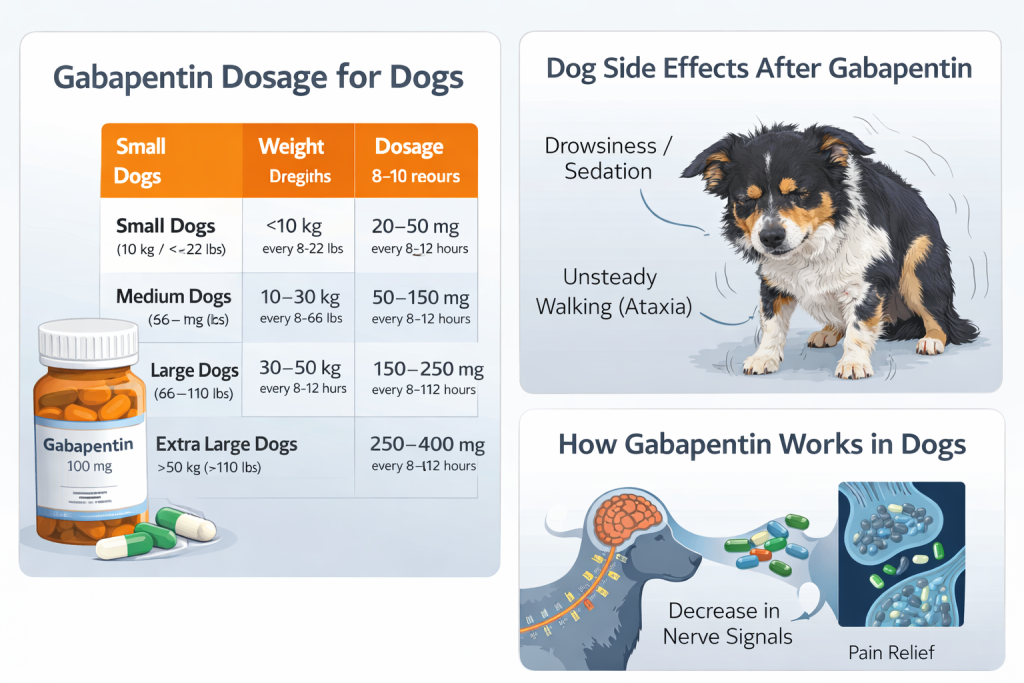

Quick Answer
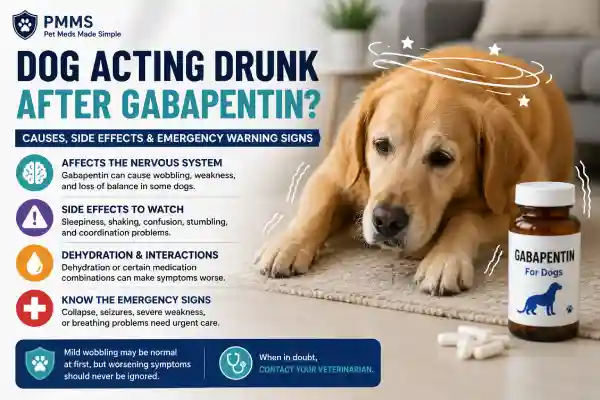
Yes, gabapentin can cause neurological side effects in some dogs. The most common include sedation, wobbliness (ataxia), weakness, and reduced coordination. Less commonly, owners may notice confusion, unusual behavior, disorientation, or tremors. Most neurological side effects are temporary and improve as the medication wears off or as the dog’s body adjusts to treatment. However, severe symptoms such as collapse, inability to stand, or loss of consciousness require immediate veterinary attention.
Can gabapentin cause neurological side effects in dogs?
Yes. Gabapentin can cause neurological side effects such as sedation, ataxia (loss of coordination), weakness, wobbliness, confusion, and behavioral changes. These effects are usually mild and temporary but may be more noticeable in senior dogs, dogs receiving higher doses, or dogs taking multiple medications.
When Owners Commonly Ask This
Most dog owners don’t search for “neurological side effects” immediately.
Instead, they notice something unusual.
Their dog may suddenly:
- Walk differently
- Seem confused
- Sleep much more than normal
- Stumble while walking
- Fall over
- Act strangely
- Appear weak
- Seem less responsive
A typical owner concern sounds like this:
“My dog started gabapentin a few days ago and now doesn’t seem like himself. Could the medication be affecting his brain or nervous system?”
In many cases, the answer is yes.
Gabapentin works directly on the nervous system, which is why neurological side effects are among the most commonly reported reactions.
The good news is that most of these effects are temporary and manageable.
Can Gabapentin Cause Neurological Side Effects?
What Neurological Side Effects Can Gabapentin Cause?
Gabapentin affects how nerves communicate throughout the body.
Because of this, certain neurological side effects can occur.
Common Neurological Side Effects
| Side Effect | How Common? |
|---|---|
| Sedation | Very Common |
| Ataxia (Loss of Coordination) | Common |
| Weakness | Common |
| Wobbliness | Common |
| Reduced Alertness | Common |
| Confusion | Less Common |
| Behavioral Changes | Less Common |
| Tremors | Rare |
| Collapse | Rare |
| Loss of Consciousness | Very Rare |
Most dogs experience only mild symptoms, if any.
However, owners should understand what these side effects look like and when they become concerning.
Can Gabapentin Cause Loss of Balance?
Yes.
Loss of balance is one of the most commonly reported neurological side effects.
Veterinarians refer to this problem as ataxia.
Dogs experiencing ataxia may:
- Wobble while walking
- Stumble unexpectedly
- Sway from side to side
- Cross their legs awkwardly
- Misjudge steps
- Fall over
Many owners who notice these symptoms begin searching why their dog is falling over after gabapentin, especially when the problem appears shortly after a dose.
What Does Ataxia Look Like?
Owners often describe affected dogs as:
“Walking like they’re drunk.”
This description is surprisingly accurate.
Ataxia affects coordination rather than strength, making movements appear abnormal even though the muscles themselves may still function normally.
Is Ataxia Dangerous?
Usually not.
Mild ataxia is often temporary.
However, severe balance problems that worsen over time should always be discussed with a veterinarian.
Can Gabapentin Cause Weakness?
Absolutely.
Weakness is another commonly reported neurological side effect.
Some dogs experience:
- Rear-leg weakness
- Difficulty standing
- Trouble climbing stairs
- Reduced activity
- Difficulty jumping
Owners researching whether gabapentin can cause weakness in dogs often report symptoms that overlap significantly with balance problems.
Weakness vs Ataxia
| Feature | Weakness | Ataxia |
|---|---|---|
| Reduced muscle strength | Yes | Usually No |
| Poor coordination | Sometimes | Yes |
| Difficulty standing | Common | Possible |
| Stumbling | Common | Common |
| Falling over | Common | Common |
Because the symptoms overlap, owners frequently confuse one condition for the other.
Can Gabapentin Cause Excessive Sleepiness?
Yes.
In fact, sedation is probably the most common neurological side effect associated with gabapentin.
Many owners become concerned because their dog suddenly:
- Sleeps more
- Plays less
- Moves slowly
- Seems less interested in activities
Dogs experiencing excessive sleepiness often lead owners to search how long gabapentin sedation lasts in dogs, especially during the first few days of treatment.
Why Does Sedation Occur?
Gabapentin slows certain neurological signaling pathways.
While this helps reduce pain and discomfort, it may also cause:
- Drowsiness
- Reduced alertness
- Slower responses
- Decreased activity
These effects are often strongest shortly after administration.
When Is Sedation Most Noticeable?
| Time After Dose | Common Effect |
|---|---|
| 30–60 minutes | Mild drowsiness |
| 1–3 hours | Sedation begins |
| 2–4 hours | Peak effects |
| 4–8 hours | Improvement begins |
| 8–12 hours | Most dogs improve |
Can Gabapentin Cause Confusion?
Sometimes.
Although less common than sedation or wobbliness, some dogs appear:
- Disoriented
- Mentally slower
- Less responsive
- Unusually quiet
Owners may describe this as:
“My dog seems confused.”
This often leads people to search why their dog seems confused after gabapentin.
What Does Confusion Look Like?
Possible signs include:
- Looking lost
- Staring into space
- Delayed responses
- Reduced interaction
- Difficulty recognizing routines
Most cases are temporary and improve as the medication wears off.
Can Gabapentin Cause Tremors?
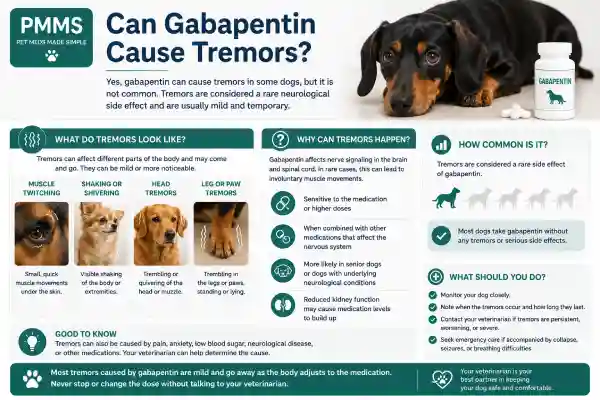
Rarely, yes.
Tremors are not among the most common side effects, but they can occur.
Owners may notice:
- Muscle twitching
- Shaking
- Trembling
- Involuntary movements
Are Tremors Always Caused by Gabapentin?
No.
Tremors may also result from:
- Pain
- Anxiety
- Underlying neurological disease
- Metabolic disorders
- Other medications
Because tremors have many potential causes, veterinary evaluation is often recommended.
Can Gabapentin Cause Behavioral Changes?
Sometimes.
Behavioral changes are less common than sedation or ataxia but can still occur.
Owners may report:
- Clinginess
- Increased dependency
- Reduced interaction
- Unusual quietness
- Personality changes
This often leads owners to ask:
These symptoms are usually temporary and improve as the medication leaves the system.
Could Senior Dogs Experience More Neurological Side Effects?
Yes.
Senior dogs are often more sensitive to medications.
Factors contributing to increased risk include:
- Reduced kidney function
- Slower medication clearance
- Existing neurological disease
- Arthritis
- Muscle loss
Owners often wonder whether senior dogs can take gabapentin safely, especially after observing wobbliness or excessive sleepiness.
The answer is generally yes, but careful monitoring becomes increasingly important as dogs age.
Could Other Medications Increase Neurological Side Effects?
Absolutely.
Many dogs receive gabapentin alongside other medications.
Examples include:
- Trazodone
- Anxiety medications
- Pain medications
- Seizure medications
- Sedatives
Common Combinations
| Medication Type | May Increase Sedation? |
|---|---|
| Trazodone | Yes |
| Anxiety medications | Yes |
| Sedatives | Yes |
| Some pain medications | Yes |
| Seizure medications | Yes |
Owners frequently compare trazodone versus gabapentin or wonder whether dogs can take gabapentin and NSAIDs together safely.
While many combinations are commonly used, side effects may become more noticeable when multiple medications affect the nervous system.
Could These Symptoms Be Signs of Overdose?
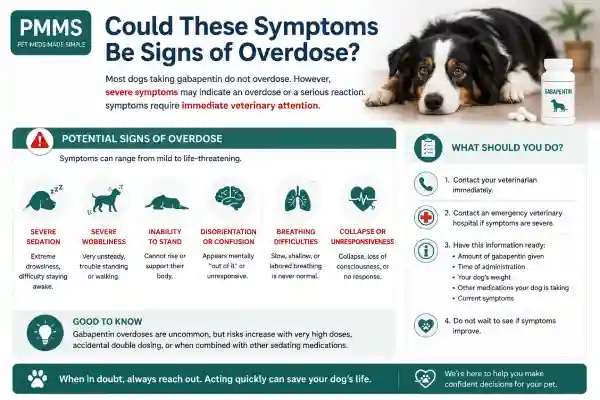
Sometimes, but not usually.
Most dogs experiencing neurological side effects from gabapentin are not suffering from an overdose. Instead, they are experiencing expected medication effects such as sedation, weakness, or ataxia.
However, severe neurological symptoms should never be ignored.
Owners often become concerned when their dog suddenly appears much worse than expected.
This frequently leads to searches such as:
- Can Dogs Overdose on Gabapentin?
- Can Dogs Overdose on Gabapentin?
- Can Gabapentin Cause Weak Back Legs?
Early Signs of Possible Overdose
Potential signs include:
- Severe wobbliness
- Extreme sedation
- Significant weakness
- Disorientation
- Difficulty walking
- Excessive sleeping
Severe Signs of Possible Overdose
More serious symptoms may include:
| Symptom | Severity |
|---|---|
| Collapse | High |
| Inability to stand | High |
| Unresponsiveness | High |
| Severe neurological abnormalities | High |
| Breathing difficulties | High |
| Loss of consciousness | Emergency |
If these symptoms develop, immediate veterinary evaluation is recommended.
What Should Owners Do?
If you suspect an overdose:
- Contact your veterinarian immediately.
- Contact an emergency veterinary hospital if necessary.
- Gather information about:
- The dose given
- When it was administered
- Other medications being used
- Current symptoms
Prompt treatment can significantly improve outcomes.
Could Another Condition Be Causing the Symptoms?
Absolutely.
One of the biggest mistakes owners make is assuming gabapentin is automatically responsible for every neurological symptom.
Many dogs taking gabapentin already have medical conditions that affect balance, coordination, or strength.
Arthritis
Dogs with arthritis often experience:
- Difficulty standing
- Reduced mobility
- Muscle weakness
- Slower movement
Owners researching Best Pain Medication for Dogs with Arthritis frequently discover that arthritis itself can contribute to instability.
Intervertebral Disc Disease (IVDD)
IVDD can cause:
- Weakness
- Ataxia
- Loss of coordination
- Difficulty walking
- Falling over
Many symptoms overlap significantly with medication side effects.
Vestibular Disease
Vestibular disease is one of the most common causes of sudden balance problems in older dogs.
Symptoms may include:
- Head tilt
- Falling to one side
- Circling
- Severe imbalance
- Rapid eye movements
Neurological Disorders
Certain neurological diseases can mimic gabapentin side effects almost perfectly.
Examples include:
- Brain disease
- Spinal cord disease
- Inflammatory neurological disorders
- Degenerative conditions
Post-Surgical Recovery
Dogs recovering from surgery may already have:
- Reduced strength
- Limited mobility
- Pain-related movement abnormalities
Gabapentin may simply make these issues more noticeable.
How Veterinarians Evaluate Neurological Side Effects
When a dog develops neurological symptoms after starting gabapentin, veterinarians rarely assume the medication is the sole cause.
Instead, they investigate multiple possibilities.
Questions Veterinarians Commonly Ask
- When did the symptoms begin?
- How severe are they?
- Was the dose recently increased?
- Is the dog taking other medications?
- Has this happened before?
- Are symptoms improving or worsening?
Physical Examination
The veterinarian may evaluate:
- Mental status
- Coordination
- Reflexes
- Strength
- Balance
- Hydration
Additional Testing
Depending on the case, testing may include:
| Test | Purpose |
|---|---|
| Bloodwork | Evaluate overall health |
| Kidney testing | Assess medication clearance |
| Liver testing | Assess drug metabolism |
| Neurological examination | Evaluate nervous system function |
| Imaging studies | Investigate structural disease |
The goal is determining whether symptoms are:
- Medication-related
- Disease-related
- A combination of both
When Do Neurological Side Effects Become an Emergency?
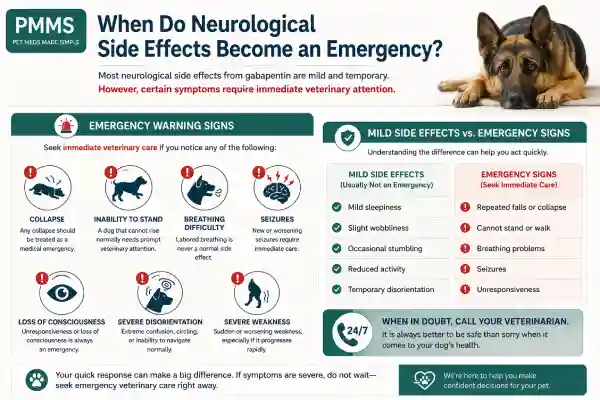
Most neurological side effects associated with gabapentin are mild.
However, certain symptoms should never be ignored.
Inability to Stand
A dog that cannot rise normally should be evaluated immediately.
Collapse
Any collapse should be treated as a medical emergency.
Severe Weakness
Progressive weakness requires prompt evaluation.
Breathing Problems
Owners frequently wonder whether gabapentin can cause breathing problems.
While uncommon, breathing abnormalities are never considered normal and should always be evaluated.
Seizures
Although gabapentin is sometimes used as a seizure medication, new seizure activity requires veterinary attention.
Loss of Consciousness
Loss of consciousness is always an emergency.
Emergency Warning Signs
| Symptom | Emergency? |
|---|---|
| Mild sleepiness | Usually No |
| Mild wobbliness | Usually No |
| Occasional stumbling | Usually No |
| Repeated falls | Yes |
| Collapse | Yes |
| Breathing difficulty | Yes |
| Seizures | Yes |
| Loss of consciousness | Yes |
Related Symptoms Owners Often Search For
Owners searching Can Gabapentin Cause Neurological Side Effects? often search for related symptoms at the same time.
Loss of Balance
Many owners noticing ataxia eventually search why their dog is falling over after gabapentin.
Weakness
Questions about whether gabapentin can cause weakness in dogs are among the most common follow-up searches.
Excessive Sleeping
Many owners wonder why their dog sleeps so much on gabapentin, particularly after starting treatment.
Confusion
Disorientation often leads owners to ask why their dog seems confused after gabapentin.
Clinginess
Some dogs become unusually attached to their owners, leading to searches about why a dog becomes clingy after gabapentin.
Acting Strange
Owners may describe their dog as “not acting normal” and search why their dog is acting strange after gabapentin.
Personality Changes
Some owners worry that medication has changed their dog’s behavior and search for information about personality-related effects.
What Questions Should Owners Ask Their Veterinarian?
Helpful questions include:
- Is this side effect expected?
- How long should it last?
- Could the dose be too high?
- Could another medication be contributing?
- Should kidney function be evaluated?
- Are these signs of ataxia or weakness?
- What symptoms would require emergency care?
- Would a dosage adjustment help?
Keeping a symptom diary can be extremely useful when discussing side effects with a veterinarian.Can Gabapentin Cause Neurological Side Effects?
Bottom Line
Gabapentin can cause neurological side effects in some dogs, including sedation, ataxia, weakness, wobbliness, confusion, and behavioral changes. Most side effects are mild, temporary, and improve as the medication wears off or as the dog’s body adjusts to treatment.
However, severe symptoms such as collapse, inability to stand, breathing difficulties, seizures, or loss of consciousness require immediate veterinary attention.Can Gabapentin Cause Neurological Side Effects?
Understanding the difference between expected side effects and emergency warning signs can help owners make safer decisions for their pets.
Veterinarian Takeaway
Gabapentin works directly on the nervous system, so neurological side effects are not unusual. The most common effects include sedation, weakness, and loss of coordination. Most dogs tolerate the medication well, but senior dogs, dogs taking multiple medications, and dogs with underlying medical conditions may be more susceptible to neurological symptoms. Owners should monitor closely during the first few days of treatment and after dosage adjustments.
Frequently Asked Questions – Can Gabapentin Cause Neurological Side Effects?
Can gabapentin cause neurological side effects in dogs?
Yes. Common neurological side effects include sedation, ataxia, weakness, and wobbliness.
Is wobbliness normal after gabapentin?
Mild wobbliness is a recognized side effect and often improves as the medication wears off.
Can gabapentin cause confusion?
Yes. Some dogs may appear disoriented or mentally slower while taking gabapentin.
Can gabapentin cause tremors?
Rarely. Tremors are less common than sedation or ataxia but can occur.
Why is my dog acting strange after gabapentin?
Behavioral changes may occur due to sedation, weakness, or altered neurological signaling.
Can gabapentin affect a dog’s personality?
Temporary behavioral changes are possible, although permanent personality changes are not expected.
Are senior dogs more sensitive to gabapentin?
Yes. Older dogs often process medications more slowly and may experience stronger side effects.
Can gabapentin and trazodone increase neurological side effects?
Yes. Combining medications that affect the nervous system may increase sedation and wobbliness.
When should I call my veterinarian?
Contact your veterinarian if symptoms are severe, worsening, or not improving as expected.
When should I seek emergency care?
Seek immediate veterinary attention if your dog collapses, cannot stand, develops breathing difficulties, has seizures, or becomes unresponsive.
Reviewed By
Pharmacy Reviewed By
Dimitar Atanasov, MPharm
Master Pharmacist | Medication Safety Educator
Editorial Policy
At Pet Meds Made Simple, we are committed to providing accurate, evidence-based information about pet medications, veterinary treatments, medication safety, and common health concerns affecting dogs and cats.
Our content is researched using veterinary reference texts, peer-reviewed literature, clinical guidelines, and trusted veterinary organizations. Every article is designed to help pet owners better understand their pet’s medications while supporting—not replacing—the advice of a licensed veterinarian.Can Gabapentin Cause Neurological Side Effects?
Sources
- Plumb’s Veterinary Drug Handbook
- American Animal Hospital Association (AAHA)
- American Veterinary Medical Association (AVMA)
- Merck Veterinary Manual
- Veterinary Pharmacology and Therapeutics
- Small Animal Clinical Pharmacology
- Journal of the American Veterinary Medical Association (JAVMA)
- Frontiers in Veterinary Science
- Veterinary Anaesthesia and Analgesia
- Veterinary Information Network (VIN)
Medical Review Statement
This article was pharmacy-reviewed by Dimitar Atanasov, MPharm, Master Pharmacist, using current veterinary pharmacology references, canine medication-safety guidelines, and published veterinary literature available at the time of review.Can Gabapentin Cause Neurological Side Effects?
Images created with AI – Can Gabapentin Cause Neurological Side Effects?