Quick Answer
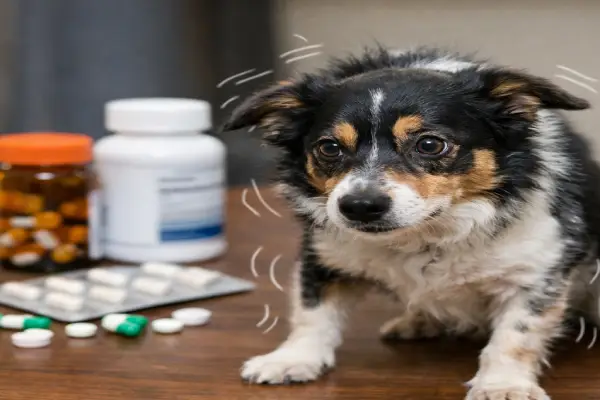
Dogs should generally not stop gabapentin suddenly unless specifically instructed by a veterinarian. Abrupt discontinuation may cause the return of pain, anxiety, or neurological symptoms and, in some cases, may lead to withdrawal-like effects. The risk depends on how long the dog has been taking gabapentin, the dose used, and the condition being treated. Veterinarians often recommend gradually reducing the dose rather than stopping it abruptly.
What happens if dogs suddenly stop gabapentin?
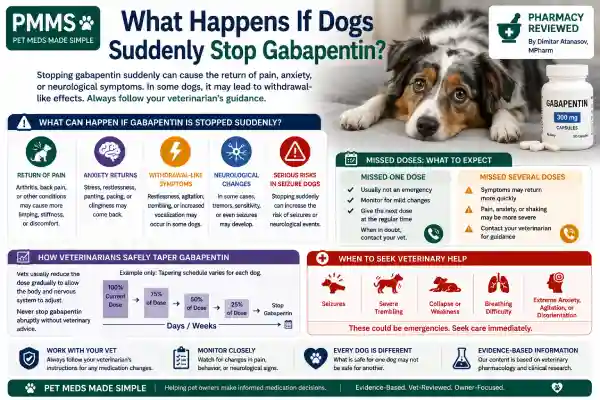
If a dog suddenly stops taking gabapentin, symptoms that were previously controlled by the medication may return. Some dogs may experience increased pain, anxiety, restlessness, agitation, or withdrawal-like symptoms. Dogs receiving gabapentin for seizure management may be at greater risk for serious complications. Veterinarians usually recommend tapering the medication gradually instead of stopping it suddenly.
When Owners Commonly Ask This
This situation is surprisingly common.
Owners often find themselves asking this question after:
- Running out of medication
- Missing a refill
- Forgetting multiple doses
- Deciding to stop treatment
- Seeing side effects
- Switching medications
A typical concern sounds like this:
“My dog hasn’t had gabapentin for two days. Is that dangerous?”
Or:
“I stopped giving gabapentin because my dog seemed sleepy. Did I make a mistake?”
The answer depends on several factors, including why the medication was prescribed and how long the dog has been taking it.
What Happens If Dogs Suddenly Stop Gabapentin?
Why Veterinarians Usually Avoid Stopping Gabapentin Abruptly
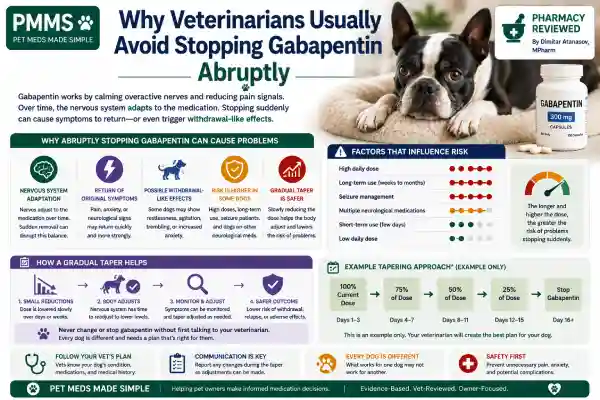
Gabapentin works by affecting how nerves transmit signals.
Over time, the nervous system adapts to the medication.
When the medication is suddenly removed, the body may need time to readjust.
This is why veterinarians often recommend a tapering schedule rather than an immediate stop.
Factors That Influence Risk
| Factor | Higher Risk? |
|---|---|
| High doses | Yes |
| Long-term use | Yes |
| Seizure patients | Yes |
| Multiple neurological medications | Yes |
| Short-term use | Usually lower risk |
The longer and more consistently a dog has been receiving gabapentin, the more carefully discontinuation should be approached.
What Is Gabapentin Usually Prescribed For?
Understanding why the medication was prescribed helps explain what may happen if it is stopped.
Common Uses
- Chronic pain
- Arthritis
- Neuropathic pain
- IVDD
- Post-surgical pain
- Anxiety
- Seizure management
Dogs receiving gabapentin for chronic arthritis often have very different risks compared with dogs receiving it as part of a seizure treatment plan.
Owners wanting more background may also find Complete Guide to Gabapentin for Dogs helpful.
Could My Dog’s Pain Come Back?
Yes.
This is probably the most common outcome.
Gabapentin does not cure pain.
Instead, it helps manage it.
When treatment stops, the underlying condition is still present.
Conditions Where Pain May Return
| Condition | Pain May Return? |
|---|---|
| Arthritis | Yes |
| Hip Dysplasia | Yes |
| IVDD | Yes |
| Surgical Recovery | Yes |
| Chronic Joint Disease | Yes |
Owners often notice:
- Increased limping
- Reduced mobility
- Stiffness
- Reluctance to walk
- Difficulty standing
This is one reason many owners who read Why Is My Dog Still Limping After Gabapentin? become concerned about stopping treatment altogether.
Could Anxiety Return After Stopping Gabapentin?
Absolutely.
Some dogs receive gabapentin primarily for anxiety management.
Examples include:
- Veterinary visits
- Thunderstorms
- Fireworks
- Travel
- Separation-related stress
If the medication is stopped, the original anxiety problem may simply return.
Possible Signs
- Panting
- Pacing
- Trembling
- Clinginess
- Restlessness
- Difficulty settling down
Owners sometimes mistake the return of anxiety for a medication withdrawal reaction.
In reality, the underlying condition may simply be reappearing.
Can Dogs Experience Gabapentin Withdrawal?
In some cases, yes.
While not every dog experiences withdrawal-like symptoms, veterinarians generally recognize that abrupt discontinuation can sometimes cause problems.
This is especially true in dogs receiving:
- High doses
- Long-term treatment
- Neurological medications
Possible Withdrawal-Like Symptoms
| Symptom | Possible? |
|---|---|
| Restlessness | Yes |
| Agitation | Yes |
| Anxiety | Yes |
| Increased vocalization | Yes |
| Trembling | Possible |
| Sleep disturbances | Possible |
Many owners searching this topic eventually find our article:
Gabapentin Withdrawal in Dogs:
which covers withdrawal symptoms in greater detail.
Could My Dog Shake After Stopping Gabapentin?
Sometimes.
Owners frequently become alarmed when they notice:
- Trembling
- Shaking
- Nervous behavior
- Increased sensitivity
These symptoms can occur because:
- Pain has returned
- Anxiety has returned
- Withdrawal-like effects are developing
- Another medical condition is involved
Shaking alone does not automatically mean withdrawal is occurring.
However, it should not be ignored.
Could Seizures Become a Concern?
Yes.
This is one of the most important reasons veterinarians take abrupt discontinuation seriously.
Dogs receiving gabapentin as part of seizure management may be at higher risk if treatment is suddenly stopped.
Why?
The nervous system has adapted to the medication.
Removing it suddenly may increase neurological instability.
Higher-Risk Patients
| Patient Type | Risk Level |
|---|---|
| Arthritis patients | Lower |
| Anxiety patients | Moderate |
| Chronic pain patients | Moderate |
| Seizure patients | Higher |
For seizure patients, medication changes should always be supervised by a veterinarian.
Could My Dog Become More Restless?
Very commonly.
Many owners describe dogs becoming:
- More alert
- More active
- Unable to settle
- Easily startled
These changes can sometimes occur because sedation is no longer present.
Owners who previously worried about:
How Long Does Gabapentin Sedation Last in Dogs?
may suddenly notice the opposite problem once treatment stops.
What If My Dog Missed One Dose?
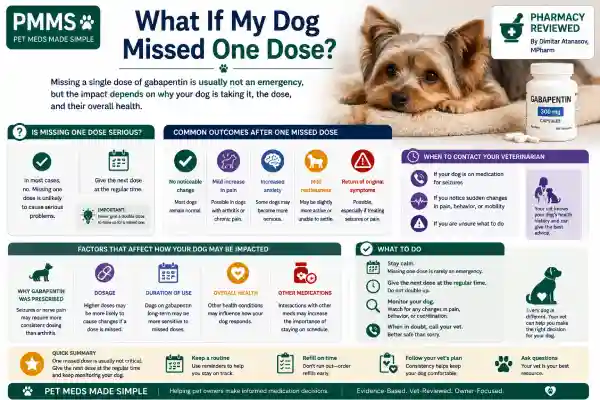
In many cases, missing a single dose is not an emergency.
However, the impact depends on:
- Why gabapentin was prescribed
- The dose being used
- The dog’s overall health
- Whether other medications are involved
Common Outcomes After One Missed Dose
| Possible Effect | Common? |
|---|---|
| No noticeable change | Yes |
| Mild increase in pain | Possible |
| Increased anxiety | Possible |
| Mild restlessness | Possible |
| Return of original symptoms | Possible |
Many owners never notice a significant difference after a single missed dose.
However, seizure patients should always follow their veterinarian’s instructions carefully.
What If My Dog Missed Several Doses?
This situation is more concerning.
The longer a dog goes without medication, the more likely symptoms are to return.
Owners May Notice
- More limping
- Increased stiffness
- Reduced mobility
- Anxiety
- Restlessness
- Trembling
- Behavioral changes
For dogs being treated for arthritis or chronic pain, owners may suddenly realize how much benefit the medication was actually providing.
Many dogs that seemed “unchanged” on gabapentin become noticeably less comfortable after several missed doses.
Could Stopping Gabapentin Cause Neurological Symptoms?
Sometimes.
Gabapentin acts directly on the nervous system.
Because of this, abrupt discontinuation may occasionally be associated with neurological changes.
Possible Neurological Symptoms
| Symptom | Possible? |
|---|---|
| Trembling | Yes |
| Agitation | Yes |
| Anxiety | Yes |
| Increased sensitivity | Yes |
| Restlessness | Yes |
| Seizures (high-risk patients) | Possible |
Owners often become concerned when symptoms resemble those discussed in:
Can Gabapentin Cause Neurological Side Effects?
The difference is that these symptoms occur after stopping treatment rather than while receiving it.
Could My Dog Seem Worse Than Before Starting Gabapentin?
Sometimes.
This is one of the most confusing experiences for owners.
A dog may appear:
- More painful
- More anxious
- Less comfortable
- More restless
than they remember before treatment started.
Why Does This Happen?
The underlying condition may have progressed while the medication was helping control symptoms.
For example:
A dog with arthritis may have experienced gradual disease progression over several months.
Once gabapentin is removed, the owner suddenly notices the current severity of the condition.
How Veterinarians Safely Taper Gabapentin
Veterinarians commonly reduce gabapentin gradually instead of stopping abruptly.
Why Tapering Helps
A gradual reduction allows:
- The nervous system to adapt
- Monitoring for returning symptoms
- Reduced risk of withdrawal-like effects
- Better comfort during transition
Important Reminder
Owners should never create their own tapering schedule.
The safest plan depends on:
- Dose
- Duration of treatment
- Medical condition
- Other medications
Every Dog Is Different
A taper that is appropriate for one patient may not be appropriate for another.
This is especially true for dogs receiving multiple neurological medications.
When Should Owners Contact Their Veterinarian?
Owners should contact their veterinarian if:
- Several doses have been missed
- Symptoms suddenly worsen
- Pain rapidly returns
- Trembling develops
- Anxiety becomes severe
- Neurological symptoms appear
- The dog has a seizure history
It is always better to ask questions early than wait for symptoms to worsen.
When Does Stopping Gabapentin Become an Emergency?
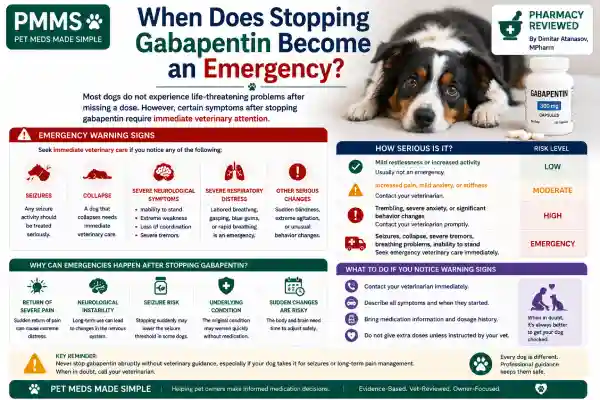
Most dogs do not experience life-threatening problems after missing a dose.
However, certain situations require immediate veterinary attention.
Seizures
Any seizure activity should be treated seriously.
This is especially important in dogs receiving gabapentin as part of seizure management.
Collapse
A dog that collapses should receive immediate veterinary evaluation.
Severe Neurological Symptoms
Examples include:
- Inability to stand
- Extreme weakness
- Loss of coordination
- Severe tremors
Owners who previously read:
Why Is My Dog Falling Over After Gabapentin?
may notice similar symptoms if neurological complications occur.
Severe Respiratory Distress
Although uncommon, breathing difficulties should never be ignored.
Emergency Warning Signs
| Symptom | Emergency? |
|---|---|
| Mild restlessness | Usually No |
| Mild anxiety | Usually No |
| Increased pain | Contact Vet |
| Severe tremors | Yes |
| Seizures | Yes |
| Collapse | Yes |
| Inability to stand | Yes |
| Breathing difficulty | Yes |
Related Symptoms Owners Often Search For
Owners searching What Happens If Dogs Suddenly Stop Gabapentin? often research several related concerns.
Withdrawal Symptoms
Many readers continue to:
for a deeper explanation of withdrawal-like reactions.
Increased Pain
Dogs with chronic pain may experience worsening symptoms after stopping treatment.
This often leads owners to:
Why Is My Dog Still Limping After Gabapentin?
Anxiety
Owners may notice increased nervousness and wonder whether anxiety symptoms are returning.
Weakness
Some dogs experience changes in mobility that prompt owners to read:
Can Gabapentin Cause Weakness in Dogs?
Neurological Symptoms
Behavioral or neurological changes often lead readers to:
Can Gabapentin Cause Neurological Side Effects?
Breathing Changes
Owners who observe panting or rapid breathing may also read:
Why Is My Dog Breathing Fast on Gabapentin?
to better understand whether medication changes may be involved.
What Questions Should Owners Ask Their Veterinarian?
Helpful questions include:
- Can my dog stop gabapentin safely?
- Does the medication need to be tapered?
- What symptoms should I monitor?
- How quickly might pain return?
- Could anxiety worsen?
- Is my dog at risk for withdrawal symptoms?
- What should I do if I miss a dose?
- When should I seek emergency care?
These discussions help reduce medication errors and improve patient safety.
Bottom Line
Dogs should generally not stop gabapentin suddenly unless directed by a veterinarian. Abrupt discontinuation may allow pain, anxiety, or other symptoms to return and, in some dogs, may lead to withdrawal-like effects. The risk is often greater in dogs receiving high doses, long-term treatment, or seizure medications. What Happens If Dogs Suddenly Stop Gabapentin?
Whenever possible, veterinarians prefer gradual dose reductions rather than abrupt discontinuation. If your dog misses several doses or develops concerning symptoms after stopping gabapentin, contact your veterinarian for guidance. What Happens If Dogs Suddenly Stop Gabapentin?
Veterinarian Takeaway
Gabapentin is often used for chronic pain, anxiety, and neurological conditions. While many dogs tolerate discontinuation without serious complications, abruptly stopping treatment can sometimes lead to increased discomfort, anxiety, restlessness, or withdrawal-like symptoms. Dogs receiving gabapentin for seizure management require particular caution. Veterinary supervision remains the safest way to discontinue therapy.
Frequently Asked Questions – What Happens If Dogs Suddenly Stop Gabapentin?
Can dogs stop gabapentin suddenly?
Veterinarians generally recommend tapering rather than stopping abruptly.
What happens if my dog misses one dose?
Many dogs experience no major problems, although symptoms may begin returning.
Can gabapentin withdrawal occur in dogs?
Yes. Some dogs may develop withdrawal-like symptoms after abrupt discontinuation.
Will my dog’s pain come back?
Possibly. The underlying condition often remains even when symptoms were controlled by medication.
Can anxiety return after stopping gabapentin?
Yes. Dogs receiving gabapentin for anxiety may experience a return of anxiety-related behaviors.
Can stopping gabapentin cause shaking?
Sometimes. Trembling may occur due to returning pain, anxiety, or withdrawal-like effects.
Is it dangerous to stop gabapentin used for seizures?
It can be. Seizure patients require careful veterinary supervision.
How do veterinarians stop gabapentin safely?
Many veterinarians gradually reduce the dose over time.
When should I call my veterinarian?
If symptoms worsen, multiple doses are missed, or concerning signs develop.
When is stopping gabapentin an emergency?
Seek immediate veterinary care for seizures, collapse, severe tremors, breathing difficulties, or inability to stand.
Reviewed By
Pharmacy Reviewed By
Dimitar Atanasov, MPharm
Master Pharmacist | Medication Safety Educator
Editorial Policy
At Pet Meds Made Simple, we are committed to providing accurate, evidence-based information about pet medications, veterinary treatments, medication safety, and common health concerns affecting dogs and cats. What Happens If Dogs Suddenly Stop Gabapentin?
Our content is researched using veterinary pharmacology references, peer-reviewed veterinary literature, clinical guidelines, and trusted veterinary organizations. Every article is designed to help pet owners make informed decisions while supporting—not replacing—the advice of their veterinarian.
Sources
- Plumb’s Veterinary Drug Handbook
- American Animal Hospital Association (AAHA)
- American Veterinary Medical Association (AVMA)
- Merck Veterinary Manual
- Veterinary Pharmacology and Therapeutics
- Small Animal Clinical Pharmacology
- Journal of the American Veterinary Medical Association (JAVMA)
- Frontiers in Veterinary Science
- Veterinary Anaesthesia and Analgesia
- Veterinary Information Network (VIN)
Medical Review Statement
This article was pharmacy-reviewed by Dimitar Atanasov, MPharm, Master Pharmacist, using current veterinary pharmacology references, canine pain-management guidelines, and published veterinary literature available at the time of review.
Images created with AI – What Happens If Dogs Suddenly Stop Gabapentin?