
Quick Answer
Can Gabapentin Cause Breathing Changes in Cats? Yes, mild breathing changes may occasionally be noticed in some cats after taking gabapentin, but clinically significant respiratory depression is uncommon when the medication is prescribed at appropriate veterinary doses. Many owners notice slower, deeper breathing simply because their cat is relaxed or sleeping more soundly. However, open-mouth breathing, severe breathing difficulty, blue gums, collapse, or extreme lethargy should always be treated as veterinary emergencies.
Can Gabapentin Cause Breathing Changes in Cats?
When Owners Commonly Ask This
The question “Can Gabapentin Cause Breathing Changes in Cats?” usually appears during a very stressful moment for cat owners.
A common situation looks like this:
Your veterinarian prescribes gabapentin before a veterinary visit to reduce stress or for long-term management of chronic pain or neurological disease.
About one to three hours after giving the medication, your cat becomes:
- much calmer
- very sleepy
- less responsive
- quieter than usual
- deeply asleep
While watching your cat sleep, you suddenly notice that the breathing seems different.
Perhaps it appears:
- slower
- deeper
- quieter
- more relaxed
- occasionally irregular during sleep
Naturally, many owners immediately search online:
- Can Gabapentin Cause Breathing Changes in Cats?
- Is my cat breathing too slowly?
- Is this normal sedation?
- Should I wake my cat up?
- Can gabapentin suppress breathing?
- Is this an emergency?
Fortunately, in many cases the breathing pattern owners observe is related to normal sedation rather than dangerous respiratory depression.
However, knowing the difference is extremely important.
Owners may also find these PMMS articles helpful:
- Gabapentin for Cats: Uses, Dosage, Side Effects & Safety
- How Long Does Gabapentin Last in Cats?
- Why Is My Cat Shaking After Gabapentin?
- Can Gabapentin Cause Vomiting in Cats?
- Is Human Gabapentin Safe for Cats?
- Can Cats Miss a Dose of Gabapentin?
Can Gabapentin Cause Breathing Changes in Cats?
The short answer is:
Yes but most breathing changes observed at home are mild and related to sedation rather than true respiratory problems.
This distinction is one of the most important concepts for cat owners to understand.
Many owners assume that if breathing appears slower after giving gabapentin, the medication must be dangerously suppressing the lungs.
In reality, cats that are deeply relaxed naturally breathe more slowly while resting or sleeping.
This is very different from true respiratory distress.
Veterinarians evaluate several factors before deciding whether breathing changes are expected or represent an emergency.
These include:
- breathing rate
- breathing effort
- gum color
- level of consciousness
- body position
- recent medication history
- underlying heart or lung disease
Only after considering the complete clinical picture can the breathing pattern be interpreted correctly.
Does Gabapentin Directly Slow a Cat’s Breathing?
At standard veterinary doses, gabapentin is not considered a medication that commonly causes clinically significant respiratory depression in healthy cats.
Its primary effects involve the nervous system.
Gabapentin is commonly prescribed to:
- reduce anxiety before veterinary visits
- manage chronic pain
- treat neuropathic pain
- assist with certain seizure disorders
- improve comfort after surgery
As these effects develop, many cats become:
- relaxed
- sleepy
- less reactive
- quieter
- more willing to rest
During sleep, breathing naturally becomes slower and deeper.
This normal physiological response is frequently mistaken for a dangerous side effect.
Why Breathing Sometimes Appears Different
Owners are often observing their cat much more closely after giving medication.
Small breathing changes that may have always been present suddenly become much more noticeable.
For example:
A relaxed cat sleeping on a blanket may take slower, deeper breaths than when alert and exploring the house.
Because gabapentin promotes relaxation, this normal sleeping pattern becomes easier to observe.
This explains why searches for “Can Gabapentin Cause Breathing Changes in Cats?” are much more common than confirmed cases of medication-induced respiratory complications.
Normal Sedation vs Dangerous Respiratory Changes
One of the most valuable things owners can learn is how to distinguish expected sedation from signs that require immediate veterinary care.
| Observation | Usually Expected? | Veterinary Emergency? |
|---|---|---|
| Sleeping more deeply | ✅ Yes | ❌ No |
| Mildly slower breathing during sleep | ✅ Yes | ❌ No |
| Calm, relaxed behavior | ✅ Yes | ❌ No |
| Difficulty waking the cat | ⚠ Sometimes | Monitor closely |
| Open-mouth breathing | ❌ No | ✅ Yes |
| Blue or gray gums | ❌ No | 🚨 Immediate emergency |
| Labored breathing | ❌ No | 🚨 Immediate emergency |
| Collapse | ❌ No | 🚨 Immediate emergency |
This table illustrates why breathing rate alone is not enough to determine whether a cat is experiencing a true emergency.
Veterinarians always assess the quality of breathing, not just the number of breaths per minute.
What Is a Normal Breathing Rate in Cats?
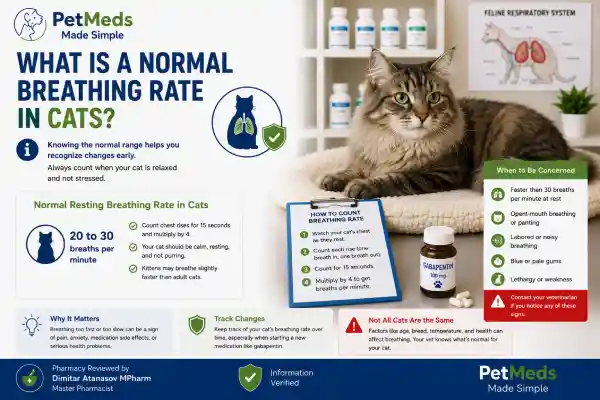
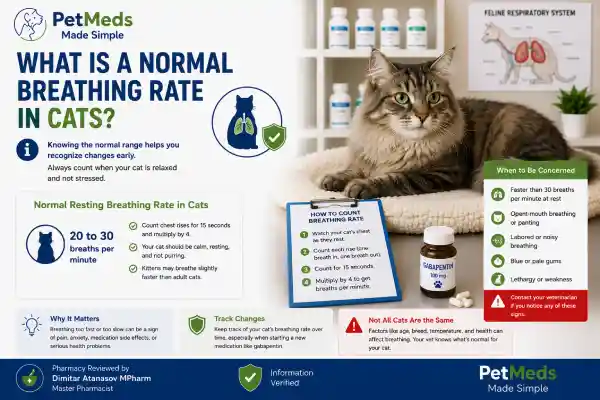
A healthy resting cat typically breathes approximately:
20–30 breaths per minute
while calm and relaxed.
Sleeping cats may occasionally breathe slightly slower.
However, breathing should remain:
- effortless
- quiet
- smooth
- regular
The chest should rise and fall comfortably without obvious strain.
Owners should avoid counting the breathing rate immediately after exercise, excitement, or stress because these situations temporarily increase respiratory rate.
Which Cats Are More Likely to Show Breathing Changes?
Although Can Gabapentin Cause Breathing Changes in Cats? is a common concern, certain cats deserve closer monitoring.
These include:
- senior cats
- obese cats
- cats with asthma
- cats with heart disease
- cats with chronic kidney disease
- cats receiving multiple sedating medications
- cats recovering from surgery
These cats may already have underlying conditions that influence breathing independent of gabapentin.
Owners may also wish to review:
- How Long Does Gabapentin Last in Cats?
- Why Is My Cat Shaking After Gabapentin?
- Can Gabapentin Cause Vomiting in Cats?
- Can Cats Miss a Dose of Gabapentin?
- Is Human Gabapentin Safe for Cats?
Why Veterinarians Don’t Judge Breathing by Rate Alone
One of the biggest misconceptions surrounding Can Gabapentin Cause Breathing Changes in Cats? is the belief that a slower breathing rate automatically indicates danger.
Veterinarians instead ask several questions:
- Is the cat asleep or awake?
- Is breathing smooth or labored?
- What color are the gums?
- Is the cat responsive?
- Has another medication also been given?
- Does the cat have heart disease?
- Does the cat have feline asthma?
- Is there evidence of pain?
Only after answering these questions can breathing changes be interpreted accurately.
Why Owners Should Stay Calm
Fortunately, most cats receiving gabapentin experience only mild, temporary sedation.
This means that slight breathing changes observed during restful sleep are often part of the expected response to the medication rather than evidence of a serious complication.
Understanding this difference can help owners avoid unnecessary panic while still recognizing the warning signs that truly require immediate veterinary attention.
Can Gabapentin Cause Respiratory Depression in Cats?
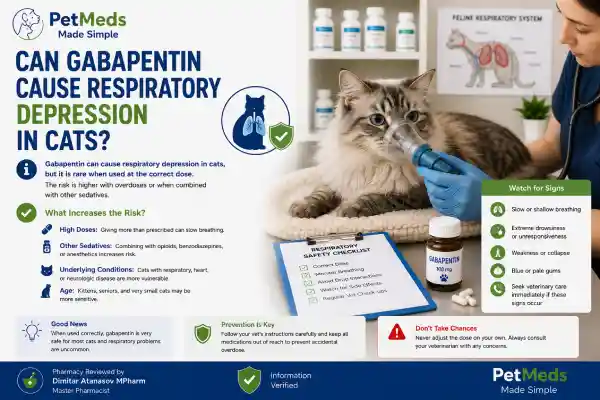
One of the biggest fears behind the question “Can Gabapentin Cause Breathing Changes in Cats?” is whether gabapentin can stop a cat from breathing normally.
Fortunately, this is uncommon in healthy cats receiving veterinarian-prescribed doses.
Gabapentin is not classified as a powerful respiratory depressant in the same way as certain opioids or anesthetic medications.
Most cats simply become:
- sleepy
- relaxed
- quieter
- less reactive to their surroundings
These expected effects may make breathing appear slower because the cat is resting comfortably.
True respiratory depression, however, involves much more than a reduced breathing rate.
Veterinarians evaluate:
- breathing effort
- oxygenation
- responsiveness
- gum color
- heart rate
- body temperature
rather than counting breaths alone.
What Does True Respiratory Distress Look Like?
Many owners searching “Can Gabapentin Cause Breathing Changes in Cats?” are actually describing completely normal sleeping behavior.
Knowing the warning signs is therefore extremely important.
Signs that require immediate veterinary care include:
- open-mouth breathing
- pronounced abdominal effort when breathing
- blue, gray, or pale gums
- gasping
- collapse
- severe weakness
- inability to wake the cat
- repeated fainting episodes
These signs are not considered normal effects of gabapentin and should always be treated as emergencies.
Can Healthy Cats Usually Tolerate Gabapentin Well?
Yes.
Gabapentin has become one of the most commonly prescribed medications for cats because it generally has an excellent safety profile.
Veterinarians routinely prescribe it for:
- transportation anxiety
- veterinary visits
- chronic pain
- osteoarthritis
- neuropathic pain
- post-operative recovery
Millions of doses have been administered worldwide with very good overall safety.
The majority of cats experience only temporary side effects such as:
- sleepiness
- mild incoordination
- reduced activity
- temporary balance changes
Serious breathing complications remain uncommon when appropriate doses are used.
Cats With Asthma Require Additional Attention
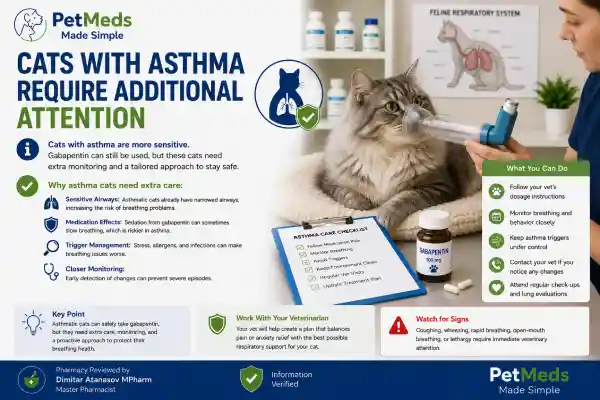
Although Can Gabapentin Cause Breathing Changes in Cats? usually has a reassuring answer, cats with feline asthma deserve closer observation.
Asthma itself may cause:
- wheezing
- coughing
- increased breathing effort
- episodes of respiratory distress
If an asthmatic cat develops breathing difficulty after receiving gabapentin, veterinarians must determine whether the medication is coincidental or whether an asthma flare is actually responsible.
This distinction is critical because the treatment approach is completely different.
Owners may also wish to review:
- Gabapentin for Cats: Uses, Dosage, Side Effects & Safety
- How Long Does Gabapentin Last in Cats?
- Why Is My Cat Shaking After Gabapentin?
- Can Gabapentin Cause Vomiting in Cats?
Cats With Heart Disease
Cats diagnosed with heart disease also require individualized monitoring.
Conditions such as hypertrophic cardiomyopathy (HCM) may cause:
- increased respiratory rate
- labored breathing
- fluid accumulation
- reduced exercise tolerance
If breathing changes develop in these patients, veterinarians investigate:
- heart disease progression
- fluid in the lungs
- stress
- medication interactions
- overall cardiovascular status
rather than assuming gabapentin is solely responsible.
Can Kidney Disease Influence Breathing?
Interestingly, yes.
Many older cats receiving gabapentin also have chronic kidney disease.
Advanced kidney disease may contribute to:
- metabolic abnormalities
- dehydration
- weakness
- acid-base disturbances
- altered breathing patterns
In these situations, the underlying kidney disease—not gabapentin—may explain the respiratory changes.
Can Combining Medications Increase Sedation?
Absolutely.
One of the most important considerations when evaluating Can Gabapentin Cause Breathing Changes in Cats? is whether other sedating medications are also being administered.
Examples include:
- opioids
- certain anti-anxiety medications
- anesthetic drugs
- some muscle relaxants
When multiple sedatives are combined, overall sedation becomes greater than with gabapentin alone.
This is why veterinarians carefully review every medication your cat receives before procedures or surgery.
Owners should also review:
- Can Cats Miss a Dose of Gabapentin?
- Is Human Gabapentin Safe for Cats?
- Can Gabapentin Cause Vomiting in Cats?
Can Gabapentin Overdose Cause Breathing Problems?
Yes.
Although uncommon, overdose represents a completely different situation from normal treatment.
A cat receiving an excessive amount of gabapentin may develop:
- profound sedation
- severe incoordination
- inability to stand
- marked weakness
- poor responsiveness
- abnormal breathing
This is one reason medications should always be stored safely and dosed exactly as prescribed.
Owners should never give additional doses simply because the first dose “didn’t seem to work quickly enough.”
How Veterinarians Evaluate Breathing Changes
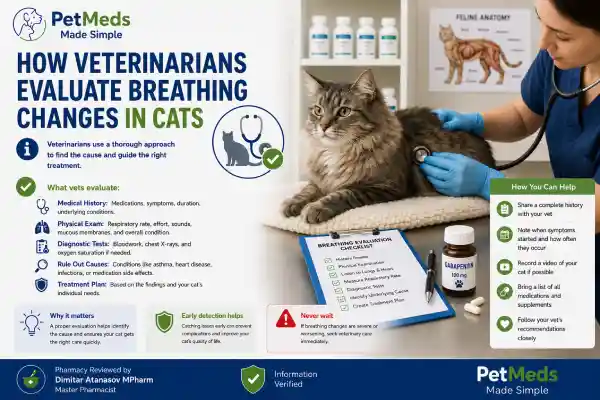
When a cat is presented after an owner searches “Can Gabapentin Cause Breathing Changes in Cats?”, the veterinary examination usually begins with several important questions.
These include:
- When was gabapentin given?
- What dose was administered?
- Is the cat awake or asleep?
- Has another medication been given?
- Does the cat have asthma?
- Does the cat have heart disease?
- Has vomiting occurred?
- Has trauma occurred recently?
These answers often provide valuable clues before any diagnostic testing is performed.
Physical Examination
A complete examination may include assessment of:
- respiratory rate
- respiratory effort
- heart rate
- mucous membrane color
- oxygenation
- body temperature
- lung sounds
- neurological status
In many cases, this examination quickly determines whether the cat is experiencing expected sedation or a true medical emergency.
Additional Diagnostic Tests
If breathing abnormalities remain unexplained, veterinarians may recommend further testing.
| Diagnostic Test | Why It May Be Performed |
|---|---|
| Chest radiographs | Evaluate lungs and heart |
| Pulse oximetry | Measure oxygen saturation |
| Blood chemistry | Assess organ function |
| Complete blood count | Detect infection or inflammation |
| Blood pressure | Evaluate cardiovascular status |
| Echocardiography | Investigate suspected heart disease |
Fortunately, most cats receiving gabapentin never require extensive testing because their breathing changes are mild and temporary.
When Should Owners Seek Emergency Care?
Contact an emergency veterinarian immediately if your cat develops:
- open-mouth breathing
- blue or gray gums
- severe breathing difficulty
- collapse
- inability to wake up
- repeated seizures
- profound weakness
- suspected overdose
- worsening respiratory effort
These signs should never be considered normal sedation.
Owners may also wish to read:
- Can Gabapentin Cause Vomiting in Cats?
- Why Is My Cat Shaking After Gabapentin?
- Can Cats Miss a Dose of Gabapentin?
- How Long Does Gabapentin Last in Cats?
- Gabapentin for Cats: Uses, Dosage, Side Effects & Safety
Can Breathing Changes Be Prevented?
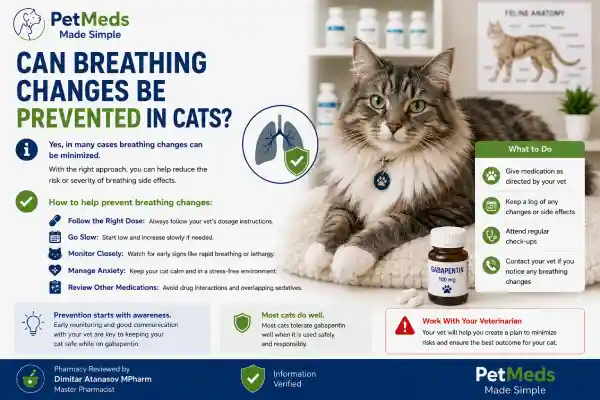
In many cases, yes.
One of the most encouraging answers to “Can Gabapentin Cause Breathing Changes in Cats?” is that most breathing-related concerns can be minimized through proper dosing, careful observation, and routine veterinary guidance.
Although no medication is completely free of side effects, gabapentin has an excellent safety record in cats when prescribed appropriately.
Owners can reduce potential problems by:
- giving the exact prescribed dose
- avoiding accidental double dosing
- informing the veterinarian about every medication the cat receives
- monitoring the cat during the first several hours after each new dose
- reporting any unusual breathing patterns promptly
Prevention is especially important for senior cats and those with pre-existing heart, lung, or kidney disease.
How Owners Can Monitor Breathing at Home
Many owners become anxious after reading about possible side effects online.
Fortunately, monitoring your cat’s breathing is usually straightforward.
A relaxed cat should generally have:
- smooth breathing
- quiet breathing
- no obvious effort
- a comfortable sleeping position
- pink gums
- normal responsiveness when awakened
Owners should avoid repeatedly waking their cat simply to check breathing, as this may increase stress and make breathing temporarily faster.
Home Monitoring Checklist
| What to Monitor | Normal Finding |
|---|---|
| Breathing effort | Comfortable and effortless |
| Gum color | Pink |
| Sleeping position | Relaxed |
| Response when awakened | Appropriate |
| Appetite | Normal or improving |
| Walking | Mild temporary wobbliness may occur after dosing |
Recording observations during the first few treatments often helps owners recognize what is normal for their individual cat.
What Usually Happens After the Medication Wears Off?
One reassuring fact about Can Gabapentin Cause Breathing Changes in Cats? is that mild sedation typically improves as the medication gradually wears off.
Most cats slowly become:
- more alert
- more active
- more responsive
- interested in food
- interested in interacting with their owners
This gradual return to normal behavior is expected.
Owners often notice that breathing also returns to its usual resting pattern as the sedative effects diminish.
Those wondering about recovery time may also wish to review:
Does Every Cat Respond the Same Way?
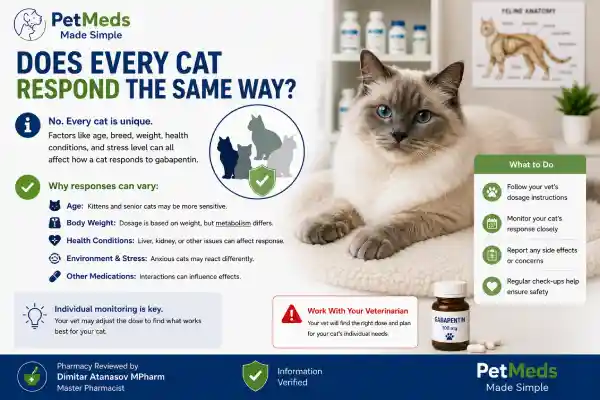
No.
Cats vary considerably in how they respond to gabapentin.
Factors influencing the response include:
- age
- body weight
- kidney function
- concurrent illness
- stress level
- previous exposure to gabapentin
- individual sensitivity
Some cats remain surprisingly alert.
Others become deeply relaxed for several hours.
Both responses may be completely normal depending on the individual patient.
Should Owners Be Concerned About Sleeping Too Deeply?
Not necessarily.
One of the most common reasons owners search “Can Gabapentin Cause Breathing Changes in Cats?” is because their cat appears to be sleeping much more deeply than usual.
Deep sleep alone is not automatically a sign of respiratory depression.
Instead, owners should evaluate the overall picture.
Questions to ask include:
- Is breathing smooth?
- Are the gums pink?
- Can the cat be awakened?
- Does the cat respond normally when stimulated?
- Is breathing effortless?
If the answers are yes, the cat is often experiencing expected sedation rather than a dangerous complication.
Can Future Doses Be Given Safely?
In many cases, yes.
If your cat experienced only expected mild sedation and recovered normally, your veterinarian may recommend continuing treatment exactly as prescribed.
However, owners should contact their veterinarian before giving additional doses if they observed:
- severe weakness
- inability to stand
- abnormal breathing
- repeated vomiting
- collapse
- prolonged unresponsiveness
Treatment decisions should always be individualized.
Can Gabapentin Cause Breathing Changes in Cats?
Veterinarian Takeaway
Yes—but most breathing changes observed after normal veterinary doses are related to relaxation and sedation rather than dangerous respiratory depression.
Healthy cats commonly breathe more slowly while sleeping deeply, especially after receiving medications that reduce anxiety or relieve pain.
True respiratory emergencies are characterized by:
- open-mouth breathing
- labored breathing
- blue or gray gums
- collapse
- severe weakness
- poor responsiveness
These signs require immediate veterinary attention regardless of the medication being used.
Bottom Line
Can Gabapentin Cause Breathing Changes in Cats? Mild changes in breathing may occasionally be noticed because gabapentin helps many cats become calm, sleepy, and deeply relaxed.
For most healthy cats, these changes are temporary and not considered dangerous.
Serious respiratory depression is uncommon at prescribed veterinary doses, but owners should always monitor their cat carefully—particularly after the first few doses or if other sedating medications are also being administered.
If breathing becomes labored, open-mouth breathing develops, the gums become blue or gray, or the cat is difficult to awaken, immediate veterinary evaluation is essential.
Frequently Asked Questions – Can Gabapentin Cause Breathing Changes in Cats
Can gabapentin cause breathing changes in cats?
Yes. Mild breathing changes may occur because cats become deeply relaxed or sleepy after taking gabapentin. Serious respiratory depression is uncommon at prescribed veterinary doses.
Is slower breathing while sleeping normal?
Often, yes.
Relaxed sleeping cats naturally breathe more slowly than awake cats. Smooth, effortless breathing with pink gums is generally reassuring.
Can gabapentin cause open-mouth breathing?
Open-mouth breathing is not considered a normal side effect of gabapentin and should always be treated as a veterinary emergency.
What breathing rate is normal for a resting cat?
Most healthy resting cats breathe approximately 20–30 breaths per minute while calm and relaxed.
Can kittens receive gabapentin?
Yes, in selected situations and under veterinary supervision. Dosage should always be determined by the veterinarian.
Are senior cats at greater risk?
Yes.
Older cats are more likely to have kidney disease, heart disease, or other medical conditions that may influence breathing independently of gabapentin.
Can other medications increase sedation?
Absolutely.
Combining gabapentin with other sedating medications may increase drowsiness and should always be supervised by a veterinarian.a
Should I wake my cat if breathing seems slower?
Not necessarily.
Instead, observe whether breathing is smooth, effortless, and quiet. If the cat can be awakened normally and the gums remain pink, mild slowing during sleep is often expected.
When should I call my veterinarian?
Contact your veterinarian immediately if your cat develops:
open-mouth breathing
labored breathing
blue or gray gums
collapse
severe weakness
inability to wake up
suspected overdosea
Is gabapentin considered safe for most cats?
Yes.
Gabapentin is widely used in feline medicine and has an excellent safety profile when prescribed appropriately and monitored by a veterinarian.
Sources
- Plumb DC. Plumb’s Veterinary Drug Handbook. Latest Edition.
- Papich MG. Saunders Handbook of Veterinary Drugs: Small and Large Animal.a
- Grimm KA et al. Veterinary Anesthesia and Analgesia.
- 2022 AAHA Pain Management Guidelines for Dogs and Cats.
- Merck Veterinary Manual – Respiratory Disorders in Cats.
- Merck Veterinary Manual – Gabapentin Clinical Use.
- International Society of Feline Medicine (ISFM) Guidelines.
- American Association of Feline Practitioners (AAFP) Clinical Guidelines.
- Veterinary Information Network (VIN).
- Frontiers in Veterinary Science – Feline Pain Management.
- BSAVA Manual of Canine and Feline Clinical Pharmacology.
Medical Review Statement
This article was written by a licensed Master Pharmacist, scientifically reviewed by a licensed Master Pharmacist, and independently reviewed by a licensed veterinarian. It is intended for educational purposes only and should not replace professional veterinary diagnosis, emergency assessment, or treatment recommendations.
Image Disclosure
Image Disclosure: Some images used in this article may be AI-generated to illustrate veterinary concepts and medication safety. They are intended for educational purposes only and should not replace professional veterinary advice.


Great content! Keep up the good work!
Thank you! We will