Quick Answer
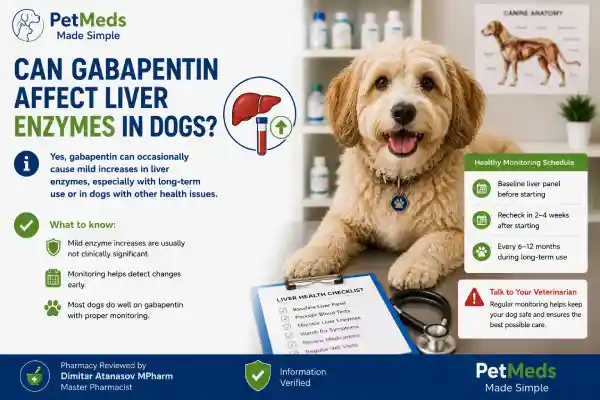
Can Gabapentin Affect Liver Enzymes in Dogs? Gabapentin is not commonly associated with clinically significant increases in liver enzymes in dogs. Most dogs tolerate the medication well, and serious liver toxicity is considered uncommon. However, dogs with pre-existing liver disease, multiple medications, or other underlying illnesses may require periodic blood tests to monitor liver health. Elevated ALT or ALP values should always be interpreted in the context of the dog’s overall medical condition rather than automatically blaming gabapentin.
Can Gabapentin Affect Liver Enzymes in Dogs?
When Owners Commonly Ask This
Most owners never think about liver enzymes until their veterinarian recommends routine blood work.
A very common situation looks like this:
Your dog has been taking gabapentin for several weeks or even months to help manage chronic arthritis, spinal pain, intervertebral disc disease (IVDD), cancer pain, or seizures. During a routine follow-up appointment, your veterinarian recommends a blood chemistry panel to evaluate your dog’s overall health.
A few days later you receive a phone call.
Your veterinarian mentions that one or more liver enzymes—such as ALT or ALP—are slightly elevated.
Immediately, many owners begin searching online:
- Can Gabapentin Affect Liver Enzymes in Dogs?
- Is gabapentin damaging my dog’s liver?
- Should I stop giving gabapentin?
- Are elevated liver enzymes dangerous?
- Does my dog have liver disease?
- Will my dog need additional blood tests?
These concerns are completely understandable because most owners associate abnormal liver values with permanent liver damage.
Fortunately, the reality is often much more reassuring.
In many cases, gabapentin is not the primary reason liver enzymes become elevated, and additional investigation may identify another explanation.
Owners may also find these PMMS articles helpful:
- Gabapentin for Dogs: Vet Guidelines, Uses, Dosage & Safety
- Can Dogs Take Gabapentin Long-Term Safely?
- Can Gabapentin Cause Weight Loss in Dogs?
- Can Gabapentin Cause Weight Gain in Dogs?
- Can Gabapentin Cause Muscle Tremors in Dogs?
- Can Gabapentin Cause Excessive Drooling in Dogs?
- Can Dogs Overdose on Gabapentin?
Can Gabapentin Affect Liver Enzymes in Dogs?
The short answer is:
Yes but significant liver enzyme elevations caused solely by gabapentin appear to be uncommon in dogs.
This distinction is extremely important.
Many owners mistakenly believe that any abnormal blood test after starting gabapentin automatically means the medication is damaging the liver.
In reality, veterinarians evaluate several factors before reaching that conclusion.
These include:
- your dog’s age
- underlying medical conditions
- current medications
- previous blood test results
- clinical signs
- duration of treatment
- changes in appetite or body weight
Only after considering the entire clinical picture can a veterinarian determine whether gabapentin is likely to be involved.
Does Gabapentin Directly Damage the Liver?
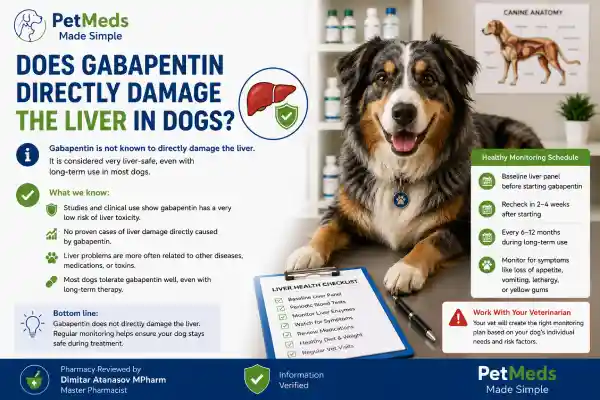
Current veterinary evidence suggests that gabapentin has a relatively low potential for causing direct liver injury in dogs.
Unlike certain medications that undergo extensive liver metabolism or are well known for causing liver toxicity, gabapentin behaves differently.
Its primary role is to:
- reduce abnormal nerve signaling
- relieve neuropathic pain
- improve chronic pain control
- support seizure management
- decrease anxiety in selected veterinary situations
Because of its pharmacologic properties, gabapentin is generally considered one of the safer neurological medications regarding liver toxicity.
That does not mean liver monitoring is unnecessary.
Rather, it means veterinarians interpret abnormal blood work carefully before assuming gabapentin is responsible.
What Are Liver Enzymes?
One of the biggest misunderstandings among dog owners is believing that elevated liver enzymes automatically mean liver failure.
Fortunately, this is not true.
Liver enzymes are proteins released into the bloodstream when liver cells become stressed, irritated, inflamed, or damaged.
Importantly:
Elevated liver enzymes are not a diagnosis.
They are simply a laboratory finding that tells veterinarians additional investigation may be appropriate.
Some dogs have mild enzyme elevations for years while remaining clinically healthy.
Others may require further testing to determine the underlying cause.
Which Liver Enzymes Are Commonly Measured?
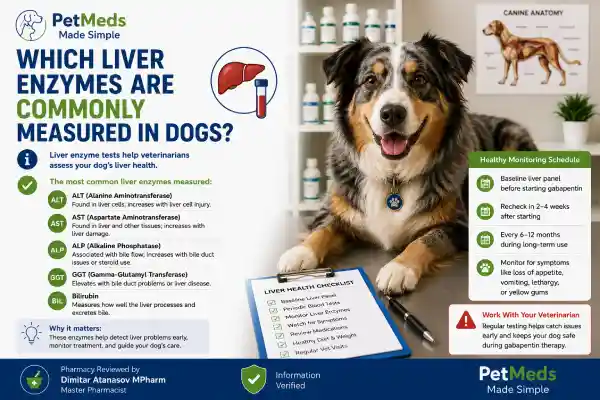
Routine veterinary blood chemistry panels typically include several important liver markers.
| Liver Marker | What It Indicates |
|---|---|
| ALT (Alanine Aminotransferase) | Liver cell injury |
| ALP (Alkaline Phosphatase) | Bile flow, steroids, liver response |
| AST (Aspartate Aminotransferase) | Muscle and liver cell injury |
| GGT (Gamma-Glutamyl Transferase) | Bile duct function |
Each marker provides different information.
For example:
A mildly elevated ALT does not automatically mean severe liver disease.
Similarly, an elevated ALP may occur because of:
- steroid medications
- endocrine disorders
- aging
- normal physiologic variation
- liver disease
This is why veterinarians rarely interpret one laboratory value in isolation.
Can Mild Liver Enzyme Elevations Be Normal?
Surprisingly, yes.
Especially in older dogs.
A mild increase in ALT or ALP does not necessarily indicate permanent liver damage.
Veterinarians often evaluate:
- how high the value is
- whether multiple enzymes are elevated
- whether the dog has clinical symptoms
- whether previous blood tests were normal
- whether values continue increasing over time
One isolated laboratory abnormality is very different from progressive liver disease.
Why Veterinarians Don’t Immediately Blame Gabapentin
When owners search “Can Gabapentin Affect Liver Enzymes in Dogs?”, they often assume cause and effect simply because the medication was started before the blood test.
Veterinarians approach the situation differently.
They ask:
- Were liver enzymes abnormal before gabapentin?
- Has your dog recently started any other medications?
- Is your dog taking NSAIDs?
- Does your dog have endocrine disease?
- Has appetite changed?
- Has weight changed?
- Are there signs of vomiting or diarrhea?
- Could another illness explain the blood work?
Only after reviewing these questions does the medication become one possible explanation among many.
Can Other Diseases Elevate Liver Enzymes?
Absolutely.
In fact, underlying disease is often a more likely explanation than gabapentin itself.
Conditions commonly associated with elevated liver enzymes include:
- chronic hepatitis
- gallbladder disease
- pancreatitis
- diabetes mellitus
- Cushing’s disease
- obesity
- cancer
- infections
- endocrine disorders
Some of these conditions may develop while a dog is taking gabapentin, creating the false impression that the medication caused the abnormal blood work.
Why Monitoring Matters During Long-Term Treatment
Although Can Gabapentin Affect Liver Enzymes in Dogs? is a common question, routine monitoring serves a much broader purpose.
Periodic blood tests help veterinarians evaluate:
- liver health
- kidney function
- electrolyte balance
- protein levels
- glucose
- hydration status
- overall response to long-term therapy
Routine laboratory monitoring often identifies unrelated health problems long before clinical signs become obvious.
Owners may also wish to review:
- Can Dogs Take Gabapentin Long-Term Safely?
- Why Does Gabapentin Stop Working in Dogs?
- Can Gabapentin Cause Weight Loss in Dogs?
- Can Gabapentin Cause Weight Gain in Dogs?
- Can Dogs Take Gabapentin With NSAIDs?
- Can Dogs Take Gabapentin and Tramadol Together?
Why This Topic Is Often Misunderstood
One reason Can Gabapentin Affect Liver Enzymes in Dogs? continues to generate so many searches is because owners often confuse two very different concepts:
Elevated liver enzymes and liver failure.
These are not the same diagnosis.
Many dogs with mildly elevated ALT or ALP continue living completely normal lives while veterinarians simply monitor blood work over time.
Understanding this difference often reduces unnecessary anxiety while ensuring dogs that truly require additional investigation receive prompt veterinary care.
Can Gabapentin Cause True Liver Damage in Dogs?
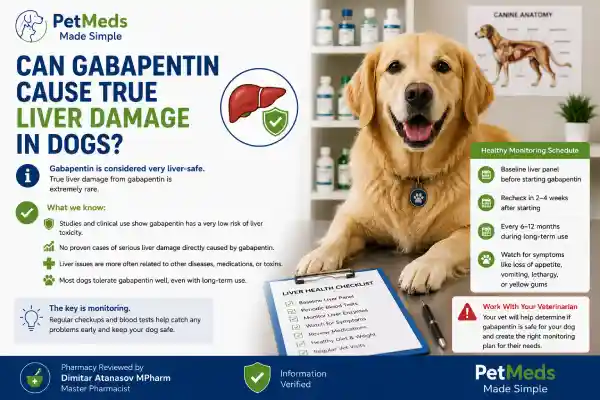
This is one of the most important questions behind the search “Can Gabapentin Affect Liver Enzymes in Dogs?”
Fortunately, current veterinary evidence suggests that clinically significant liver injury caused solely by gabapentin is considered uncommon in dogs.
This is reassuring because many medications used in veterinary medicine can potentially affect the liver to varying degrees.
Gabapentin, however, has earned a reputation as a medication with a relatively favorable safety profile when used appropriately and under veterinary supervision.
That said, “rare” does not mean “impossible.”
Every dog responds differently to medication.
Factors that may increase the likelihood of abnormal blood work include:
- advanced age
- pre-existing liver disease
- multiple medications
- chronic systemic illness
- prolonged treatment
- dehydration
- concurrent infections
This is why veterinarians evaluate each patient individually instead of assuming every elevated liver enzyme is medication-related.
How Is Gabapentin Processed in the Body?
Understanding how gabapentin behaves inside the body helps explain why veterinarians generally consider it relatively safe for the liver.
Unlike many medications that undergo extensive liver metabolism, gabapentin has a comparatively simple pharmacokinetic profile.
After administration:
- the medication is absorbed through the gastrointestinal tract
- it circulates in the bloodstream
- reaches nervous tissue
- produces pain-relieving and anticonvulsant effects
- is eliminated primarily through the kidneys
Because renal excretion plays a major role, gabapentin places less metabolic demand on the liver than many other medications.
This is one reason veterinarians are often comfortable prescribing gabapentin for long-term pain management.
Owners may also wish to review:
- Can Dogs Take Gabapentin Long-Term Safely?
- Gabapentin for Dogs: Vet Guidelines, Uses, Dosage & Safety
- Can Dogs Overdose on Gabapentin?
Dogs With Pre-Existing Liver Disease
The conversation changes somewhat when a dog already has liver disease before starting gabapentin.
Examples include:
- chronic hepatitis
- liver fibrosis
- congenital liver disorders
- liver tumors
- chronic cholangitis
- previous episodes of liver inflammation
These dogs may already have elevated:
- ALT
- ALP
- AST
- GGT
before the first gabapentin dose is ever given.
For these patients, veterinarians often recommend:
✔ baseline blood work
✔ periodic chemistry panels
✔ careful medication review
✔ monitoring appetite
✔ monitoring body weight
✔ watching for neurological changes
The goal is not necessarily to stop gabapentin but to ensure the underlying liver disease remains stable.
Does Long-Term Gabapentin Increase Liver Enzymes?
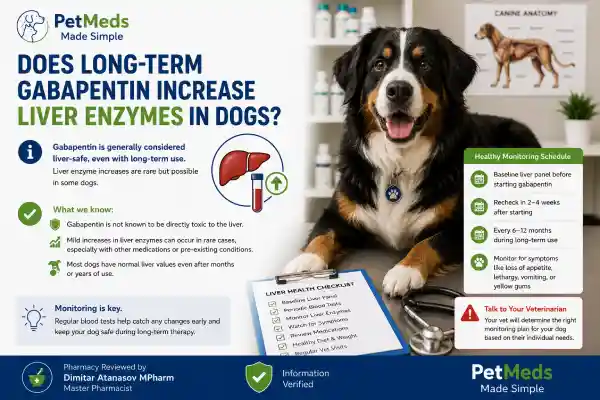
Current veterinary literature does not identify progressive liver enzyme elevation as a common consequence of long-term gabapentin therapy.
However, dogs receiving gabapentin for many months often undergo routine laboratory monitoring simply because:
- they are older
- they have arthritis
- they have chronic neurological disease
- they take several medications
- veterinarians wish to monitor overall health
Sometimes these routine blood tests detect abnormalities that would have developed regardless of gabapentin.
Why Timing Can Be Misleading
One of the biggest diagnostic traps is assuming:
Started gabapentin
↓
Blood test became abnormal
↓
Gabapentin caused it.
Veterinarians know that medicine is rarely this simple.
For example:
A twelve-year-old Labrador begins gabapentin for severe osteoarthritis.
Three months later:
ALT is mildly elevated.
Was it:
- gabapentin?
- early chronic hepatitis?
- obesity?
- endocrine disease?
- age-related change?
- another medication?
- a temporary laboratory fluctuation?
Without additional evaluation, no one can answer with certainty.
Medications More Commonly Associated With Liver Enzyme Changes
Interestingly, veterinarians are often more concerned about other medications than gabapentin itself.
Examples include:
| Medication | Liver Monitoring Often Recommended? |
|---|---|
| Phenobarbital | ✅ Yes |
| Carprofen | ✅ Sometimes |
| Deracoxib | ✅ Sometimes |
| Prednisone | ✅ May elevate ALP |
| Ketoconazole | ✅ Yes |
| Gabapentin | Usually low concern |
This comparison helps place gabapentin into proper clinical perspective.
Owners may also find these articles useful:
- Can Dogs Take Gabapentin and NSAIDs Together?
- Can Dogs Take Tramadol and Gabapentin Together?
- Can Seizure Medication Damage the Liver?
Understanding ALT
ALT (Alanine Aminotransferase) is often the first liver enzyme owners hear about.
ALT primarily reflects injury to liver cells, but it does not measure how well the liver functions.
A mild ALT increase may occur because of:
- inflammation
- temporary irritation
- medications
- infection
- trauma
- underlying liver disease
Many dogs with mildly elevated ALT continue feeling perfectly normal.
Understanding ALP
ALP behaves quite differently.
Unlike ALT, ALP may increase because of:
- corticosteroids
- Cushing’s disease
- bile duct disease
- growing puppies
- aging
- liver disease
This explains why veterinarians interpret ALP together with other laboratory values rather than in isolation.
Understanding AST
AST is less specific.
It may originate from:
- liver
- skeletal muscle
- heart muscle
For example, a dog recovering from orthopedic surgery may have mild AST elevation because of muscle injury rather than liver disease.
Understanding GGT
GGT primarily helps veterinarians evaluate the biliary system.
Elevated GGT may suggest:
- bile duct disease
- gallbladder disorders
- cholestasis
- certain liver diseases
When ALT, ALP, AST and GGT are interpreted together, veterinarians obtain a much clearer understanding of overall liver health.
What If Only One Liver Enzyme Is Elevated?
Owners frequently panic after seeing one abnormal value.
Fortunately, veterinarians rarely base important decisions on a single laboratory number.
Instead they evaluate:
- how high the enzyme is
- whether multiple enzymes are abnormal
- whether clinical signs are present
- previous laboratory trends
- medications
- physical examination findings
In many cases, repeating blood work several weeks later provides more useful information than making immediate medication changes.
What Additional Tests Might Be Recommended?
If liver enzymes remain elevated, your veterinarian may recommend:
| Diagnostic Test | Purpose |
|---|---|
| Repeat Chemistry Panel | Confirm persistent changes |
| Complete Blood Count | Detect infection or inflammation |
| Urinalysis | Evaluate kidney function |
| Abdominal Ultrasound | Examine liver architecture |
| Bile Acid Testing | Assess liver function |
| Fine Needle Aspirate or Biopsy | Selected complex cases |
Fortunately, most dogs never require all of these tests.
The choice depends entirely on the individual patient.
Can Liver Enzymes Return to Normal?
Yes.
Many mild enzyme elevations improve once the underlying cause is addressed.
Examples include:
- successful treatment of infection
- improved weight management
- recovery from pancreatitis
- medication adjustment
- resolution of temporary liver irritation
This is another reason veterinarians avoid assuming gabapentin is automatically responsible.
When Should Owners Contact Their Veterinarian?
Owners should schedule prompt veterinary evaluation if their dog develops:
- yellow gums or eyes (jaundice)
- repeated vomiting
- persistent appetite loss
- severe lethargy
- abdominal swelling
- confusion
- seizures
- dark urine
- unexplained weight loss
- progressive weakness
These signs deserve immediate attention regardless of whether gabapentin is being administered.
Owners may also wish to review:
- Can Gabapentin Cause Weight Loss in Dogs?
- Can Gabapentin Cause Weight Gain in Dogs?
- Can Gabapentin Cause Muscle Tremors in Dogs?
- Can Gabapentin Cause Excessive Drooling in Dogs?
- Why Is My Dog Vomiting After Gabapentin?
- Can Gabapentin Cause Neurological Side Effects?
- Why Does Gabapentin Stop Working in Dogs?
- Can Dogs Suddenly Stop Gabapentin?
Can Liver Problems Be Prevented While Taking Gabapentin?
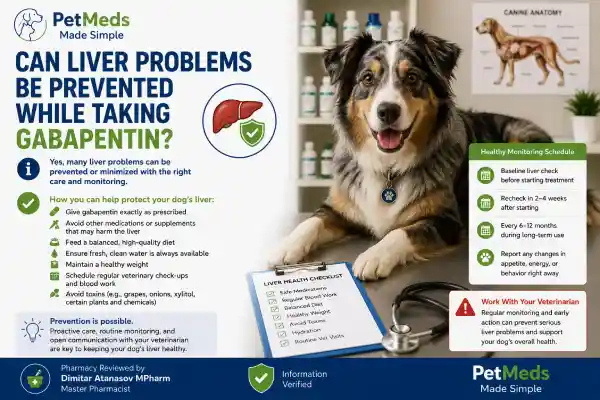
One of the most reassuring aspects of answering “Can Gabapentin Affect Liver Enzymes in Dogs?” is that, for most dogs, liver problems are not expected during normal gabapentin therapy.
However, that does not mean monitoring should be ignored.
Instead, veterinarians focus on early detection, especially in senior dogs or dogs receiving several medications simultaneously.
Fortunately, many potential problems can be recognized before a dog becomes clinically ill.
How Veterinarians Monitor Liver Health
Veterinarians rarely rely on a single blood test.
Instead, they monitor trends over time.
A typical monitoring plan may look like this:
| Stage of Treatment | Recommended Monitoring |
|---|---|
| Before starting long-term gabapentin | Complete physical examination and baseline blood chemistry if indicated |
| First follow-up (4–8 weeks for high-risk patients) | Repeat blood chemistry when clinically appropriate |
| Stable long-term therapy | Periodic examinations and laboratory testing based on age, concurrent diseases, and medications |
| Dogs with known liver disease | Individualized monitoring schedule determined by the veterinarian |
Monitoring is tailored to the individual patient. A healthy young dog taking gabapentin for a short period usually does not require the same laboratory schedule as a senior dog with chronic liver disease and multiple medications.
Owners may also wish to read:
- Can Dogs Take Gabapentin Long-Term Safely?
- Can Dogs Take Gabapentin With NSAIDs?
- Can Seizure Medication Damage the Liver?
Can Diet Help Protect the Liver?
Nutrition plays an important role in maintaining liver health.
Although there is no special “gabapentin diet,” veterinarians often recommend supporting overall health through:
- maintaining a healthy body weight
- feeding a complete and balanced diet
- ensuring adequate hydration
- avoiding unnecessary supplements unless recommended
- preventing obesity
- scheduling regular wellness examinations
Dogs with diagnosed liver disease may require prescription hepatic diets, but these should only be introduced following veterinary evaluation.
Should Liver Supplements Be Given?
Many owners become interested in supplements after asking:
“Can Gabapentin Affect Liver Enzymes in Dogs?”
While products containing ingredients such as SAMe, silybin (milk thistle extract), or vitamin E are sometimes used in veterinary medicine, they should never be started without veterinary advice.
Not every dog with mildly elevated liver enzymes needs supplementation.
In some cases, monitoring alone is the most appropriate approach.
Lifestyle Habits That Support Liver Health
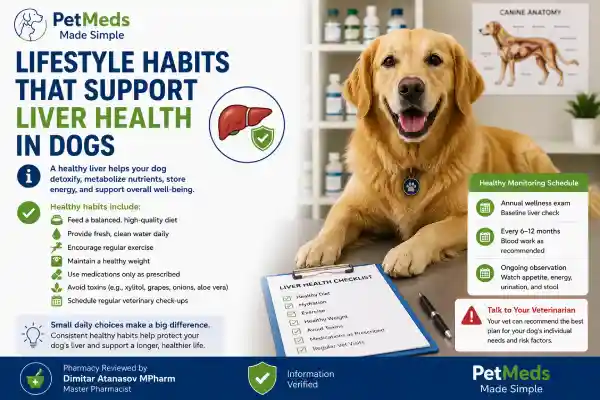
Simple daily habits can make a significant difference.
Owners should:
✔ Give gabapentin exactly as prescribed.
✔ Avoid doubling missed doses.
✔ Never combine medications without veterinary approval.
✔ Attend recommended follow-up appointments.
✔ Monitor appetite and body weight.
✔ Report vomiting, diarrhea, jaundice, or behavioral changes promptly.
These steps help identify developing problems early while allowing gabapentin to continue providing pain relief when appropriate.
Does Every Elevated Liver Enzyme Require Stopping Gabapentin?
No.
This is one of the biggest misconceptions surrounding Can Gabapentin Affect Liver Enzymes in Dogs?
In many situations, veterinarians continue gabapentin while investigating the underlying cause because:
- the elevation may be unrelated
- the change may be temporary
- another medication may be responsible
- the benefits of pain control outweigh the theoretical risks
Stopping gabapentin without veterinary guidance may lead to:
- worsening pain
- increased anxiety
- seizure recurrence in susceptible dogs
- reduced quality of life
Every treatment decision should balance potential risks against the benefits of ongoing therapy.
Veterinarian Takeaway
Can Gabapentin Affect Liver Enzymes in Dogs?
Yes—but clinically important liver enzyme changes caused solely by gabapentin appear to be uncommon.
Most dogs tolerate gabapentin very well, and mild elevations in ALT, ALP, AST, or GGT often have explanations unrelated to the medication itself.
Rather than assuming gabapentin is damaging the liver, veterinarians evaluate:
- the dog’s clinical signs
- previous laboratory results
- concurrent medications
- underlying diseases
- trends in blood work over time
Routine monitoring allows veterinarians to identify genuine liver disease while avoiding unnecessary discontinuation of an effective medication.
Bottom Line
Can Gabapentin Affect Liver Enzymes in Dogs? Yes, but significant liver injury directly caused by gabapentin is considered uncommon based on current veterinary evidence.
Most mild liver enzyme elevations are associated with other medical conditions, age-related changes, concurrent medications, or temporary physiological responses rather than gabapentin itself.
If your dog’s blood work shows elevated ALT, ALP, AST, or GGT, your veterinarian will evaluate the complete clinical picture before deciding whether additional testing or treatment is necessary.
For most dogs, gabapentin remains a safe and valuable medication for managing chronic pain, neuropathic pain, and seizure disorders when used under appropriate veterinary supervision.
Frequently Asked Questions – Can Gabapentin Affect Liver Enzymes in Dogs
Can gabapentin affect liver enzymes in dogs?
Yes, but significant liver enzyme elevations directly caused by gabapentin are uncommon. Mild abnormalities should always be interpreted together with the dog’s medical history, clinical signs, and other laboratory results.
Does gabapentin cause liver failure in dogs?
Current veterinary evidence does not identify gabapentin as a common cause of liver failure in dogs. Most dogs tolerate the medication well when used appropriately.
Which liver enzymes are usually measured?
Veterinarians commonly evaluate:
ALT
ALP
AST
GGT
Each enzyme provides different information about liver or biliary health.
Can older dogs have higher liver enzymes while taking gabapentin?
Yes.
Senior dogs are more likely to develop unrelated liver disease, endocrine disorders, obesity, or other chronic illnesses that may increase liver enzyme values.
Should my dog have routine blood tests during long-term gabapentin therapy?
Many veterinarians recommend periodic laboratory monitoring for dogs receiving long-term treatment, particularly senior dogs or those taking multiple medications.
Can NSAIDs increase liver enzymes more than gabapentin?
Some NSAIDs are more commonly associated with liver enzyme changes than gabapentin, although serious adverse effects remain uncommon when used correctly and monitored appropriately.
What symptoms may indicate liver disease?
Possible warning signs include:
jaundice
vomiting
poor appetite
weight loss
lethargy
abdominal swelling
dark urine
confusion
These signs require prompt veterinary evaluation.
Can elevated ALT return to normal?
Yes.
Many mild ALT elevations improve after the underlying cause is identified and appropriately managed.
Should I stop gabapentin if my dog’s liver enzymes are elevated?
No.
Never discontinue gabapentin without speaking to your veterinarian. Abrupt medication changes may worsen pain control or interfere with seizure management.
Is gabapentin considered safe for dogs with liver disease?
Many dogs with liver disease can still receive gabapentin, but treatment decisions should always be individualized. Your veterinarian may recommend periodic blood tests and dosage adjustments depending on your dog’s overall health.
Sources
- Plumb DC. Plumb’s Veterinary Drug Handbook. Latest Edition.
- Papich MG. Saunders Handbook of Veterinary Drugs: Small and Large Animal.
- Grimm KA et al. Veterinary Anesthesia and Analgesia.
- Merck Veterinary Manual – Liver Disease in Dogs.
- Merck Veterinary Manual – Interpretation of Liver Enzyme Abnormalities.
- AAHA Pain Management Guidelines for Dogs and Cats (2022).
- International Veterinary Epilepsy Task Force Consensus Report.
- Veterinary Information Network (VIN).
- BSAVA Manual of Canine and Feline Clinical Pathology.
- Frontiers in Veterinary Science – Canine Hepatology and Drug Safety.
- JAVMA – Clinical Pathology in Small Animals.
Medical Review Statement
This article was written by a licensed Master Pharmacist, scientifically reviewed by a licensed Master Pharmacist, and independently reviewed by a licensed veterinarian. It is intended for educational purposes only and should not replace professional veterinary diagnosis, laboratory interpretation, or treatment recommendations.
Image Disclosure
Image Disclosure: Some images used in this article may be AI-generated for educational illustration. They are intended to explain veterinary concepts and medication safety and should not be interpreted as actual clinical photographs.