Quick Answer
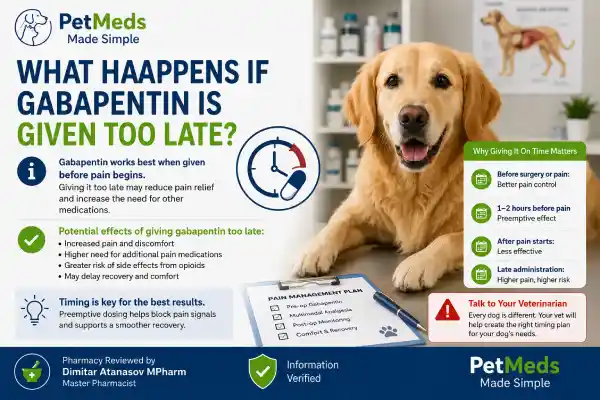
What Happens If Gabapentin Is Given Too Late? In many cases, giving one gabapentin dose later than scheduled is not an emergency. The safest response depends on how late the dose is, how often your dog normally receives gabapentin, why the medication was prescribed, and your dog’s overall health. Rather than doubling doses or making sudden schedule changes, owners should follow their veterinarian’s instructions and seek advice whenever they are uncertain.
Why This Situation Happens So Often
Medication schedules don’t always go according to plan.
Perhaps you normally give your dog’s gabapentin every evening at 8:00 PM, but today:
- you worked late
- you forgot the medication at home
- your family routine changed
- your dog refused the capsule
- you simply lost track of time
Hours later you suddenly remember.
Your first thought is usually:
“What Happens If Gabapentin Is Given Too Late?”
Almost immediately, even more questions follow.
- Should I give the dose now?
- Should I wait until the next scheduled dose?
- Will my dog be in pain?
- Can giving it late cause withdrawal?
- Should I double the next dose?
- Is this dangerous?
Fortunately, most delayed doses are not medical emergencies, but the safest response depends on the individual situation.
Throughout this guide, we’ll explain how veterinarians approach delayed doses and what owners should avoid doing after realizing a timing mistake.
You may also find these PMMS articles helpful:
- What Happens If Gabapentin Is Given Too Early?
- Does Gabapentin Build Up in a Dog’s System?
- Can Dogs Overdose on Gabapentin?
- Can Dogs Take Gabapentin Long-Term Safely?
- Gabapentin for Dogs: Vet Guidelines, Uses, Dosage & Safety
What Happens If Gabapentin Is Given Too Late?
Why Consistent Timing Is Important
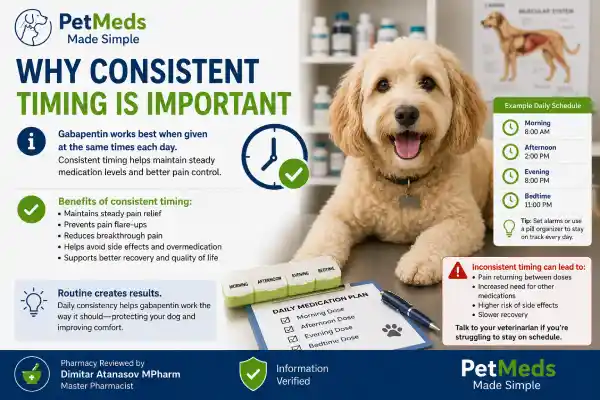
Gabapentin works best when doses are given at reasonably consistent intervals.
Depending on your dog’s condition, veterinarians may prescribe it:
- every 8 hours
- every 12 hours
- every 24 hours
These intervals help maintain relatively stable medication levels while providing continuous pain control or seizure support.
Giving doses significantly later than planned may allow medication levels to fall more than intended.
For dogs receiving gabapentin to control chronic pain, this may lead to reduced comfort until the next dose begins working again.
For dogs receiving gabapentin as part of seizure management, maintaining the prescribed schedule becomes even more important.
When a Late Dose Is Usually Not an Emergency
One of the most reassuring facts for owners is that many delayed doses do not create serious problems.
For example, a dose given:
- 30 minutes late
- one hour late
- occasionally two hours late
may have little clinical significance for many otherwise healthy dogs.
However, the situation becomes more individualized if:
- the medication is several hours late
- multiple doses have been delayed
- the dog receives gabapentin for seizure control
- kidney disease is present
- several medications are administered together
This is why veterinarians evaluate each situation individually instead of using one rule for every dog.
Why the Reason for Treatment Matters
The answer to “What Happens If Gabapentin Is Given Too Late?” depends partly on why your dog is taking gabapentin.
For example:
A dog receiving gabapentin after orthopedic surgery may experience temporary discomfort if a dose is delayed.
A dog receiving gabapentin for chronic neuropathic pain may become less comfortable until medication levels recover.
A dog receiving gabapentin as part of seizure management may require even more careful attention to dosing consistency.
The underlying medical condition always influences how veterinarians assess a delayed dose.
Could My Dog Become More Uncomfortable?
Yes.
One of the most common consequences of delayed dosing is reduced symptom control rather than medication toxicity.
Owners may notice:
- increased stiffness
- more limping
- reluctance to walk
- restlessness
- discomfort when changing position
- increased sensitivity to touch
These changes occur because medication levels gradually decrease over time.
Fortunately, many dogs improve once treatment returns to its normal schedule.
Why Owners Should Never Double the Next Dose
One of the biggest mistakes owners make after realizing a dose was late is trying to “catch up.”
Examples include:
- giving two doses together
- doubling the following dose
- giving doses much closer together than prescribed
- repeatedly changing the schedule
These strategies may increase the risk of side effects without improving treatment.
Instead, veterinarians usually recommend evaluating how late the dose actually was before deciding how to proceed.
Never assume that giving extra medication will compensate for a delayed dose.
How Veterinarians Evaluate a Delayed Dose
When an owner phones the clinic asking:
“I gave my dog’s gabapentin late. What should I do?”
the veterinarian will usually ask several questions before making recommendations.
These commonly include:
- What time was the previous dose given?
- What time was the delayed dose discovered?
- How often is gabapentin prescribed?
- Why is your dog taking gabapentin?
- Has your dog shown any unusual symptoms?
- Is your dog receiving other medications?
- Does your dog have kidney disease?
The answers help determine the safest way to return to the normal medication schedule.
Timing Mistakes Should Be Viewed in Context
One of the most important messages in this article is that not every delayed dose carries the same level of risk.
A dose that is:
- 45 minutes late
is very different from one that is:
- six hours late
Likewise, a delayed dose in a healthy young dog differs from the same situation in an elderly dog with chronic kidney disease receiving several medications.
Rather than focusing only on the clock, veterinarians evaluate:
- your dog’s overall health
- the medical condition being treated
- the prescribed dose
- other medications
- current clinical signs
This individualized approach leads to much safer recommendations than relying on general advice alone.
How Long Is Too Late?
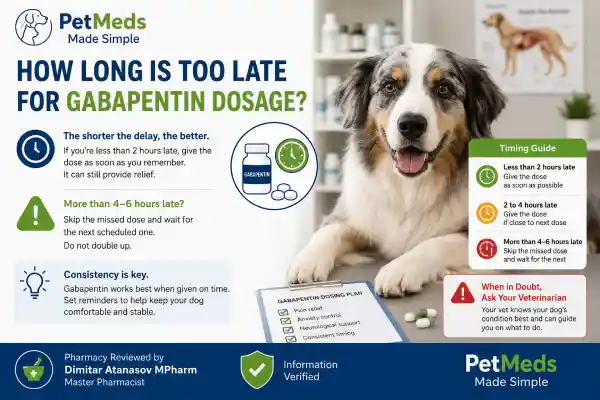
One of the first questions owners ask after realizing they missed the scheduled time is:
“How late is too late?”
Unfortunately, there is no single answer that applies to every dog.
The safest recommendation depends on several important factors, including:
- the prescribed dosing interval
- how many hours have passed
- why gabapentin was prescribed
- your dog’s age
- kidney function
- other medications being administered
For example, a dog receiving gabapentin every 8 hours has a different schedule than one receiving it every 12 or 24 hours.
This is why veterinarians rarely rely on a fixed rule for every patient.
Why the Timing of the Next Dose Also Matters
An important consideration is how close you are to the next scheduled dose.
For example:
Imagine your dog’s gabapentin is prescribed every 12 hours.
If you remember the missed dose shortly after the scheduled time, your veterinarian may recommend a different approach than if you remember just before the next dose is due.
This decision requires balancing two goals:
- maintaining adequate symptom control
- avoiding doses that are too close together
Because every treatment plan is different, owners should avoid making assumptions based on advice intended for another dog.
Can Delayed Doses Cause Withdrawal?
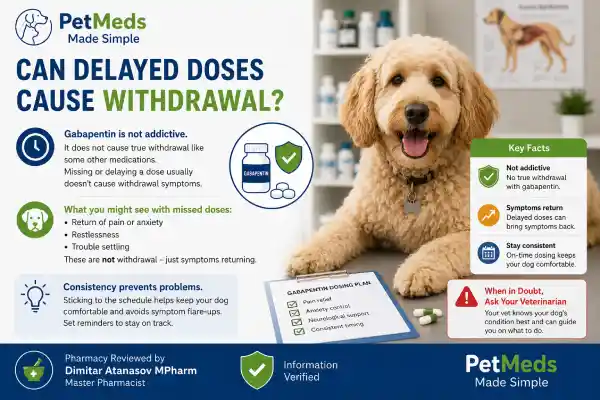
Many owners become worried after reading about gabapentin withdrawal online.
Fortunately, one delayed dose does not usually cause withdrawal symptoms in most dogs.
Withdrawal is generally associated with:
- abrupt discontinuation after prolonged therapy
- repeated missed doses
- sudden cessation of high-dose treatment
A single delayed dose is a very different situation.
However, dogs receiving gabapentin for seizure disorders or those taking high doses for extended periods should always follow their veterinarian’s instructions carefully.
Could a Late Dose Trigger Breakthrough Pain?
Yes.
One of the most common consequences of delayed dosing is that medication levels gradually decline.
As those levels decrease, owners may notice signs that the underlying condition is becoming less well controlled.
These may include:
- increased limping
- difficulty rising
- stiffness after resting
- reluctance to exercise
- whining or vocalizing
- increased sensitivity when touched
These signs usually reflect the return of the underlying pain rather than harm caused by the medication itself.
Once treatment returns to its normal schedule, many dogs regain their previous level of comfort.
If your dog begins showing increased discomfort between doses, our article Why Is My Dog Crying Before the Next Gabapentin Dose? explains why this can happen and when it may indicate that the treatment plan should be reassessed.
What If My Dog Takes Gabapentin for Seizures?
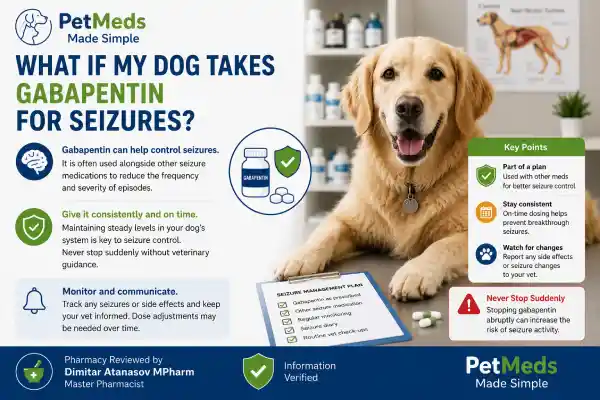
Dogs receiving gabapentin as part of seizure management require particularly careful medication schedules.
Consistent dosing helps maintain stable drug concentrations that support seizure control.
Although one delayed dose does not guarantee a seizure will occur, maintaining the prescribed schedule is especially important for these patients.
Owners should contact their veterinarian promptly if:
- multiple doses have been delayed
- vomiting prevents medication administration
- several doses have been missed
- seizures occur after a scheduling error
Managing epilepsy often involves several medications working together, making consistency an essential part of treatment.
How Other Medications Influence Timing Decisions
Many dogs taking gabapentin also receive additional medications.
Examples include:
- NSAIDs
- trazodone
- tramadol
- phenobarbital
- levetiracetam
- muscle relaxants
These combinations are often prescribed intentionally.
However, they also mean that changing one medication schedule may affect the overall treatment plan.
This is another reason veterinarians evaluate every medication rather than considering gabapentin alone.
Owners using combination therapy may also benefit from reading Can Dogs Take Tramadol and Gabapentin Together? and Can Dogs Take Gabapentin With NSAIDs?, where we discuss how multimodal pain management is commonly used in veterinary medicine.
What Symptoms Should Owners Watch After a Delayed Dose?
Most delayed doses cause no serious complications.
However, owners should continue monitoring their dog’s overall condition.
Pay attention to:
- increasing pain
- worsening mobility
- unusual weakness
- excessive sleepiness after the delayed dose is eventually given
- vomiting
- loss of appetite
- behavioral changes
Keeping a written record of both the medication timing and your dog’s symptoms can be extremely helpful if your veterinarian needs to evaluate the situation.
When Should You Contact Your Veterinarian?
Although many delayed doses can be managed without emergency treatment, veterinary advice is recommended if:
- your dog received multiple late doses over several days
- you are unsure whether today’s dose was already given
- your dog has kidney disease
- your dog takes gabapentin for seizure control
- unusual symptoms develop
- another medication error occurred at the same time
Prompt communication helps prevent small medication mistakes from becoming larger problems.
Why Consistency Is Better Than Perfection
One reassuring message for owners is that almost everyone makes a medication mistake at some point.
Veterinarians understand this.
The goal is not perfect timing every single day.
Instead, the goal is maintaining a schedule that remains as consistent as reasonably possible over weeks and months.
Occasional delays happen.
What matters most is responding appropriately afterward instead of making additional dosing errors.
If you’re also interested in the opposite situation, where gabapentin is administered earlier than planned, our companion guide What Happens If Gabapentin Is Given Too Early? explains how veterinarians evaluate early dosing mistakes and how they differ from delayed doses.
Practical Tips to Prevent Future Late Doses
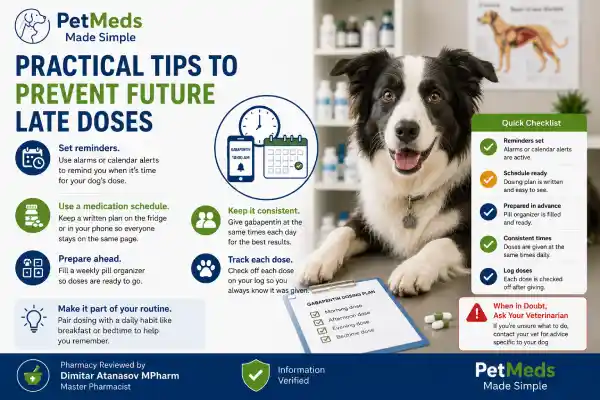
The easiest medication mistake to manage is the one that never happens.
Whether your dog receives gabapentin for arthritis, chronic pain, seizures, or postoperative recovery, establishing a simple routine can dramatically reduce missed or delayed doses.
Veterinarians commonly recommend:
- administering medication at the same time every day
- setting smartphone alarms
- using a medication calendar
- recording each dose immediately after it is given
- keeping medications in a consistent location
- making sure all family members know who is responsible for each dose
Small habits often prevent the majority of timing errors.
What If You Forgot Whether You Already Gave the Dose?
This situation is surprisingly common.
Perhaps your phone rings while you’re giving medication, or another family member normally helps with your dog’s care.
Later you begin wondering:
“Did I already give today’s gabapentin?”
Rather than guessing, try to:
- check your medication log
- ask anyone else caring for your dog
- review reminder notifications
- count remaining tablets or capsules if appropriate
Giving an extra dose “just to be safe” can sometimes create more risk than waiting a few minutes to confirm whether the medication was actually administered.
Developing a written medication routine is one of the simplest ways to avoid this type of uncertainty.
Why Good Communication Makes Medication Safer
Many medication timing mistakes happen in households where several people share responsibility for pet care.
For example:
- one person gives the morning dose
- another gives the evening dose
- someone else assumes the medication was forgotten
Without communication, accidental duplicate doses or delayed doses become much more likely.
A simple written schedule placed near the medication cabinet often prevents these problems.
Some owners also use shared reminder apps so every caregiver knows exactly when each medication has been administered.
Can Delayed Doses Affect Long-Term Treatment Success?
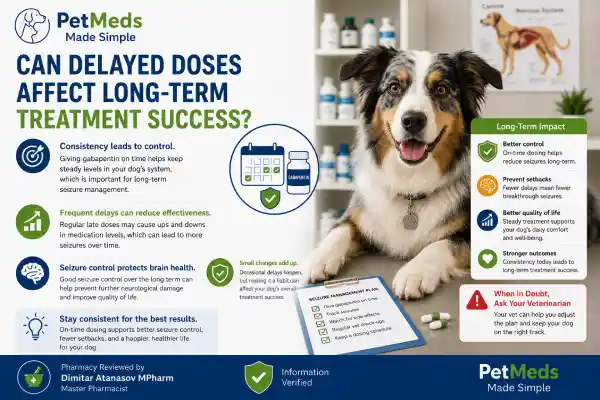
One delayed dose usually has little long-term impact for most dogs.
However, repeated medication timing errors may reduce the consistency of symptom control.
For dogs receiving gabapentin to manage chronic arthritis, neuropathic pain, or seizure disorders, maintaining a regular schedule allows veterinarians to better evaluate:
- whether the medication is working
- whether the dose remains appropriate
- whether additional therapies are needed
- whether side effects are related to treatment or the underlying disease
Consistency provides the clearest picture of how well the treatment plan is performing.
A Real-World Example
Imagine your twelve-year-old Golden Retriever normally receives gabapentin every evening at 8:00 PM for chronic arthritis.
One evening, you become busy with family commitments and suddenly realize it is already 10:15 PM.
Your dog appears:
- comfortable
- alert
- breathing normally
- interested in food
Although it is understandable to worry, this situation does not automatically mean your dog is in danger.
Instead of doubling the next dose or making major changes to the schedule, the safest approach is to follow your veterinarian’s recommendations and return to a consistent routine as advised.
Most isolated timing mistakes can be managed successfully when handled calmly.
Veterinarian Takeaway
What Happens If Gabapentin Is Given Too Late?
For many healthy dogs, one delayed dose is not an emergency.
The safest response depends on:
- how late the medication was given
- the prescribed dosing schedule
- your dog’s medical condition
- kidney function
- whether gabapentin is being used for pain or seizure management
- any symptoms that develop
Owners should avoid doubling doses or making significant schedule changes without veterinary guidance.
If there is uncertainty about what to do next, contacting your veterinarian is always the safest option.
Bottom Line
What Happens If Gabapentin Is Given Too Late? In many cases, a single delayed dose causes no lasting harm, especially when the delay is relatively short and the dog is otherwise healthy.
The greatest risks often arise after the timing mistake, when owners attempt to compensate by doubling doses or making large schedule changes without professional advice.
By remaining calm, monitoring your dog, maintaining accurate medication records, and consulting your veterinarian whenever questions arise, most delayed-dose situations can be managed safely.
Consistent dosing remains one of the most important factors in helping gabapentin provide reliable long-term pain control and neurological support.
Frequently Asked Questions
What happens if gabapentin is given too late?
For many dogs, one delayed dose is not an emergency. The safest response depends on how late the medication is, why it was prescribed, and your dog’s overall health.
Can I still give gabapentin if I’m a few hours late?
Possibly, but the correct approach depends on your dog’s dosing schedule and how close you are to the next scheduled dose. Contact your veterinarian if you are unsure.
Should I double the next gabapentin dose?
No. Never double a dose unless your veterinarian specifically instructs you to do so.
Can a late gabapentin dose make my dog uncomfortable?
Yes. Dogs taking gabapentin for chronic pain may temporarily become less comfortable as medication levels decrease.
Is a delayed dose dangerous for dogs with seizures?
Dogs receiving gabapentin for seizure management generally benefit from maintaining consistent dosing schedules. Contact your veterinarian if significant delays occur or seizures develop.
What if I cannot remember whether I already gave today’s dose?
Check your medication records or confirm with other caregivers before giving another dose. Guessing may increase the risk of accidental double dosing.
How can I prevent future delayed doses?
Using reminders, medication logs, and maintaining a consistent daily routine are among the most effective strategies.
Should I contact my veterinarian after every delayed dose?
Not necessarily. However, veterinary advice is recommended if the delay is significant, multiple doses have been affected, your dog has kidney disease, receives gabapentin for seizures, or develops concerning symptoms.
Sources
- Plumb DC. Plumb’s Veterinary Drug Handbook. Latest Edition.
- Papich MG. Saunders Handbook of Veterinary Drugs: Small and Large Animal.
- 2022 AAHA Pain Management Guidelines for Dogs and Cats.
- Merck Veterinary Manual – Gabapentin.
- Merck Veterinary Manual – Pain Management in Dogs.
- BSAVA Small Animal Formulary.
- Veterinary Information Network (VIN).
- Grimm KA, Lamont LA, Tranquilli WJ, Greene SA, Robertson SA. Veterinary Anesthesia and Analgesia.
- WSAVA Global Pain Council Guidelines.
- Frontiers in Veterinary Science – Pain Management and Analgesia in Companion Animals.
Medical Review Statement
This article was written by Dimitar Georgiev Atanasov, MPharm, scientifically reviewed by Gergana Krasimirova Atanasova, MPharm, and independently veterinary reviewed by Dr. Valcho Georgiev Valchev, DVM. It is intended for educational purposes only and should never replace individualized veterinary diagnosis, medication management, or professional treatment recommendations.
Image Disclosure
Image Disclosure: Some images used in this article may be AI-generated to illustrate veterinary concepts, medication safety, and treatment schedules. They are intended for educational purposes only and should not replace professional veterinary advice.