Quick Answer
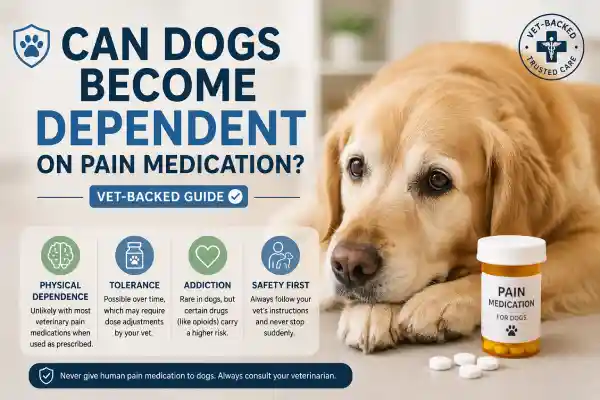
Can Dogs Become Dependent on Pain Medication? The answer depends on the medication. Most commonly used veterinary pain medications such as carprofen, meloxicam, deracoxib, and firocoxib do not cause addiction. However, some medications that affect the nervous system, including gabapentin, tramadol, and opioid-based pain medications, may lead to physical dependence if used long-term and then stopped suddenly. In many cases, what owners interpret as “dependence” is actually the return of the dog’s underlying pain condition rather than true withdrawal.
Can Dogs Become Dependent on Pain Medication?
One of the most common fears dog owners have when managing chronic pain is:
“What if my dog becomes dependent on this medication?”
The concern is understandable.
Many dogs with arthritis, hip dysplasia, degenerative joint disease, cancer, spinal problems, or chronic nerve pain may take medication for months or even years.
As owners watch their dog improve, another worry often appears:
“Will my dog eventually need this medication forever?”
“Is my dog becoming addicted?”
“What happens if I stop giving it?”
The good news is that most veterinary pain medications do not create addiction in the way people typically imagine. However, some medications can produce physical dependence, while others may create the appearance of dependence simply because they are successfully controlling pain.
Understanding the difference is extremely important.
Can Dogs Become Dependent on Pain Medication?
When Owners Commonly Ask This Question
Veterinarians hear this concern almost every day.
Most owners begin worrying about dependence when one of the following situations occurs:
- Their dog has been taking pain medication for several months.
- Arthritis symptoms return after a missed dose.
- Their dog seems uncomfortable before the next dose is due.
- A veterinarian recommends long-term treatment.
- The medication appears to be helping dramatically.
- The dog becomes restless when medication is delayed.
Many owners immediately assume addiction.
In reality, addiction is usually not the explanation.
Dependence vs Addiction vs Tolerance
These three terms are often used interchangeably, but they mean very different things.
Comparison Table
| Term | What It Means | Common in Dogs? |
|---|---|---|
| Dependence | Body adapts to medication and reacts when it is stopped | Possible |
| Addiction | Compulsive drug-seeking behavior despite harm | Rare |
| Tolerance | Medication becomes less effective over time | Possible |
The distinction matters because most dogs that owners think are “addicted” are actually experiencing either:
- The return of pain
- Physical dependence
- Medication toleranceас
rather than true addiction.
What Is Physical Dependence?
Physical dependence occurs when the body adjusts to the presence of a medication.
After weeks or months of treatment, the nervous system may begin operating differently because the medication is consistently present.
If the medication is suddenly removed, the body may react.
This reaction is known as withdrawal.
Physical dependence does not mean the medication is harmful.
It simply means the body has adapted to it.
This process can occur with many medications used in both veterinary and human medicine.
What Is Addiction?
Addiction involves compulsive drug-seeking behavior.
In humans, addiction may involve:
- Cravings
- Obsession with obtaining the drug
- Continued use despite harmful consequences
Dogs generally do not develop addiction in the same way humans do.
This is one reason why veterinarians usually prefer the term:
physical dependence
rather than addiction.
What Is Tolerance?
Tolerance occurs when a medication becomes less effective over time.
The same dose that once worked well may no longer provide the same level of pain relief.
Owners often notice:
- More limping
- Increased stiffness
- Less activity
- More discomfort between doses
Tolerance can sometimes occur with long-term medication use, although progression of the underlying disease is often the bigger factor.
You may also find our PMMS guide helpful:
Why Does Pain Medication Stop Working?
Why Dogs Sometimes Seem Dependent on Pain Medication
One of the biggest misconceptions in veterinary medicine is the belief that improvement equals dependence.
Let’s look at a common example.
Before Treatment
A dog with severe arthritis:
- Struggles to stand
- Walks slowly
- Avoids stairs
- Sleeps most of the day
After Treatment
The same dog:
- Runs again
- Climbs stairs
- Plays more
- Appears comfortable
Missed Dose
The owner accidentally skips a dose.
Suddenly the dog:
- Limps again
- Moves slowly
- Seems uncomfortable
The owner concludes:
“My dog is dependent on the medication.”
But something else is usually happening.
The medication was working.
The arthritis never disappeared.
The pain simply returned.
Could My Dog Just Be Experiencing More Pain?
In many cases, yes.
This is actually the most common explanation.
Signs of Returning Pain
| Symptom | Common with Returning Pain? |
|---|---|
| Limping | Yes |
| Difficulty standing | Yes |
| Stiffness | Yes |
| Reduced activity | Yes |
| Reluctance to jump | Yes |
| Crying during movement | Yes |
Signs More Suggestive of Withdrawal
| Symptom | Possible Withdrawal? |
|---|---|
| Tremors | Yes |
| Severe restlessness | Yes |
| Sudden anxiety | Yes |
| Agitation | Yes |
| Hyper-reactivity | Yes |
Understanding this difference helps prevent unnecessary worry.
Which Pain Medications Can Cause Dependence?
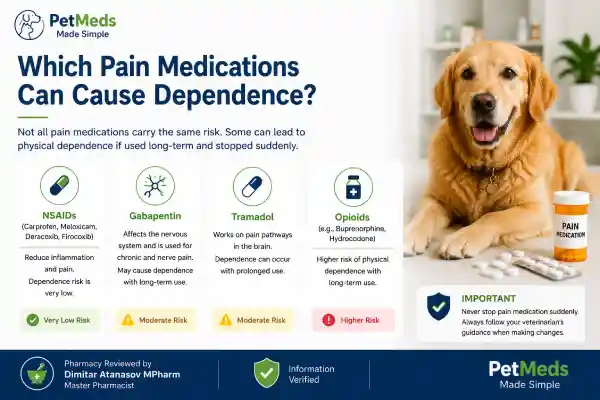
Not all pain medications behave the same way.
Some have almost no dependence risk.
Others require more careful monitoring.
Pain Medication Comparison
| Medication | Dependence Risk | Addiction Risk |
|---|---|---|
| Carprofen | Very Low | Very Low |
| Meloxicam | Very Low | Very Low |
| Deracoxib | Very Low | Very Low |
| Firocoxib | Very Low | Very Low |
| Gabapentin | Moderate | Low |
| Tramadol | Moderate | Low |
| Buprenorphine | Moderate | Moderate |
| Other Opioids | Higher | Moderate |
The majority of dogs receiving NSAIDs will never develop medication dependence.
Can Dogs Become Dependent on Gabapentin?
Gabapentin is one of the most frequently prescribed pain medications in veterinary medicine.
It is commonly used for:
- Chronic pain
- Arthritis
- Nerve pain
- Cancer pain
- Post-surgical discomfort
Because many dogs take gabapentin long-term, owners often ask whether dependence can occur.
The answer is:
Yes, physical dependence may develop after prolonged use.
This does not mean gabapentin is unsafe.
It simply means sudden discontinuation may occasionally cause problems.
Potential signs after abrupt discontinuation may include:
- Anxiety
- Restlessness
- Trembling
- Increased pain sensitivity
- Agitation
This is why veterinarians often recommend tapering rather than suddenly stopping treatment.
Related PMMS articles:
- Can Dogs Take Gabapentin Long-Term Safely?
- What Happens If Dogs Suddenly Stop Gabapentin?
- Can Dogs Become Addicted to Gabapentin?
- Why Is My Dog Still in Pain on Gabapentin?
- Why Does Gabapentin Stop Working in Dogs?
Can Dogs Become Dependent on Tramadol?
Tramadol is another medication that deserves special attention.
Unlike NSAIDs, tramadol affects:
- Pain perception pathways
- Neurotransmitters
- Opioid receptors
Because of these effects, long-term use can sometimes lead to physical dependence.
Potential withdrawal symptoms may include:
- Restlessness
- Vocalization
- Anxiety
- Tremors
- Increased sensitivity to pain
Veterinarians generally avoid abrupt discontinuation when tramadol has been used for extended periods.
Can NSAIDs Cause Dependence?
This is where many owners are relieved.
Common NSAIDs include:
- Carprofen
- Meloxicam
- Deracoxib
- Firocoxib
These medications work primarily by reducing inflammation.
They do not affect the brain’s reward pathways in the same way opioids or certain nervous-system medications do.
As a result:
NSAIDs are not considered addictive.
NSAIDs do not typically cause withdrawal syndromes.
NSAIDs rarely create physical dependence.
However, they can create the appearance of dependence because they are controlling chronic pain.
When the medication stops, the inflammation returns.
The dog becomes uncomfortable again.
The medication is not causing dependence.
The disease is still present.
Can Senior Dogs Be More Vulnerable?
Older dogs are more likely to receive long-term pain management.
This makes dependence concerns more common.
Senior dogs often have:
- Arthritis
- Degenerative joint disease
- Spinal disease
- Cancer-related pain
- Multiple medications
Because of this, veterinarians monitor medication plans carefully and regularly reassess treatment effectiveness.
Signs Owners Often Notice
Dogs that owners worry are becoming dependent often show:
- Limping between doses
- Panting
- Stiffness
- Crying
- Weakness
- Restlessness
- Slower movement
- Reduced willingness to exercise
These signs are usually related to pain returning rather than addiction.
However, some medications can occasionally contribute to withdrawal-like symptoms when stopped abruptly.
Could Multiple Pain Medications Increase the Risk?
Yes.
Dogs receiving several medications simultaneously may have a greater risk of developing medication-related adaptation.
Examples include:
- Gabapentin + NSAID
- Tramadol + NSAID
- Gabapentin + Tramadol
- Multiple chronic pain medications
The more medications affecting the nervous system, the more important gradual adjustments become.
What Does Dependence Look Like in Dogs?
One of the biggest challenges for dog owners is that dependence rarely looks obvious.
Unlike people, dogs cannot tell us:
“I feel withdrawal symptoms.”
Instead, owners see changes in behavior, activity level, and comfort.
Many of these changes can look identical to the original painful condition.
This is why veterinarians often focus on the timing of symptoms.
Comparison Table: Returning Pain vs Possible Dependence
| Sign | Returning Pain More Likely | Dependence/Withdrawal More Likely |
|---|---|---|
| Limping | ✓ | |
| Difficulty standing | ✓ | |
| Stiffness | ✓ | |
| Reluctance to walk | ✓ | |
| Anxiety | ✓ | |
| Tremors | ✓ | |
| Restlessness | ✓ | |
| Agitation | ✓ | |
| Vocalization without movement | ✓ | |
| Increased pain sensitivity | ✓ | ✓ |
The reality is that many dogs experience a combination of both.
A dog with arthritis that suddenly stops gabapentin may experience:
- Returning arthritis pain
- Increased nerve sensitivity
- Mild withdrawal effects
all at the same time.
Can Dogs Experience Withdrawal Symptoms?
Yes.
Certain pain medications can produce withdrawal symptoms if stopped abruptly after long-term use.
The medications most commonly associated with withdrawal include:
- Gabapentin
- Tramadol
- Opioid medications
- Certain sedative medications used alongside pain treatment
Withdrawal symptoms are generally uncommon when medications are tapered properly.
However, they can occur.
Possible signs include:
- Anxiety
- Restlessness
- Trembling
- Excessive panting
- Agitation
- Increased sensitivity to pain
- Difficulty settling
- Hyperactivity
Many owners mistake these symptoms for a worsening disease.
Sometimes they are.
Sometimes they represent the body’s adjustment to the absence of medication.
What Happens If Pain Medication Is Stopped Suddenly?
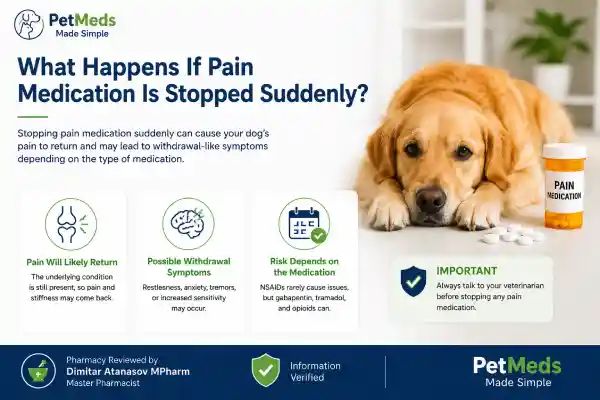
The answer depends on the medication.
NSAIDs
Examples:
- Carprofen
- Meloxicam
- Deracoxib
- Firocoxib
These medications typically do not produce withdrawal symptoms.
The primary concern is the return of inflammation and pain.
Gabapentin
Dogs receiving long-term gabapentin may occasionally develop:
- Anxiety
- Agitation
- Restlessness
- Increased nerve pain
- Tremors
This is why tapering is often recommended.
Related PMMS articles:
Tramadol
Abrupt discontinuation may sometimes cause:
- Vocalization
- Restlessness
- Anxiety
- Behavioral changes
- Increased pain sensitivity
The risk is generally higher after prolonged use.
Which Dogs Are Most At Risk?
Not every dog has the same risk profile.
Several factors may increase the likelihood of dependence-related concerns.
Risk Factors Table
| Risk Factor | Increased Risk? |
|---|---|
| Long-term medication use | ✓ |
| Multiple pain medications | ✓ |
| Chronic nerve pain | ✓ |
| Senior age | ✓ |
| High medication doses | ✓ |
| Frequent dosage increases | ✓ |
| Opioid use | ✓ |
| Short-term NSAID use | Low |
The highest-risk dogs are usually those receiving medications that affect the nervous system rather than simple anti-inflammatory medications.
Could Multiple Pain Medications Increase the Risk?
Absolutely.
Modern veterinary pain management often uses a multimodal approach.
A dog may receive:
- Carprofen
- Gabapentin
- Amantadine
- Tramadol
at the same time.
This strategy can be extremely effective because each medication targets pain differently.
However, it can also make medication adjustments more complicated.
Why?
Because if symptoms appear after stopping a medication, it may be difficult to determine whether the dog is experiencing:
- Returning pain
- Withdrawal
- Disease progression
- A medication interaction
This is one reason veterinarians prefer gradual changes whenever possible.
Could My Dog Need Pain Medication for Life?
Many owners hope pain medication will be temporary.
Unfortunately, chronic diseases often do not disappear.
Examples include:
- Osteoarthritis
- Hip dysplasia
- Elbow dysplasia
- Degenerative joint disease
- Certain spinal disorders
- Some cancer-related pain conditions
In these situations, lifelong pain management may be appropriate.
This does not mean the dog is dependent.
It means the underlying disease is chronic.
A dog with arthritis may need ongoing support just as a person with arthritis often requires ongoing treatment.
How Veterinarians Evaluate Suspected Dependence
When owners express concern about dependence, veterinarians usually evaluate several important factors.
Questions a Veterinarian May Ask
- How long has the medication been used?
- What medication is involved?
- What symptoms appear when doses are missed?
- How quickly do symptoms develop?
- Is the underlying disease progressing?
- Has the dosage changed recently?
The answers help determine whether symptoms are more consistent with:
- Pain recurrence
- Medication tolerance
- Withdrawal
- Disease progression
Diagnostic Clues Veterinarians Consider
| Finding | Suggests Pain Return | Suggests Withdrawal |
|---|---|---|
| Limping returns | ✓ | |
| Joint stiffness returns | ✓ | |
| Arthritis progression | ✓ | |
| Tremors appear suddenly | ✓ | |
| Anxiety after stopping medication | ✓ | |
| Agitation without movement-related pain | ✓ |
The goal is not simply to identify dependence.
The goal is to ensure the dog remains comfortable and safe.
How Veterinarians Safely Reduce Long-Term Pain Medication
Veterinarians rarely recommend abrupt discontinuation of medications with dependence potential.
Instead, they often use a tapering strategy.
Common Goals
- Minimize withdrawal symptoms
- Maintain pain control
- Monitor for disease progression
- Improve long-term safety
The exact schedule varies significantly depending on:
- Medication type
- Dose
- Duration of treatment
- Underlying medical condition
Owners should never create their own tapering schedule without veterinary guidance.
Can Dependence Be Prevented?
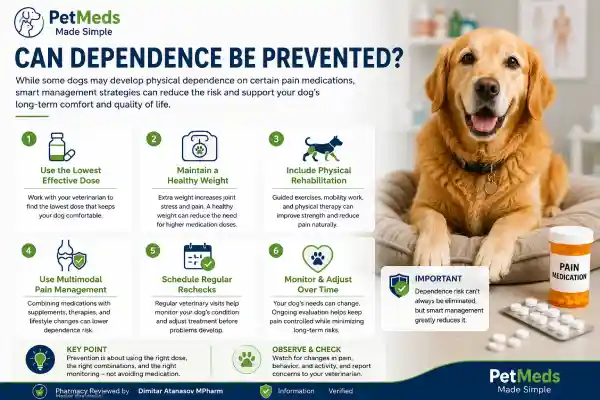
Sometimes.
Although not every case can be prevented, several strategies may help reduce risk.
Use the Lowest Effective Dose
Veterinarians aim to use enough medication to control pain without using more than necessary.
Maintain a Healthy Weight
Excess body weight increases stress on joints.
Many overweight dogs require higher levels of pain management.
Incorporate Physical Rehabilitation
Rehabilitation may improve:
- Mobility
- Strength
- Comfort
- Quality of life
This can sometimes reduce medication requirements.
Use Multimodal Pain Management
Veterinarians often combine:
- Weight management
- Exercise modification
- Joint supplements
- Physical therapy
- Pain medications
rather than relying on a single drug.
Related Symptoms Owners Often Search For
Owners concerned about dependence frequently search for related problems such as:
- Why Is My Dog Still Limping After Medication?
- Why Is My Dog Weak After Pain Medication?
- Why Is My Dog Panting After Pain Medication?
- Why Is My Dog Crying Even After Pain Medication?
- Can Pain Medication Cause Anxiety in Dogs?
- Can Pain Medication Cause Anxiety in Dogs?
- Can Pain Medication Cause Personality Changes in Dogs?
- Can Anxiety Medication Cause Confusion in Dogs?
- What Happens If Dogs Overdose on Pain Medication?
- Can Dogs Take Pain Medication Long-Term?
These symptoms often overlap because pain, medication effects, and disease progression can look surprisingly similar.
When Should Owners Contact Their Veterinarian?
Contact your veterinarian if your dog develops:
- Tremors
- Severe anxiety
- Unusual agitation
- Sudden behavioral changes
- Collapse
- Severe weakness
- Difficulty walking
- Persistent crying
- Refusal to eat
- Signs of uncontrolled pain
Emergency Warning Signs
| Symptom | Emergency? |
|---|---|
| Collapse | Yes |
| Seizures | Yes |
| Severe breathing difficulty | Yes |
| Loss of consciousness | Yes |
| Inability to stand | Yes |
| Mild stiffness | No |
| Mild limping | Usually No |
Bottom Line
Most dogs do not become addicted to pain medication. However, certain medications—particularly gabapentin, tramadol, and opioid-based drugs—can lead to physical dependence after long-term use. In many cases, what owners interpret as dependence is actually the return of chronic pain when medication is stopped. If your dog receives long-term pain treatment, medication changes should always be discussed with your veterinarian rather than made abruptly at home.
Veterinarian Takeaway
The majority of dogs that appear “dependent” on pain medication are actually experiencing the return of an underlying painful condition. True addiction is uncommon in dogs, but physical dependence can occur with certain medications that affect the nervous system. Careful monitoring, regular veterinary rechecks, and gradual medication adjustments help ensure long-term pain management remains both safe and effective.
Frequently Asked Questions
Can dogs become addicted to pain medication?
True addiction is uncommon in dogs. Physical dependence is more likely than addiction.
Can gabapentin cause dependence in dogs?
Yes. Long-term gabapentin use may lead to physical dependence in some dogs.
Can tramadol cause withdrawal symptoms?
It can. Withdrawal symptoms may occur if tramadol is stopped abruptly after prolonged use.
Can carprofen cause addiction?
No. Carprofen is not considered addictive.
Can meloxicam cause dependence?
No. Meloxicam does not typically cause physical dependence.
Why does my dog seem worse after missing a dose?
The most common reason is the return of the underlying painful condition.
Should I stop pain medication suddenly?
No. Always consult your veterinarian before changing long-term medications.
Which dogs are most at risk?
Dogs receiving long-term nervous-system medications such as gabapentin or tramadol generally have higher risk.
Can dependence be prevented?
Risk can often be reduced through proper dosing, monitoring, and gradual medication adjustments.
Can a dog need pain medication for life?
Yes. Many dogs with severe arthritis or chronic pain conditions require long-term treatment.
Reviewed By
Dimitar Atanasov, MPharm
Master Pharmacist | Medication Safety Educator
Editorial Policy
At Pet Meds Made Simple, we are committed to providing accurate, evidence-based information about pet medications, veterinary treatments, medication safety, and common health concerns affecting dogs and cats.
For more information, see our Editorial Policy:
Sources
- Plumb’s Veterinary Drug Handbook
- AAHA Pain Management Guidelines
- AVMA Resources
- Merck Veterinary Manual
- Veterinary Pharmacology and Therapeutics
- Small Animal Clinical Pharmacology
- JAVMA
- VIN
- Frontiers in Veterinary Science
Medical Review Statement
This article was pharmacy-reviewed by Dimitar Atanasov, MPharm, Master Pharmacist, using current veterinary pharmacology references, canine pain-management guidelines, and published veterinary literature available at the time of review.
Images created with AI – Can Dogs Become Dependent on Pain Medication