What to do if dog medication is not working? If your dog’s medication does not seem effective, the most important step is identifying why the treatment is failing before making changes yourself. In many cases, the issue is not simply the medication itself—it may involve the diagnosis, dosage, disease progression, absorption problems, incorrect timing, or even the type of pain or illness being treated.
Many dog owners experience this frustrating situation:
- the medication worked at first
- symptoms improved slightly
- then progress stopped
Or worse:
- the medication never seemed to help at all
This is one of the most important topics in veterinary medicine because owners often react emotionally and make dangerous decisions too quickly.
Some stop treatment suddenly. Others increase the dose themselves. Some combine medications without veterinary guidance.
Unfortunately, these reactions can worsen the situation dramatically.
Quick Answer
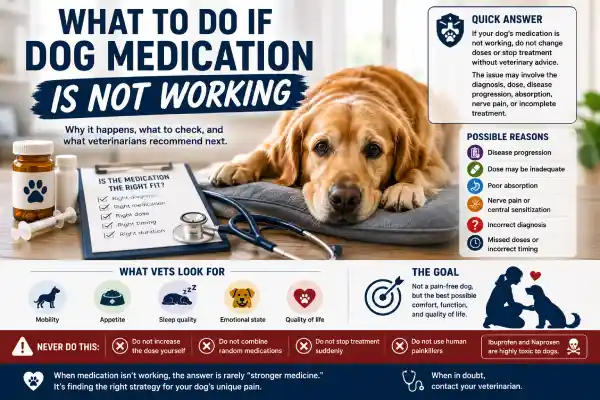
If dog medication is not working, do not change doses or stop treatment without veterinary advice. The medication may be inappropriate for the condition, the disease may have progressed, the dose may be inadequate, or the issue may involve poor absorption, nerve pain, or an incomplete diagnosis.
Why “Medication Not Working” Is More Complex Than It Sounds
Most people think medication failure means:
👉 “the drug is weak”
But veterinary medicine is rarely that simple.
A medication can appear ineffective for many reasons:
- wrong diagnosis
- wrong pain pathway
- poor absorption
- missed doses
- disease progression
- unrealistic expectations
Sometimes the medication is actually working partially—but not enough to fully control symptoms anymore.
What to Do If Dog Medication Is Not Working
The First Thing You Should NEVER Do
This is critical.
If your dog’s medication is not working:
❌ do NOT immediately increase the dose yourself
❌ do NOT combine random medications
❌ do NOT stop treatment suddenly
❌ do NOT use human painkillers
Especially avoid:
- Ibuprofen
- Naproxen
These can be highly toxic to dogs.
This connects naturally with:
- What Is the Safest NSAID for Dogs Long-Term?
- Can Dogs Take Ibuprofen Instead of Carprofen?
- Safest Pain Medication for Dogs (Vet Comparison Guide)
which help owners understand why medication safety matters so much.
Step 1: Determine Whether the Medication Ever Worked
This sounds simple, but it changes everything.
There are two completely different situations:
Scenario A: The Medication Worked Initially
If your dog improved at first and later worsened, the most likely causes include:
- disease progression
- chronic pain development
- tolerance-like progression
- central sensitization
This is extremely common in arthritis and chronic pain management.
Scenario B: The Medication Never Worked
If there was never improvement at all, the issue may involve:
- incorrect diagnosis
- wrong medication type
- incorrect dosing
- absorption problems
This distinction is extremely important.
Why Chronic Pain Changes Over Time
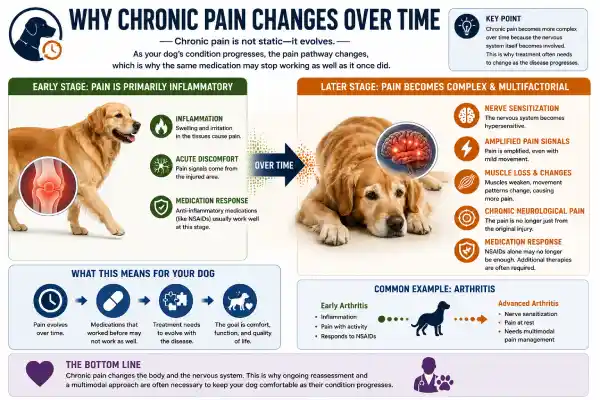
One of the biggest reasons medications stop helping is that pain evolves biologically.
Early disease often involves:
- inflammation
- swelling
- acute discomfort
But later stages involve:
- nerve sensitization
- muscle loss
- altered movement patterns
- chronic neurological pain
At that point, anti-inflammatory medications alone may no longer be enough.
This connects directly with:
- Why Is My Dog Still in Pain After Medication?
- Amantadine for Dogs: A Hidden Pain Management Tool
- How Fast Does Gabapentin Work in Dogs?
because chronic pain almost always becomes more complex over time.
Understanding the Different Types of Pain
Not all pain responds to the same medications.
Main Pain Types in Dogs
| Pain Type | Common Causes | Often Responds Best To |
|---|---|---|
| Inflammatory pain | arthritis, injury | NSAIDs |
| Nerve pain | spinal disease | gabapentin |
| Severe acute pain | surgery, trauma | opioids |
| Chronic pain | advanced arthritis | multimodal therapy |
This is why some dogs continue hurting despite medication.
The treatment may simply be targeting the wrong pain pathway.
Central Sensitization: The Hidden Reason Many Dogs Stop Responding
This is one of the most overlooked topics in veterinary medicine.
Central sensitization happens when:
- the nervous system becomes hypersensitive
- pain signals become amplified
- mild movement becomes painful
At this stage:
👉 the nervous system itself becomes part of the disease.
This explains why:
- NSAIDs may “stop working”
- pain spreads
- symptoms seem disproportionate
This is why articles like:
- Signs Your Dog Needs Stronger Pain Medication
- Can Amantadine Be Used for Arthritis in Dogs?
- Natural Pain Relief for Dogs: What Actually Works?
fit naturally into this cluster.
Step 2: Look for Subtle Signs the Medication Is Partially Working
Sometimes owners expect dramatic changes too quickly.
But improvement may actually appear as:
- slightly easier movement
- improved appetite
- better sleep
- less whining
- improved mood
These smaller improvements matter.
Signs the Medication MAY Be Helping
| Improvement | Why It Matters |
|---|---|
| improved sleep | reduced nighttime pain |
| eating better | discomfort may be decreasing |
| more interaction | emotional improvement |
| less stiffness | inflammation reduction |
Step 3: Check Whether Doses Are Being Missed
This is far more common than most owners realize.
Even occasional missed doses can reduce effectiveness dramatically.
This is especially important with:
- antibiotics
- gabapentin
- seizure medications
This connects naturally with:
- Miss a Dose of Antibiotics in Dogs?
- How Long Should Dogs Stay on Antibiotics?
- Can You Stop Antibiotics Early in Dogs?
because treatment consistency is one of the biggest factors in success.
Step 4: Consider Absorption Problems
Sometimes the medication is correct—but the dog is not absorbing it properly.
This may happen because of:
- vomiting
- diarrhea
- digestive disease
- giving medication incorrectly
For example, vomiting after antibiotics can prevent proper absorption completely.
This links naturally with:
because side effects often interfere with treatment success.
Why the Underlying Disease May Be Worse Than Expected
This is emotionally difficult for many owners.
Sometimes the medication is not failing.
Instead:
👉 the disease is progressing faster than expected.
Examples include:
- advanced arthritis
- degenerative spinal disease
- cancer-related pain
- neurological disease
Medication can improve comfort, but it cannot always stop progression completely.
The Emotional Side of “Medication Failure”
Many owners feel guilt when medications stop working.
They think:
👉 “I failed my dog.”
But chronic diseases are often progressive by nature.
Modern veterinary medicine focuses on:
- slowing decline
- improving comfort
- maximizing quality of life
not always “curing” the condition completely.
Why Some Dogs Need Combination Therapy
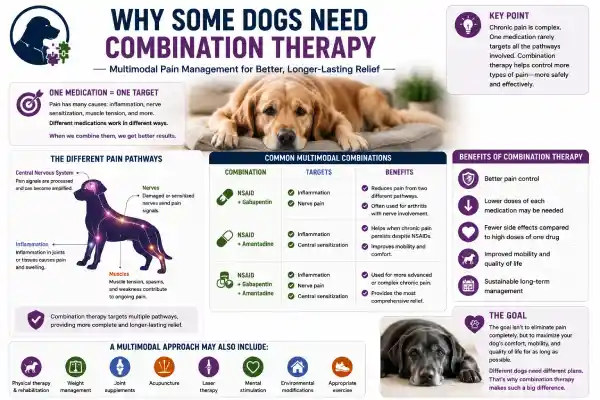
Veterinary medicine increasingly uses:
Multimodal pain management
This means combining therapies that target different mechanisms.
Common Multimodal Combinations
| Combination | Purpose |
|---|---|
| NSAID + Gabapentin | inflammation + nerve pain |
| NSAID + Amantadine | chronic sensitization |
| Triple therapy | advanced chronic pain |
This is why internal linking within your site is becoming so powerful.
A reader starting with:
👉 “dog medication not working”
naturally continues into:
- Gabapentin for Dogs
- Amantadine for Dogs
- Signs Your Dog Needs Stronger Pain Medication
- Best Pain Medication for Dogs with Arthritis
This creates topical authority and longer session duration simultaneously.
When the Diagnosis Might Be Wrong
This is another important possibility.
Examples include:
- arthritis mistaken for spinal disease
- orthopedic pain mistaken for neurological pain
- cancer-related pain missed early
Persistent symptoms should always trigger reassessment.What to Do If Dog Medication Is Not Working
Signs You Should Contact Your Veterinarian Immediately
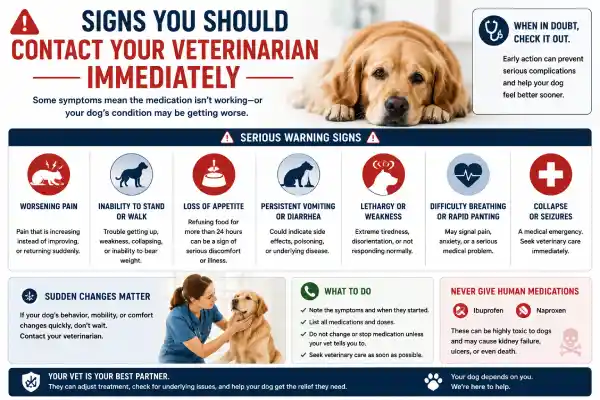
Some situations require prompt evaluation.
Serious Warning Signs
| Symptom | Why It Matters |
|---|---|
| worsening pain | disease progression |
| inability to stand | severe neurological issue |
| loss of appetite | uncontrolled discomfort |
| persistent vomiting | medication intolerance |
| collapse | emergency |
Why Owners Sometimes Expect Results Too Quickly
This happens constantly.
Some medications work rapidly.
Others require time.
For example:
- NSAIDs may help within days
- gabapentin may require adjustment
- chronic pain therapy often takes weeks
This is why expectations matter.
What Veterinarians Actually Look For
Vets rarely ask:
👉 “Is the pain completely gone?”
Instead they assess:
- mobility
- appetite
- sleep
- emotional state
- quality of life
This is a much more realistic long-term approach.
Real-Life Example
Dog A
- mild arthritis
- responds well to NSAID alone
Dog B
- advanced arthritis + nerve pain
Result:
❌ same medication no longer enough
Needs:
✔ gabapentin
✔ amantadine
✔ multimodal management
This is one of the most common chronic pain scenarios in older dogs.
The Future of Veterinary Pain Management

Modern veterinary medicine is moving toward:
- personalized treatment
- neurological pain management
- combination therapy
- long-term quality of life focus
This is changing outcomes dramatically for chronic pain patients.
Conclusion
If your dog’s medication is not working, the answer is rarely as simple as “stronger medicine.” Persistent symptoms may involve disease progression, nerve pain, absorption issues, missed doses, or an incomplete diagnosis.What to Do If Dog Medication Is Not Working
The most important thing is reassessing the situation carefully instead of reacting impulsively.
Veterinary medicine now offers far more options than many owners realize—but successful treatment often requires adjusting the strategy as the condition evolves.What to Do If Dog Medication Is Not Working
FAQ – What to Do If Dog Medication Is Not Working
What should I do if my dog’s medication stops working?
Contact your veterinarian before changing doses or stopping treatment.
Why is my dog still in pain after medication?
The pain may involve nerve pathways, disease progression, or chronic sensitization.
Can dogs become resistant to pain medication?
Not in the same way bacteria become resistant, but chronic pain often evolves and becomes harder to control.
Should I increase my dog’s medication dose myself?
No. This can be dangerous, especially with NSAIDs.
Why did the medication work at first and then stop?
This commonly happens when disease progresses or chronic pain develops.
Sources & Scientific References
- American Animal Hospital Association (AAHA) Pain Management Guidelines
- Merck Veterinary Manual
- Plumb’s Veterinary Drug Handbook
- Veterinary Information Network (VIN)
Medical Disclaimer
This article is for educational purposes only and does not replace professional veterinary advice.