Quick Answer
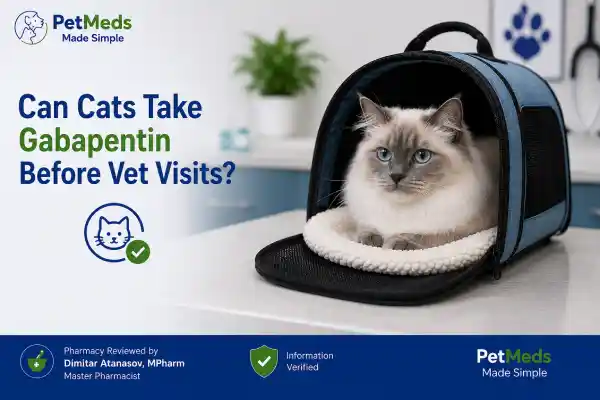
Can Cats Take Gabapentin Before Vet Visits? Yes. Gabapentin is commonly prescribed by veterinarians before veterinary appointments to reduce fear, anxiety, and stress in cats. When given at the veterinarian’s recommended dose and timing, it can make transportation, physical examinations, blood collection, imaging procedures, and other veterinary visits significantly less stressful for both cats and their owners. However, gabapentin should only be used under veterinary guidance, as the correct dose and timing vary between individual cats.
When Owners Commonly Ask This
The question “Can Cats Take Gabapentin Before Vet Visits?” has become increasingly common over the past decade as more veterinarians adopt Fear Free® and low-stress handling techniques.
Many cat owners experience the same frustrating scenario.
Their normally affectionate cat suddenly becomes completely different when it’s time for a veterinary appointment.
The cat may:
- hide under the bed
- refuse to enter the carrier
- vocalize loudly during travel
- drool from stress
- attempt to escape
- scratch or bite when handled
- become impossible to examine safely
After a difficult appointment, many veterinarians recommend giving gabapentin before the next visit.
Naturally, owners immediately begin searching online:
- Can cats take gabapentin before vet visits?
- Is it safe?
- Will my cat be unconscious?
- How sleepy will my cat become?
- How long before the appointment should I give it?
- Will my veterinarian still be able to examine my cat?
Fortunately, for most healthy cats, gabapentin has become one of the most commonly used medications to reduce fear and anxiety before veterinary appointments.
Owners may also find these PMMS articles helpful:
- Gabapentin for Cats: Uses, Dosage, Side Effects & Safety
- How Long Does Gabapentin Last in Cats?
- Can Gabapentin Cause Breathing Changes in Cats?
- Why Is My Cat Shaking After Gabapentin?
- Can Gabapentin Cause Vomiting in Cats?
- Can Cats Miss a Dose of Gabapentin?
- Is Human Gabapentin Safe for Cats?
Can Cats Take Gabapentin Before Vet Visits?
Can Cats Take Gabapentin Before Vet Visits?
The short answer is:
Yes. Veterinarians commonly prescribe gabapentin before veterinary visits to help reduce stress, fear, and anxiety in cats.
This practice has become increasingly common because many cats experience significant stress during:
- transportation
- unfamiliar environments
- physical examinations
- blood collection
- nail trimming
- diagnostic imaging
- hospitalization
Stress affects more than behavior.
It can also:
- increase heart rate
- elevate blood pressure
- increase respiratory rate
- make pain assessments more difficult
- interfere with physical examinations
- reduce the accuracy of some diagnostic findings
By reducing anxiety, gabapentin often allows veterinarians to perform a safer and more complete examination while improving the experience for the cat.
Why Do Veterinarians Recommend Gabapentin Before Veterinary Appointments?
One of the biggest reasons owners search “Can Cats Take Gabapentin Before Vet Visits?” is because they are surprised that their veterinarian recommends a medication before what seems like a routine examination.
The goal is not to heavily sedate the cat.
Instead, veterinarians aim to reduce fear.
A calmer cat is often:
- easier to transport
- less fearful
- less reactive
- easier to examine
- safer for veterinary staff
- less likely to experience severe stress
Reducing stress benefits everyone involved including the cat.
This approach aligns with modern feline medicine, which emphasizes minimizing fear whenever possible.
How Does Gabapentin Help Nervous Cats During Veterinary Visits?
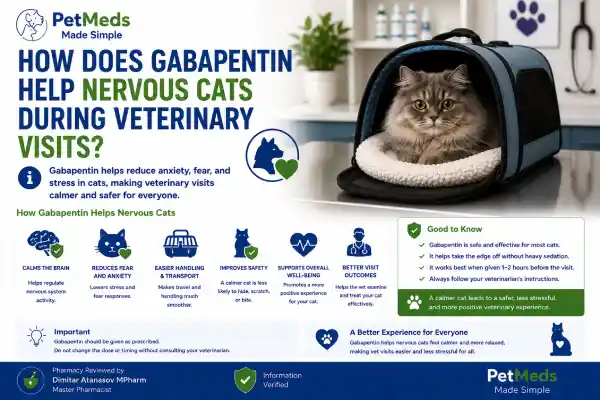
Gabapentin works by reducing abnormal activity within certain parts of the nervous system.
Although it was originally developed as an anticonvulsant medication, veterinarians now commonly use it because it also helps reduce:
- anxiety
- fear responses
- stress-related behaviors
- excessive reactivity
For many cats, this means they remain awake but become:
- calmer
- less fearful
- easier to handle
- more tolerant of examination
Owners often describe their cats as:
- sleepy
- quieter
- unusually relaxed
These effects are expected and usually temporary.
Is Gabapentin Used by Veterinary Specialists?
Absolutely.
One reason Can Cats Take Gabapentin Before Vet Visits? has become such a popular search is that gabapentin is now widely used by:
- general practice veterinarians
- feline-only clinics
- internal medicine specialists
- cardiologists
- neurologists
- oncologists
- emergency hospitals
- referral centers
It has become an important part of low-stress feline handling protocols throughout North America and many other countries.
Which Veterinary Visits Commonly Involve Gabapentin?
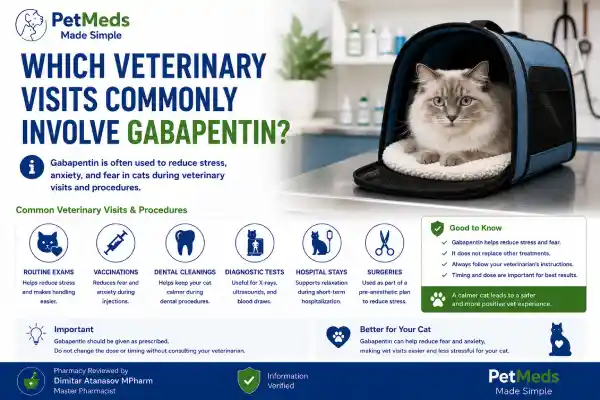
Gabapentin may be prescribed before many different appointments.
Examples include:
- annual wellness examinations
- vaccination visits
- blood collection
- blood pressure measurement
- ultrasound examinations
- radiographs (X-rays)
- orthopedic evaluations
- neurological examinations
- dental consultations
- follow-up appointments
Not every cat requires gabapentin.
However, for anxious or fearful cats, it often makes the visit much more comfortable.
Owners may also wish to review:
- How Long Does Gabapentin Last in Cats?
- Can Gabapentin Cause Breathing Changes in Cats?
- Can Gabapentin Cause Vomiting in Cats?
- Why Is My Cat Shaking After Gabapentin?
- Can Cats Miss a Dose of Gabapentin?
- Gabapentin for Cats: Uses, Dosage, Side Effects & Safety
Is Gabapentin Given to Sedate Cats or Reduce Anxiety?
This is one of the biggest misconceptions surrounding “Can Cats Take Gabapentin Before Vet Visits?”
Most veterinarians prescribe gabapentin primarily to reduce fear and anxiety, not to make the cat unconscious.
Many cats remain:
- awake
- responsive
- able to walk
- able to eat
while simply becoming much calmer than they would otherwise be.
Some cats become sleepier than others because individual responses vary.
Veterinarians consider:
- age
- body weight
- medical history
- kidney function
- previous response to gabapentin
before recommending treatment.
Why Fear-Free Veterinary Visits Are Becoming the New Standard
Modern feline medicine has shifted dramatically over the past several years.
Instead of forcing frightened cats through examinations, many veterinary teams now use Fear Free® principles that aim to reduce anxiety before, during, and after appointments.
Gabapentin has become one of the most valuable tools supporting this approach because calmer cats often experience:
- lower stress levels
- easier handling
- shorter examinations
- fewer restraint techniques
- safer procedures
- more accurate physical examinations
Reducing stress may also improve the owner’s overall experience, making future veterinary visits much less intimidating.
Can Every Cat Receive Gabapentin Before a Veterinary Visit?
Not necessarily.
Although gabapentin is considered safe for many cats, veterinarians first evaluate:
- age
- current medications
- kidney function
- neurological disorders
- pregnancy status
- overall medical history
This individualized assessment helps determine whether gabapentin is appropriate for each patient.
Owners should never give gabapentin prescribed for another pet or use leftover medication without veterinary guidance.
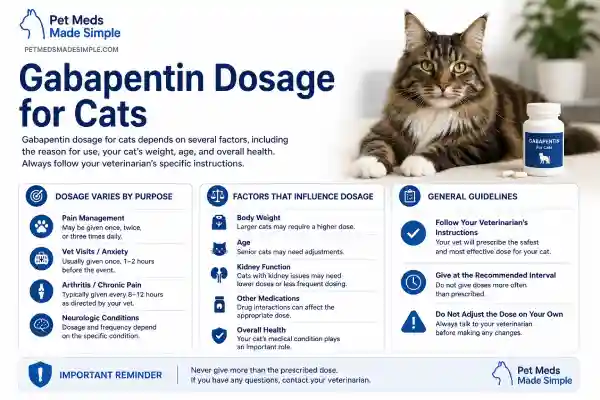
When Should You Give Gabapentin Before a Vet Visit?
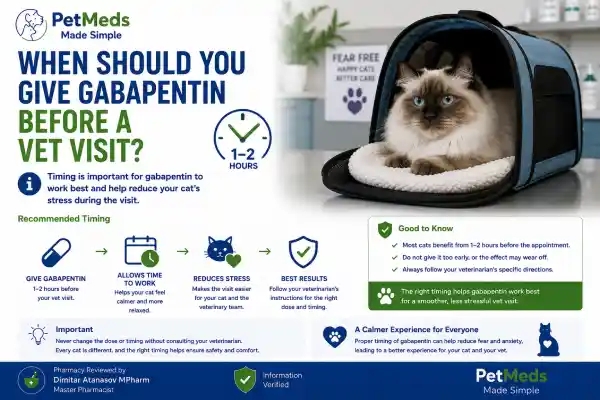
One of the most common questions owners ask after learning “Can Cats Take Gabapentin Before Vet Visits?” is exactly when the medication should be given.
Timing is extremely important.
Gabapentin needs enough time to be absorbed before the stressful event begins.
If it is given too late, your cat may already be frightened by:
- entering the carrier
- traveling in the car
- arriving at the veterinary clinic
- unfamiliar smells and sounds
- seeing other animals
For this reason, veterinarians usually recommend administering gabapentin several hours before the appointment, following the specific instructions provided for your cat.
Because every patient is different, always follow your veterinarian’s timing recommendations rather than using a schedule from another pet or information found online.
How Long Before a Veterinary Appointment Does Gabapentin Start Working?
Owners searching “Can Cats Take Gabapentin Before Vet Visits?” often wonder whether the medication works immediately.
The answer is no.
Like most oral medications, gabapentin requires time to be:
- swallowed
- absorbed through the gastrointestinal tract
- distributed throughout the body
- reach effective concentrations within the nervous system
This gradual process explains why veterinarians recommend giving the medication before leaving home, not after arriving at the clinic.
What Can Owners Expect After Giving Gabapentin?
Although every cat responds differently, many owners notice gradual behavioral changes.
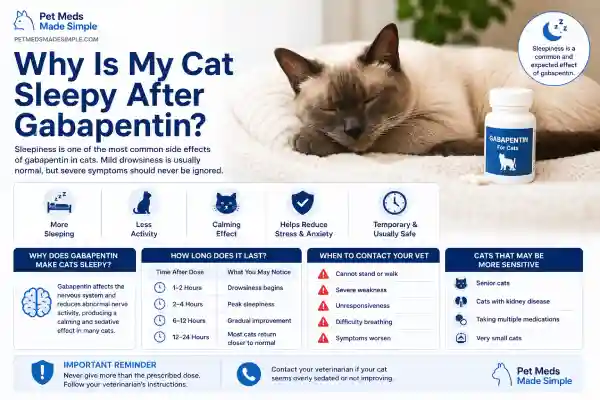
A typical progression may look like this:
| Time After Administration | What Owners May Notice |
|---|---|
| First 30–60 minutes | Little or no obvious change in many cats |
| Around 1–2 hours | Increasing relaxation and reduced anxiety |
| Approximately 2–3 hours | Calmer behavior, easier handling, mild sleepiness in some cats |
| Several hours after the visit | Effects gradually begin wearing off |
The exact timing varies depending on:
- individual metabolism
- body weight
- overall health
- prescribed dose
- whether food was given with the medication
This variation is completely normal.
Will My Cat Be Too Sleepy for the Veterinarian to Perform an Examination?
One of the biggest fears owners have when asking “Can Cats Take Gabapentin Before Vet Visits?” is that their cat will become “knocked out.”
Fortunately, this is usually not the goal.
Veterinarians generally want cats to be:
- awake
- responsive
- comfortable
- less fearful
- easier to examine
Many cats become mildly sleepy, but they are still able to:
- walk
- respond to their owner
- undergo a physical examination
- have blood collected
- undergo imaging procedures
A calm cat often allows the veterinarian to perform a better examination than a frightened one.
What Side Effects Can Cats Experience After Taking Gabapentin Before a Vet Visit?
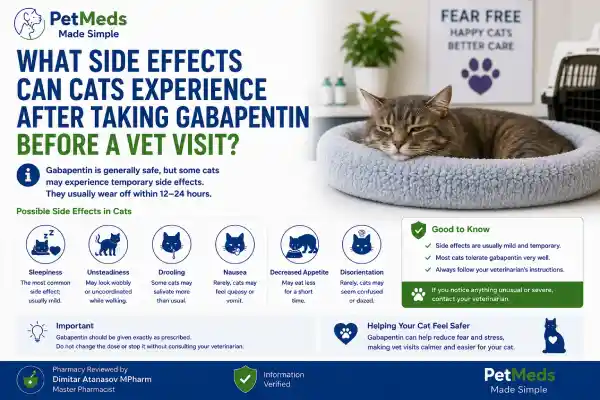
Like any medication, gabapentin may cause side effects.
Fortunately, most are mild and temporary.
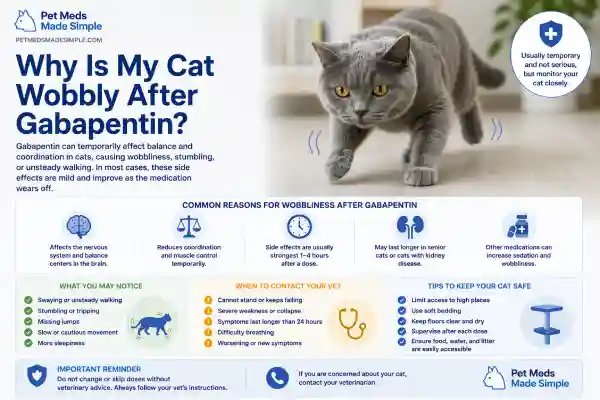
Common effects include:
- sleepiness
- mild wobbliness
- slower movements
- reduced activity
- temporary loss of coordination
- quieter behavior
These effects generally improve as the medication is gradually eliminated from the body.
Owners may also find these PMMS guides helpful:
- How Long Does Gabapentin Last in Cats?
- Why Is My Cat Shaking After Gabapentin?
- Can Gabapentin Cause Breathing Changes in Cats?
- Can Gabapentin Cause Vomiting in Cats?
Which Side Effects Are Considered Normal?
Many owners become worried because their cat behaves differently after receiving gabapentin.
The following changes are commonly expected:
- sleeping more than usual
- walking more slowly
- appearing relaxed
- decreased interest in playing
- quieter vocalization
- slight wobbliness
These temporary effects are often the reason gabapentin helps reduce fear during veterinary visits.
Which Symptoms Require Immediate Veterinary Advice?
Although serious reactions are uncommon, owners should know when to contact a veterinarian promptly.
Seek veterinary advice if your cat develops:
- difficulty breathing
- collapse
- inability to wake normally
- repeated vomiting
- seizures
- severe weakness that continues worsening
- loss of consciousness
- suspected accidental overdose
These situations require prompt professional evaluation.
Fortunately, they are uncommon when gabapentin is administered according to veterinary instructions.
Can Older Cats Receive Gabapentin Before Veterinary Visits?
Yes—many senior cats benefit from pre-visit gabapentin.
However, veterinarians often take additional factors into account, including:
- kidney function
- liver health
- body condition
- concurrent medications
- chronic illnesses
Because older cats may metabolize or eliminate medications differently, individualized treatment plans are especially important.
Owners of senior cats may also wish to read:
- How Long Does Gabapentin Last in Cats?
- Can Gabapentin Cause Breathing Changes in Cats?
- Can Gabapentin Cause Vomiting in Cats?
- Gabapentin for Cats: Uses, Dosage, Side Effects & Safety
Can Gabapentin Be Combined With Other Fear-Free Techniques?
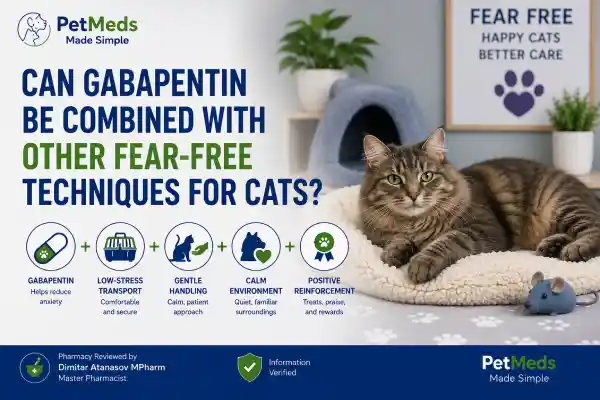
Absolutely.
Medication is only one part of creating a low-stress veterinary experience.
Many veterinary teams also recommend:
- keeping the carrier available at home so it becomes familiar
- placing comfortable bedding inside the carrier
- using treats or favorite toys to encourage voluntary entry
- covering the carrier with a light towel during travel if recommended
- minimizing loud noises during transportation
- scheduling quieter appointment times when possible
These strategies often work together with gabapentin to reduce anxiety even further.
Does Every Cat Need Gabapentin Before Every Veterinary Visit?
No.
Some cats remain calm during routine examinations and do not require medication.
Others become extremely fearful every time they leave home.
Veterinarians evaluate each cat individually based on:
- previous veterinary visits
- behavior during transportation
- temperament
- medical history
- owner’s observations
This personalized approach helps ensure gabapentin is recommended only when it is likely to improve the experience and reduce stress.
Owners may also wish to review:
- Gabapentin for Cats: Uses, Dosage, Side Effects & Safety
- How Long Does Gabapentin Last in Cats?
- Why Is My Cat Shaking After Gabapentin?
- Can Cats Miss a Dose of Gabapentin?
- Is Human Gabapentin Safe for Cats?
- Can Gabapentin Cause Vomiting in Cats?
- Can Gabapentin Cause Breathing Changes in Cats?
What Should You Do After Your Cat Returns Home?
Many owners feel relieved once the veterinary appointment is over but become concerned when their cat continues acting sleepy after returning home.
If you’re wondering “Can Cats Take Gabapentin Before Vet Visits?”, it’s important to remember that the calming effects do not disappear immediately after the examination ends.
For several hours after returning home, many cats simply need:
- a quiet environment
- fresh water
- easy access to a litter box
- a comfortable place to rest
- minimal stress
Most cats gradually return to their normal behavior as the medication is eliminated from the body.
Owners should avoid forcing interaction if the cat prefers to sleep.
Rest is usually part of the normal recovery process.
How Long Will My Cat Remain Sleepy After the Veterinary Visit?
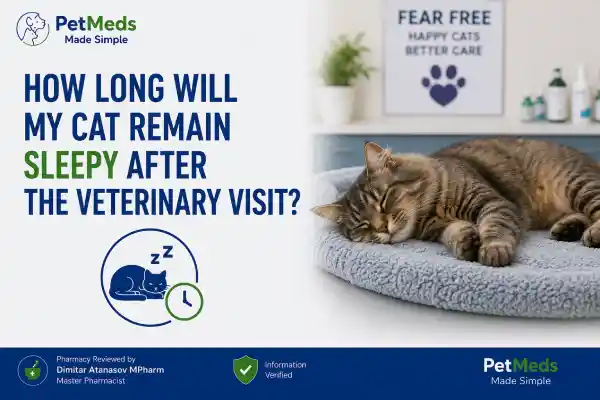
One of the most common follow-up questions after “Can Cats Take Gabapentin Before Vet Visits?” is how long the effects will last.
The answer varies between cats.
Several factors influence recovery, including:
- the prescribed dose
- age
- kidney function
- overall health
- whether other medications were administered during the visit
- individual sensitivity
Some cats appear almost completely normal within a few hours.
Others may remain quieter than usual until later the same day.
This variation is expected and does not necessarily indicate a problem.
Owners may also wish to review:
- How Long Does Gabapentin Last in Cats?
- Why Is My Cat Shaking After Gabapentin?
- Can Gabapentin Cause Breathing Changes in Cats?
- Can Gabapentin Cause Vomiting in Cats?
Should You Let Your Cat Sleep?
Yes.
One of the biggest misconceptions surrounding “Can Cats Take Gabapentin Before Vet Visits?” is that owners should try to keep their cat awake.
In reality, mild sleepiness is one of the expected effects of gabapentin.
If your cat:
- wakes when gently approached
- responds normally
- breathes comfortably
- changes position occasionally
- appears relaxed
allowing your cat to rest is generally appropriate.
Sleep helps many cats recover from both the medication and the stress of the veterinary visit.
When Should Owners Contact Their Veterinarian After Returning Home?
Although most cats recover uneventfully, owners should know which situations deserve veterinary advice.
Contact your veterinarian if your cat develops:
- severe difficulty breathing
- repeated vomiting
- collapse
- inability to stand long after the expected effects should be improving
- seizures
- profound weakness
- inability to swallow
- suspected accidental overdose
Fortunately, serious complications remain uncommon when gabapentin is prescribed and administered correctly.
Can Gabapentin Make Future Vet Visits Less Stressful?
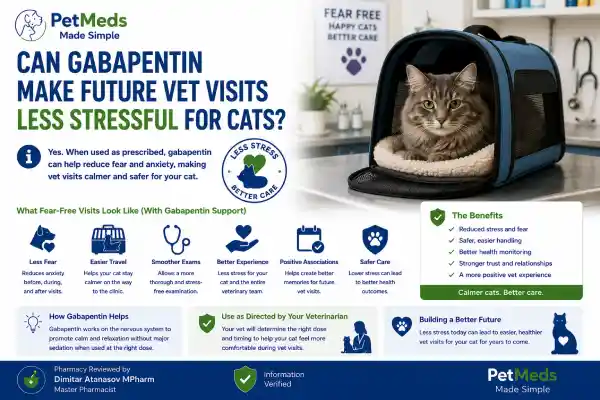
For many cats, the answer is yes.
Cats remember stressful experiences remarkably well.
A frightening veterinary visit can make future appointments even more difficult.
By reducing fear during one visit, gabapentin may help prevent negative experiences from becoming reinforced.
Many owners report that future appointments become:
- easier
- shorter
- less stressful
- safer
- more successful
Veterinarians also benefit because calmer cats often allow more complete examinations with less restraint.
Can Owners Help Reduce Stress Without Medication?
Absolutely.
Medication works best when combined with good feline handling practices.
Veterinary behavior specialists often recommend:
- leaving the carrier out year-round instead of hiding it in a closet
- placing familiar blankets inside the carrier
- rewarding voluntary carrier entry with treats
- using calm handling during transportation
- avoiding loud music during car rides
- scheduling appointments during quieter clinic hours when possible
These simple strategies may reduce anxiety before the appointment even begins.
Are Fear-Free Veterinary Visits Becoming the Standard?
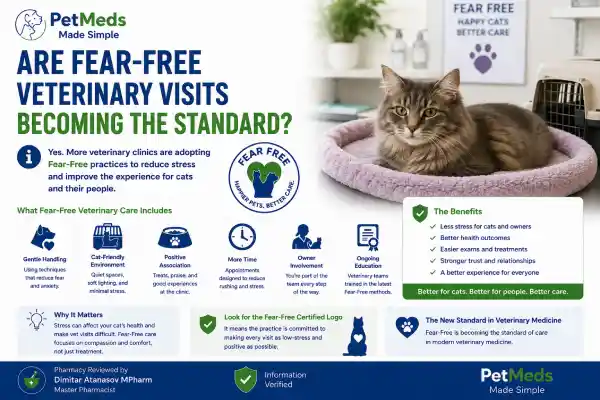
Yes.
Modern feline medicine increasingly emphasizes reducing emotional stress rather than simply completing the examination as quickly as possible.
Many veterinary clinics now incorporate:
- Fear Free® principles
- feline-friendly handling
- low-stress restraint
- quieter examination rooms
- pre-visit pharmaceuticals such as gabapentin
These approaches improve both patient welfare and diagnostic quality.
A relaxed cat often allows the veterinarian to:
- perform a more thorough examination
- obtain better blood samples
- measure blood pressure more accurately
- reduce the need for forceful restraint
Can Every Veterinary Visit Be Improved With Gabapentin?
Not necessarily.
Some cats travel comfortably and remain calm throughout the appointment.
Others experience severe anxiety before they even leave home.
Veterinarians evaluate factors such as:
- previous visit history
- temperament
- medical conditions
- age
- current medications
before deciding whether gabapentin is appropriate.
The goal is always to use the lowest effective approach that allows a safe and comfortable examination.
Veterinarian Takeaway
Can Cats Take Gabapentin Before Vet Visits?
For many cats, yes.
Gabapentin has become one of the most commonly prescribed medications for reducing fear and anxiety before veterinary appointments.
Rather than making cats unconscious, the goal is usually to help them remain calmer, easier to handle, and less frightened during transportation and examination.
When prescribed appropriately and administered according to veterinary instructions, gabapentin can significantly improve the experience for:
- the cat
- the owner
- the veterinarian
- the veterinary nursing team
If your cat has previously experienced stressful veterinary visits, discussing pre-visit gabapentin with your veterinarian may help make future appointments much more comfortable.
Bottom Line
Can Cats Take Gabapentin Before Vet Visits? Yes many veterinarians routinely prescribe gabapentin before appointments to reduce fear, anxiety, and handling stress.
For most healthy cats, the medication is safe when used under veterinary supervision and given at the recommended time before the visit.
Although mild sleepiness and temporary wobbliness are common, these effects usually resolve as the medication wears off.
Combined with modern Fear Free® handling techniques, gabapentin has transformed the veterinary experience for countless anxious cats, making examinations safer, less stressful, and more successful for everyone involved.
Frequently Asked Questions – Can Cats Take Gabapentin Before Vet Visits
Can cats take gabapentin before vet visits?
Yes. Veterinarians commonly prescribe gabapentin before appointments to reduce fear, anxiety, and stress associated with travel and handling.
How long before a vet visit should I give gabapentin?
Always follow your veterinarian’s instructions. Gabapentin is typically administered several hours before the appointment so it has time to take effect.
Will gabapentin make my cat unconscious?
No. Most cats remain awake but become calmer, less anxious, and easier to examine.
Is it normal for my cat to sleep after returning home?
Yes. Mild sleepiness is one of the most common temporary effects and usually improves as the medication is eliminated.
Can my cat still walk after taking gabapentin?
Most cats can still walk, although some may appear temporarily wobbly or less coordinated.
Can gabapentin make blood collection easier?
Often, yes. A calmer cat usually tolerates handling and diagnostic procedures much better than a frightened one.
Can senior cats receive gabapentin before veterinary appointments?
Many can, but veterinarians may adjust recommendations based on kidney function, overall health, and concurrent medications.
Should I use leftover gabapentin from another pet?
No. Never administer medication prescribed for another animal without veterinary approval.
What should I do if my cat seems excessively sleepy?
Contact your veterinarian if your cat is difficult to wake, has trouble breathing, collapses, or develops other concerning symptoms.
Can gabapentin make future veterinary visits easier?
For many anxious cats, yes. Reducing fear during appointments may help create more positive experiences over time.
Sources
- Plumb DC. Plumb’s Veterinary Drug Handbook. Latest Edition.
- American Association of Feline Practitioners (AAFP). Feline-Friendly Handling Guidelines.
- AAFP Feline Anesthesia and Sedation Guidelines.
- Fear Free® Veterinary Program – Low-Stress Handling Principles.
- Rodan I, et al. AAFP and ISFM Feline-Friendly Handling Guidelines.
- Merck Veterinary Manual – Behavioral Disorders in Cats.
- Merck Veterinary Manual – Gabapentin.
- Veterinary Information Network (VIN).
- BSAVA Manual of Feline Practice.
- Journal of Feline Medicine and Surgery – Pre-visit pharmaceuticals and feline stress reduction.
Medical Review Statement
This article was written by Dimitar Georgiev Atanasov, MPharm, scientifically reviewed by Gergana Krasimirova Atanasova, MPharm, and independently veterinary reviewed by Dr. Valcho Georgiev Valchev, DVM. It is intended for educational purposes only and should never replace individualized veterinary advice or treatment recommendations.
Image Disclosure
Image Disclosure: Some images used in this article may be AI-generated to illustrate veterinary concepts, feline handling, and medication safety. They are intended for educational purposes only and should not replace professional veterinary guidance.