Quick Answer
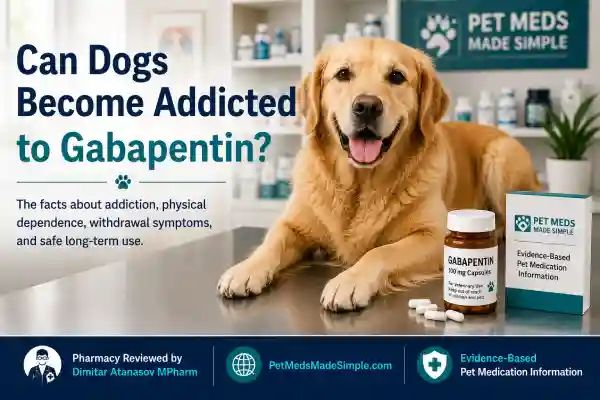
Can dogs become addicted to gabapentin? In most cases, dogs do not develop addiction to gabapentin in the same way humans can become addicted to certain drugs. However, dogs receiving gabapentin long-term may become physically dependent on the medication, meaning sudden discontinuation can sometimes lead to withdrawal-like symptoms or a return of the condition being treated. This is why veterinarians typically recommend gradual medication changes rather than abruptly stopping treatment.
Many owners become concerned after their dog has been taking gabapentin for months.
The medication seems to help.
The dog appears more comfortable.
Then one day a dose is missed.
Suddenly the dog seems different.
Perhaps they become:
- More uncomfortable
- More anxious
- Less mobile
- More vocal
- Less willing to rest
Naturally, many owners begin wondering:
“Has my dog become addicted to gabapentin?”
Fortunately, addiction is usually not the best way to describe what is happening.
When Owners Commonly Ask This
Owners often search for this question when:
- Their dog has been taking gabapentin for a long time.
- A missed dose seems to cause problems.
- Symptoms quickly return.
- Their veterinarian discusses tapering the medication.
- Their dog appears to rely on the medication for comfort.
These situations can be confusing because dependency and addiction are not the same thing.
Can Dogs Become Addicted to Gabapentin?
Addiction vs Physical Dependence: What’s the Difference?
This distinction is extremely important.
Addiction
Addiction involves compulsive drug-seeking behavior despite harmful consequences.
Humans with addiction often crave a substance and actively seek it out.
Dogs do not typically develop this type of behavior with gabapentin.
Physical Dependence
Physical dependence means the body has adapted to the medication.
When the medication is stopped suddenly, symptoms may occur because the body has become accustomed to its presence.
This is much more relevant to long-term gabapentin use.
Related article: Can Dogs Take Gabapentin Long-Term Safely?
Why Do Some Dogs Seem Worse After Missing a Dose?
This is one of the most common reasons owners worry about addiction.
In many cases, the explanation is much simpler.
The medication was helping.
When the medication level drops, the original symptoms become noticeable again.
For example:
- Arthritis pain returns
- Nerve pain becomes more obvious
- Mobility decreases
- Restlessness increases
The dog may not be addicted.
The dog may simply be experiencing the condition that gabapentin was successfully managing.
Related articles:
- Why Does Gabapentin Stop Working in Dogs?
- Best Pain Medication for Dogs with Arthritis (Comparison Guide – Vet-Backed)
- Safest Pain Medication for Dogs (Vet Comparison Guide)
Can Dogs Experience Withdrawal Symptoms?
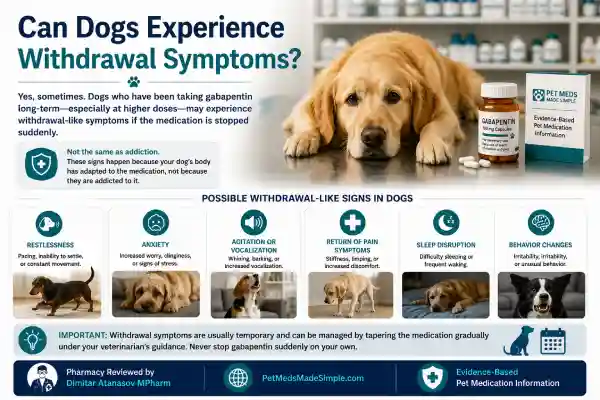
Sometimes.
Veterinarians generally avoid stopping long-term gabapentin abruptly, particularly in dogs receiving high doses or prolonged treatment.
Possible withdrawal-like signs may include:
- Restlessness
- Anxiety
- Agitation
- Increased vocalization
- Return of pain symptoms
This does not automatically mean addiction.
Instead, it reflects the body’s adjustment to the absence of the medication.
Is Physical Dependence More Likely With Long-Term Use?
Yes.
Dogs receiving gabapentin for:
- Months
- Years
- Chronic conditions
are more likely to develop some degree of physical dependence than dogs receiving short-term treatment.
This is one reason veterinarians carefully evaluate long-term treatment plans.
Related articles:
- Can Dogs Take Gabapentin Long-Term Safely?
- Can Senior Dogs Safely Take Anxiety Medication?
- Why Does Gabapentin Stop Working in Dogs?
What Happens If Gabapentin Is Stopped Suddenly?
The answer depends on the individual dog.
Some dogs show no obvious changes.
Others may experience:
- Increased pain
- Increased anxiety
- Restlessness
- Sleep disruption
- Behavioral changes
Veterinarians generally prefer gradual changes whenever possible.
Could Returning Symptoms Be Mistaken for Addiction?
Absolutely.
This happens frequently.
Imagine a dog receiving gabapentin for chronic arthritis.
The medication reduces pain for several months.
Then treatment stops.
The dog suddenly appears uncomfortable again.
Many owners interpret this as addiction.
In reality, the arthritis never disappeared.
The medication was simply helping manage the symptoms.
Which Dogs Are Most Likely to Develop Physical Dependence?
Certain groups may be more likely to experience problems when treatment is stopped abruptly.
Examples include:
- Dogs on long-term treatment
- Dogs receiving higher doses
- Dogs with chronic pain
- Dogs with neurological conditions
- Senior dogs receiving multiple medications
Dependence is still not the same as addiction.
That distinction remains important.
Related Symptoms Owners Often Notice
Owners concerned about dependence or withdrawal may also report:
Increased Panting
Related article: Why Is My Dog Panting After Gabapentin?
Anxiety-Like Behavior
Related article: Can Gabapentin Cause Anxiety in Dogs?
Crying or Vocalization
Related article: Why Is My Dog Crying Despite Gabapentin?
Restlessness
Related article: What Causes Rebound Anxiety in Dogs?
Weakness
Related article: Can Gabapentin Cause Weakness in Dogs?
Mobility Changes
Related article:Can Gabapentin Cause Weak Back Legs?
Clinginess
Related article: Why Does My Dog Follow Me Everywhere After Medication?
When Owners Should Contact Their Veterinarian
Owners should contact their veterinarian if:
- A dose was missed and symptoms are severe.
- Gabapentin needs to be discontinued.
- New behavioral changes appear.
- Pain seems uncontrolled.
- Withdrawal-like symptoms are suspected.
- Mobility suddenly declines.
Professional guidance helps ensure medication changes occur safely.
Can Gabapentin Be Tapered Safely?
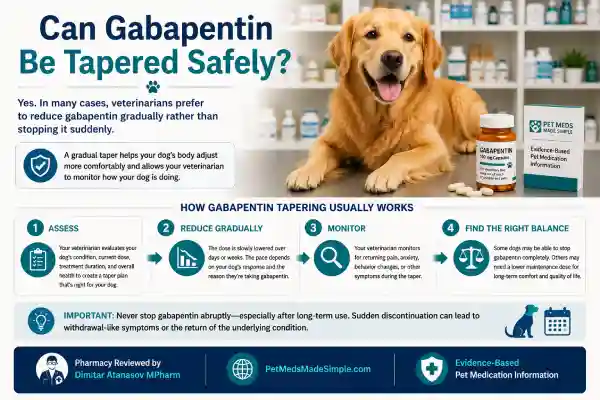
Yes.
In many situations, veterinarians prefer to reduce gabapentin gradually rather than stopping it abruptly.
This approach allows the body to adjust more comfortably and helps veterinarians monitor for:
- Returning pain
- Anxiety
- Mobility changes
- Behavioral changes
- Neurological symptoms
A gradual reduction also helps determine whether the medication is still providing meaningful benefits.
How Veterinarians Discontinue Gabapentin
Every dog is different.
There is no single tapering schedule that works for all patients.
Veterinarians consider factors such as:
- Treatment duration
- Current dosage
- Age
- Medical history
- Other medications
- The condition being treated
Dogs receiving gabapentin for a few days may not require the same approach as dogs receiving treatment for months or years.
This is one reason owners should never create their own tapering plan.
What Should Owners Watch For During a Taper?
As medication levels decrease, veterinarians often recommend monitoring for:
Returning Pain
Pain is one of the most common signs that treatment was helping.
Owners may notice:
- Limping
- Stiffness
- Reduced activity
- Difficulty standing
Related articles:
Changes in Mobility
Some dogs become less active as symptoms return.
Owners may notice:
- Difficulty climbing stairs
- Reluctance to jump
- Slower walking
- Reduced endurance
Related articles:
Behavioral Changes
Changes in comfort often affect behavior.
Owners may notice:
- Restlessness
- Increased clinginess
- Irritability
- Difficulty relaxing
Related articles:
- Why Does My Dog Follow Me Everywhere After Medication?
- Can Dogs Become Emotionally Numb on Anxiety Medication?
Increased Anxiety
Some dogs appear more anxious when underlying discomfort returns.
Owners may notice:
- Pacing
- Panting
- Vocalization
- Increased sensitivity to noise
Related articles:
- Why Is My Dog Panting After Gabapentin?
- Why Is My Dog Sensitive to Noise Suddenly?
- What Causes Rebound Anxiety in Dogs?
Does Physical Dependence Mean the Medication Is Dangerous?
No.
This is one of the biggest misconceptions owners have.
Many commonly used medications can produce physical dependence after long-term use.
Physical dependence simply means the body has adapted to the medication.
It does not automatically mean:
- Addiction
- Abuse
- Harmful use
In fact, many dogs safely receive gabapentin for extended periods under veterinary supervision.
Related articles:
Why Owners Sometimes Confuse Dependence With Addiction
The confusion often happens because the results look similar on the surface.
For example:
A dog receives gabapentin for chronic pain.
The medication helps significantly.
The medication is stopped.
The dog becomes uncomfortable again.
Owners may think:
“My dog needs the drug.”
What is actually happening may be:
“My dog still has the condition the drug was treating.”
This distinction is important because it helps owners understand the role gabapentin is playing in their dog’s care.
Could Gabapentin Ever Be Abused by Dogs?
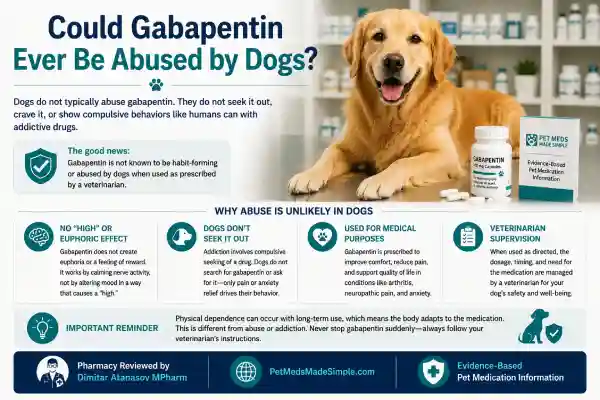
Not in the way addiction is typically discussed.
Dogs do not usually display the compulsive drug-seeking behaviors that define addiction in humans.
Veterinarians generally focus on:
- Safety
- Effectiveness
- Long-term management
- Physical dependence
rather than addiction itself.
Related Symptoms Owners Often Notice
When owners are concerned about dependence, tapering, or missed doses, they often notice symptoms such as:
Panting
Related article: Why Is My Dog Panting After Gabapentin?
Crying
Related article: Why Is My Dog Crying Despite Gabapentin?
Anxiety-Like Behavior
Related article: Can Gabapentin Cause Anxiety in Dogs?
Wobbliness
Related article: Why Is My Dog Wobbly After Gabapentin?
Weak Hind Legs
Related article: Can Gabapentin Cause Weak Back Legs?
General Weakness
Related article: Can Gabapentin Cause Weakness in Dogs?
Noise Reactivity
Related article: Why Is My Dog Sensitive to Noise Suddenly?
Veterinarian Takeaway
Can dogs become addicted to gabapentin? In most cases, no. Dogs do not typically develop addiction to gabapentin in the same way humans can become addicted to certain drugs. However, dogs receiving long-term treatment may develop physical dependence, meaning the body adapts to the medication over time. Because of this, veterinarians often recommend gradual medication changes rather than abrupt discontinuation.
Bottom Line
Gabapentin is widely used in veterinary medicine for chronic pain, nerve pain, anxiety-related conditions, and neurological disorders.
While dogs generally do not become addicted to gabapentin, they can develop physical dependence after long-term use.
That distinction matters.
Addiction involves compulsive drug-seeking behavior.
Dependence means the body has adapted to the medication.
If gabapentin needs to be discontinued, the safest approach is usually to work with your veterinarian and follow a gradual plan designed for your dog’s specific situation.
Frequently Asked Questions – Can Dogs Become Addicted to Gabapentin?
Can dogs become addicted to gabapentin?
True addiction is not commonly recognized in dogs receiving gabapentin under veterinary supervision.
Can dogs become physically dependent on gabapentin?
Yes. Long-term treatment may result in physical dependence.
Is dependence the same as addiction?
No. Physical dependence and addiction are different concepts.
What happens if my dog misses a dose of gabapentin?
Some dogs show no obvious changes, while others may experience returning symptoms or discomfort.
Can stopping gabapentin suddenly cause problems?
In some dogs, abrupt discontinuation may lead to withdrawal-like symptoms or the return of the original condition.
How long does it take for dependence to develop?
There is no exact timeline. It depends on dosage, treatment duration, and the individual dog.
Is physical dependence dangerous?
Not necessarily. Many medications can cause dependence without being dangerous when used properly.
Can senior dogs become dependent on gabapentin?
Yes. Senior dogs receiving long-term treatment may develop physical dependence just like younger dogs.
Should I stop gabapentin on my own?
No. Always discuss medication changes with your veterinarian.
How do veterinarians usually stop gabapentin?
Many veterinarians prefer a gradual taper when long-term treatment is being discontinued.
Reviewed By
Pharmacy Reviewed By
Dimitar Atanasov, MPharm
Master Pharmacist | Medication Safety Educator
Editorial Policy
At Pet Meds Made Simple, our content is researched using current veterinary references, peer-reviewed veterinary literature, and established medication safety guidelines. Every article is reviewed for medication safety, accuracy, and owner education.
Read our full Editorial Policy:
Sources
- Merck Veterinary Manual
- American Veterinary Medical Association (AVMA)
- American Animal Hospital Association (AAHA)
- FDA Center for Veterinary Medicine
- Veterinary Information Network (VIN)
- American College of Veterinary Internal Medicine (ACVIM)
- Plumb’s Veterinary Drug Handbook
- Veterinary Pharmacology and Therapeutics
- Small Animal Clinical Pharmacology
- Peer-reviewed research on gabapentin use in dogs
Images created with AI – Can Dogs Become Addicted to Gabapentin?