Quick Answer
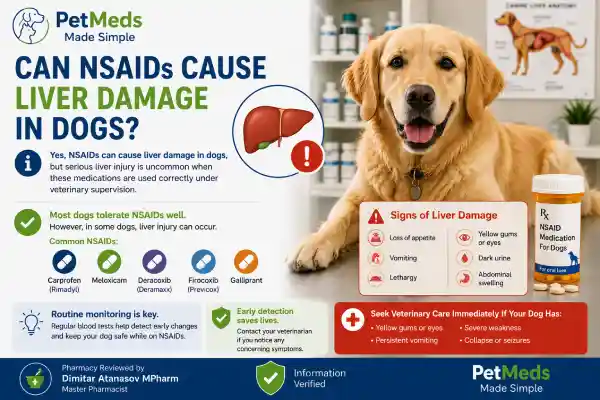
Can NSAIDs Cause Liver Damage in Dogs? Yes, NSAIDs can cause liver damage in dogs, but serious liver injury is uncommon when these medications are used correctly under veterinary supervision. Most dogs tolerate NSAIDs such as carprofen, meloxicam, deracoxib, firocoxib, and Galliprant well. However, a small percentage of dogs may develop liver-related side effects ranging from mild liver enzyme elevations to more serious liver injury. Early recognition of symptoms and regular veterinary monitoring are important for long-term safety.
When Owners Commonly Ask This Question
Most owners do not search this topic before starting an NSAID.
They search after:
- Their dog has been taking NSAIDs for weeks or months
- Blood work shows elevated liver values
- Their veterinarian recommends monitoring tests
- Their dog develops vomiting or appetite loss
- They read online warnings about Rimadyl or carprofen
- They notice yellow gums or yellow eyes
Common questions include:
“Can carprofen damage my dog’s liver?”
“Should I worry about liver failure?”
“How common is NSAID liver damage?”
“Can liver damage be reversed?”
“Should my dog have blood tests?”
The good news is that most dogs never experience severe liver complications.
The important part is understanding the warning signs.
Can NSAIDs Cause Liver Damage in Dogs?
What Are NSAIDs?
NSAID stands for:
Non-Steroidal Anti-Inflammatory Drug
These medications help reduce:
- Pain
- Inflammation
- Swelling
- Arthritis discomfort
Common veterinary NSAIDs include:
| NSAID | Common Use |
|---|---|
| Carprofen (Rimadyl) | Arthritis, pain |
| Meloxicam | Pain and inflammation |
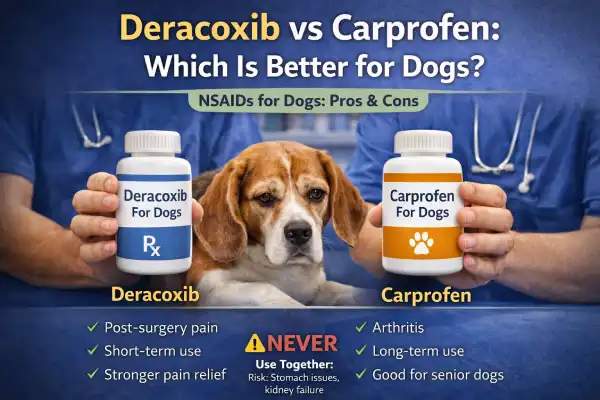
| Deracoxib (Deramaxx) | Orthopedic pain |
| Firocoxib (Previcox) | Arthritis |
| Galliprant | Osteoarthritis |
NSAIDs are among the most commonly prescribed medications in veterinary medicine.
Can NSAIDs Really Cause Liver Damage?
Yes.
Although uncommon, liver injury is a recognized adverse effect of NSAID therapy.
The severity can vary dramatically.
Possible Outcomes
| Outcome | Severity |
|---|---|
| Mild liver enzyme elevation | Mild |
| Temporary liver irritation | Mild-Moderate |
| Drug-induced liver injury | Moderate |
| Liver failure | Severe but rare |
Most affected dogs develop mild abnormalities rather than life-threatening disease.
How Do NSAIDs Affect the Liver?
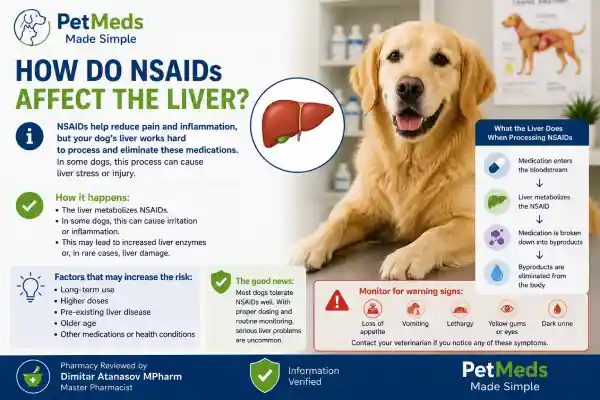
The liver plays a major role in processing medications.
Every time your dog receives an NSAID, the liver helps metabolize and eliminate the drug.
Most of the time this process occurs normally.
However, in some dogs, the liver may react negatively.
Potential Mechanisms
| Mechanism | Description |
|---|---|
| Individual sensitivity | Unpredictable reaction |
| Drug metabolism issues | Slower processing |
| Immune-mediated reaction | Rare inflammatory response |
| Existing liver disease | Increased vulnerability |
One important point:
Many liver reactions are idiosyncratic, meaning they occur unexpectedly and cannot always be predicted.
Which NSAIDs Are Most Commonly Linked to Liver Problems?
Any NSAID has the potential to cause liver injury.
However, liver toxicity is considered uncommon across all approved veterinary NSAIDs.
Common Veterinary NSAIDs
| Medication | Potential Liver Risk |
|---|---|
| Carprofen | Documented but uncommon |
| Meloxicam | Uncommon |
| Deracoxib | Uncommon |
| Firocoxib | Uncommon |
| Galliprant | Generally low |
Carprofen receives the most attention because it has been used for many years and has one of the largest safety databases available.
This does not necessarily mean it is the most dangerous.
It simply means it has been studied extensively.
How Common Is NSAID-Related Liver Damage?
The risk is generally low.
Most dogs take NSAIDs without developing significant liver problems.
Overall Risk Assessment
| Event | Frequency |
|---|---|
| Mild enzyme increase | Occasional |
| Clinically significant liver injury | Rare |
| Severe liver failure | Very Rare |
This is why veterinarians continue prescribing NSAIDs—they remain among the most effective pain-control tools available.
Are Some Dogs More At Risk?
Yes.
Certain dogs appear more susceptible to adverse effects.
Higher-Risk Groups
| Risk Factor | Increased Risk? |
|---|---|
| Senior dogs | Yes |
| Pre-existing liver disease | Yes |
| Multiple medications | Yes |
| Long-term NSAID therapy | Yes |
| Chronic illness | Yes |
| Previous drug reactions | Yes |
Dogs with known liver disease often require closer monitoring.
Can Long-Term NSAID Use Increase Liver Risk?
Potentially.
Long-term exposure increases opportunities for adverse reactions to occur.
This does not mean long-term therapy is unsafe.
Many dogs successfully receive NSAIDs for years.
However, veterinarians often recommend periodic monitoring.
Related reading:
- Can Dogs Take Pain Medication Long-Term?
- Safest Pain Medication for Dogs
- Best Pain Medication for Dogs with Arthritis
What Are the Early Signs of Liver Damage?
Early symptoms are often subtle.
Many owners initially assume the signs are unrelated to medication.
Early Warning Signs
| Symptom | Common? |
|---|---|
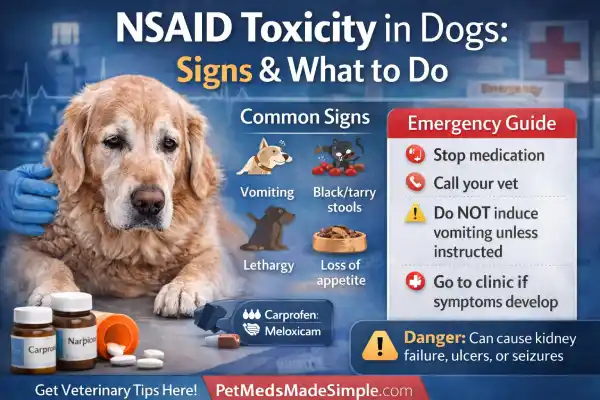
| Reduced appetite | Yes |
| Vomiting | Yes |
| Lethargy | Yes |
| Diarrhea | Sometimes |
| Weight loss | Sometimes |
| Increased thirst | Sometimes |
These symptoms can overlap with many other medical conditions.
That is why veterinary evaluation is important.
Can Liver Damage Cause Vomiting?
Absolutely.
Vomiting is one of the most common symptoms associated with medication-related liver issues.
Owners may notice:
- Intermittent vomiting
- Loss of appetite
- Nausea
- Lip licking
- Drooling
Because vomiting is also a common NSAID gastrointestinal side effect, diagnosis may require blood work.
Can NSAID Liver Damage Cause Yellow Eyes or Gums?
Yes.
This condition is called:
Jaundice (Icterus)
Jaundice develops when bilirubin accumulates in the body.
Common Areas Owners Notice
- Eyes
- Gums
- Skin
- Ear flaps
Jaundice is always considered a serious symptom requiring veterinary evaluation.
Can Liver Damage Make My Dog Weak?
Yes.
As liver function declines, dogs may become:
- Weak
- Tired
- Less active
- Less interested in exercise
This may resemble symptoms discussed in:
Related Symptoms Owners Often Search For
Owners researching liver damage frequently also search:
- Why Is My Dog Panting After Pain Medication?
- Why Is My Dog Weak After Pain Medication?
- Can Pain Medication Cause Personality Changes in Dogs?
- What Happens If Dogs Overdose on Pain Medication?
- Can Dogs Become Dependent on Pain Medication?
- Why Does Pain Medication Stop Working?
- Can Dogs Take Pain Medication Long-Term?
- Safest Pain Medication for Dogs
- Best Pain Medication for Dogs with Arthritis
How Do Veterinarians Diagnose NSAID-Related Liver Damage?
Diagnosing liver damage is not always straightforward.
Many of the symptoms associated with liver injury can also occur with:
- Gastrointestinal upset
- Kidney disease
- Infections
- Pancreatitis
- Cancer
- Progression of the underlying painful condition
This is why veterinarians rely heavily on blood work.
Diagnostic Process
| Step | Purpose |
|---|---|
| Medical history | Identify medication exposure |
| Physical examination | Assess overall health |
| Blood chemistry panel | Evaluate liver function |
| Complete blood count | Rule out other diseases |
| Urinalysis | Assess overall organ function |
| Abdominal ultrasound | Evaluate liver structure if needed |
In many cases, blood testing identifies abnormalities before severe symptoms develop.
Which Liver Values Do Veterinarians Monitor?
Several blood markers help evaluate liver health.
Common Liver Tests
| Test | What It Evaluates |
|---|---|
| ALT | Liver cell injury |
| AST | Liver and muscle damage |
| ALP | Bile flow and liver function |
| GGT | Bile duct function |
| Bilirubin | Liver processing ability |
| Albumin | Liver protein production |
ALT is often the value owners hear about most frequently.
What Does an Elevated ALT Mean?
An elevated ALT does not automatically mean liver failure.
Many dogs develop mild increases without developing serious disease.
ALT Interpretation
| ALT Result | Possible Meaning |
|---|---|
| Mild elevation | Monitoring may be needed |
| Moderate elevation | Further evaluation recommended |
| Severe elevation | Significant liver injury possible |
The trend is often more important than a single number.
Veterinarians usually evaluate:
- Degree of elevation
- Clinical symptoms
- Other blood values
- Medication history
Should Dogs Taking NSAIDs Have Routine Blood Tests?
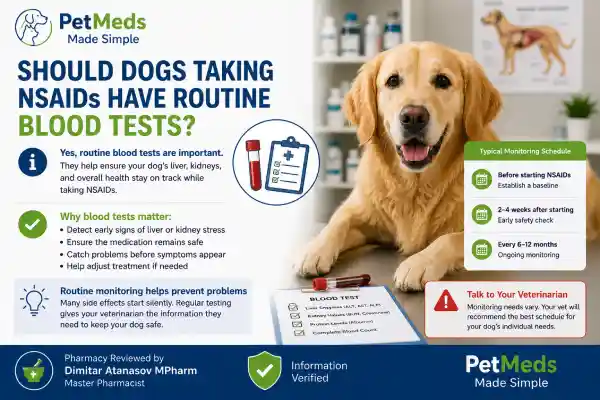
Most veterinarians say yes.
Especially for:
- Long-term therapy
- Senior dogs
- Dogs receiving multiple medications
- Dogs with chronic illnesses
Common Monitoring Schedule
| Timing | Purpose |
|---|---|
| Before starting NSAIDs | Establish baseline |
| 2–4 weeks after starting | Early monitoring |
| Every 6–12 months | Long-term monitoring |
Some veterinarians recommend more frequent testing for higher-risk patients.
Can Liver Damage Be Reversed?
In many cases, yes.
The liver has a remarkable ability to recover.
If liver injury is detected early and the medication is stopped appropriately, many dogs experience substantial improvement.
Recovery Potential
| Severity | Recovery Potential |
|---|---|
| Mild enzyme elevations | Excellent |
| Moderate liver injury | Good |
| Severe liver injury | Variable |
| Advanced liver failure | Guarded |
Early detection dramatically improves outcomes.
What Happens If NSAID Liver Damage Is Suspected?
The first step is usually stopping the suspected medication under veterinary supervision.
Veterinarians may then recommend:
Common Treatment Strategies
| Treatment | Purpose |
|---|---|
| Discontinue NSAID | Remove potential cause |
| IV fluids | Support circulation |
| Liver protectants | Support liver recovery |
| Monitoring blood work | Track improvement |
| Dietary adjustments | Reduce liver workload |
Treatment varies based on severity.
Which Liver Support Medications Might Be Used?
Veterinarians sometimes prescribe supportive medications.
Common examples include:
| Medication | Purpose |
|---|---|
| SAMe | Liver support |
| Silybin (Milk Thistle Extract) | Antioxidant support |
| Ursodiol | Improve bile flow |
| Vitamin E | Antioxidant support |
The specific plan depends on the dog’s condition and laboratory results.
Can NSAID Liver Damage Become Life-Threatening?
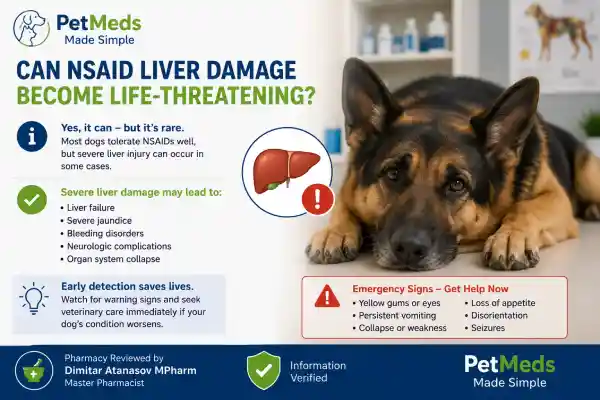
Unfortunately, yes.
Although rare, severe liver injury can occur.
Severe Complications
| Complication | Severity |
|---|---|
| Liver failure | Serious |
| Severe jaundice | Serious |
| Bleeding disorders | Serious |
| Neurologic complications | Serious |
| Death | Rare |
Fortunately, most dogs never experience these severe outcomes.
What Emergency Signs Should Owners Watch For?
Certain symptoms require immediate veterinary attention.
Seek Veterinary Care Immediately If Your Dog Develops
| Symptom | Emergency? |
|---|---|
| Yellow gums | Yes |
| Yellow eyes | Yes |
| Persistent vomiting | Yes |
| Collapse | Yes |
| Severe weakness | Yes |
| Refusal to eat for 24+ hours | Yes |
| Seizures | Yes |
| Disorientation | Yes |
These symptoms may indicate significant liver dysfunction or another serious medical problem.
Are Some NSAIDs Safer Than Others?
This is one of the most common owner questions.
The answer is complicated.
Every NSAID has:
- Benefits
- Risks
- Individual responses
General Safety Comparison
| Medication | Overall Safety Profile |
|---|---|
| Galliprant | Generally favorable |
| Carprofen | Well studied |
| Meloxicam | Well established |
| Deracoxib | Well established |
| Firocoxib | Well established |
The safest medication for one dog may not be the safest medication for another.
This topic is discussed further in:
How Can Owners Reduce The Risk Of Liver Problems?
Several strategies can help improve medication safety.
Risk Reduction Checklist
Follow Prescribed Doses
Never increase doses without veterinary approval.
Attend Monitoring Appointments
Routine blood testing helps identify problems early.
Report Symptoms Quickly
Prompt reporting improves outcomes.
Avoid Combining Medications Without Approval
Some medication combinations may increase adverse-effect risks.
Keep a Medication Record
Track:
- Medication names
- Dosages
- Administration times
- Side effects
This information is extremely useful if problems develop.
Can NSAIDs Be Used Safely Long-Term?
For many dogs, yes.
Thousands of dogs receive long-term NSAID therapy successfully.
The key factors are:
- Appropriate patient selection
- Proper dosing
- Routine monitoring
- Good communication with the veterinarian
When these factors are present, long-term treatment can dramatically improve quality of life.
Bottom Line
Can NSAIDs cause liver damage in dogs? Yes, but serious liver injury is uncommon. Most dogs tolerate veterinary NSAIDs such as carprofen, meloxicam, deracoxib, firocoxib, and Galliprant well when used appropriately. The greatest protection comes from proper dosing, routine monitoring, and early recognition of symptoms such as vomiting, appetite loss, weakness, and jaundice. Dogs receiving long-term NSAID therapy should have regular veterinary checkups and blood work to help ensure continued safety.
Veterinarian Takeaway
NSAIDs remain among the most effective and widely used medications for managing pain and inflammation in dogs. While liver damage is a recognized risk, it is relatively uncommon compared with the benefits these medications provide for many patients. Early monitoring, client education, and prompt evaluation of concerning symptoms allow veterinarians to identify problems quickly and help most dogs continue enjoying a good quality of life.
Frequently Asked Questions – Can NSAIDs Cause Liver Damage in Dogs
Can NSAIDs cause liver damage in dogs?
Yes. Although uncommon, NSAIDs can occasionally cause liver injury ranging from mild enzyme elevations to severe liver disease.
Which NSAID is most likely to cause liver problems?
No single NSAID is clearly the most dangerous. Carprofen is most commonly discussed because it has been studied extensively.
Can liver damage be reversed?
Many dogs recover well when liver injury is identified and treated early.
What are the first signs of liver damage?
Common early signs include appetite loss, vomiting, lethargy, and reduced activity.
Can NSAIDs cause jaundice?
Yes. Yellow eyes, gums, or skin may occur in severe cases.
Should my dog have blood tests while taking NSAIDs?
Most veterinarians recommend periodic blood testing, especially during long-term therapy.
How often should blood work be checked?
Many veterinarians recommend baseline testing, rechecks after starting treatment, and ongoing monitoring every 6–12 months.
Can senior dogs safely take NSAIDs?
Many can, but they often require closer monitoring.
Is Galliprant safer for the liver?
Galliprant may have a favorable safety profile for some dogs, but every medication carries potential risks.
Should I stop NSAIDs if my dog vomits?
Contact your veterinarian immediately. Do not make medication changes without professional guidance.
Reviewed By
Dimitar Atanasov, MPharm
Master Pharmacist | Medication Safety Educator
Dr. Valcho Valev, DVM
Veterinary Consultant | 30+ Years of Clinical Experience
Editorial Policy
This article follows the PetMedsMadeSimple editorial standards for evidence-based veterinary medication education, medication safety, and responsible pet-owner guidance.
Sources
- Plumb’s Veterinary Drug Handbook, 10th Edition.
- Merck Veterinary Manual – Nonsteroidal Anti-Inflammatory Drugs in Dogs.
- American Animal Hospital Association (AAHA) Pain Management Guidelines for Dogs and Cats.
- American Veterinary Medical Association (AVMA) Client Resources.
- Veterinary Pharmacology and Therapeutics, 11th Edition.
- Small Animal Clinical Pharmacology and Therapeutics.
- Veterinary Information Network (VIN).
- Journal of the American Veterinary Medical Association (JAVMA).
- Veterinary Anaesthesia and Analgesia.
- Frontiers in Veterinary Science – Long-Term Pain Management and NSAID Safety.
Medical Review Statement
This article was pharmacy-reviewed by Dimitar Atanasov, MPharm, and veterinary-reviewed by Dr. Valcho, DVM, using current veterinary pharmacology references, canine pain-management guidelines, and published veterinary literature available at the time of review.
Images created with AI – Can NSAIDs Cause Liver Damage in Dogs