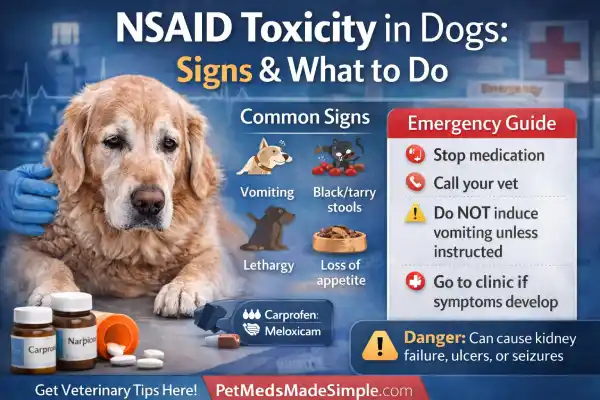
Quick Answer
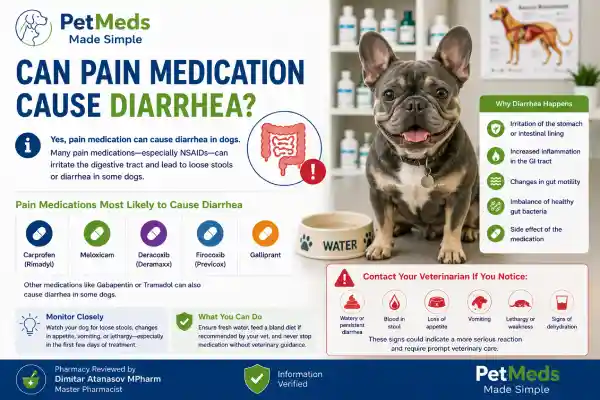
Can Pain Medication Cause Diarrhea? Yes, pain medication can cause diarrhea in dogs. Gastrointestinal side effects are among the most common adverse reactions seen with many pain medications, especially NSAIDs such as carprofen, meloxicam, deracoxib, firocoxib, and Galliprant. In some dogs, diarrhea is mild and temporary, while in others it may signal a more serious reaction requiring veterinary attention. If diarrhea develops after starting pain medication, owners should monitor their dog closely and contact their veterinarian if symptoms persist, worsen, or occur alongside vomiting, weakness, appetite loss, or blood in the stool.
When Owners Commonly Ask This Question
Many owners notice a similar pattern.
Their dog starts:
- Carprofen
- Rimadyl
- Meloxicam
- Galliprant
- Deramaxx
- Previcox
Within a few days they suddenly see:
- Loose stools
- Soft stools
- Frequent bowel movements
- Watery diarrhea
Naturally, the first question becomes:
“Is the medication causing this?”
In many cases, the answer may be yes.
However, diarrhea can also occur for several other reasons that have nothing to do with the medication itself.
Understanding the difference is important.
Can Pain Medication Cause Diarrhea?
What Is Diarrhea?
Diarrhea occurs when stool contains excess water or passes through the digestive tract too quickly.
Common Signs
- Loose stool
- Soft stool
- Frequent bowel movements
- Urgency to defecate
- Watery stool
- Accidents in the house
Severity Levels
| Severity | Description |
|---|---|
| Mild | Slightly soft stool |
| Moderate | Repeated loose stools |
| Severe | Watery diarrhea |
| Emergency | Bloody diarrhea or severe illness |
Not all diarrhea is equally concerning.
Can Pain Medication Cause Diarrhea?
Yes.
In fact, gastrointestinal side effects are among the most commonly reported medication-related problems in dogs.
Pain medications may affect:
- Stomach lining
- Intestinal lining
- Digestive motility
- Gut bacteria
- Inflammatory pathways
This can result in diarrhea in some patients.
Which Pain Medications Are Most Likely to Cause Diarrhea?
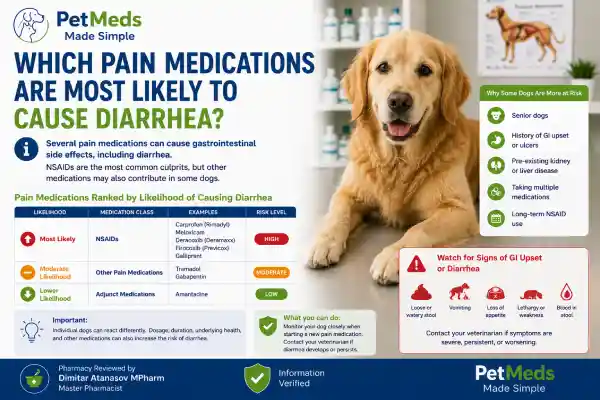
Several commonly prescribed medications have diarrhea listed among their potential side effects.
NSAIDs
| Medication | Diarrhea Possible? |
|---|---|
| Carprofen (Rimadyl) | Yes |
| Meloxicam | Yes |
| Deracoxib (Deramaxx) | Yes |
| Firocoxib (Previcox) | Yes |
| Galliprant | Yes |
NSAIDs are among the most frequent causes of medication-related digestive upset.
Other Pain Medications
| Medication | Diarrhea Possible? |
|---|---|
| Gabapentin | Occasionally |
| Tramadol | Occasionally |
| Amantadine | Occasionally |
NSAIDs remain the most common culprits.
Why Do NSAIDs Cause Diarrhea?
NSAIDs work by blocking enzymes involved in inflammation.
Unfortunately, these same pathways also help protect the gastrointestinal tract.
Normal Protective Functions
These pathways help:
- Maintain stomach lining protection
- Support intestinal health
- Regulate blood flow
- Promote mucus production
When these protective mechanisms are altered, digestive upset may occur.
Possible Outcomes
| Effect | Possible? |
|---|---|
| Soft stool | Yes |
| Diarrhea | Yes |
| Nausea | Yes |
| Vomiting | Yes |
| Ulcers | Rare but serious |
This explains why veterinarians often recommend monitoring dogs carefully after starting NSAIDs.
How Soon Can Diarrhea Start?
The timeline varies.
Some dogs develop diarrhea within:
- Hours
- 1–3 days
- The first week
Others may tolerate the medication for months before symptoms appear.
Typical Timeline
| Time After Starting Medication | Possible? |
|---|---|
| Same day | Yes |
| 1–3 days | Very common |
| 1 week | Common |
| Several months | Possible |
This variability can make diagnosis challenging.
Is Mild Diarrhea Normal?
Mild diarrhea can occur as a temporary side effect.
Some dogs experience:
- One or two loose stools
- Slight digestive upset
- Brief intestinal irritation
Mild Symptoms
| Symptom | Usually Serious? |
|---|---|
| One loose stool | Usually No |
| Soft stool for a day | Usually No |
| Normal appetite | Reassuring |
| Normal energy | Reassuring |
Many mild cases resolve quickly.
When Is Diarrhea More Concerning?
Certain symptoms suggest a more significant problem.
Warning Signs
| Symptom | Concern Level |
|---|---|
| Repeated diarrhea | Moderate |
| Blood in stool | High |
| Vomiting | High |
| Appetite loss | High |
| Weakness | High |
| Lethargy | High |
These symptoms deserve prompt veterinary attention.
Can Pain Medication Cause Bloody Diarrhea?
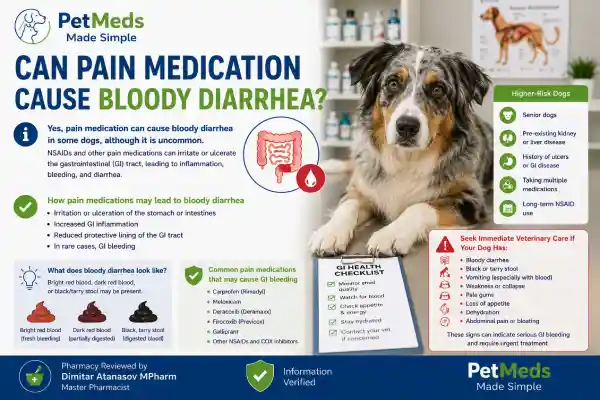
Yes.
Although uncommon, NSAIDs can sometimes contribute to gastrointestinal bleeding.
Possible Warning Signs
- Black stool
- Tarry stool
- Red blood in stool
- Vomiting blood
These symptoms should never be ignored.
Veterinary evaluation is recommended immediately.
Could Diarrhea Mean the Medication Is Damaging the Intestines?
Sometimes.
Most diarrhea results from mild irritation.
However, more severe cases may indicate:
- Significant gastrointestinal inflammation
- Ulcer formation
- Gastrointestinal bleeding
Serious GI Complications
| Complication | Severity |
|---|---|
| Mild irritation | Mild |
| Colitis | Moderate |
| Gastric ulcer | Serious |
| Intestinal bleeding | Serious |
Fortunately, severe complications remain uncommon.
Are Some Dogs More Likely to Develop Diarrhea?
Yes.
Certain dogs appear more susceptible.
Higher-Risk Groups
| Risk Factor | Increased Risk? |
|---|---|
| Senior dogs | Yes |
| Sensitive stomachs | Yes |
| Previous GI disease | Yes |
| Multiple medications | Yes |
| Long-term NSAID use | Yes |
These dogs often benefit from closer monitoring.
Could the Underlying Disease Be Responsible?
Absolutely.
This is one of the most overlooked possibilities.
Sometimes the medication receives the blame when another issue is responsible.
Examples include:
- Dietary indiscretion
- Intestinal parasites
- Stress colitis
- Inflammatory bowel disease
- Infection
Timing alone does not prove the medication caused the diarrhea.
Can Diarrhea Lead to Dehydration?
Yes.
This is one reason veterinarians take persistent diarrhea seriously.
Risks of Ongoing Diarrhea
- Fluid loss
- Electrolyte loss
- Weakness
- Reduced appetite
- Dehydration
Related reading:
Related Symptoms Owners Often Search For
Owners researching diarrhea often also search for:
- Why Is My Dog Panting After Pain Medication?
- Why Is My Dog Weak After Pain Medication?
- Can NSAIDs Cause Liver Damage in Dogs?
- Why Is My Dog Drinking Excess Water on Pain Medication?
- Can Pain Medication Cause Personality Changes in Dogs?
- Can Dogs Take Pain Medication Long-Term?
- What Happens If Dogs Overdose on Pain Medication?
- Why Does Pain Medication Stop Working?
- Safest Pain Medication for Dogs
How Do Veterinarians Determine Whether the Medication Is Responsible?
When diarrhea develops after starting a pain medication, veterinarians try to answer an important question:
“Is the medication causing the diarrhea, or is something else happening?”
This is not always obvious.
Many gastrointestinal diseases can appear at the same time a dog starts treatment.
Common Diagnostic Steps
| Diagnostic Step | Purpose |
|---|---|
| Medical history | Review medication timing |
| Physical examination | Assess hydration and illness severity |
| Stool evaluation | Rule out parasites |
| Blood work | Check organ function |
| Medication review | Identify potential side effects |
| Imaging if needed | Rule out other diseases |
The timing of the diarrhea often provides valuable clues.
Does Timing Matter?
Absolutely.
Veterinarians pay close attention to when symptoms begin.
Common Timeline Patterns
| Timing | Possible Interpretation |
|---|---|
| Within hours | Medication reaction possible |
| Within 1–3 days | Common medication-related timing |
| After several weeks | Possible but less specific |
| After months | May indicate another issue |
A close relationship between starting medication and developing diarrhea makes a medication side effect more likely.
What Happens If Diarrhea Continues?
Persistent diarrhea should not be ignored.
Ongoing gastrointestinal upset can lead to:
- Dehydration
- Weight loss
- Weakness
- Poor medication absorption
- Reduced quality of life
Signs the Problem Is Worsening
| Sign | Concern Level |
|---|---|
| Multiple episodes daily | Moderate |
| Refusing food | High |
| Vomiting develops | High |
| Weight loss occurs | High |
| Bloody stool appears | Very High |
The longer severe diarrhea continues, the greater the risk of complications.
Can Diarrhea Cause Dehydration?
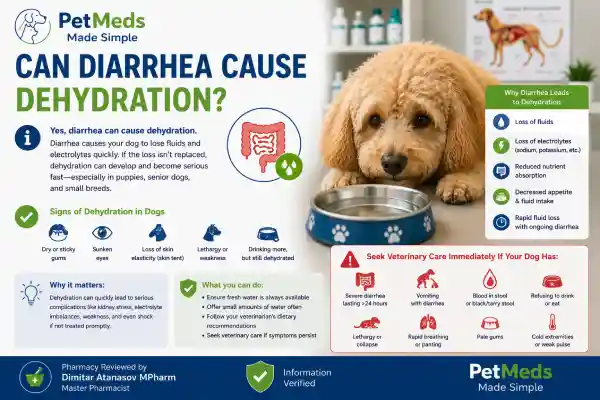
Yes.
This is one of the biggest concerns.
Dogs lose significant amounts of fluid through persistent diarrhea.
Signs of Dehydration
- Dry gums
- Lethargy
- Sunken eyes
- Reduced skin elasticity
- Increased thirst
- Weakness
Some owners notice their dog drinking much more water during these episodes.
This overlaps with concerns discussed in:
Should Owners Stop the Pain Medication?
Not without veterinary guidance.
Many owners immediately discontinue treatment after seeing diarrhea.
While understandable, abruptly stopping medication may not always be the best solution.
Risks of Stopping Pain Medication
| Possible Consequence | Possible? |
|---|---|
| Return of pain | Yes |
| Reduced mobility | Yes |
| Increased inflammation | Yes |
| Decline in quality of life | Yes |
Always contact your veterinarian before making medication changes whenever possible.
What Treatments May Help?
Treatment depends on the severity of symptoms and the underlying cause.
Common Veterinary Recommendations
| Treatment | Purpose |
|---|---|
| Medication adjustment | Reduce side effects |
| Temporary discontinuation | Allow recovery |
| Gastrointestinal support | Protect digestive tract |
| Fluid therapy | Correct dehydration |
| Dietary modification | Reduce intestinal irritation |
| Additional diagnostics | Rule out other diseases |
Many dogs improve quickly once the cause is identified.
Can Probiotics Help?
Sometimes.
Veterinarians may recommend probiotics for dogs experiencing mild gastrointestinal upset.
Potential benefits include:
- Supporting normal gut bacteria
- Improving stool consistency
- Assisting digestive recovery
However, probiotics are not a substitute for veterinary evaluation if symptoms are severe.
Could Another Medication Be Contributing?
Yes.
Dogs taking multiple medications may have a higher risk of gastrointestinal side effects.
Medication Combinations Sometimes Evaluated
- NSAIDs plus steroids
- NSAIDs plus antibiotics
- Multiple pain medications
- NSAIDs plus certain supplements
Always inform your veterinarian about every medication and supplement your dog receives.
Can Long-Term NSAID Use Increase The Risk?
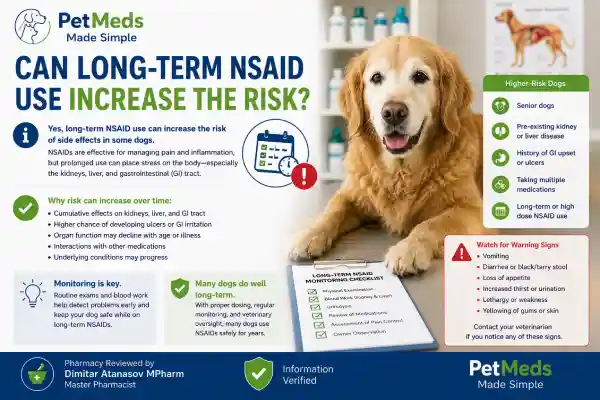
Potentially.
Long-term use may increase opportunities for gastrointestinal irritation to develop.
This does not mean long-term treatment is unsafe.
Many dogs receive NSAIDs safely for years.
The key factors are:
- Proper dosing
- Routine monitoring
- Early recognition of side effects
Related reading:
- Can Dogs Take Pain Medication Long-Term?
- Can NSAIDs Cause Liver Damage in Dogs?
- Safest Pain Medication for Dogs
When Should Owners Contact Their Veterinarian?
Contact your veterinarian if:
- Diarrhea lasts more than 24–48 hours
- Symptoms are worsening
- Appetite decreases
- Vomiting develops
- Weakness develops
- Blood appears in the stool
Veterinary Attention Recommended
| Situation | Contact Vet? |
|---|---|
| One loose stool | Usually monitor |
| Repeated diarrhea | Yes |
| Blood in stool | Yes |
| Vomiting plus diarrhea | Yes |
| Appetite loss | Yes |
| Severe lethargy | Yes |
Early intervention often prevents more serious complications.
What Symptoms Require Emergency Care?
Certain symptoms should never be ignored.
Seek Immediate Veterinary Care If Your Dog Develops
| Emergency Sign | Serious? |
|---|---|
| Bloody diarrhea | Yes |
| Black or tarry stool | Yes |
| Vomiting blood | Yes |
| Collapse | Yes |
| Severe weakness | Yes |
| Pale gums | Yes |
| Refusal to drink | Yes |
| Signs of shock | Yes |
These symptoms may indicate severe gastrointestinal injury or another life-threatening condition.
Related Symptoms Owners Often Search For
Owners researching diarrhea frequently also search for:
- Why Is My Dog Panting After Pain Medication?
- Why Is My Dog Weak After Pain Medication?
- Why Is My Dog Drinking Excess Water on Pain Medication?
- Can NSAIDs Cause Liver Damage in Dogs?
- Can Pain Medication Cause Personality Changes in Dogs?
- Why Does Pain Medication Stop Working?
- What Happens If Dogs Overdose on Pain Medication?
- Can Dogs Become Dependent on Pain Medication?
- Can Dogs Take Pain Medication Long-Term?
These symptoms often occur together because gastrointestinal, liver, kidney, and medication-related problems can overlap.
Bottom Line
Can pain medication cause diarrhea? Yes. Diarrhea is one of the most common side effects associated with many canine pain medications, particularly NSAIDs such as carprofen, meloxicam, deracoxib, firocoxib, and Galliprant. While mild diarrhea may resolve on its own, persistent diarrhea, bloody stool, vomiting, weakness, or appetite loss require veterinary evaluation. Early recognition and prompt action help keep most dogs safe while maintaining effective pain control.
Veterinarian Takeaway
Diarrhea is a common reason owners contact veterinarians after starting pain medication. Most cases are mild and manageable, but gastrointestinal side effects should never be dismissed—especially if they worsen or occur alongside other symptoms. Monitoring stool quality, appetite, hydration, and overall behavior can help identify problems early and allow treatment adjustments before complications develop.
Frequently Asked Questions – Can Pain Medication Cause Diarrhea
Can pain medication cause diarrhea in dogs?
Yes. Diarrhea is one of the most common gastrointestinal side effects associated with canine pain medications.
Which pain medications most commonly cause diarrhea?
NSAIDs such as carprofen, meloxicam, deracoxib, firocoxib, and Galliprant are common causes.
Is one episode of diarrhea an emergency?
Usually not. However, owners should monitor closely for worsening symptoms.
Can diarrhea occur weeks after starting medication?
Yes. Although most cases occur early, delayed reactions are possible.
Can NSAIDs cause bloody diarrhea?
Yes. Bloody diarrhea may indicate significant gastrointestinal irritation or bleeding.
Should I stop my dog’s pain medication if diarrhea develops?
Contact your veterinarian before making medication changes whenever possible.
Can diarrhea cause dehydration?
Yes. Persistent diarrhea can lead to significant fluid loss.
Can probiotics help?
Some dogs benefit from probiotics, but veterinary guidance is recommended.
When should I call my veterinarian?
If diarrhea persists, worsens, or occurs alongside vomiting, weakness, or appetite loss.
When is diarrhea an emergency?
Seek immediate veterinary care for bloody stool, black stool, collapse, severe weakness, vomiting blood, or signs of shock.
Reviewed By
Dimitar Atanasov, MPharm
Master Pharmacist | Medication Safety Educator
Dr. Valcho, DVM
Veterinary Consultant | 30+ Years of Clinical Experience
Editorial Policy
This article follows the PetMedsMadeSimple editorial standards for evidence-based veterinary medication education, medication safety, and responsible pet-owner guidance.
Sources
- Plumb’s Veterinary Drug Handbook, 10th Edition.
- Merck Veterinary Manual – Adverse Effects of NSAIDs in Dogs.
- American Animal Hospital Association (AAHA) Pain Management Guidelines for Dogs and Cats.
- American Veterinary Medical Association (AVMA) Client Education Resources.
- Veterinary Pharmacology and Therapeutics, 11th Edition.
- Small Animal Clinical Pharmacology and Therapeutics.
- Veterinary Information Network (VIN).
- Journal of the American Veterinary Medical Association (JAVMA).
- Frontiers in Veterinary Science.
- Veterinary Anaesthesia and Analgesia.
Medical Review Statement
This article was pharmacy-reviewed by Dimitar Atanasov, MPharm, and veterinary-reviewed by Dr. Valcho, DVM, using current veterinary pharmacology references, canine pain-management guidelines, and published veterinary literature available at the time of review.
Images created with AI – Can Pain Medication Cause Diarrhea