Quick Answer
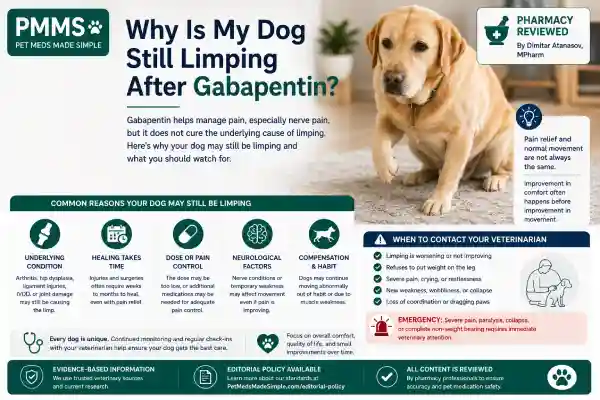
If your dog is still limping after taking gabapentin, it does not necessarily mean the medication is failing. Gabapentin helps manage pain, especially nerve-related pain, but it does not cure the underlying cause of limping. Arthritis, joint injuries, ligament damage, spinal disease, or severe inflammation may continue to cause limping even when pain medication is working. Persistent or worsening limping should always be discussed with your veterinarian.
Why is my dog still limping after gabapentin?
A dog may still limp after gabapentin because the medication helps reduce pain but does not treat the underlying injury or disease causing the limp. Common reasons include arthritis, ligament injuries, hip dysplasia, IVDD, post-surgical recovery, or insufficient pain control. If limping persists or worsens, veterinary evaluation is recommended.
When Owners Commonly Ask This
Most owners become concerned after a situation like this:
Their dog starts limping.
The veterinarian prescribes gabapentin.
A few days later, the dog is still limping.
Naturally, the next question becomes:
“Why is my dog still limping after gabapentin if the medication is supposed to help?”
This is one of the most common misunderstandings about pain medications.
Many people expect gabapentin to completely eliminate limping.
In reality, the situation is often more complicated.
Pain relief and normal movement are not always the same thing.
A dog may experience less pain while still showing visible lameness.
Understanding why this happens can help owners set realistic expectations and recognize when further veterinary care may be needed.
Why Is My Dog Still Limping After Gabapentin?
What Does Gabapentin Actually Do?
One of the biggest misconceptions is that gabapentin “fixes” limping.
It doesn’t.
Gabapentin is primarily used to help manage:
- Chronic pain
- Nerve pain
- Arthritis discomfort
- Post-surgical pain
- Spinal disease discomfort
- Anxiety in some situations
The medication works by changing how nerves transmit pain signals.
It does not:
- Repair torn ligaments
- Heal arthritis
- Fix joint damage
- Repair spinal injuries
- Correct hip dysplasia
This is why some dogs continue limping even when gabapentin is helping.
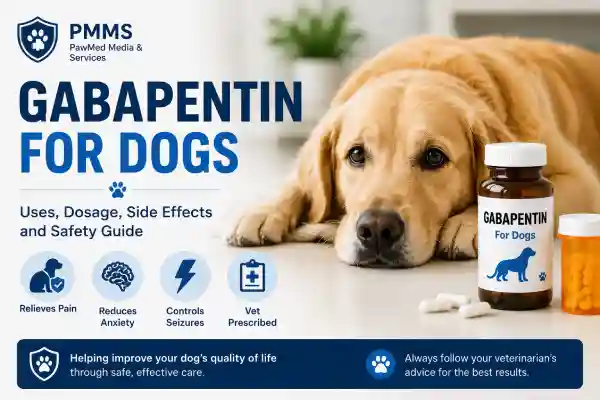
Owners interested in understanding the medication better may also find our article Gabapentin for Dogs helpful.
Could the Underlying Condition Still Be Causing the Limp?
Absolutely.
This is probably the most common explanation.
The medication may be reducing pain while the underlying problem remains.
Common Causes of Persistent Limping
| Condition | Can Limping Continue Despite Gabapentin? |
|---|---|
| Arthritis | Yes |
| Hip Dysplasia | Yes |
| ACL/CCL Injury | Yes |
| IVDD | Yes |
| Joint Injury | Yes |
| Fracture Recovery | Yes |
| Muscle Injury | Yes |
In many cases, the medication is doing its job, but the disease itself still affects movement.
Could Arthritis Be the Reason?
Arthritis is one of the most common reasons dogs continue limping despite treatment.
Arthritis causes:
- Joint inflammation
- Reduced mobility
- Stiffness
- Pain during movement
Gabapentin may reduce discomfort, but arthritic joints remain damaged.
Owners often notice:
- Improvement in comfort
- Better sleep
- Increased willingness to walk
while still seeing some degree of limping.
Many owners exploring treatment options also read Best Pain Medication for Dogs with Arthritis and Safest Pain Medication for Dogs to understand how gabapentin compares with other therapies.
Signs Arthritis May Still Be Affecting Your Dog
- Limping after exercise
- Stiffness after rest
- Difficulty climbing stairs
- Trouble standing up
- Slower walking
Could the Injury Need More Time to Heal?
Yes.
Many owners expect rapid improvement.
Unfortunately, healing often takes longer than pain relief.
Examples
| Condition | Typical Recovery Time |
|---|---|
| Muscle strain | Weeks |
| Ligament injury | Weeks to months |
| Orthopedic surgery | Several weeks to months |
| Fracture recovery | Several weeks |
| Spinal injury | Variable |
Gabapentin can help control discomfort during recovery, but it cannot speed up tissue healing.
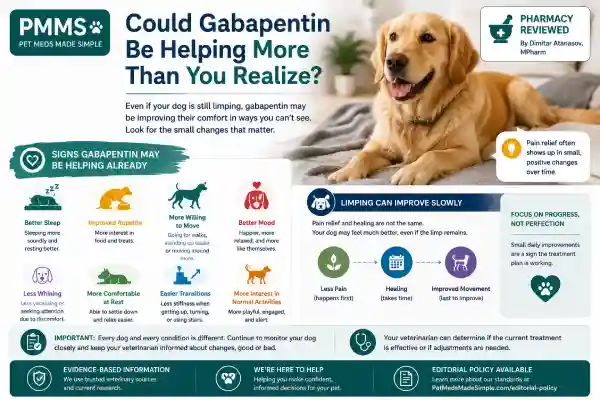
Could Gabapentin Be Helping More Than You Realize?
Sometimes.
Owners often focus on the limp because it remains visible.
However, other improvements may indicate the medication is working.
Positive Signs
- Better sleep
- More activity
- Improved appetite
- Less whining
- More willingness to move
- Improved mood
A dog that still limps but appears significantly more comfortable may actually be responding well to treatment.
Could the Dose Be Too Low?
Occasionally.
Every dog responds differently to gabapentin.
Some dogs require:
- Dosage adjustments
- Combination therapy
- Additional pain management strategies
However, owners should never adjust medication without veterinary guidance.
Possible Signs Pain Control Is Inadequate
| Sign | Possible Meaning |
|---|---|
| Persistent limping | Pain may remain |
| Reluctance to walk | Pain may remain |
| Crying when moving | Pain may remain |
| Restlessness | Pain may remain |
| Difficulty sleeping | Pain may remain |
Veterinarians often evaluate the entire clinical picture before making dosage changes.
Could Another Medication Be Needed?
Sometimes.
Gabapentin is frequently used as part of a larger pain-management plan.
For example, veterinarians commonly combine gabapentin with other therapies.
Many owners ask whether Can Dogs Take Gabapentin and NSAIDs Together?
The answer is often yes.
This combination is commonly used because the medications work differently.
Why Combination Therapy May Help
| Medication Type | Target |
|---|---|
| Gabapentin | Nerve pain |
| NSAIDs | Inflammation |
| Joint supplements | Joint support |
| Physical therapy | Mobility improvement |
A dog with arthritis may benefit from several approaches rather than a single medication.
Could Weakness Be Making the Limp Look Worse?
Yes.
Some dogs develop temporary weakness while taking gabapentin.
This may make owners think the original limp is worsening.
Owners noticing this symptom often ask:
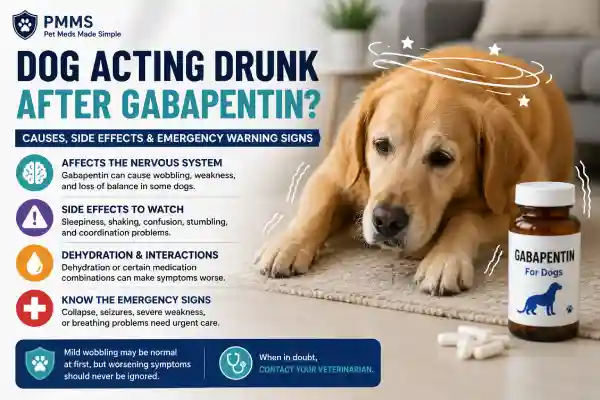
Can Gabapentin Cause Weakness in Dogs?
Weakness may cause:
- Slower walking
- Reduced stability
- Difficulty standing
- Abnormal gait
These changes can sometimes resemble worsening lameness.
Could Neurological Problems Affect the Way My Dog Walks?
Absolutely.
Not every abnormal gait is true limping.
Some dogs develop:
- Wobbliness
- Poor coordination
- Balance issues
- Ataxia
Owners may initially assume the medication isn’t working when the real issue is neurological.
Related articles include:
Could My Dog Still Be in Pain?
Yes.
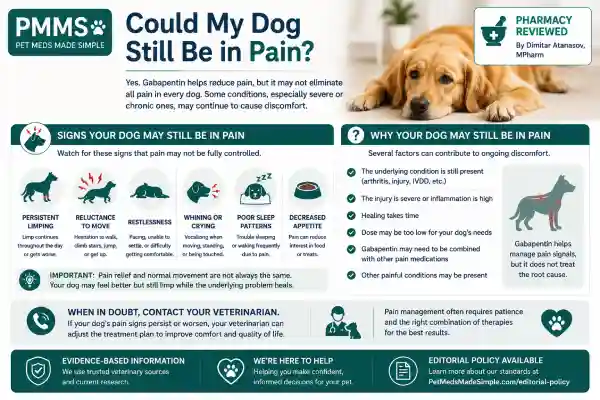
One of the simplest explanations for persistent limping is that your dog is still experiencing pain.
Gabapentin can be very effective, but it does not eliminate every type of pain in every dog.
This is especially true when:
- The injury is severe
- Significant inflammation is present
- Joint damage is advanced
- Multiple painful conditions exist
Many owners mistakenly assume that because their dog is taking medication, all pain should disappear.
Unfortunately, chronic pain management is rarely that simple.
Signs Your Dog May Still Be Uncomfortable
- Limping continues throughout the day
- Reluctance to walk
- Refusing stairs
- Crying during movement
- Restlessness
- Difficulty getting comfortable
If these signs persist, your veterinarian may recommend adjusting the treatment plan.
Could IVDD Cause Persistent Limping?
Absolutely.
Intervertebral Disc Disease (IVDD) is one of the most common reasons dogs continue to walk abnormally despite receiving pain medication.
IVDD affects the spinal cord and nerves.
Because gabapentin is commonly prescribed for nerve pain, many owners assume improvement should be immediate.
However, spinal problems often require:
- Time
- Restricted activity
- Additional medications
- Physical rehabilitation
Common Signs of IVDD
| Symptom | Common? |
|---|---|
| Limping | Yes |
| Weakness | Yes |
| Pain | Yes |
| Wobbliness | Yes |
| Difficulty standing | Yes |
| Dragging paws | Sometimes |
Dogs with IVDD may also cause owners to wonder whether Why Is My Dog Falling Over After Gabapentin? because neurological symptoms can overlap with spinal disease symptoms.
Could My Dog Be Using the Leg Differently?
Yes.
A dog that has been limping for weeks or months often develops compensatory movement patterns.
Even when pain improves, the dog may continue moving abnormally out of habit.
Veterinarians commonly see dogs that:
- Favor one leg
- Shift weight unevenly
- Walk cautiously
- Continue mild limping during recovery
This does not necessarily mean the medication is failing.
Sometimes the body simply needs time to relearn normal movement.
Could Recovery Be Slower Than Expected?
Very often.
Owners naturally hope to see improvement within a few days.
Unfortunately, many orthopedic and neurological conditions improve gradually.
Conditions That Often Require Patience
| Condition | Improvement Timeline |
|---|---|
| Arthritis | Weeks |
| Hip Dysplasia | Ongoing management |
| IVDD | Weeks to months |
| Ligament Injury | Weeks to months |
| Orthopedic Surgery | Several weeks |
| Fracture Recovery | Several weeks |
One of the biggest challenges in veterinary medicine is balancing realistic expectations with owner concerns.
How Veterinarians Evaluate Persistent Limping
When a dog continues limping despite gabapentin, veterinarians typically investigate several possibilities.
Questions Veterinarians Commonly Ask
- Has the limp improved at all?
- Is the limp worsening?
- When did treatment start?
- Is the dog receiving other medications?
- Are there neurological symptoms?
- Is the dog willing to exercise?
Physical Examination
A veterinarian may assess:
- Joint mobility
- Muscle mass
- Pain response
- Neurological function
- Weight-bearing ability
- Range of motion
Additional Testing
Depending on the situation, further testing may include:
- X-rays
- Bloodwork
- Neurological examination
- CT scans
- MRI imaging
The goal is identifying whether the issue is:
- Ongoing pain
- Poor healing
- Neurological disease
- Structural damage
- Medication-related
When Should Owners Contact Their Veterinarian?
Owners should contact their veterinarian if:
- Limping is not improving
- Limping suddenly worsens
- New symptoms appear
- The dog stops using the limb
- Weakness develops
- Balance problems occur
Early communication often prevents small problems from becoming larger ones.
When Does Limping Become an Emergency?
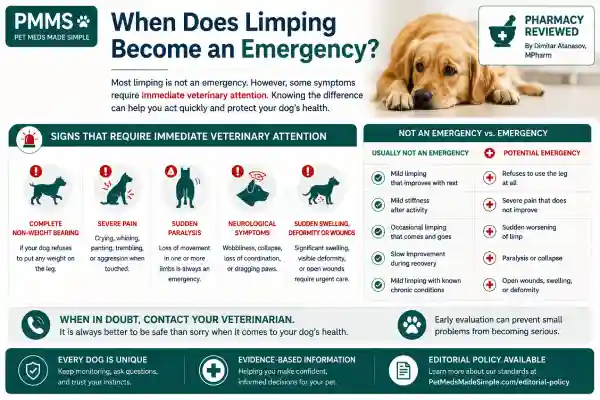
Most limping is not an emergency.
However, some situations require immediate veterinary attention.
Complete Non-Weight Bearing
If your dog refuses to place any weight on the leg, evaluation is recommended.
Severe Pain
Signs may include:
- Crying
- Panting
- Trembling
- Aggression when touched
Sudden Paralysis
This is always considered an emergency.
Neurological Symptoms
Owners who notice:
- Wobbliness
- Collapse
- Loss of coordination
should seek veterinary advice promptly.
This is particularly important if symptoms resemble those discussed in Can Gabapentin Cause Neurological Side Effects?
Emergency Warning Signs
| Symptom | Emergency? |
|---|---|
| Mild limping | Usually No |
| Moderate limping | Usually No |
| Worsening limp | Contact Vet |
| Refusing to use limb | Yes |
| Severe pain | Yes |
| Paralysis | Yes |
| Collapse | Yes |
Related Symptoms Owners Often Search For
Owners searching Why Is My Dog Still Limping After Gabapentin? frequently search for related concerns as well.
Persistent Pain
Many owners wonder whether Why Does Gabapentin Stop Working in Dogs? when limping continues.
Weakness
Questions about Can Gabapentin Cause Weakness in Dogs? often arise when dogs seem unstable.
Wobbliness
Some dogs develop balance problems that owners initially mistake for worsening pain. – Why Is My Dog Wobbly After Gabapentin?
Excessive Sleepiness
Owners may also read Why Does My Dog Sleep So Much on Gabapentin? when activity levels decrease.
Falling Over
Dogs that become unsteady often lead owners to Why Is My Dog Falling Over After Gabapentin?
Long-Term Treatment
Owners frequently ask how long a dog can safely remain on gabapentin and whether ongoing treatment is expected. – Can Dogs Take Gabapentin Long-Term Safely?
What Questions Should Owners Ask Their Veterinarian?
Helpful questions include:
- Is my dog’s limp improving normally?
- Could another medication help?
- Does my dog need imaging?
- Is this pain or weakness?
- Could a neurological condition be involved?
- How long should recovery take?
- Would physical therapy help?
- What signs indicate an emergency?
These conversations often provide reassurance and help guide future treatment decisions.
Bottom Line
If your dog is still limping after gabapentin, it does not automatically mean the medication has failed. Gabapentin helps manage pain, particularly nerve-related pain, but it does not repair injuries, cure arthritis, or reverse structural joint disease. Many dogs improve in comfort before they improve in movement.
Persistent limping may result from the underlying condition, incomplete pain control, ongoing healing, weakness, neurological disease, or simply the time required for recovery. If limping persists, worsens, or is accompanied by new symptoms, veterinary evaluation is recommended.
Veterinarian Takeaway
Gabapentin is designed to help reduce pain, not eliminate the underlying cause of limping. Dogs with arthritis, IVDD, hip dysplasia, ligament injuries, or orthopedic disease may continue to limp despite treatment. Improvement in comfort often occurs before improvement in gait. Owners should focus on overall quality of life, activity level, and pain control while maintaining regular communication with their veterinarian.
Frequently Asked Questions – Why Is My Dog Still Limping After Gabapentin
Is it normal for my dog to still limp after starting gabapentin?
Yes. Many dogs continue limping because the underlying condition has not yet healed.
How long should it take gabapentin to help a limp?
Some dogs improve within days, while others require weeks depending on the underlying condition.
Does gabapentin cure arthritis?
No. It helps manage pain but does not reverse joint damage.
Why is my dog still limping but seems happier?
Pain may have improved even though the physical condition causing the limp remains.
Could the dose be too low?
Possibly. Your veterinarian can determine whether dosage adjustments are appropriate.
Can IVDD cause limping even with gabapentin?
Yes. Spinal disease can continue affecting movement despite pain management.
Should my dog be taking another medication too?
Some dogs benefit from combination therapy, including NSAIDs or other treatments.
Could weakness make my dog appear lame?
Yes. Weakness and limping can sometimes look similar.
When should I contact my veterinarian?
If limping is worsening, not improving, or accompanied by new symptoms.
When is limping an emergency?
Seek immediate veterinary care if your dog develops severe pain, paralysis, collapse, or refuses to bear weight on the affected limb.
Reviewed By
Pharmacy Reviewed By
Dimitar Atanasov, MPharm
Master Pharmacist | Medication Safety Educator
Editorial Policy
At Pet Meds Made Simple, we are committed to providing accurate, evidence-based information about pet medications, veterinary treatments, medication safety, and common health concerns affecting dogs and cats.
Our content is researched using veterinary pharmacology references, peer-reviewed veterinary literature, clinical guidelines, and trusted veterinary resources. Every article is designed to help pet owners make informed decisions while supporting—not replacing—the advice of their veterinarian.
Sources
- Plumb’s Veterinary Drug Handbook
- American Animal Hospital Association (AAHA)
- American Veterinary Medical Association (AVMA)
- Merck Veterinary Manual
- Veterinary Pharmacology and Therapeutics
- Small Animal Clinical Pharmacology
- Journal of the American Veterinary Medical Association (JAVMA)
- Frontiers in Veterinary Science
- Veterinary Anaesthesia and Analgesia
- Veterinary Information Network (VIN)
Medical Review Statement
This article was pharmacy-reviewed by Dimitar Atanasov, MPharm, Master Pharmacist, using current veterinary pharmacology references, canine pain-management guidelines, and published veterinary literature available at the time of review.
Images created with AI – Why Is My Dog Still Limping After Gabapentin