Quick Answer
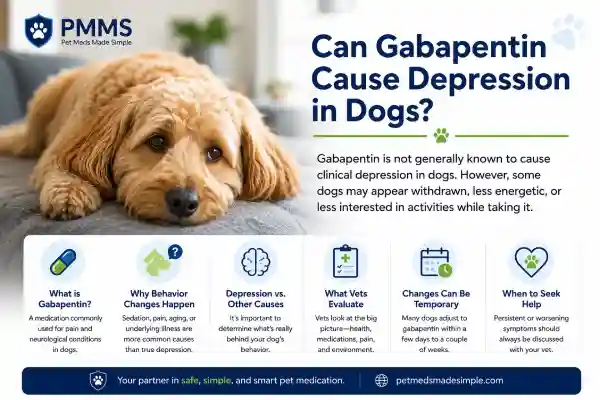
Can gabapentin cause depression in dogs? Gabapentin is not generally known to cause clinical depression in dogs. However, some dogs may appear withdrawn, less energetic, less interested in activities, or unusually quiet while taking the medication. In many cases, these changes are related to sedation, reduced activity, pain, aging, underlying illness, or adjustment to treatment rather than true depression. If your dog’s personality changes significantly or symptoms persist, a veterinary evaluation is recommended.
Many owners become concerned when their dog seems different after starting gabapentin.
Instead of being playful and engaged, the dog may appear:
- Less energetic
- Less interested in toys
- More withdrawn
- Less interactive
- Sleepier than usual
Owners often describe it by saying:
“My dog seems depressed after taking gabapentin.”
This can be alarming, especially when the medication was prescribed to improve comfort and quality of life.
Fortunately, what owners interpret as depression is often something else.
When Owners Commonly Ask This
Owners usually begin searching for answers when they notice:
- Their dog is sleeping more than usual.
- Their dog seems uninterested in activities.
- Their dog appears emotionally different.
- Their dog no longer greets family members enthusiastically.
- Their dog seems less playful.
- Their dog spends more time resting alone.
The challenge is determining whether these changes are truly related to gabapentin or whether another explanation is more likely.
Can Dogs Actually Become Depressed?
Dogs can experience behavioral and emotional changes that resemble depression.
Veterinarians may see symptoms such as:
- Withdrawal
- Reduced interest in activities
- Changes in appetite
- Increased sleeping
- Reduced social interaction
However, diagnosing depression in dogs is far more complicated than diagnosing it in people.
Many medical conditions can create similar signs.
That is why veterinarians usually investigate physical causes first.
Can Gabapentin Cause Depression in Dogs?
Does Gabapentin Directly Cause Depression?
There is currently no strong evidence suggesting that gabapentin directly causes clinical depression in dogs.
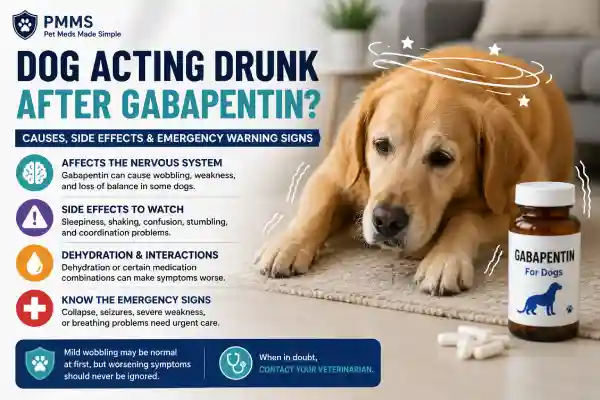
However, some dogs may experience side effects that can look similar.
For example:
- Sedation
- Reduced activity
- Increased sleeping
- Lower energy levels
To an owner, these changes can sometimes appear as sadness or emotional withdrawal.
In reality, the dog may simply be feeling calmer or more tired than usual.
What Does “Depression-Like” Behavior Look Like?
Owners often report behaviors such as:
Sleeping More Than Normal
Many dogs rest more while adjusting to gabapentin.
Less Interest in Play
A dog may temporarily show less enthusiasm for games and toys.
Reduced Excitement
Greetings and daily activities may seem less energetic.
Spending More Time Alone
Some dogs seek quiet areas to rest.
Lower Activity Levels
Dogs may simply prefer relaxing rather than engaging in physical activity.
These changes can be concerning, but they do not automatically indicate true depression.
Could Sedation Be Mistaken for Depression?
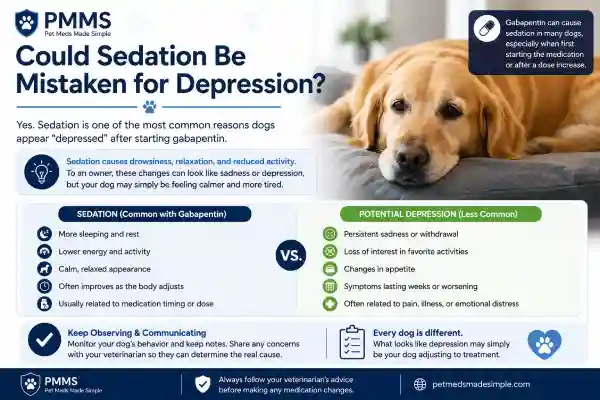
Absolutely.
This is one of the most common explanations.
Gabapentin can cause:
- Drowsiness
- Relaxation
- Reduced activity
Many owners expect these effects.
However, if they are more noticeable than expected, owners may worry that their dog’s personality has changed.
Often, what appears to be depression is actually sedation.
Related articles:
- Can Dogs Take Gabapentin Long-Term Safely?
- Why Is My Dog Wobbly After Gabapentin?
- Can Gabapentin Cause Weakness in Dogs?
Could Pain Be Affecting Behavior?
Yes.
Pain itself can dramatically affect a dog’s mood and behavior.
A dog experiencing discomfort may appear:
- Withdrawn
- Less playful
- Less social
- Less active
In some situations, owners blame the medication when the underlying condition is actually responsible.
Related articles:
- Why Does Gabapentin Stop Working in Dogs?
- Best Pain Medication for Dogs with Arthritis (Comparison Guide – Vet-Backed)
- Safest Pain Medication for Dogs (Vet Comparison Guide)
Are Senior Dogs More Likely to Show These Changes?
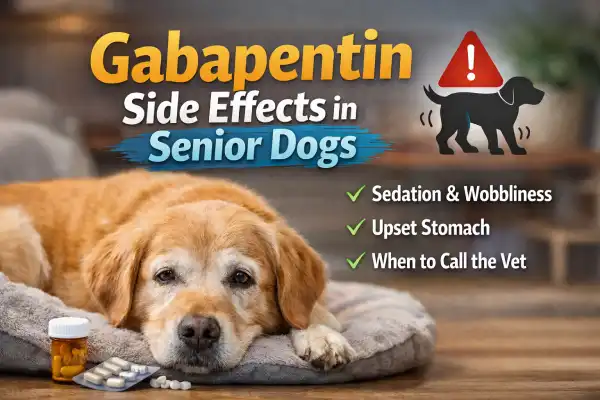
Senior dogs often experience factors that influence behavior, including:
- Chronic pain
- Arthritis
- Cognitive decline
- Reduced mobility
- Multiple medications
Because of these factors, behavioral changes may be more noticeable in older dogs.
Related articles:
Could Another Medication Be Responsible?
Sometimes.
Dogs receiving multiple medications may experience behavioral changes that are difficult to attribute to a single drug.
Veterinarians often review:
- Anxiety medications
- Pain medications
- Sedatives
- Supplements
when evaluating personality changes.
Related articles:
- Can Dogs Take Prozac and Trazodone Together?
- Can Dogs Take Melatonin With Anxiety Medication?
- Can Dogs Take CBD With Anxiety Medication?
What Should Owners Watch For?
Pay attention to:
- Activity level
- Appetite
- Sleep patterns
- Social behavior
- Interest in favorite activities
The duration of symptoms is often just as important as the symptoms themselves.
A dog that appears quiet for a day or two may simply be adjusting to treatment.
A dog that continues declining deserves closer evaluation.
Could Emotional Numbness Be Confused With Depression?
Yes.
Owners sometimes describe their dog as:
“Not acting like themselves.”
The dog may appear emotionally flat, less responsive, or less enthusiastic.
These observations do not necessarily mean depression is present.
Related article:Can Dogs Become Emotionally Numb on Anxiety Medication?
Related Symptoms Owners Often Notice
Behavioral changes often occur alongside other symptoms.
Increased Sleeping
Dogs may rest more than usual.
Weakness
Related article: Can Gabapentin Cause Weakness in Dogs?
Wobbliness
Related article: Why Is My Dog Wobbly After Gabapentin?
Panting
Related article: Why Is My Dog Panting After Gabapentin?
Hyperactivity
Some dogs show the opposite reaction.
Related article: Why Is My Dog Hyper After Gabapentin?
Anxiety-Like Behavior
Related article: Can Gabapentin Cause Anxiety in Dogs?
Clinginess
Related article: Why Does My Dog Follow Me Everywhere After Medication?
When Behavioral Changes Become Concerning
Contact your veterinarian if:
- Symptoms are worsening
- Appetite decreases significantly
- Your dog stops enjoying favorite activities
- Social withdrawal becomes severe
- New neurological symptoms appear
- Quality of life declines
Behavioral changes are often easier to address when evaluated early.
How Veterinarians Evaluate Depression-Like Symptoms
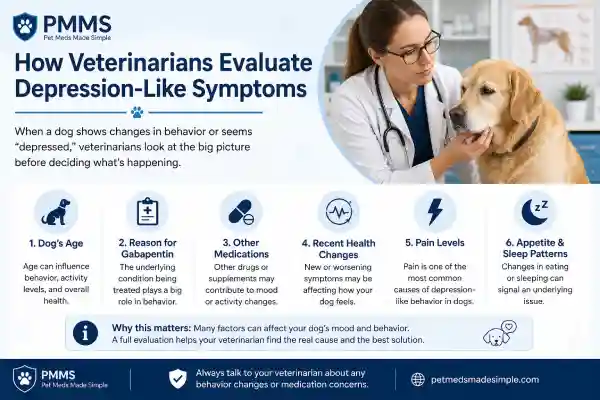
When owners report that their dog seems depressed after starting gabapentin, veterinarians rarely assume the medication is the only explanation.
Instead, they evaluate several factors:
- The dog’s age
- The reason gabapentin was prescribed
- Other medications being used
- Recent health changes
- Pain levels
- Mobility changes
- Appetite and sleep patterns
One of the first questions is often:
“Did these symptoms start after beginning gabapentin, or were they already developing beforehand?”
The answer can provide important clues.
Can These Changes Be Temporary?
Yes.
Many dogs experience temporary adjustments when starting a new medication.
Owners sometimes notice:
- Increased sleeping
- Lower energy levels
- Less excitement
- Reduced activity
during the first few days of treatment.
In many cases, these changes gradually improve as the dog’s body adapts.
This is particularly common when gabapentin is first introduced or when the dosage is increased.
Why Symptom Tracking Can Be Helpful
Behavioral changes can be difficult to remember accurately.
Keeping simple notes can help.
Consider tracking:
- Activity level
- Appetite
- Sleep duration
- Interest in walks
- Interest in toys
- Social interaction
- Medication timing
Patterns often emerge that make it easier for veterinarians to determine what is happening.
Related articles:
- Why Does Gabapentin Stop Working in Dogs?
- Can Dogs Become Addicted to Gabapentin?
- Can Dogs Take Gabapentin Long-Term Safely?
Could an Underlying Illness Be Causing the Changes?
Absolutely.
Many medical conditions can cause symptoms that owners describe as depression.
Examples include:
- Chronic pain
- Arthritis
- Cognitive dysfunction
- Heart disease
- Neurological disorders
- Hormonal conditions
This is why veterinarians focus on the entire patient rather than a single symptom.
Behavioral changes often have multiple contributing factors.
Is True Depression Common in Dogs Taking Gabapentin?
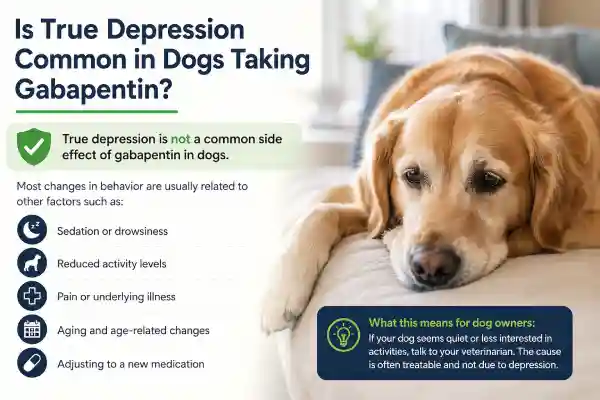
Not particularly.
Most cases involve one or more of the following:
- Sedation
- Reduced activity
- Pain
- Aging
- Illness
- Medication adjustments
While dogs can experience depression-like behavior, gabapentin itself is not widely recognized as a common cause of clinical depression. Can Gabapentin Cause Depression in Dogs?
Related Symptoms Owners Often Notice
Dogs that appear depressed may also show:
Panting
Related article: Why Is My Dog Panting After Gabapentin?
Hyperactivity
Some dogs experience the opposite reaction.
Related article: Why Is My Dog Hyper After Gabapentin?
Crying
Related article: Why Is My Dog Crying Despite Gabapentin?
Weak Back Legs
Related article: Can Gabapentin Cause Weak Back Legs?
Wobbliness
Related article: Why Is My Dog Wobbly After Gabapentin?
Noise Sensitivity
Related article: Why Is My Dog Sensitive to Noise Suddenly?
Anxiety
Related article: Can Gabapentin Cause Anxiety in Dogs?
Following Owners More Often
Related article: Why Does My Dog Follow Me Everywhere After Medication?
When Owners Should Contact Their Veterinarian
Contact your veterinarian if:
- Behavioral changes continue worsening.
- Appetite declines significantly.
- Your dog becomes socially withdrawn.
- Favorite activities are no longer enjoyable.
- Mobility declines.
- New symptoms appear.
- Quality of life seems reduced.
Prompt evaluation can help identify whether medication, illness, pain, or another factor is responsible. Can Gabapentin Cause Depression in Dogs?
Veterinarian Takeaway
Can gabapentin cause depression in dogs? Gabapentin is not generally associated with clinical depression in dogs. However, some dogs may appear quieter, less active, or less interested in normal activities while taking the medication. These changes are often related to sedation, adjustment to treatment, pain, aging, or underlying medical conditions rather than true depression. Persistent or concerning behavioral changes should always be discussed with a veterinarian. Can Gabapentin Cause Depression in Dogs?
Bottom Line
If your dog seems depressed after starting gabapentin, try not to assume the medication is solely responsible.
Many factors can affect behavior, including:
- Pain levels
- Age
- Mobility
- Other medications
- Medical conditions
- Temporary adjustment effects
Careful observation and communication with your veterinarian can help determine whether the behavior is expected, temporary, or something that deserves further investigation. Can Gabapentin Cause Depression in Dogs?
Frequently Asked Questions – Can Gabapentin Cause Depression in Dogs?
Can gabapentin make dogs seem sad?
Some dogs may appear quieter or less energetic, but this does not necessarily mean they are depressed.
Is sleeping more a sign of depression?
Not always. Increased sleeping is commonly associated with sedation, relaxation, or recovery from pain.
Can gabapentin change a dog’s personality?
Some owners notice temporary behavioral changes, but major personality changes should be discussed with a veterinarian.
How long do behavioral changes last after starting gabapentin?
Some dogs adjust within a few days, while others may require closer monitoring.
Can pain cause depression-like behavior?
Yes. Chronic pain can significantly affect mood, activity, and social interaction.
Are senior dogs more likely to seem depressed?
Senior dogs often have multiple health factors that can influence behavior and activity levels.
Can other medications contribute to these symptoms?
Yes. Medication combinations may influence energy levels and behavior.
Should I stop gabapentin if my dog seems depressed?
No. Always consult your veterinarian before making medication changes.
Is loss of interest in play normal?
It can occur temporarily, but persistent changes should be evaluated.
When should I contact my veterinarian?
If symptoms are worsening, persistent, or affecting your dog’s quality of life.
Reviewed By
Pharmacy Reviewed By
Dimitar Atanasov, MPharm
Master Pharmacist | Medication Safety Educator
Editorial Policy
At Pet Meds Made Simple, our content is researched using current veterinary references, peer-reviewed veterinary literature, and established medication safety guidelines. Every article is reviewed for medication safety, accuracy, and owner education. Can Gabapentin Cause Depression in Dogs?
Read our full Editorial Policy:
Sources
- Merck Veterinary Manual
- American Veterinary Medical Association (AVMA)
- American Animal Hospital Association (AAHA)
- FDA Center for Veterinary Medicine
- Veterinary Information Network (VIN)
- American College of Veterinary Internal Medicine (ACVIM)
- Plumb’s Veterinary Drug Handbook
- Veterinary Pharmacology and Therapeutics
- Small Animal Clinical Pharmacology
- Peer-reviewed research on gabapentin use in dogs
Images created with AI – Can Gabapentin Cause Depression in Dogs?