Quick Answer
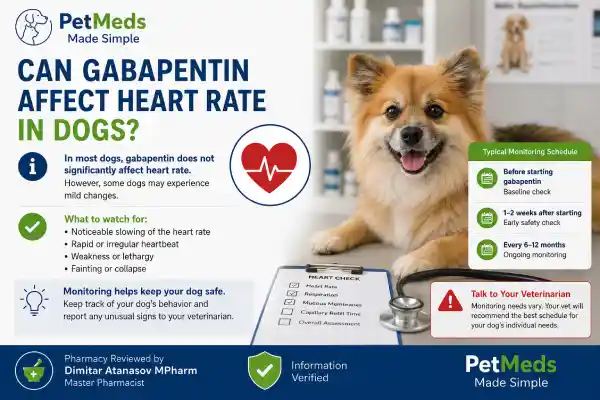
Can Gabapentin Affect Heart Rate in Dogs? Yes, gabapentin can affect heart rate in dogs, but significant changes are uncommon when the medication is used at the prescribed dose. Most healthy dogs experience little or no direct effect on heart rate. However, gabapentin may indirectly influence the pulse by reducing pain, causing relaxation or sedation, or interacting with other medications. If your dog develops a very slow heart rate, a racing heartbeat, collapse, pale gums, difficulty breathing, or weakness, immediate veterinary evaluation is essential.
Why Owners Worry About Heart Rate After Giving Gabapentin
Many owners naturally check their dog’s breathing and heartbeat after starting a new medication.
Gabapentin is commonly prescribed for:
- chronic pain
- arthritis
- nerve pain
- seizures
- anxiety before veterinary visits
- post-operative recovery
Because the medication affects the nervous system, some owners notice that their dog appears calmer—or much sleepier—than usual. This often leads to questions such as:
- “Is my dog’s heart beating more slowly?”
- “Is gabapentin affecting my dog’s circulation?”
- “Should I be worried about the pulse?”
- “Can gabapentin cause dangerous heart problems?”
Fortunately, true cardiovascular complications from gabapentin are considered uncommon in dogs. In most cases, changes owners notice are related to the dog’s level of relaxation, reduced pain, or concurrent medications rather than a direct toxic effect on the heart itself.
If your dog also seems unusually sleepy, you may find our article Can Dogs Stay Awake on Gabapentin? helpful, while dogs showing behavioral changes should also be evaluated using Why Is My Dog Acting Strange After Gabapentin?
Can Gabapentin Affect Heart Rate in Dogs?
How Does Gabapentin Work in Dogs?
Understanding how gabapentin works helps explain why heart rate changes are generally uncommon.
Unlike medications that directly affect the heart or blood vessels, gabapentin primarily acts on the central nervous system.
It binds to calcium channels within nerve cells, reducing the release of excitatory neurotransmitters responsible for transmitting pain signals and certain abnormal neurological activity.
This leads to:
- decreased nerve pain
- reduced abnormal nerve firing
- calmer behavior
- improved comfort
- mild sedation in some dogs
Because its primary target is the nervous system not the cardiovascular system—most dogs maintain a normal heart rate throughout treatment.
However, the nervous system and cardiovascular system constantly communicate with one another. As a result, indirect changes in heart rate may occasionally occur, particularly in dogs experiencing severe pain, anxiety, or sedation.
For owners interested in how gabapentin affects other body systems, related guides include:
- Can Gabapentin Cause Eye Changes in Dogs?
- Can Gabapentin Cause Dilated Pupils in Dogs?
- Can Gabapentin Cause Balance Problems in Senior Dogs?
- Can Gabapentin Cause Muscle Tremors in Dogs?
Together, these articles explain how neurological effects can sometimes appear in different ways.
Can Gabapentin Affect Heart Rate in Dogs Directly?
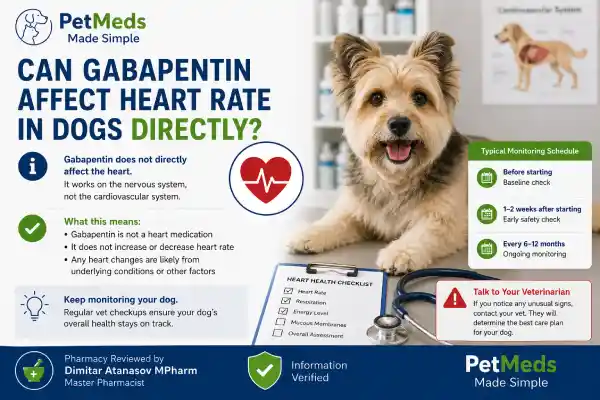
Usually not.
Current veterinary experience suggests that gabapentin has minimal direct effects on cardiac function in most healthy dogs.
Unlike certain heart medications, gabapentin does not typically:
- alter the heart’s electrical conduction system
- change blood pressure significantly
- directly increase heart muscle contraction
- routinely slow the heartbeat
Instead, any heart rate changes are often secondary to other factors.
For example:
A painful dog may initially have:
- rapid heart rate
- panting
- elevated blood pressure
- restlessness
After gabapentin successfully relieves pain, the dog relaxes.
As relaxation occurs, the heart rate naturally decreases toward normal.
This reduction is usually a sign that the dog feels better not that the medication is harming the heart.
Can Gabapentin Slow a Dog’s Heart Rate?
Occasionally, owners believe their dog’s pulse feels slower after giving gabapentin.
Several explanations are possible.
Reduced pain
Pain naturally increases heart rate.
When pain improves, the pulse commonly becomes slower because stress hormones decrease.
This is generally considered a normal physiological response.
Relaxation and sedation
Gabapentin frequently causes mild sedation, especially:
- during the first few doses
- after dose increases
- in senior dogs
- when combined with other sedatives
A relaxed, sleeping dog naturally has a slower heart rate than an excited dog running around the house.
This difference is expected and usually does not indicate a dangerous side effect.
Owners of older pets should also review Can Gabapentin Cause Balance Problems in Senior Dogs?, since senior dogs often experience stronger neurological responses to the medication.
Other medications
Many dogs taking gabapentin also receive medications such as:
- trazodone
- opioids
- anti-anxiety medications
- seizure medications
- certain anesthetic drugs
These combinations may produce greater sedation than gabapentin alone, making the heartbeat seem slower while the dog is resting.
Rather than adjusting medications at home, owners should discuss these observations with their veterinarian.
Can Gabapentin Cause a Fast Heart Rate in Dogs?
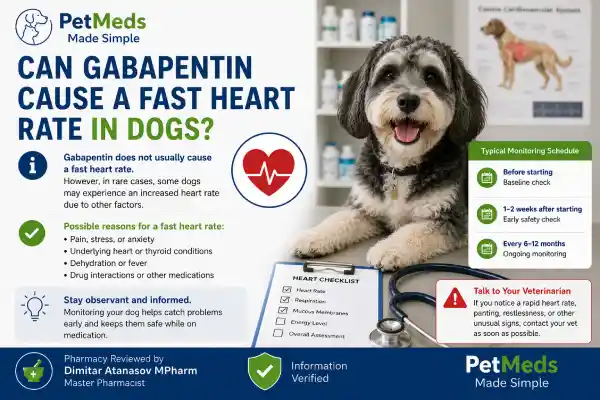
Yes but usually indirectly rather than directly.
Some owners become concerned because they notice a rapid heartbeat shortly after administering gabapentin.
In many cases, another explanation is more likely.
Examples include:
- persistent pain
- anxiety
- excitement
- fear during veterinary visits
- underlying illness
- fever
- dehydration
Even though gabapentin is present in the body, these conditions themselves can increase heart rate.
For example, a dog with severe arthritis may still experience breakthrough pain despite receiving gabapentin. The resulting discomfort—not the medication—may cause the pulse to remain elevated.
Similarly, an anxious dog traveling to the veterinary clinic may have a racing heartbeat caused by stress long before gabapentin reaches its maximum effect.
Understanding the underlying reason is far more important than assuming every change in heart rate is caused by the medication.
Why Pain Often Changes Heart Rate More Than Gabapentin
Pain activates the sympathetic nervous system.
This causes the body to release stress hormones that increase:
- heart rate
- blood pressure
- respiratory rate
- muscle tension
When gabapentin successfully reduces pain, these stress responses often diminish.
Owners sometimes mistake this healthy return to a normal heart rate for a medication side effect.
In reality, it often indicates that the treatment is working exactly as intended.
Likewise, dogs becoming more comfortable may also begin moving differently or resting more. Related articles such as Can Dogs Exercise After Taking Gabapentin?, Can Dogs Take Gabapentin for Arthritis Forever?, and Can Gabapentin Cause Weight Gain in Dogs? explain how improved pain control can influence overall activity, mobility, and body condition.
Can Anxiety Affect Heart Rate More Than Gabapentin?
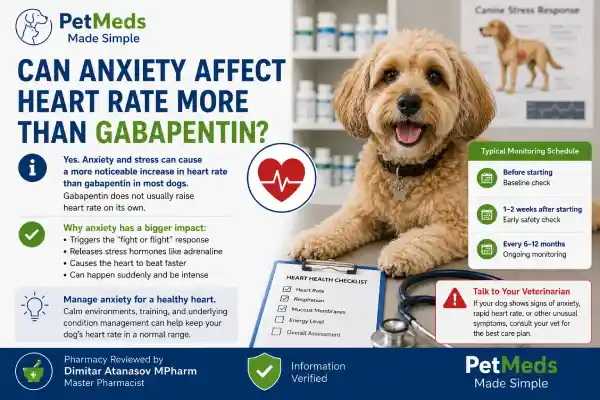
Absolutely.
One of the biggest misconceptions among dog owners is that every change occurring after a medication is started must be caused by that medication.
In reality, anxiety is far more likely to increase a dog’s heart rate than gabapentin itself.
When a dog becomes frightened or stressed, the body releases adrenaline and other stress hormones. These chemicals prepare the body for a “fight-or-flight” response by increasing:
- heart rate
- breathing rate
- blood pressure
- muscle tension
- pupil size
Ironically, gabapentin is often prescribed specifically to reduce this stress before:
- veterinary visits
- grooming appointments
- travel
- diagnostic imaging
- fireworks or thunderstorms
If your dog still appears anxious despite receiving gabapentin, the elevated heart rate may simply reflect ongoing fear rather than a medication side effect.
Owners whose dogs also seem restless or behave differently should read Why Is My Dog Acting Strange After Gabapentin?, as behavioral changes and anxiety frequently occur together.
Can Other Medications Affect Heart Rate Together With Gabapentin?
Yes.
Gabapentin is commonly used alongside several other medications, including:
- trazodone
- opioids
- NSAIDs
- phenobarbital
- levetiracetam
- muscle relaxants
- sedatives
Most of these combinations are prescribed intentionally and are considered safe when monitored by a veterinarian.
However, combining multiple medications can sometimes make side effects more noticeable.
Rather than directly changing heart rhythm, these medications may increase:
- sedation
- weakness
- reduced activity
- slower breathing
- decreased responsiveness
Because the dog is calmer and less active, owners sometimes believe the heart rate has become abnormally slow when it is actually appropriate for a resting animal.
Never discontinue one medication simply because another has been added. If your dog is taking several neurological medications, our articles Can Dogs Stay Awake on Gabapentin?, Can Dogs Take Gabapentin Every 8 Hours?, and Can Dogs Overdose on Gabapentin? explain how treatment plans are safely adjusted by veterinarians.
Can Senior Dogs Be More Sensitive to Heart Rate Changes?
Yes.
Older dogs frequently respond differently to medications because aging affects multiple body systems.
Senior dogs are more likely to have:
- heart disease
- kidney disease
- arthritis
- reduced muscle mass
- neurological disorders
- multiple prescription medications
Although gabapentin itself usually has little direct effect on the heart, these underlying conditions may influence how an older dog responds to treatment.
For example, a senior dog with chronic arthritis may finally become comfortable enough to sleep deeply after beginning gabapentin. Owners sometimes interpret this normal relaxation as evidence that the medication is “slowing the heart.”
Because senior pets often have several age-related conditions at the same time, veterinarians evaluate the whole patient rather than focusing on a single symptom.
If your older dog also seems unsteady, be sure to read Can Gabapentin Cause Balance Problems in Senior Dogs?, which explains why age increases sensitivity to certain neurological side effects.
Can Gabapentin Affect Heart Rate During Exercise?

Indirectly, yes.
Exercise naturally increases heart rate in every healthy dog.
Gabapentin does not normally prevent this response.
However, dogs receiving gabapentin may:
- exercise less intensely
- tire more quickly
- move more cautiously
- rest sooner because of mild sedation
As a result, owners sometimes notice a lower heart rate after activity compared with before treatment.
This usually reflects reduced physical exertion rather than a harmful cardiovascular effect.
Dogs recovering from surgery or managing arthritis often benefit from controlled exercise instead of complete rest. Our guide Can Dogs Exercise After Taking Gabapentin? discusses how activity should be adjusted safely while treatment continues.
Can Gabapentin Cause Collapse From Heart Problems?
This is extremely uncommon.
If a dog collapses after receiving gabapentin, veterinarians consider many possibilities before assuming the medication directly affected the heart.
Potential causes include:
- accidental overdose
- severe underlying heart disease
- dehydration
- low blood pressure
- neurological disease
- seizures
- toxin exposure
- another unrelated medical emergency
Collapse should never be dismissed as a normal medication side effect.
Immediate veterinary assessment is always recommended.
Owners concerned about accidental overdosing should also review Can Dogs Overdose on Gabapentin?, since overdose symptoms involve far more than changes in heart rate alone.
Can Heart Rate Changes Indicate an Emergency?
Sometimes.
Seek emergency veterinary care immediately if heart rate changes occur together with:
- collapse
- pale or blue gums
- difficulty breathing
- repeated fainting
- inability to stand
- severe weakness
- seizures
- loss of consciousness
- persistent vomiting
- profound lethargy
These signs suggest that another serious medical condition may be affecting your dog and should never be attributed to gabapentin without professional evaluation.
Even if the medication was given shortly beforehand, timing alone does not prove it is the cause.
How Veterinarians Evaluate Heart Rate Changes in Dogs Taking Gabapentin
When owners ask Can Gabapentin Affect Heart Rate in Dogs?, veterinarians rarely focus on the pulse alone.
Instead, they perform a complete cardiovascular and neurological assessment.
Typical questions include:
- When was gabapentin given?
- What dose was administered?
- Has the dose recently changed?
- Is this the first dose?
- Is your dog taking other medications?
- Does your dog have a known heart condition?
- Has your dog been exercising?
- Has your dog shown signs of pain?
- Is the heart rate consistently abnormal or only temporary?
The answers often provide valuable clues before additional testing is needed.
If necessary, the veterinarian may perform:
- a complete physical examination
- heart auscultation
- blood pressure measurement
- electrocardiogram (ECG)
- blood tests
- chest radiographs
- echocardiography
These tests help determine whether the heart itself is affected or whether another medical condition is responsible for the change.
Can Owners Monitor Heart Rate at Home?

Yes.
Learning how to check your dog’s resting heart rate can be extremely helpful, especially for dogs receiving long-term medications.
Most owners can feel the pulse by placing their fingers:
- inside the upper hind leg (femoral artery)
- against the left side of the chest
- over the lower chest just behind the elbow
Count the beats for 15 seconds and multiply by four.
For the most accurate results:
- measure when your dog is relaxed
- avoid checking immediately after exercise
- repeat the measurement several times
- record the results for future comparison
Many healthy adult dogs have a resting heart rate between 60 and 140 beats per minute, although normal values vary depending on body size, age, fitness level, and excitement.
Rather than focusing on a single number, veterinarians are more interested in sudden or persistent changes from your dog’s normal resting heart rate.
Can Gabapentin Affect Heart Rate in Dogs With Heart Disease?
Dogs with existing heart disease deserve closer monitoring whenever a new medication is started.
Fortunately, gabapentin is generally considered compatible with many cardiac conditions, particularly because it has minimal direct effects on heart rhythm in most patients.
However, every dog is different.
Veterinarians may adjust treatment according to:
- the severity of heart disease
- kidney function
- current medications
- blood pressure
- overall health
- response to previous doses
Owners should always inform the veterinarian if their dog has been diagnosed with:
- congestive heart failure
- heart murmurs
- arrhythmias
- dilated cardiomyopathy
- mitral valve disease
This information allows the safest treatment plan to be developed.
Can Dehydration Change Heart Rate More Than Gabapentin?
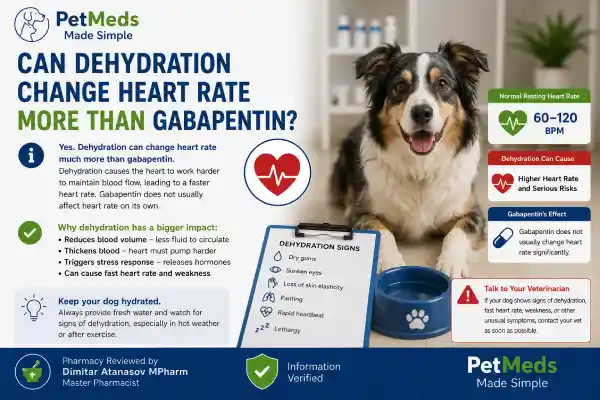
Yes.
Dehydration is a much more common reason for an elevated heart rate than gabapentin itself.
A dehydrated dog may develop:
- rapid heart rate
- dry gums
- weakness
- sunken eyes
- poor skin elasticity
- lethargy
If dehydration occurs because of vomiting, diarrhea, overheating, or another illness, the cardiovascular system works harder to maintain normal blood circulation.
Owners should therefore evaluate the entire dog—not simply assume gabapentin is responsible.
If your dog is also experiencing gastrointestinal symptoms, our articles Can Gabapentin Cause Vomiting in Dogs? explain when these problems require veterinary attention.
Can Gabapentin Affect Heart Rate in Dogs Together With Breathing Changes?
Sometimes.
The heart and lungs work closely together.
If a dog develops:
- rapid breathing
- labored breathing
- noisy breathing
- excessive panting
owners often assume the heart rate has changed as well.
In reality, breathing abnormalities may have completely different causes.
For example:
- pain
- anxiety
- overheating
- heart disease
- lung disease
- medication interactions
Dogs showing breathing changes after gabapentin should also be evaluated using our guide Can Gabapentin Cause Breathing Changes in Dogs?, since respiratory symptoms deserve prompt attention.
Why Looking at the Whole Dog Is More Important Than Looking at the Pulse Alone

One of the biggest mistakes owners make is concentrating on a single symptom.
For example:
“My dog’s heart seems slower.”
This observation is helpful—but it tells only part of the story.
Veterinarians also consider:
- gum color
- breathing effort
- temperature
- hydration
- appetite
- neurological function
- mobility
- mental status
- blood pressure
A slightly slower resting pulse in a relaxed, comfortable dog is usually far less concerning than a dog with a normal pulse that is collapsing or struggling to breathe.
Looking at the entire clinical picture leads to much safer decisions.
Frequently Asked Questions – Can Gabapentin Affect Heart Rate in Dogs?
Can gabapentin affect heart rate in dogs after the first dose?
Yes, but significant heart rate changes are uncommon. If gabapentin affects heart rate in dogs, it is usually because the medication reduces pain or causes temporary relaxation rather than directly affecting the heart.
Can gabapentin slow a dog’s heart rate?
It can indirectly.
A relaxed dog resting comfortably often has a slower heart rate than a dog experiencing pain, stress, or excitement.
This is usually considered a normal physiological response.
Can gabapentin cause a racing heart?
Gabapentin itself is not commonly associated with a rapid heart rate.
Pain, anxiety, dehydration, fever, or another underlying illness are much more likely explanations.
Should I stop gabapentin if my dog’s heart rate changes?
No.
Never stop gabapentin without consulting your veterinarian.
If you are considering changing the treatment plan, you should also read Can Dogs Stop Gabapentin Suddenly?, since abrupt discontinuation is not appropriate for every patient.
Can gabapentin affect heart rate in senior dogs?
Older dogs may appear more sensitive because they frequently have:
heart disease
arthritis
kidney disease
multiple medications
reduced physiological reserve
Veterinarians therefore monitor senior dogs more closely throughout treatment.
Can gabapentin affect blood pressure as well?
Significant blood pressure changes are uncommon in healthy dogs receiving normal doses.
If blood pressure abnormalities occur, veterinarians usually investigate other medical conditions before blaming gabapentin alone.
Can anxiety increase heart rate more than gabapentin?
Yes.
Stress and fear commonly produce much larger increases in heart rate than gabapentin itself.
This is one reason gabapentin is frequently prescribed before stressful veterinary visits.
How long do heart rate changes usually last?
If heart rate changes are related to temporary sedation or pain relief, they generally improve as the medication’s effects gradually wear off.
Persistent abnormalities require veterinary evaluation.
When is an abnormal heart rate an emergency?
Immediate veterinary care is recommended if abnormal heart rate occurs together with:
collapse
difficulty breathing
blue or pale gums
seizures
unconsciousness
inability to stand
severe weakness
These signs should never be monitored at home without professional advice.
Bottom Line
Can gabapentin affect heart rate in dogs? Yes but usually only indirectly. In most healthy dogs, gabapentin has little direct effect on the cardiovascular system. Temporary changes in heart rate are more commonly related to reduced pain, relaxation, anxiety, exercise, dehydration, or other medical conditions than to the medication itself. Dogs that develop collapse, breathing difficulty, pale gums, severe weakness, or persistent heart rate abnormalities should receive immediate veterinary evaluation.
Veterinarian Takeaway
Gabapentin remains one of the most commonly prescribed medications for managing chronic pain, nerve pain, anxiety, and certain neurological conditions in dogs. While owners may occasionally notice changes in heart rate after treatment begins, these changes are usually secondary to improved comfort or altered activity rather than direct effects on the heart. Veterinarians evaluate the entire patient—including cardiovascular health, neurological status, medications, pain control, and underlying diseases—before determining whether gabapentin is contributing to any abnormal findings. Owners should never discontinue or adjust gabapentin without professional guidance.
Sources
- Plumb DC. Plumb’s Veterinary Drug Handbook.
- Papich MG. Saunders Handbook of Veterinary Drugs.
- Merck Veterinary Manual. Analgesics and Adjunctive Pain Medications in Small Animals.
- BSAVA Small Animal Formulary.
- AAHA Pain Management Guidelines for Dogs and Cats.
- WSAVA Global Pain Council Guidelines.
- Veterinary Information Network (VIN). Clinical discussions regarding gabapentin use in dogs.
- Journal of Veterinary Internal Medicine.
- Frontiers in Veterinary Science. Reviews on gabapentin pharmacology and adverse effects in companion animals.
Medical Review Statement
Medical Review Statement
This article was written by Dimitar Georgiev Atanasov, MPharm, Master Pharmacist and Medication Safety Educator (Bulgarian Pharmaceutical Union, UIN: 0210000586).
The content has been pharmacy and scientific reviewed by Gergana Krasimirova Atanasova, MPharm (Bulgarian Pharmaceutical Union, UIN: 0210000587).
The veterinary information has been reviewed by Dr. Valcho Georgiev Valchev, DVM (Bulgarian Veterinary Union Registration No. 28000115).
This article is intended for educational purposes only and should never replace individualized veterinary diagnosis, examination, or treatment.
Image Disclosure
Image Disclosure: Some images used in this article may be AI-generated for educational purposes. They are intended to illustrate veterinary concepts and should not replace professional veterinary examination or diagnosis.